Quick Verdict: The Premium Family Hybrid SUV Done Right
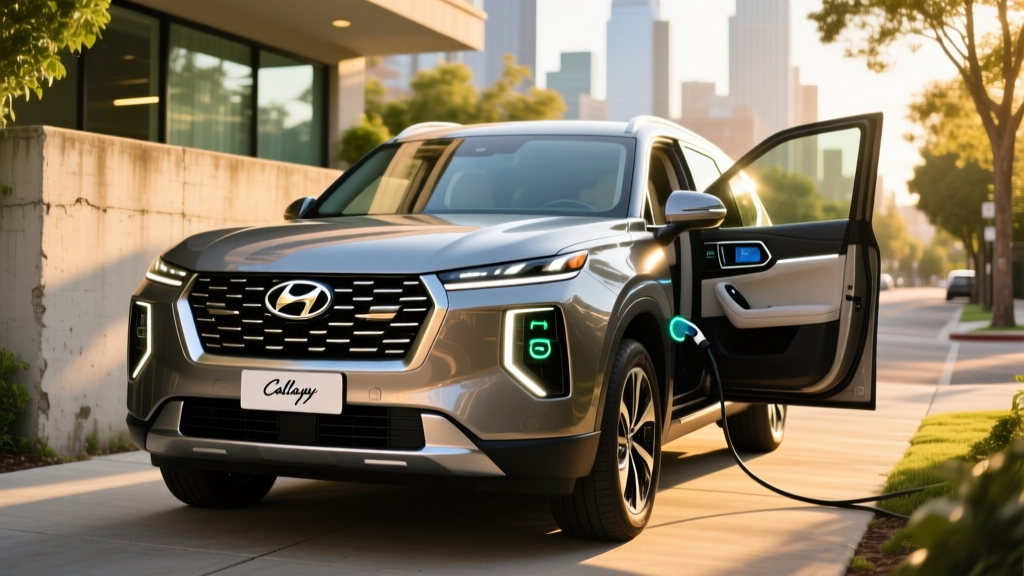
The 2026 Hyundai Palisade Hybrid Calligraphy AWD occupies a specific niche: three-row luxury for families who want meaningful fuel savings without plugging in. Unlike its plug-in hybrid competitors, this is a conventional hybrid (HEV) — it charges its own battery through regenerative braking and the engine, requiring zero lifestyle changes from the owner. With an EPA-estimated 27 MPG combined and a turbocharged hybrid powertrain producing 329 horsepower, it delivers on both efficiency and the passing power a 4,700-pound SUV needs.
At a starting MSRP of approximately $56,500 for the Calligraphy AWD trim, the Palisade Hybrid undercuts luxury-badge rivals like the BMW X5 xDrive50e and Volvo XC90 Recharge by tens of thousands while offering comparable interior refinement. The trade-off? No electric-only driving mode and no federal EV tax credit eligibility. Here's the complete breakdown.
2026 Palisade Hybrid Calligraphy AWD: Full Spec Sheet
| Specification | Value |
|---|---|
| Powertrain | 2.5L turbocharged 4-cylinder + electric motor (HEV) |
| Combined Output | 329 HP / 383 lb-ft torque |
| Transmission | 6-speed automatic |
| Drivetrain | HTRAC AWD (standard on Calligraphy) |
| EPA MPG (City / Hwy / Combined) | 27 / 28 / 27 |
| Fuel Tank Capacity | 18.8 gallons |
| Total Driving Range | ~507 miles |
| 0-60 MPH | ~7.2 seconds |
| Towing Capacity | 4,000 lbs (with towing package) |
| Seating Capacity | 7 (captain's chairs) or 8 (bench) |
| Cargo Volume (behind 3rd / 2nd / 1st row) | 20.4 / 46.0 / 86.4 cu ft |
| Hybrid Battery Warranty | 10 years / 100,000 miles |
| Calligraphy AWD MSRP | $56,500 |
HEV vs. PHEV: Why the Palisade Hybrid Is Not a Plug-In
Before evaluating fuel economy, it's critical to understand what the 2026 Palisade Hybrid is not. This is a conventional self-charging hybrid — Hyundai does not currently offer a plug-in hybrid (PHEV) variant of the Palisade. Here's how the two architectures differ:
| Factor | HEV (Palisade Hybrid) | PHEV (e.g., Tucson PHEV) |
|---|---|---|
| Plug-in charging | No — self-charging via regen + engine | Yes — plug in for EV range |
| Electric-only range | None (EV assist only) | Typically 28-38 miles |
| Battery size | ~1.5 kWh (small buffer) | 13-22 kWh |
| Federal tax credit | Not eligible (§30D requires plug-in) | Up to $7,500 if sourcing/income rules met |
| Best for | Drivers without home charging access | Drivers with home charging + short commutes |
The Palisade's hybrid system pairs a 2.5-liter turbocharged inline-four with an electric motor integrated into the transmission. The small lithium-ion battery pack captures energy during braking and coasting, then deploys it to assist acceleration and enable brief low-speed electric creep. You never plug it in — the system manages itself entirely. This is a major advantage for apartment dwellers, street parkers, and anyone without access to a Level 2 home charger.
Fuel Economy: EPA Ratings and Real-World MPG
The 2026 Palisade Hybrid AWD carries EPA estimates of 27 MPG city / 28 MPG highway / 27 MPG combined. With an 18.8-gallon fuel tank, that translates to roughly 507 miles of total range before needing a fill-up.
| Driving Condition | EPA Estimate | Real-World Expectation |
|---|---|---|
| City (stop-and-go) | 27 MPG | 28-30 MPG (regen excels here) |
| Highway (70+ MPH) | 28 MPG | 25-27 MPG (aero drag on boxy SUV) |
| Combined | 27 MPG | 26-28 MPG |
| Cold weather (below 32°F) | — | 23-25 MPG (engine runs more for heat) |
Like most hybrids, the Palisade benefits from regenerative braking in city driving, where the electric motor recaptures kinetic energy and reduces brake wear. Expect real-world city MPG to meet or slightly exceed the EPA sticker. Highway driving tells a different story — the Palisade's upright, three-row SUV profile creates significant aerodynamic drag above 70 MPH, and the turbo engine works harder to maintain speed. On a fully loaded road trip with seven passengers and cargo, plan for 24-25 MPG at highway speeds.
For context, the non-hybrid 2026 Palisade AWD with the 3.8L V6 achieves approximately 21 MPG combined. The hybrid's 27 MPG combined represents a 28% improvement in fuel efficiency, saving roughly $400-$600 annually in fuel costs depending on local gas prices and annual mileage (based on 15,000 miles/year and $3.50/gallon regular unleaded).
Powertrain Performance: 329 HP Turbo Hybrid
The Palisade Hybrid's 2.5-liter turbocharged four-cylinder produces 277 HP on its own, supplemented by a 72-HP electric motor for a combined system output of 329 horsepower and 383 lb-ft of torque. That's 40 more horsepower than the V6 model and substantially more torque, available lower in the rev range thanks to electric assist.
The result is a 0-60 MPH time of approximately 7.2 seconds — adequate for a vehicle of this size, and the electric motor fills in the torque gap that turbo lag typically creates. Merging onto highways and overtaking at speed feels confident, though the six-speed automatic transmission isn't as seamless as the continuously variable transmissions (CVTs) found in Toyota and Honda hybrids. Under hard acceleration, you'll feel traditional gear shifts rather than the drone of a CVT, which many buyers actually prefer.
The HTRAC all-wheel-drive system is standard on the Calligraphy trim and uses a torque-vectoring rear axle to distribute power between front and rear wheels. It's a competent system for rain, light snow, and gravel roads, though it's not designed for serious off-road use. The 4,000-pound towing capacity (with the factory towing package) is competitive with V6 rivals, though towing will reduce fuel economy to the low 20s.
Calligraphy Trim: What $56,500 Buys You
The Calligraphy sits near the top of the Palisade Hybrid lineup, positioned above SEL and Limited trims. At an MSRP of approximately $56,500 (including destination), it includes:
- Nappa leather seating surfaces with quilted stitching
- Heated and ventilated front and second-row seats
- Head-up display (HUD) with hybrid energy-flow readout
- Dual 12.3-inch displays (instrument cluster + infotainment)
- Hyundai Digital Key 2 (phone-as-key via NFC/UWB)
- Premium 12-speaker Bose audio system
- Highway Driving Assist 2 (HDA2) — Level 2 ADAS with lane-centering and adaptive cruise
- Remote Smart Parking Assist
- Power-folding third row with one-touch tumble
- 20-inch alloy wheels
The Calligraphy trim's interior materials and noise isolation rival entry-level luxury SUVs from Audi and Mercedes-Benz, at a price point $15,000-$25,000 lower. Hyundai's 10-year/100,000-mile powertrain warranty also applies to the hybrid battery and electric motor components.
Tax Credits and Ownership Economics
The 2026 Palisade Hybrid does not qualify for the IRS §30D Clean Vehicle Credit. This credit is exclusively available to plug-in electric vehicles (BEVs and PHEVs) with sufficient battery capacity. Conventional hybrids like the Palisade HEV are ineligible regardless of price or buyer income. Some states may offer minor incentives for hybrid purchases — check your state's energy office or fueleconomy.gov for current details.
Despite the lack of a federal tax credit, the Palisade Hybrid's ownership economics remain strong when compared to both its gas counterpart and luxury-brand alternatives:
| 5-Year Cost Factor | Palisade Hybrid Calligraphy AWD | Palisade V6 Calligraphy AWD | BMW X5 xDrive40i |
|---|---|---|---|
| MSRP (approx.) | $56,500 | $54,500 | $70,000 |
| Fuel cost (75,000 mi @ $3.50/gal) | $9,722 | $12,500 | $13,462 |
| Federal tax credit | $0 | $0 | $0 |
| Est. insurance (5 yr) | $9,500 | $9,200 | $12,000 |
| Est. maintenance (5 yr) | $3,200 | $3,500 | $5,500 |
| Total 5-year est. | $78,922 | $79,700 | $100,962 |
The hybrid's $2,000 MSRP premium over the V6 model is typically recouped within 3-4 years through fuel savings alone, with additional savings from reduced brake wear (regenerative braking extends pad life significantly). Against the BMW X5, the Palisade Hybrid saves over $22,000 across five years while offering similar interior space and technology.
Hybrid Battery Reliability and Warranty Coverage
Hyundai covers the Palisade Hybrid's lithium-ion battery pack for 10 years or 100,000 miles (whichever comes first) under its hybrid/EV component warranty. This covers capacity loss below a manufacturer-specified threshold and any defect in the battery, inverter, or electric motor. Hyundai's hybrid systems have demonstrated strong longevity — the company's earlier Sonata and Ioniq hybrids routinely exceed 150,000 miles with minimal battery degradation.
Conventional hybrid batteries are significantly smaller (typically 1-2 kWh) and experience far less stress than full EV batteries because they never undergo deep charge/discharge cycles. The system keeps the battery in a narrow state-of-charge window (roughly 40-80%), which is the least stressful operating range for lithium-ion cells. Based on industry data from Hyundai/Kia hybrid platforms, battery replacement is rarely needed within the warranty period, and out-of-warranty replacement costs are estimated at $2,000-$3,500 — substantially less than EV battery replacements, which can exceed $10,000.
The Palisade Hybrid's overall reliability outlook is bolstered by the proven nature of Hyundai's turbocharged 2.5L engine and the relatively simple hybrid architecture. Unlike PHEVs, there's no onboard charger, no charge port hardware, and no high-voltage DC fast-charging system to maintain. According to NHTSA and IIHS data on prior Palisade model years, the platform has earned strong safety ratings, and the hybrid variant shares the same structural engineering.
Who Should Buy the Palisade Hybrid — and Who Shouldn't
- You need three rows but want better fuel economy than a V6
- You don't have access to home or workplace charging (no plug needed)
- You want luxury-level features without a luxury badge price
- You tow occasionally (4,000 lb capacity)
- You prefer Hyundai's 10-year warranty coverage
- You drive a mix of city and highway miles
- You want electric-only driving for a short commute (consider a PHEV)
- You need the $7,500 federal tax credit (only BEVs/PHEVs qualify)
- You prioritize maximum highway MPG (a midsize sedan hybrid beats any SUV)
- You want Level 3+ autonomous driving (HDA2 is Level 2 — driver must stay engaged)
- You frequently tow over 4,000 lbs
For families who have considered a full EV like the Kia EV9 or Tesla Model X but are deterred by charging logistics on road trips, the Palisade Hybrid offers a pragmatic middle ground. You get roughly 507 miles of total range, fill up at any gas station in five minutes, and still achieve 27 MPG combined in a vehicle that seats seven with genuine cargo space behind the third row.
Frequently Asked Questions
How many MPG does the 2026 Palisade Hybrid get?
The EPA rates the 2026 Palisade Hybrid AWD at 27 MPG city, 28 MPG highway, and 27 MPG combined. In real-world city driving, expect 28-30 MPG thanks to regenerative braking. Highway driving at sustained speeds above 70 MPH typically yields 25-27 MPG. Cold weather can reduce combined efficiency to 23-25 MPG.
Does the Palisade Hybrid need to be plugged in?
No. The Palisade Hybrid is a conventional (HEV) hybrid, not a plug-in hybrid (PHEV). The battery charges itself through regenerative braking and the gasoline engine. There is no charge port and no need for any external charging infrastructure.
How far can the Palisade Hybrid drive on electric power alone?
As a conventional hybrid, the Palisade does not have a meaningful electric-only range. The electric motor assists the engine during acceleration and can propel the vehicle at very low speeds (under ~25 MPH) for brief distances, but it cannot sustain highway speeds on electric power alone. If electric-only commuting is a priority, look at PHEVs like the Hyundai Tucson PHEV (33 miles EV range) or the Toyota RAV4 Prime (42 miles EV range).
Does the 2026 Palisade Hybrid qualify for a federal tax credit?
No. The IRS §30D Clean Vehicle Credit requires a vehicle to have a plug-in capability and a battery capacity of at least 7 kWh. The Palisade Hybrid's small self-charging battery does not meet these criteria. Only plug-in hybrids (PHEVs) and battery electric vehicles (BEVs) are eligible. Always verify current rules at irs.gov.
How reliable is the Palisade Hybrid battery, and what does replacement cost?
Hyundai covers the hybrid battery for 10 years / 100,000 miles. Conventional hybrid batteries experience minimal degradation because they operate in a narrow charge window and are much smaller than EV batteries. Based on long-term data from Hyundai's hybrid platforms, most batteries last well beyond the warranty period. If replacement is eventually needed, expect $2,000-$3,500 for the battery pack — a fraction of EV battery replacement costs.
Is the Palisade Hybrid better than a full EV for a family?
It depends on your charging access and driving patterns. If you have reliable home Level 2 charging and primarily drive under 300 miles between stops, a full EV like the Kia EV9 (270-304 mile range) offers lower per-mile energy costs and zero tailpipe emissions. If you lack charging access, take frequent road trips beyond 300 miles, or live in an area with sparse DC fast-charging infrastructure, the Palisade Hybrid's 507-mile range and 5-minute refueling make it the more practical choice.