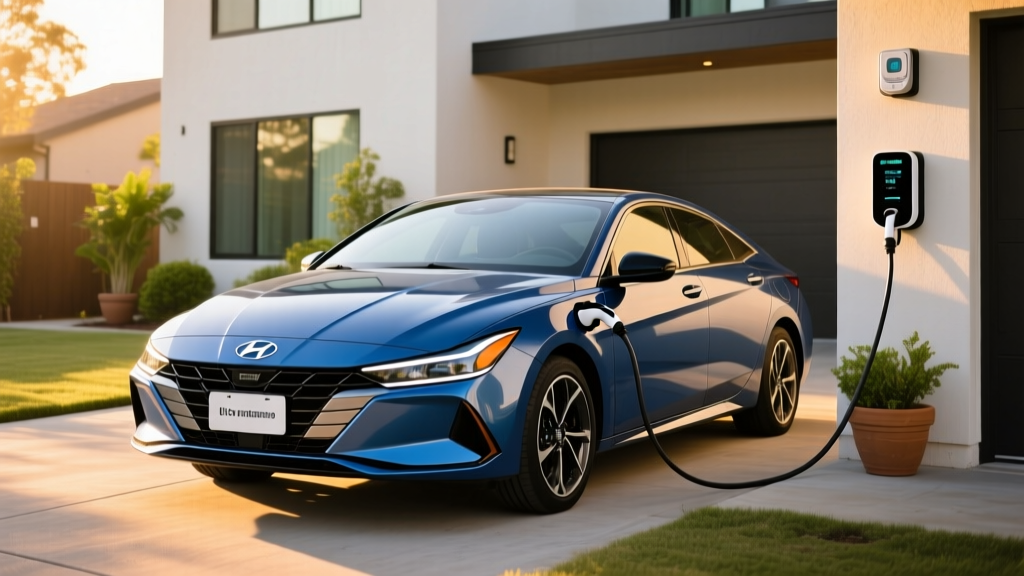
The compact hybrid sedan segment has no shortage of fuel-sipping contenders, but the 2026 Hyundai Elantra Hybrid continues to carve out a compelling position by pairing class-leading fuel economy with a genuinely usable back seat and a tech-forward cabin. Unlike Toyota's Corolla Hybrid or Honda's Civic Hybrid, the Elantra Hybrid leans into a slightly larger footprint—making it a credible alternative for buyers who want hybrid efficiency without stepping up to a midsize sedan.
In this guide, we break down every number that matters: EPA-rated MPG, real-world fuel economy observations, powertrain output, pricing by trim, battery warranty coverage, and how the Elantra Hybrid stacks up against plug-in hybrids and full battery-electric vehicles for different driving lifestyles.
2026 Hyundai Elantra Hybrid at a Glance: Key Specs
| Specification | 2026 Hyundai Elantra Hybrid |
|---|---|
| Powertrain | 1.6L GDI 4-cylinder + permanent-magnet electric motor |
| Combined Horsepower | 139 hp |
| Combined Torque | 195 lb-ft |
| Transmission | 6-speed dual-clutch automatic (DCT) |
| Battery | 1.56 kWh lithium-ion polymer |
| EPA MPG (Blue / SEL trims) | 54 city / 58 highway / 56 combined |
| EPA MPG (Limited trim) | 49 city / 52 highway / 50 combined |
| Fuel Tank Capacity | 11.1 gallons |
| Estimated Total Range | ~620 miles (Blue trim) |
| 0–60 mph | ~8.6 seconds (est.) |
| Drivetrain | Front-wheel drive |
| Base MSRP (Blue trim) | $26,250 |
| Hybrid Battery Warranty | 10 years / 100,000 miles |
EPA Fuel Economy vs. Real-World MPG
The 2026 Elantra Hybrid's headline number is its EPA rating, which varies meaningfully by trim. The Blue and SEL trims, equipped with smaller 16-inch wheels and fewer power-drawing accessories, achieve an exceptional 54 city / 58 highway / 56 combined MPG according to fueleconomy.gov. The range-topping Limited trim, with its 17-inch alloy wheels, leather ventilated seats, and additional electronics, drops to 49 city / 52 highway / 50 combined.
| Trim | City MPG | Highway MPG | Combined MPG |
|---|---|---|---|
| Blue | 54 | 58 | 56 |
| SEL | 54 | 58 | 56 |
| Limited | 49 | 52 | 50 |
What Real Owners Actually See
Hyundai's hybrid system uses a parallel hybrid architecture with a 6-speed dual-clutch transmission rather than a continuously variable transmission (CVT). This gives the Elantra Hybrid a more natural driving feel—shifts are perceptible and acceleration is linear—but it also means real-world results depend heavily on driving style.
In mixed suburban and highway driving, owners of the Blue and SEL trims commonly report 50–57 MPG combined, with city-heavy commutes occasionally pushing above the EPA city estimate thanks to aggressive regenerative braking. Highway-only trips at 75+ mph tend to settle around 48–52 MPG. Cold weather (below 35°F) typically drops observed economy by 5–8 MPG as the engine runs more frequently to generate cabin heat.
The Limited trim's real-world economy generally lands between 45–51 MPG combined, with the gap from the lower trims driven primarily by rolling resistance and parasitic electrical load rather than any powertrain difference.
HEV vs. PHEV: Understanding What the Elantra Hybrid Is (and Isn't)
A common point of confusion in the Hyundai lineup is whether the Elantra Hybrid is a plug-in hybrid. It is not. The 2026 Elantra Hybrid is a conventional hybrid electric vehicle (HEV)—it has no plug, no external charging port, and no meaningful electric-only driving range.
| Feature | Elantra Hybrid (HEV) | Plug-In Hybrid (PHEV) Example |
|---|---|---|
| External Charging | Not required or possible | Plugs into Level 1 or Level 2 charger |
| Battery Size | 1.56 kWh | Typically 10–20 kWh |
| Electric-Only Range | None (motor assists engine) | 25–40 miles typical |
| Refueling | Gas station only | Gas station + electric outlet/charger |
| Federal Tax Credit (§30D) | Not eligible | Up to $7,500 (if eligible) |
| Best For | No home charging access; simplicity | Home charging + short daily commutes |
The Elantra Hybrid's 1.56 kWh battery is charged exclusively through regenerative braking and the gasoline engine. It stores just enough energy to assist during acceleration, enable brief low-speed electric creep, and allow the engine to shut off at stops. If you want plug-in capability from Hyundai, you would need to look at models like the Tucson PHEV or Ioniq PHEV (availability varies by model year).
Powertrain Deep Dive: 1.6L Engine Meets Electric Motor
The 2026 Elantra Hybrid pairs a 1.6-liter GDI inline-four producing 104 horsepower with a 32 kW (43 hp) permanent-magnet synchronous electric motor integrated into the transmission housing. Combined system output is 139 hp and 195 lb-ft of torque.
Unlike Toyota's Hybrid Synergy Drive, which uses a planetary gearset to blend power seamlessly (and produces a characteristic "rubber-band" CVT feel), Hyundai employs a 6-speed dual-clutch transmission. The result is a driving experience that feels more like a conventional gasoline car: gear shifts are tangible, engine RPM correlates more directly with vehicle speed, and there's no drone under hard acceleration.
The trade-off is that the DCT can occasionally hesitate during low-speed maneuvers—a characteristic of dry-clutch designs. Hyundai has refined this significantly over earlier generations, but drivers accustomed to the seamless (if soulless) feel of a Toyota hybrid CVT will notice the difference.
For passing power and highway merging, 139 hp is adequate rather than quick. The 0–60 mph time of approximately 8.6 seconds puts it behind the Honda Civic Hybrid (~7.2 seconds) but ahead of the Corolla Hybrid (~9.2 seconds). Most buyers in this segment prioritize fuel economy over acceleration, and the Elantra Hybrid delivers where it counts.
Pricing, Trims, and Tax Credit Eligibility
The 2026 Hyundai Elantra Hybrid is offered in three trims:
- Blue: ~$26,250 MSRP — the efficiency champion with 16-inch wheels, cloth seats, and an 8-inch touchscreen
- SEL: ~$28,500 MSRP — adds SmartSense safety suite upgrades, wireless CarPlay/Android Auto, and proximity key
- Limited: ~$32,400 MSRP — leather seats, 10.25-inch digital cluster, Bose audio, sunroof, and 17-inch wheels
Federal Tax Credit: Does the Elantra Hybrid Qualify?
No. Under current IRS §30D rules, the federal clean vehicle credit applies only to battery electric vehicles (BEVs) and plug-in hybrid electric vehicles (PHEVs) that meet battery capacity, critical mineral sourcing, and MSRP/income thresholds. Conventional hybrids like the Elantra Hybrid—those that cannot be plugged in—do not qualify for the §30D credit.
Some states may offer modest rebates or reduced registration fees for hybrid vehicles, but these vary by jurisdiction and change frequently. Check your state energy office or department of environmental quality for current programs. There is no federal incentive for purchasing a conventional HEV as of 2026.
Battery Longevity, Warranty, and Replacement Cost
Hybrid battery anxiety is one of the most persistent concerns among first-time hybrid buyers. Here's the reality for the 2026 Elantra Hybrid:
Hyundai Hybrid Battery Warranty: 10 years or 100,000 miles (whichever comes first), covering defects and capacity loss below a manufacturer-defined threshold. The powertrain warranty covers the engine, transmission, and electric motor for the same 10-year/100,000-mile period. For reference, Hyundai's warranty is transferable to subsequent owners but reverts to 5 years/60,000 miles upon transfer.
The Elantra Hybrid's 1.56 kWh lithium-ion polymer battery is small and operates within a narrow state-of-charge window—the hybrid system never fully charges or fully depletes it. This "shallow cycling" is one of the main reasons hybrid batteries outlast their warranty periods. Many Toyota and Hyundai hybrid owners report original batteries lasting 150,000–200,000+ miles with minimal degradation.
If replacement is needed out of warranty, a new OEM hybrid battery for the Elantra Hybrid typically costs between $2,000 and $3,500 including labor, depending on the dealer and region. Third-party reconditioned batteries can reduce this to $1,200–$2,000. For context, this is significantly less than a full EV battery replacement ($8,000–$20,000+) because the hybrid battery is a fraction of the capacity.
Who Should Buy the Elantra Hybrid — and Who Shouldn't
The Elantra Hybrid isn't the right choice for every buyer. Here's a practical decision framework:
Choose the Elantra Hybrid if:
- You drive 12,000–20,000+ miles per year and want to minimize fuel costs without changing your refueling habits
- You don't have access to home or workplace EV charging
- You want a proven, low-complexity powertrain with a strong warranty
- You value a larger rear seat and trunk than a Corolla Hybrid offers
- You want 50+ MPG without paying a PHEV or BEV price premium
Consider a PHEV or full EV instead if:
- You have reliable Level 2 home charging and a commute under 30 miles (a PHEV could cover most trips on electricity)
- You want to qualify for the federal §30D tax credit (up to $7,500 for eligible BEVs/PHEVs)
- You want zero tailpipe emissions for daily driving (BEV) or near-zero for commutes (PHEV)
- You prioritize acceleration and driving dynamics over fuel economy (EVs deliver instant torque)
How the Elantra Hybrid Compares to Key Rivals
| Spec | 2026 Elantra Hybrid (Blue) | 2026 Corolla Hybrid (LE) | 2026 Civic Hybrid (Sport) |
|---|---|---|---|
| Combined MPG | 56 | 50 | 49 |
| Combined HP | 139 | 138 | 200 |
| 0–60 mph | ~8.6 sec | ~9.2 sec | ~7.2 sec |
| Transmission | 6-speed DCT | eCVT | eCVT |
| Base MSRP | ~$26,250 | ~$24,550 | ~$30,350 |
| Hybrid Battery Warranty | 10 yr / 100k mi | 10 yr / 150k mi | 8 yr / 100k mi |
The Elantra Hybrid wins on fuel economy and total range (its 11.1-gallon tank plus 56 combined MPG yields over 620 miles between fill-ups). The Corolla Hybrid undercuts on price and offers Toyota's legendary hybrid reliability reputation, though with less rear-seat room. The Civic Hybrid is the performance pick—200 hp makes it genuinely quick—but it costs several thousand more and sacrifices 7 MPG combined to do it.
Frequently Asked Questions
How many MPG does the 2026 Hyundai Elantra Hybrid get?
The EPA rates the Elantra Hybrid Blue and SEL trims at 54 city / 58 highway / 56 combined MPG. The Limited trim is rated at 49 city / 52 highway / 50 combined. Real-world results for the Blue trim typically fall between 50–57 MPG combined depending on driving conditions, with cold weather reducing economy by roughly 5–8 MPG.
Is the Hyundai Elantra Hybrid a plug-in hybrid?
No. The Elantra Hybrid is a conventional hybrid (HEV). It does not have a charging port and cannot be plugged in. Its small 1.56 kWh battery charges through regenerative braking and the gasoline engine. If you want a Hyundai plug-in hybrid, look at the Tucson PHEV or check current Ioniq PHEV availability.
Does the Elantra Hybrid qualify for a federal tax credit?
No. The IRS §30D clean vehicle credit applies only to battery electric vehicles and plug-in hybrids that meet specific battery sourcing, MSRP, and buyer income requirements. Conventional hybrids like the Elantra Hybrid are not eligible. Some states may offer separate hybrid incentives—check your local programs.
How long will the Elantra Hybrid battery last, and what does replacement cost?
Hyundai covers the hybrid battery for 10 years or 100,000 miles. Because the system uses shallow charge cycles (never fully charging or depleting the battery), many hybrid batteries last 150,000–200,000+ miles. Out-of-warranty replacement costs approximately $2,000–$3,500 for a new OEM battery, or $1,200–$2,000 for a reconditioned unit.
Hybrid vs. PHEV vs. EV — which should I choose?
If you lack home charging and want maximum simplicity, the Elantra Hybrid (HEV) is the right call—you just fill up at gas stations and let the system handle the rest. If you have home Level 2 charging and a short commute, a PHEV lets you drive 25–40 miles on electricity before the engine kicks in. If you want zero tailpipe emissions, lower running costs, and have reliable charging access, a full BEV eliminates gasoline entirely but requires a larger upfront investment and charging planning for road trips.
Is the Elantra Hybrid reliable?
Hyundai's hybrid powertrain has proven durable across two generations of the Elantra Hybrid and related models (Ioniq, Sonata Hybrid). The 10-year/100,000-mile powertrain and hybrid battery warranty is among the best in the industry. The IIHS has historically rated the Elantra well for crashworthiness, though you should verify the 2026 model year's specific ratings when published. Long-term reliability data from sources like Consumer Reports and J.D. Power should be checked closer to the model year's release for the latest scores.
The 2026 Hyundai Elantra Hybrid occupies a specific and valuable niche: maximum fuel economy for drivers who aren't ready—or able—to plug in. With 56 combined MPG on the Blue trim, a 620-mile total range, a comfortable cabin, and Hyundai's industry-leading hybrid warranty, it makes a strong case as one of the most practical compact sedans on the market. Just know what it is—a gasoline car that sips fuel intelligently—and what it isn't: a plug-in, a tax-credit qualifier, or a performance sedan.