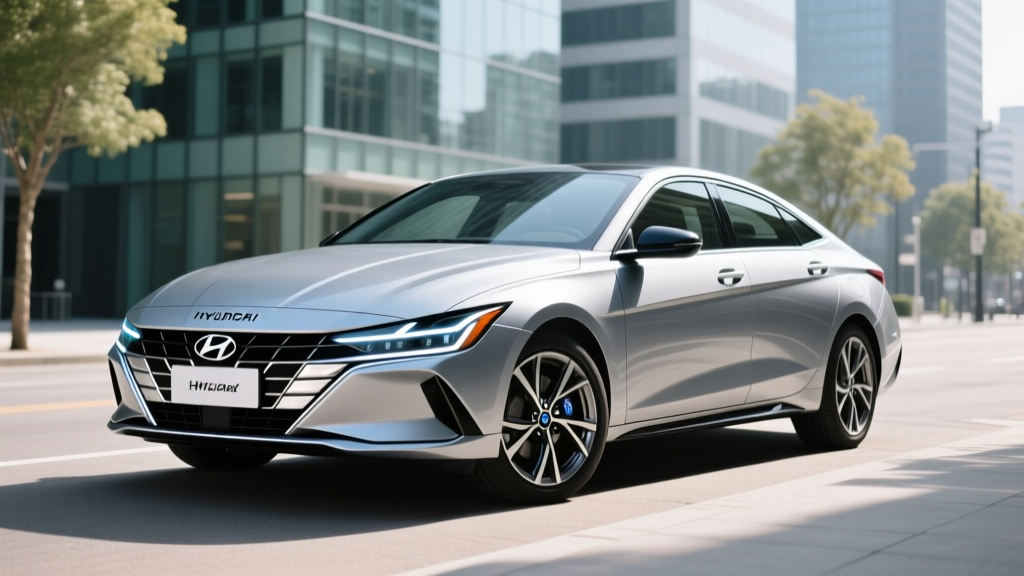
The 2026 Hyundai Elantra Hybrid Limited sits at a compelling crossroads for buyers who want maximum fuel efficiency without the charging logistics of a plug-in hybrid or full electric vehicle. With an EPA-estimated 54 MPG combined and a loaded Limited trim that punches well above its price class, this compact hybrid sedan deserves serious consideration — especially if you're weighing it against a PHEV or BEV alternative.
Below, we break down every spec that matters: real-world fuel economy, the hybrid powertrain, battery longevity and warranty, tax-credit eligibility, and who should actually choose this car over a plug-in or gas-only competitor.
HEV vs PHEV vs EV: Where the Elantra Hybrid Fits
Before diving into specs, it's critical to understand what the Elantra Hybrid is — and what it isn't. This is a conventional hybrid (HEV), meaning it generates all its electricity internally through regenerative braking and the gasoline engine. You never plug it in. There is no electric-only driving range to manage and no charging cable to deal with.
| Feature | Elantra Hybrid (HEV) | Typical PHEV | Battery Electric (BEV) |
|---|---|---|---|
| Plug-in charging required? | No | Yes (for EV range) | Yes (always) |
| Electric-only range | None (motor assists engine) | 25–45 miles typical | 200–400+ miles |
| Fuel/energy source | Gasoline + regen | Gasoline + grid electricity | Grid electricity only |
| Federal tax credit (§30D) | Not eligible | Up to $7,500 (if eligible) | Up to $7,500 (if eligible) |
| Best for | No home charging access; long commutes | Home chargers with short daily drives | Home chargers; low running costs |
Hyundai does not currently offer a plug-in hybrid variant of the Elantra in the U.S. market for 2026. If you need electric-only commuting capability, you'd need to look at competitors like the Toyota Prius Prime or the Kia Niro PHEV.
Fuel Economy: EPA Ratings and Real-World MPG
The headline number for the 2026 Elantra Hybrid Limited is its EPA-estimated fuel economy. The Limited trim, equipped with 17-inch alloy wheels, carries slightly different ratings than the lower Blue trim due to weight and tire differences.
| Trim | City MPG | Highway MPG | Combined MPG |
|---|---|---|---|
| Elantra Hybrid Blue | 53 | 56 | 54 |
| Elantra Hybrid SEL / Limited | 49 | 52 | 50 |
Source: EPA Fuel Economy (fueleconomy.gov). Verify current-year figures at time of purchase.
Real-World MPG vs EPA Estimates
Hybrids like the Elantra tend to outperform their EPA city ratings in stop-and-go traffic, where regenerative braking recaptures the most energy. In real-world mixed driving, owners frequently report 50–55 MPG in the Limited trim during warm-weather city commutes. Highway driving at sustained 70–80 MPH speeds typically yields 45–50 MPG, as the electric motor provides less benefit at constant velocity.
Cold weather (below 35°F) reduces fuel economy by roughly 5–10% due to increased engine runtime for cabin heat and reduced battery efficiency. Expect 44–48 MPG combined in winter conditions — still exceptional for a gasoline vehicle.
Powertrain and Performance Specs
| Specification | 2026 Elantra Hybrid Limited |
|---|---|
| Engine | 1.6L 4-cylinder GDI |
| Engine output | 104 HP / 109 lb-ft torque |
| Electric motor output | 43 HP (32 kW) / 125 lb-ft torque |
| Combined system horsepower | 139 HP |
| Transmission | 6-speed dual-clutch automatic (DCT) |
| Drivetrain | Front-wheel drive |
| 0–60 MPH (est.) | ~8.5 seconds |
| Fuel tank capacity | 11.1 gallons |
| Total driving range (est.) | ~555 miles (Limited trim) |
| Curb weight | ~3,050 lbs |
The 1.6-liter Atkinson-cycle engine pairs with a 43 HP electric motor sandwiched into a 6-speed dual-clutch transmission. Unlike the CVT-style e-CVT found in the Toyota Prius, Hyundai's DCT provides more direct, gear-based acceleration feel. The trade-off is occasional low-speed shift hesitation — a characteristic of most DCT-equipped hybrids — though it's largely imperceptible in normal driving.
The 139 HP combined output won't win drag races, but it's sufficient for confident highway merging and passing. Torque delivery from the electric motor is immediate at low RPMs, which makes city driving feel peppier than the horsepower figure suggests.
Pricing and Tax Credit Eligibility
The 2026 Hyundai Elantra Hybrid Limited carries an MSRP starting around $30,550 (including destination). The Blue trim starts near $26,550, while the SEL Sport sits in between. These prices position the Elantra Hybrid as one of the most affordable high-MPG vehicles in its segment.
Federal Tax Credit: Not Eligible
Under current IRS §30D rules, the federal clean vehicle credit applies only to plug-in electric vehicles (PHEVs and BEVs) that meet battery capacity, critical-mineral sourcing, and MSRP thresholds. The Elantra Hybrid, as a conventional HEV, does not qualify for the §30D federal tax credit.
Some states and municipalities offer separate incentives for high-efficiency hybrids, but these vary widely by jurisdiction and change frequently. Check your state's energy office or the Alternative Fuels Data Center for current local programs.
Hybrid Battery Longevity and Warranty
Battery Warranty Coverage
- Hybrid battery warranty: 10 years / 100,000 miles (whichever comes first)
- Hybrid system components: 10 years / 100,000 miles
- Basic vehicle warranty: 5 years / 60,000 miles
- Powertrain warranty: 10 years / 100,000 miles
Warranty applies to original owner; transferable coverage for subsequent owners may differ. Verify with dealer.
The Elantra Hybrid uses a relatively small lithium-ion polymer battery pack (approximately 1.56 kWh usable capacity) that works in tandem with the gasoline engine. Unlike EV batteries, this pack undergoes shallow charge-discharge cycles — typically cycling between 40% and 80% state of charge — which dramatically reduces degradation stress.
Hyundai's hybrid batteries have proven durable in real-world use. Most hybrid battery failures before 150,000 miles are covered under warranty. Out-of-warranty replacement costs for Hyundai hybrid batteries typically range from $2,500 to $4,000 including labor, though many units last well beyond 200,000 miles with minimal capacity loss.
Is the Elantra Hybrid Reliable?
The Elantra Hybrid's powertrain — the 1.6L GDI engine and 6-speed DCT — has been in Hyundai's lineup since the 2021 model year refresh, giving it several years of field data. The hybrid system itself is simpler than a PHEV or BEV powertrain (no high-voltage charging circuitry, no large thermal management system), which reduces failure points. IIHS crash-test ratings and Hyundai's strong warranty coverage provide additional confidence.
Who Should Choose the Elantra Hybrid Limited?
Choose the Elantra Hybrid If:
- You lack access to home or workplace charging (apartment, street parking)
- You drive 15,000+ miles/year and want minimal fuel costs without plug-in hassle
- You want a loaded compact sedan (heated/ventilated seats, premium audio, ADAS) under $32,000
- You frequently take long road trips and don't want to plan around charging stops
- You want proven reliability with a 10-year hybrid battery warranty
Look at a PHEV or EV Instead If:
- You have reliable Level 2 home charging and a commute under 35 miles
- You want to drive on electricity alone for daily trips (zero tailpipe emissions in EV mode)
- You want to claim the up-to-$7,500 federal §30D tax credit (PHEVs/BEVs only)
- You want the lowest possible cost-per-mile (electricity is cheaper than gasoline per mile)
- You prioritize instant, silent torque and one-pedal driving
Ownership Cost Snapshot
At 50 MPG combined (Limited trim) and a national average gas price of approximately $3.25/gallon, the Elantra Hybrid Limited costs roughly $720 per year in fuel for a 12,000-mile annual commute. A comparable gas-only compact sedan averaging 30 MPG would cost about $1,200 per year — a savings of roughly $480 annually with the hybrid.
Over a 5-year ownership period, that translates to approximately $2,400 in fuel savings versus a gas-only competitor, which helps offset the hybrid's modest price premium. Insurance costs for the Elantra Hybrid are generally comparable to its gas siblings, though rates vary by carrier and driving record.
Frequently Asked Questions
How many MPG does the 2026 Hyundai Elantra Hybrid Limited get?
The EPA rates the Elantra Hybrid Limited at 49 MPG city, 52 MPG highway, and 50 MPG combined. The Blue trim achieves 53/56/54 MPG. Real-world mixed driving typically returns 48–55 MPG depending on conditions and driving style.
Does the Elantra Hybrid need to be plugged in?
No. The Elantra Hybrid is a conventional HEV that charges its small battery pack through regenerative braking and the gasoline engine. There is no plug, no charging cable, and no electric-only driving range. You fuel it like any other gasoline car.
How far can the Elantra Hybrid go on a full tank?
With an 11.1-gallon fuel tank and 50 MPG combined (Limited trim), expect approximately 555 miles of total range. The Blue trim can stretch to roughly 600 miles. In practice, most drivers refuel between 400 and 500 miles to maintain a reserve.
Is the Elantra Hybrid eligible for any federal tax credit?
No. Under current IRS §30D rules, only plug-in electric vehicles (PHEVs and BEVs) with qualifying battery capacity and sourcing can receive the federal clean vehicle credit. The Elantra Hybrid, as a non-plug-in HEV, does not qualify. Check your state for possible local hybrid incentives.
What is the hybrid battery replacement cost?
Out-of-warranty hybrid battery replacement for the Elantra Hybrid typically costs $2,500–$4,000 including labor. However, Hyundai covers the hybrid battery for 10 years / 100,000 miles, and these batteries routinely last 200,000+ miles due to shallow cycling. Premature failure is uncommon.
How does the Elantra Hybrid compare to the Toyota Prius?
The Toyota Prius (EPA 57 MPG combined on LE trim) edges out the Elantra Hybrid on fuel economy, while the Elantra Hybrid Limited offers a more upscale interior, Hyundai's longer 10-year warranty, and a lower starting price for equivalent equipment. The Prius uses an e-CVT; the Elantra Hybrid uses a 6-speed DCT for a more traditional driving feel.
Does the Elantra Hybrid have all-wheel drive?
No. The 2026 Elantra Hybrid is front-wheel drive only across all trims. If AWD is a priority, consider the Toyota Prius AWD or a compact hybrid SUV like the Hyundai Tucson Hybrid.
The 2026 Hyundai Elantra Hybrid Limited occupies a practical sweet spot: maximum fuel efficiency with zero lifestyle compromise. No charging infrastructure, no range planning, no tax-credit paperwork — just fill up every 500+ miles and drive. For buyers without reliable plug-in access, or those who simply want excellent MPG with a premium feature set, it remains one of the smartest purchases in the compact sedan segment.