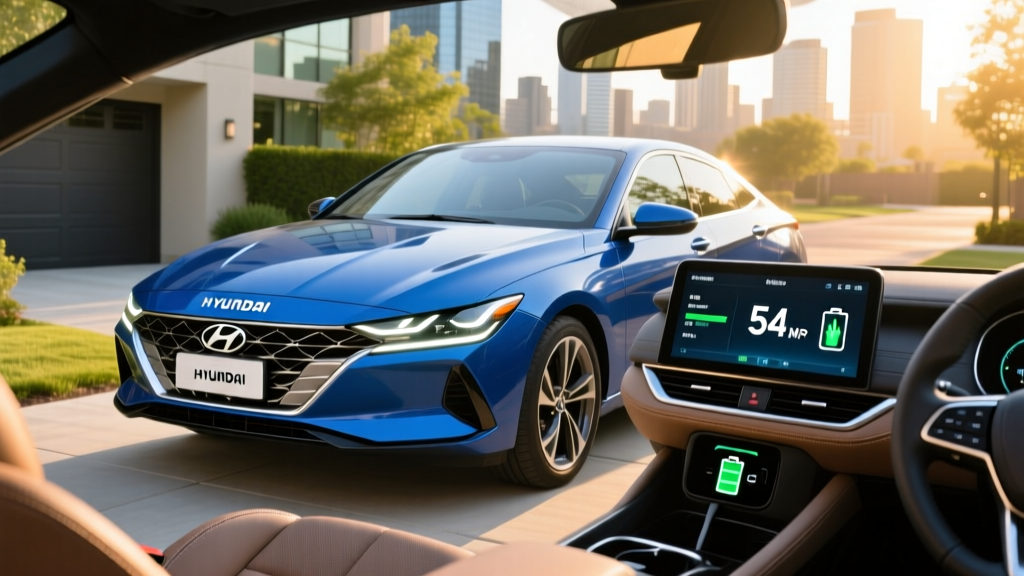
If you want maximum fuel efficiency from a gasoline-electric powertrain without ever plugging in, the 2026 Hyundai Elantra Hybrid Blue sits at the top of the compact hybrid sedan segment. The Blue trim is Hyundai's efficiency-optimized variant — lighter wheels, lower rolling-resistance tires, and specific aerodynamic tuning squeeze every last mile out of its 1.6-liter hybrid system. The result: an EPA-estimated 54 MPG combined, a number that rivals the Toyota Prius and undercuts most competitors in both price and fuel cost.
This guide covers everything a research-driven buyer needs: exact EPA figures versus what you'll see on real roads, the powertrain math behind the numbers, how the Elantra Hybrid compares to plug-in hybrids and full EVs, battery longevity, warranty coverage, and whether any tax credits apply. Let's get into the data.
HEV vs PHEV: What the Elantra Hybrid Actually Is
Before diving into specs, it's critical to understand what you're buying. The 2026 Elantra Hybrid is a conventional hybrid electric vehicle (HEV). It does not have a charging port. You cannot plug it in. The small lithium-ion battery recharges exclusively through regenerative braking and the gasoline engine.
This is fundamentally different from a plug-in hybrid (PHEV) like the Hyundai Tucson PHEV or Toyota RAV4 Prime, which carries a larger battery (typically 10–20 kWh), offers 25–45 miles of electric-only driving, and requires access to an electrical outlet or Level 2 charger to realize its full efficiency advantage.
| Feature | HEV (Elantra Hybrid) | PHEV (e.g., Tucson PHEV) | BEV (e.g., Ioniq 6) |
|---|---|---|---|
| Plug-in charging | No | Yes (Level 1/2) | Yes (Level 1/2/DC) |
| Electric-only range | ~1 mi at low speed | 25–45 mi | 250–360 mi |
| Battery size | ~1.6 kWh | ~13.8 kWh | 54–77.4 kWh |
| Gasoline required | Yes | Yes | No |
| Federal tax credit (§30D) | Not eligible | Up to $7,500* | Up to $7,500* |
*§30D credit eligibility depends on MSRP caps, buyer income limits, and battery critical-mineral sourcing requirements per current IRS rules. Always verify before purchasing.
EPA Fuel Economy and Real-World MPG
The 2026 Hyundai Elantra Hybrid Blue carries the following EPA estimates, as published on fueleconomy.gov:
| Driving Cycle | EPA Estimate |
|---|---|
| City | 56 MPG |
| Highway | 51 MPG |
| Combined | 54 MPG |
These numbers apply specifically to the Blue trim. Higher trims (SEL, Limited) use larger alloy wheels and wider tires that reduce efficiency to approximately 50 MPG combined — still excellent, but a meaningful 4-MPG drop if maximum efficiency is your priority.
Real-World MPG: What to Actually Expect
Hybrids have an unusual characteristic: they often exceed their EPA city estimate in real-world stop-and-go driving, because regenerative braking recovers energy that a gas car wastes as heat. In warm-weather city driving with moderate traffic, owners of Hyundai's 1.6L hybrid system commonly report 55–60 MPG on shorter commutes.
Highway driving is where hybrids lose their advantage. At sustained 70–80 MPH speeds, the electric motor contributes less and the gasoline engine does most of the work. Expect 46–50 MPG on extended highway trips. Cold weather (below 35°F) reduces battery efficiency and increases engine warm-up time, dropping combined real-world figures to roughly 44–48 MPG in winter conditions.
Real-world fuel economy summary: City commuters in mild climates will see 54–58 MPG regularly. Highway-heavy drivers should budget for 46–50 MPG. Cold-climate owners can expect a 10–15% seasonal reduction, consistent with all hybrid systems.
Powertrain Specs: Engine, Motor, and Combined Output
| Specification | 2026 Elantra Hybrid Blue |
|---|---|
| Engine | 1.6L GDI 4-cylinder Atkinson cycle |
| Engine output | 104 hp / 109 lb-ft torque |
| Electric motor | 32 kW (43 hp) permanent-magnet synchronous |
| Combined system output | 139 hp / 195 lb-ft torque |
| Transmission | 6-speed dual-clutch automatic (DCT) |
| Drivetrain | Front-wheel drive |
| Hybrid battery | ~1.6 kWh lithium-ion polymer |
| 0–60 MPH | ~8.5 seconds (estimated) |
| Fuel tank | 11.1 gallons |
| Total range | ~599 miles (combined EPA) |
Hyundai uses a 6-speed dual-clutch transmission rather than the continuously variable transmission (CVT) found in the Prius. The result is more natural-feeling acceleration without the "rubber band" effect some drivers dislike about CVTs. The trade-off is slightly less seamless low-speed electric assist — you may notice brief gear-shift hesitations at parking-lot speeds.
The 139 combined horsepower is adequate for commuting and highway merging but won't satisfy performance-oriented drivers. This is an efficiency-first powertrain, and it shows in the 0–60 time. For context, the Toyota Prius LE (also FWD, 194 hp combined) hits 60 MPH roughly a second quicker.
Pricing, Trims, and Tax Credit Eligibility
The 2026 Elantra Hybrid lineup starts at an MSRP of approximately $26,250 for the Blue trim, making it one of the most affordable hybrids in its class. Key trim pricing:
| Trim | MSRP (approx.) | Key Features | EPA Combined |
|---|---|---|---|
| Blue | $26,250 | 16" aero wheels, LED headlights, 8" touchscreen | 54 MPG |
| SEL | $28,500 | 17" alloy wheels, heated seats, wireless CarPlay | ~50 MPG |
| Limited | $31,500 | Leather, 10.25" nav, Bose audio, highway assist | ~50 MPG |
Does the Elantra Hybrid Qualify for a Federal Tax Credit?
No. The 2026 Elantra Hybrid is a conventional HEV, not a plug-in vehicle. The federal §30D New Clean Vehicle Credit applies only to battery electric vehicles (BEVs) and plug-in hybrids (PHEVs) that meet battery-sourcing, MSRP, and buyer income requirements. Conventional hybrids have not qualified for the §30D credit since the program was restructured.
Some states and municipalities offer rebates or HOV-lane access for hybrids, but these vary by jurisdiction and change frequently. Check your state energy office or the Alternative Fuels Data Center for local incentive details.
Hybrid Battery Warranty and Longevity
Hybrid battery replacement cost is the single most common concern among first-time hybrid buyers. Here's what Hyundai provides:
Hyundai Hybrid Battery Warranty:
- Hybrid battery: 10 years / 100,000 miles (original owner); 10 years / 100,000 miles in CARB states for subsequent owners
- Hybrid system components: 10 years / 100,000 miles (inverter, motor, controller)
- Basic vehicle warranty: 5 years / 60,000 miles
- Powertrain warranty: 10 years / 100,000 miles
Battery Degradation and Replacement Cost
Hyundai's lithium-ion polymer hybrid batteries are designed to last the life of the vehicle under normal use. Unlike the large traction batteries in EVs, a hybrid's ~1.6 kWh battery operates in a narrow state-of-charge window (roughly 40–60%) managed by the vehicle's battery management system. This shallow cycling dramatically reduces degradation.
In practice, Hyundai hybrid battery failures before 150,000 miles are rare. When replacement is needed out of warranty, expect a cost of approximately $2,000–$3,500 for the battery pack plus labor — far less than an EV battery replacement. Independent hybrid repair shops are increasingly available and may offer refurbished pack options at lower cost.
The 10-year/100,000-mile warranty is among the strongest in the industry and matches or exceeds Toyota's hybrid coverage, providing substantial peace of mind for long-term ownership.
Who Should Buy the Elantra Hybrid Blue vs a PHEV or EV?
Choosing between an HEV, PHEV, and full BEV depends on your driving patterns, home charging access, and budget. Here's a decision framework:
Choose the Elantra Hybrid Blue (HEV) if:
- You cannot install a home charger (apartment, street parking, no garage)
- You want the lowest purchase price — under $27K before destination
- Your annual mileage is moderate (10,000–15,000 mi/yr) and fuel savings alone justify the hybrid premium over a gas-only Elantra
- You take frequent long road trips and don't want to plan around charging stops
- You want zero behavior change — just fill up with gas and drive
Choose a PHEV (e.g., Tucson PHEV or Prius Prime) if:
- You have home Level 1 or Level 2 charging and a commute under 40 miles round-trip
- You want to drive mostly electric on weekdays but need gas flexibility for weekend trips
- You may qualify for the §30D federal tax credit (up to $7,500, subject to eligibility)
Choose a full BEV (e.g., Ioniq 6, Tesla Model 3) if:
- You have reliable home Level 2 charging
- Your daily driving is under 250 miles and you can plan road-trip charging
- You want to eliminate gasoline entirely and minimize maintenance (no oil changes, fewer brake replacements via regen)
- You qualify for federal and state EV incentives that offset the higher upfront cost
Pros and Cons at a Glance
Pros
- 54 MPG combined EPA — among the highest of any non-PHEV sedan
- Under $27K starting MSRP — strong value proposition
- 10-year/100,000-mile hybrid battery warranty
- 6-speed DCT avoids CVT "drone" — more engaging to drive
- Nearly 600 miles of total range per tank
- No charging infrastructure required
Cons
- 139 hp combined — acceleration is leisurely, not sporty
- Blue trim's 16" wheels and basic interior may feel sparse vs higher trims
- No federal tax credit eligibility (HEV, not PHEV)
- Highway MPG drops noticeably above 75 MPH
- Rear seat and trunk slightly compromised vs non-hybrid Elantra due to battery placement
- DCT can exhibit low-speed shift hesitation in stop-and-go traffic
Safety and Driver Assistance
The 2026 Elantra Hybrid comes standard with Hyundai SmartSense, which includes forward collision-avoidance assist with pedestrian detection, lane-keeping assist, blind-spot monitoring, rear cross-traffic alert, and adaptive cruise control with stop-and-go. The Limited trim adds Highway Driving Assist, which combines adaptive cruise with lane-centering for hands-on, semi-automated highway driving.
Important clarity: Highway Driving Assist and similar features are SAE Level 2 driver-assistance systems. They require continuous driver attention, hands on the wheel, and eyes on the road. They are not autonomous or "self-driving" in any capacity. Check IIHS and NHTSA for the latest crash-test ratings as they become available for the 2026 model year.
Frequently Asked Questions
How many MPG does the 2026 Hyundai Elantra Hybrid Blue actually get?
The EPA rates it at 56 city / 51 highway / 54 combined. Real-world city driving in mild weather often yields 55–58 MPG thanks to regenerative braking. Highway-heavy drivers at 75+ MPH should expect 46–50 MPG. Cold weather reduces figures by roughly 10–15%.
Can I plug in the Elantra Hybrid to charge?
No. The Elantra Hybrid is a conventional HEV with no charging port. The ~1.6 kWh battery recharges through regenerative braking and the gasoline engine. If you want plug-in capability, consider a PHEV like the Hyundai Tucson PHEV or the Toyota Prius Prime.
Does the Elantra Hybrid qualify for any federal tax credit?
No. The §30D New Clean Vehicle Credit applies only to plug-in vehicles (BEVs and PHEVs) that meet specific battery sourcing, MSRP, and buyer income requirements. Conventional hybrids do not qualify. Some state or local incentives may apply — check your jurisdiction's energy office.
How long will the hybrid battery last, and what does replacement cost?
Hyundai covers the hybrid battery for 10 years / 100,000 miles. The battery operates in a shallow charge cycle (40–60% SoC) that minimizes degradation, and failures before 150,000 miles are uncommon. Out-of-warranty replacement costs approximately $2,000–$3,500 including labor.
Is the Elantra Hybrid Blue slower than the regular gas Elantra?
The hybrid's 139 combined horsepower is slightly less than the standard 2.0L gas Elantra's 147 hp, but the hybrid's electric motor provides instant low-end torque that makes city acceleration feel responsive. The 0–60 MPH time of approximately 8.5 seconds is adequate but not quick. Highway passing power is sufficient but requires planning at higher speeds.
How does the Elantra Hybrid compare to the Toyota Prius?
The Prius LE (FWD) achieves 57 MPG combined — 3 MPG more than the Elantra Hybrid Blue — and has 194 hp for noticeably quicker acceleration. However, the Prius starts approximately $1,500–$2,000 higher and has a hatchback body style that may not suit sedan buyers. Both are excellent choices; the Elantra wins on price, the Prius on peak efficiency and power.
What's the total driving range on a full tank?
With an 11.1-gallon fuel tank and 54 MPG combined, the Elantra Hybrid Blue can travel approximately 599 miles between fill-ups. In real-world mixed driving, expect 520–570 miles before the low-fuel warning.