Quick Verdict: The Midsize Hybrid Truck Worth Waiting For
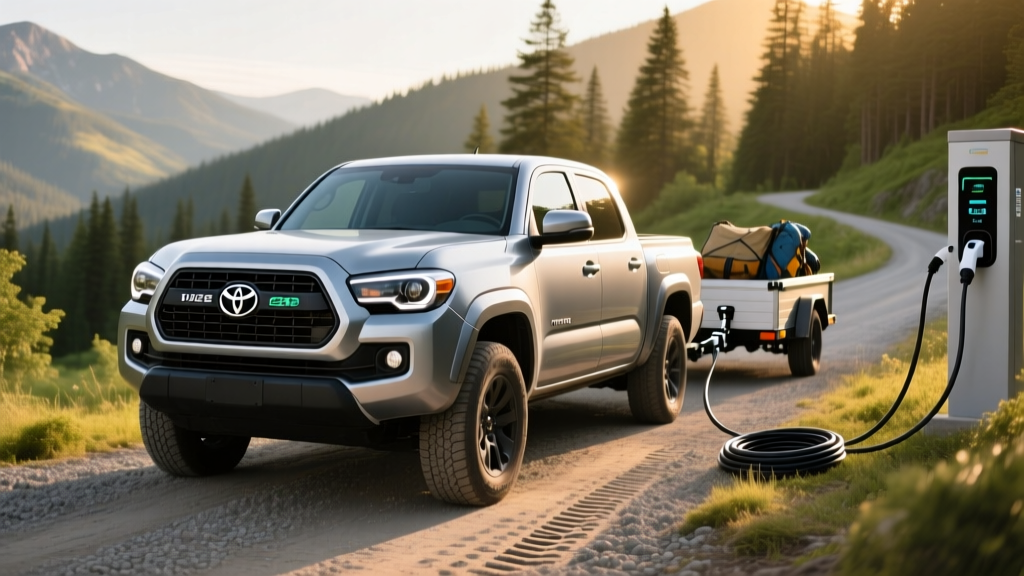
Toyota brought the i-FORCE MAX hybrid powertrain to the Tacoma for the 2024 model year, and by 2026 it has matured into one of the most compelling options in the midsize truck segment. Unlike a plug-in hybrid or a full battery-electric pickup, the hybrid Tacoma truck is a conventional self-charging hybrid (HEV) — no plug required, no range anxiety, and no dependency on charging infrastructure. It recovers energy through regenerative braking and engine-driven charging, storing it in a compact battery pack to assist acceleration, smooth out stop-and-go driving, and improve fuel economy.
The trade-off is straightforward: you sacrifice the electric-only driving range of a PHEV or the zero-tailpipe-emission profile of a BEV, but you gain simplicity, proven reliability, and a tow rating that neither the Ford Maverick Hybrid nor any current electric midsize truck can match in this price bracket. If your daily driving involves truck utility, moderate commuting, and the occasional road trip without reliable charging en route, the Tacoma Hybrid lands in a practical sweet spot.
i-FORCE MAX Powertrain: How the Hybrid Tacoma Works
Every Tacoma Hybrid uses Toyota's i-FORCE MAX powertrain, which pairs a 2.4-liter turbocharged inline-four gasoline engine with a 48-horsepower electric motor integrated between the engine and an 8-speed automatic transmission. Combined system output is 326 horsepower and 465 lb-ft of torque — figures that put it ahead of the standard non-hybrid 2.4L turbo Tacoma (278 hp / 317 lb-ft) and in the same league as V6 competitors.
The electric motor sits inside the transmission bell housing (a P2 hybrid architecture), meaning it can provide torque assist from a standstill and fill in the gaps during turbo spool-up. The result is notably smooth low-speed acceleration and reduced turbo lag — a characteristic we've observed across Toyota's i-FORCE MAX lineup, including the Tundra and Sequoia.
| Specification | Value |
|---|---|
| Powertrain | 2.4L turbo I-4 + electric motor (i-FORCE MAX) |
| Combined Horsepower | 326 hp |
| Combined Torque | 465 lb-ft |
| Transmission | 8-speed automatic |
| Drivetrain | 4WD (standard on hybrid trims) |
| Hybrid Battery | ~1.87 kWh, NiMH (sealed) |
| EPA Fuel Economy (4WD) | 23 city / 27 highway / 27 combined MPG |
| Max Towing Capacity | 6,000 lbs (SR5 i-FORCE MAX) |
| Max Payload | ~1,705 lbs (varies by trim) |
| 0–60 mph (est.) | ~6.5 seconds |
| Hybrid Battery Warranty | 10 years / 150,000 miles |
| Base MSRP (SR5 i-FORCE MAX) | $42,990 |
One important distinction: the i-FORCE MAX is not the same as the standard i-FORCE turbo four. The MAX designation specifically indicates the hybrid variant. All 2026 Tacoma Hybrid trims come with four-wheel drive as standard equipment, which is a factor in the EPA ratings discussed below.
Fuel Economy: EPA Numbers vs. Real-World MPG
According to EPA data on fueleconomy.gov, the 2026 Toyota Tacoma Hybrid 4WD achieves:
| Driving Condition | MPG |
|---|---|
| City | 23 MPG |
| Highway | 27 MPG |
| Combined | 27 MPG |
Wait — highway higher than city? That's unusual for a hybrid. Most conventional hybrids (like the Toyota RAV4 Hybrid or Honda CR-V Hybrid) earn their best numbers in city driving, where regenerative braking and electric-motor assist shine in stop-and-go traffic. The Tacoma Hybrid's higher highway figure reflects its aerodynamic profile, the 8-speed transmission's tall overdrive gears, and the fact that this is a body-on-frame truck with a relatively tall frontal area that penalizes city driving more than a crossover would.
Real-World Expectations
In mixed driving, owners and testers have reported real-world fuel economy in the 22–25 MPG range for combined city/highway use. Highway-only driving at 70–75 mph with an empty bed can push toward the EPA's 27 MPG figure. However, several factors will pull your numbers down:
- Towing: Expect 12–16 MPG when towing near the 6,000-lb max capacity. The hybrid system helps with initial acceleration, but sustained towing load falls primarily on the gasoline engine.
- Payload: A fully loaded bed (1,500+ lbs) reduces fuel economy by roughly 2–3 MPG in mixed driving.
- Cold weather: Hybrid fuel economy typically drops 5–10% in winter months as the engine runs more frequently to maintain cabin heat and battery temperature.
- Aftermarket tires: Switching to aggressive all-terrain or mud-terrain tires can reduce MPG by 1–3 MPG depending on tread pattern and weight.
Compared to the non-hybrid 2.4L turbo Tacoma 4WD (EPA-rated around 20 city / 26 highway / 22 combined for the automatic), the hybrid's advantage is most visible in city and mixed driving — roughly a 3–5 MPG improvement in stop-and-go conditions, narrowing to 1–2 MPG on the highway.
Hybrid vs. PHEV vs. Full EV: Which Truck Fits Your Life?
The Tacoma Hybrid is a conventional hybrid (HEV). It does not plug in, has no electric-only driving mode, and cannot operate as a pure electric vehicle. To put this in context for buyers cross-shopping electrified trucks:
| Factor | Tacoma Hybrid (HEV) | PHEV Truck (e.g., future options) | Full EV Truck (e.g., Rivian R1T, Ford F-150 Lightning) |
|---|---|---|---|
| Plug-in Required? | No | Yes (for electric range) | Yes |
| Electric-Only Range | 0 miles | 20–50 miles (typical) | 270–400+ miles |
| Home Charging Needed | No | Recommended (Level 2) | Essential (Level 2) |
| Tailpipe Emissions | Yes (reduced vs. gas-only) | Yes (when engine runs) | None |
| Federal Tax Credit (§30D) | Not eligible | Up to $7,500 (if qualified) | Up to $7,500 (if qualified) |
| Maintenance Complexity | Low (proven Toyota hybrid) | Moderate (two full systems) | Low (fewer moving parts) |
| Best For | Truck utility + modest MPG gains, no charging access needed | Short electric commutes + truck flexibility | Home charging access + low fuel cost + max torque |
As of 2026, there is no plug-in hybrid (PHEV) midsize truck available in the U.S. market. If Toyota or a competitor introduces one, it would offer 25–40 miles of electric-only range for commuting with a gasoline engine for longer trips and towing. Until then, the Tacoma Hybrid fills the efficiency gap for truck buyers who cannot or do not want to install a home charger.
Decision Framework: Is the Tacoma Hybrid Right for You?
Choose the Tacoma Hybrid if:
- You need a midsize truck for towing, trailering, or off-road use
- You lack reliable access to Level 2 home or workplace charging
- You want better fuel economy than a gas-only truck without changing your habits
- You plan to own the truck for 10+ years and value Toyota's hybrid reliability track record
Consider a full EV truck (Rivian R1T, F-150 Lightning) if:
- You have Level 2 home charging and a daily commute under 200 miles
- You want the lowest per-mile fuel cost and zero tailpipe emissions
- You qualify for the §30D federal tax credit (up to $7,500)
- You rarely tow more than 5,000–7,000 lbs
Pricing, Trims, and Tax Credit Eligibility
For the 2026 model year, the i-FORCE MAX hybrid powertrain is available across multiple Tacoma trims. Here's the approximate MSRP breakdown:
| Trim Level | Starting MSRP |
|---|---|
| SR5 i-FORCE MAX | $42,990 |
| Limited i-FORCE MAX | $51,490 |
| TRD Off-Road i-FORCE MAX | $47,790 |
| TRD Pro i-FORCE MAX | $64,990 |
| Trailhunter i-FORCE MAX | $62,990 |
Destination charges add approximately $1,495. Prices reflect 2026 model-year MSRPs as published by Toyota's official site and are subject to dealer pricing adjustments.
Federal Tax Credit: Does the Tacoma Hybrid Qualify?
No. Under current IRS §30D Clean Vehicle Credit rules, conventional hybrids (HEVs) that do not have plug-in capability are not eligible for the federal EV tax credit. The §30D credit applies only to battery electric vehicles (BEVs) and plug-in hybrid electric vehicles (PHEVs) that meet battery capacity, critical mineral sourcing, MSRP caps, and buyer income thresholds.
The Tacoma Hybrid does not qualify for the $7,500 credit, the $4,000 used-EV credit, or the point-of-sale transfer option. If Toyota introduces a Tacoma PHEV in a future model year, it could become eligible — but as of 2026, no such variant has been announced.
Some states offer their own hybrid or clean-vehicle rebates that may apply. Check your state's energy or environmental agency for current programs, as these vary significantly by jurisdiction.
Battery Reliability, Warranty, and Replacement Costs
Hybrid Battery Warranty
Toyota covers the Tacoma Hybrid's battery pack under its 10-year / 150,000-mile Hybrid Battery Warranty (whichever comes first). This warranty applies to the hybrid battery and all hybrid-system components, including the electric motor, inverter, and control modules. It is transferable to subsequent owners.
The Tacoma Hybrid uses a nickel-metal hydride (NiMH) battery pack with approximately 1.87 kWh of capacity. This is a small, sealed battery designed for charge-assist and regenerative braking — not for electric-only driving. Toyota has used NiMH chemistry in its hybrids for over two decades (the Prius launched with NiMH in 1997), and the technology is extremely well-proven for longevity.
Real-World Battery Lifespan
Based on data from Toyota's broader hybrid fleet (Prius, RAV4 Hybrid, Highlander Hybrid, Tundra i-FORCE MAX), hybrid battery packs routinely last 150,000–200,000+ miles before requiring replacement. NiMH chemistry is less prone to the rapid degradation seen in some early lithium-ion packs. The primary failure mode is gradual capacity loss over 10–15 years, which manifests as slightly reduced fuel economy rather than a sudden failure.
Battery Replacement Cost
If the hybrid battery does fail outside of warranty, expect a replacement cost in the range of $3,000–$5,000 for a new OEM pack installed at a Toyota dealership. Independent hybrid-battery specialists may offer refurbished packs for $1,500–$2,500. Given the 10-year/150,000-mile warranty and NiMH longevity data, most Tacoma Hybrid owners will never face this expense.
The broader powertrain — the 2.4L turbo engine, 8-speed automatic transmission, and electric motor assembly — is covered under Toyota's standard 5-year / 60,000-mile powertrain warranty.
Pros and Cons: Honest Assessment
Pros
- 326 hp and 465 lb-ft of torque — strong acceleration and towing performance for a midsize truck
- 3–5 MPG improvement over the non-hybrid Tacoma in city/mixed driving
- No plug-in charging required — works with existing fueling habits
- Proven Toyota hybrid reliability with 10-year / 150,000-mile battery warranty
- 6,000-lb towing capacity exceeds most midsize truck competitors
- Available in off-road (TRD Off-Road, TRD Pro) and overlanding (Trailhunter) trims
- Smooth low-speed driving with reduced turbo lag from electric motor assist
Cons
- Not eligible for the $7,500 federal §30D tax credit (HEV, not PHEV/BEV)
- Highway MPG advantage over non-hybrid is modest (1–2 MPG)
- Premium price: $3,000–$4,000 more than equivalent non-hybrid trims
- Hybrid system adds ~150 lbs of weight, slightly reducing payload capacity
- No electric-only driving mode for zero-emission short trips
- Fuel economy drops significantly when towing (12–16 MPG under load)
- Bed length and cab configurations may be limited by trim on hybrid models
How It Stacks Up: Tacoma Hybrid vs. Competitors
The midsize hybrid truck segment is still small, but there are direct alternatives worth considering:
| Model | Combined MPG | Max Towing | Combined HP | Starting MSRP |
|---|---|---|---|---|
| Toyota Tacoma Hybrid (i-FORCE MAX 4WD) | 27 MPG | 6,000 lbs | 326 hp | $42,990 |
| Ford Maverick Hybrid (FWD) | 42 MPG | 2,000 lbs | 191 hp | $28,145 |
| Toyota Tacoma (non-hybrid 2.4T 4WD) | 22 MPG | 6,500 lbs | 278 hp | $38,990 |
| Chevrolet Colorado (2.7T 4WD, gas) | 20 MPG | 7,700 lbs | 310 hp | $33,795 |
The Ford Maverick Hybrid dominates on fuel economy (42 MPG combined) and price, but it is a unibody compact truck with front-wheel drive and a 2,000-lb tow limit. If your truck needs are light — commuting, light hauling, weekend projects — the Maverick Hybrid is the more economical choice. If you need 4WD, serious towing, and off-road capability, the Tacoma Hybrid is the only game in town at the midsize level.
Ownership Costs: 5-Year Fuel Savings Estimate
Let's compare the Tacoma Hybrid to the non-hybrid 2.4T Tacoma 4WD over 5 years and 75,000 miles, assuming $3.60/gallon regular unleaded and 15,000 miles per year:
| Metric | Tacoma Hybrid (27 MPG) | Tacoma Non-Hybrid (22 MPG) |
|---|---|---|
| Gallons Used (75,000 mi) | 2,778 gal | 3,409 gal |
| Total Fuel Cost | $10,001 | $12,272 |
| 5-Year Fuel Savings | ~$2,271 saved with Hybrid | |
| Hybrid Premium (SR5 trim) | ~$4,000 | |
| Net 5-Year Cost Difference | Hybrid costs ~$1,729 more (before resale value) | |
The hybrid's fuel savings alone do not fully offset its higher purchase price over five years. However, the hybrid's stronger torque output, smoother drivetrain behavior, and Toyota's hybrid resale-value premium (historically 5–10% higher than non-hybrid equivalents at trade-in) can narrow or close that gap. This is a powertrain you buy for the driving experience and long-term reliability, not purely for fuel-cost payback.
Frequently Asked Questions
How many MPG does the hybrid Tacoma truck get?
The 2026 Toyota Tacoma Hybrid 4WD is EPA-rated at 23 city / 27 highway / 27 combined MPG. Real-world mixed driving typically yields 22–25 MPG, with lower numbers when towing or carrying heavy payloads.
Does the Tacoma Hybrid need to be plugged in?
No. The Tacoma Hybrid is a conventional hybrid (HEV), not a plug-in hybrid (PHEV). It charges its battery through regenerative braking and the gasoline engine. You fuel it exactly like a standard gas truck — at the pump.
Does the Tacoma Hybrid qualify for any federal tax credit?
No. Under current IRS §30D rules, conventional hybrids are not eligible for the federal Clean Vehicle Credit. Only plug-in hybrids (PHEVs) and battery electric vehicles (BEVs) qualify. Check your state's incentive programs for any applicable local rebates.
How long will the Tacoma Hybrid battery last?
Toyota's NiMH hybrid batteries in similar applications (RAV4 Hybrid, Highlander Hybrid) routinely last 150,000–200,000+ miles. The Tacoma Hybrid battery is covered by a 10-year / 150,000-mile warranty. Out-of-pocket replacement costs range from $3,000–$5,000 for an OEM pack, though most owners will never need one.
Can the Tacoma Hybrid drive on electric power only?
Not in any meaningful way. The i-FORCE MAX system can operate the electric motor alone at very low speeds for brief moments (e.g., creeping in a parking lot), but it has no dedicated EV mode and no meaningful electric-only range. For electric-only commuting, you would need a PHEV or BEV.
How much can the Tacoma Hybrid tow?
The 2026 Tacoma Hybrid (SR5 i-FORCE MAX) is rated for up to 6,000 lbs of towing capacity. Higher trims with additional off-road equipment may have slightly lower ratings. Expect fuel economy to drop to 12–16 MPG when towing near maximum capacity.
Is the Tacoma Hybrid better than the Ford Maverick Hybrid?
They serve different buyers. The Maverick Hybrid delivers 42 MPG combined and starts under $29,000, but it's a FWD compact truck with a 2,000-lb tow limit. The Tacoma Hybrid offers 4WD, 6,000-lb towing, 326 hp, and serious off-road capability at a significantly higher price and lower MPG. If you need a real truck, the Tacoma Hybrid wins. If you need fuel-efficient light-duty hauling, the Maverick Hybrid is the better value.
What is the difference between i-FORCE and i-FORCE MAX?
i-FORCE is Toyota's standard 2.4L turbocharged four-cylinder engine (278 hp, 317 lb-ft). i-FORCE MAX adds a 48-hp electric motor between the engine and transmission, boosting combined output to 326 hp and 465 lb-ft while improving fuel economy. The MAX is the hybrid variant.