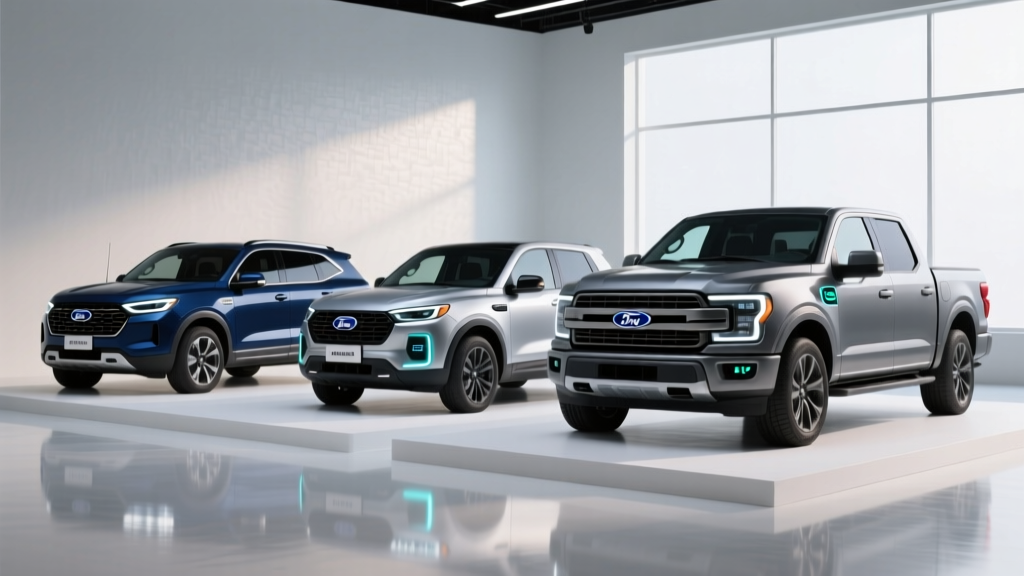
Ford has bet heavily on hybrids, and for good reason: they deliver EV-like city efficiency without range anxiety or charging infrastructure dependence. But Ford's hybrid lineup spans three very different vehicles — the compact Escape Hybrid, the unibody Maverick Hybrid, and the full-size F-150 PowerBoost — each with distinct trade-offs in efficiency, capability, and price. This guide breaks down every 2026 hybrid Ford with exact EPA figures, real-world expectations, battery warranty details, and whether a plug-in hybrid (PHEV) variant makes more sense for your commute.
Ford's 2026 Hybrid Lineup at a Glance
Ford offers conventional hybrids (HEVs) across three nameplates. A conventional hybrid uses a small battery and electric motor to assist the gas engine — it never plugs in and recovers energy through regenerative braking. Ford also previously offered the Escape PHEV (plug-in hybrid), which adds a larger battery and the ability to drive on electricity alone for a limited range. Below is the core spec comparison.
| Model | Type | Powertrain | Combined HP | EPA Combined MPG | Base MSRP |
|---|---|---|---|---|---|
| Escape Hybrid | HEV | 2.5L I4 + eMotor | 210 hp | 42 MPG | $33,000 |
| Escape PHEV | PHEV | 2.5L I4 + eMotor + 14.4 kWh | 210 hp | 42 MPG (hybrid) / 105 MPGe (elec) | $40,500 |
| Maverick Hybrid | HEV | 2.5L I4 + eMotor | 191 hp | 42 MPG | $28,500 |
| F-150 PowerBoost | HEV | 3.5L V6 TT + eMotor + 1.5 kWh | 430 hp | 25 MPG | $62,000 |
HEV vs PHEV: Which Ford Hybrid Architecture Fits You?
Conventional Hybrid (HEV)
Used in the Escape Hybrid, Maverick Hybrid, and F-150 PowerBoost. The battery is small (typically 1.1–1.5 kWh usable), charged entirely by the engine and regenerative braking. You never plug in. The electric motor assists during acceleration and enables brief low-speed electric-only driving, but the engine is always the primary power source. Think of it as a more efficient gas car — same fueling habits, better MPG.
Plug-In Hybrid (PHEV)
Available only on the Escape PHEV. It carries a larger 14.4 kWh battery that provides roughly 37 miles of electric-only range before the engine takes over. You plug it in (Level 1 or Level 2 — no DC fast charging on this platform). Once the battery depletes, it operates as a conventional hybrid at 42 MPG combined. The PHEV is ideal if your daily commute is under 40 miles round-trip and you have access to a standard 120V or 240V outlet.
Fuel Economy Breakdown: EPA vs Real-World MPG
| Model | City MPG | Highway MPG | Combined MPG | Real-World Note |
|---|---|---|---|---|
| Escape Hybrid (FWD) | 44 | 37 | 42 | City often exceeds EPA; highway drops to 33-35 at 75+ mph |
| Escape Hybrid (AWD) | 42 | 36 | 39 | AWD penalty is modest; expect 36-38 combined |
| Escape PHEV (charge-depleted) | 44 | 37 | 42 | Matches HEV once battery is used up |
| Maverick Hybrid (FWD) | 42 | 40 | 42 | One of few hybrids where hwy nearly matches city; real-world 40-44 typical |
| F-150 PowerBoost (4WD) | 24 | 24 | 25 | Expect 22-24 loaded/towing; 26-27 possible empty highway at 65 mph |
Source: fueleconomy.gov
Hybrids shine in stop-and-go traffic because regenerative braking recovers energy that would otherwise be wasted as heat. The Escape and Maverick both post higher city MPG than highway — the opposite of a conventional gas car. If your driving is predominantly urban or suburban with frequent stops, expect to match or even exceed EPA city figures. On sustained highway runs above 70 mph, the engine does most of the work and efficiency drops closer to a non-hybrid equivalent.
The F-150 PowerBoost is a different animal. At 430 hp and 570 lb-ft of torque, it prioritizes capability over efficiency. Its 25 MPG combined is impressive for a full-size, body-on-frame truck — a non-hybrid 3.5L EcoBoost F-150 returns roughly 20 MPG combined — but don't expect hypermiler numbers. Towing drops efficiency to the high teens or lower depending on trailer weight.
Escape PHEV: Electric-Only Range and Charging Details
The Escape PHEV's 14.4 kWh battery pack (NMC chemistry) delivers an EPA-rated 37 miles of electric-only range. In mild weather at city speeds, owners commonly report 35-40 miles before the engine engages. At highway speeds or in cold weather (below 35°F), expect that to shrink to 28-32 miles as cabin heating and higher energy consumption take their toll.
Charging the Escape PHEV:
- Level 1 (120V household outlet): ~2.0 kW charge rate, 0–100% in approximately 7 hours. Plug in overnight and wake up to a full battery.
- Level 2 (240V home charger or public station): ~6.6 kW onboard charger, 0–100% in approximately 2.5 hours.
- DC Fast Charging: Not available. The Escape PHEV uses a J1772 connector for AC charging only. No CCS or NACS DC capability.
The total combined range (electric + gas) exceeds 400 miles, eliminating any range concern. If you can charge at home nightly, a 30-mile round-trip commute could mean visiting a gas station once every few months.
Powertrain Deep Dive: What's Under the Hood
Escape Hybrid & PHEV
Both use Ford's 2.5-liter Atkinson-cycle inline-four paired with an electric motor integrated into the eCVT transaxle. Combined output is 210 hp. The PHEV adds the larger battery and a more powerful electric motor for its electric-only mode (approximately 131 hp on electric alone). The eCVT is a power-split device, not a traditional belt-driven CVT — it's mechanically robust and avoids the rubber-band feel some CVTs exhibit.
Maverick Hybrid
The Maverick pairs the same 2.5L Atkinson-cycle I4 with a 96-kW electric motor for a combined 191 hp. It's FWD only (AWD is not available on the hybrid powertrain as of 2026). The 1.1 kWh battery is sufficient for low-speed electric assist and regenerative capture. Towing capacity is limited to 2,000 lbs on the hybrid, versus 4,000 lbs on the turbo AWD model — a key trade-off if you need to haul.
F-150 PowerBoost
This is Ford's hybrid flagship: a twin-turbo 3.5L V6 mated to a 35-kW electric motor built into the 10-speed automatic transmission. Combined output is 430 hp and 570 lb-ft of torque — more torque than the 5.0L V8. The 1.5 kWh battery is liquid-cooled and mounted under the bed, preserving interior and cargo space. The PowerBoost also includes Pro Power Onboard (up to 7.2 kW of 120V/240V outlet power in the bed), which can run job-site tools, a camper, or even provide limited home backup power during an outage.
Pricing, Tax Credits, and Incentives
Here's what each 2026 hybrid Ford costs before any incentives:
| Model | Base MSRP | Top Trim MSRP | Federal §30D Credit | State Incentives |
|---|---|---|---|---|
| Escape Hybrid | $33,000 | $41,000 | Not eligible (HEV) | Varies by state |
| Escape PHEV | $40,500 | $46,000 | Up to $3,750* | Varies — check state programs |
| Maverick Hybrid | $28,500 | $38,000 | Not eligible (HEV) | Varies by state |
| F-150 PowerBoost | $62,000 | $82,000+ | Not eligible (HEV) | Varies by state |
*The Escape PHEV may qualify for a partial federal tax credit under IRS §30D rules, subject to critical-mineral and battery-component sourcing requirements that change annually. Conventional hybrids (HEVs) do not qualify for the federal §30D new clean vehicle credit. Income caps ($150K single / $300K joint) and MSRP caps apply to PHEV eligibility. Always confirm current-year rules with a tax professional or the IRS clean vehicle credits page. Point-of-sale transfer is available for qualifying PHEVs at participating dealers.
Battery Warranty, Lifespan, and Replacement Cost
Ford Hybrid Battery Warranty: All Ford hybrid and PHEV models carry a high-voltage battery warranty of 8 years or 100,000 miles (whichever comes first). In states that follow California Air Resources Board (CARB) standards — including CA, NY, MA, WA, CO, and several others — that extends to 10 years or 150,000 miles.
The warranty covers battery capacity loss below a defined threshold (typically 70% of original capacity) and any defects in the battery management system.
How long do Ford hybrid batteries actually last? Ford's hybrid system is one of the most proven in the industry — the Escape Hybrid has been in production since 2005, and taxi fleets accumulated hundreds of thousands of miles on original battery packs. The batteries in Ford HEVs are relatively small and conservatively managed (never fully charged or fully depleted), which extends cycle life significantly.
Replacement cost: If a hybrid battery does need replacement out of warranty:
- Escape/Maverick HEV battery: approximately $2,500–$4,000 (parts and labor)
- Escape PHEV battery: approximately $6,000–$9,000 (larger pack, more complex)
- F-150 PowerBoost battery: approximately $3,000–$5,000 (small pack, but labor-intensive access)
For context, most hybrid batteries outlast the vehicle itself when properly maintained. The liquid-cooled system in the F-150 and the conservative state-of-charge window Ford programs into all its hybrids significantly reduce degradation risk.
Who Should Choose a Ford Hybrid vs a Full EV or Gas Car?
Choose a Ford Hybrid If:
- You want better fuel economy without changing your fueling habits
- You lack access to home or workplace charging (apartment, street parking)
- You frequently drive long highway routes where EV charging infrastructure is sparse
- You need a truck (Maverick/F-150) and want to reduce fuel costs without sacrificing capability
- You live in an extreme climate where EV range loss in cold weather is a concern
- You want a lower purchase price than a comparable EV
Choose a Full EV Instead If:
- You can install a Level 2 home charger and want zero tailpipe emissions
- Your daily commute is predictable and within EV range
- You want to eliminate oil changes, spark plugs, and transmission fluid service
- You qualify for the full $7,500 federal EV tax credit (not available on HEVs)
- You want instant torque, one-pedal driving, and a frunk
Choose the Escape Hybrid if you want a compact crossover with top-tier city MPG and AWD availability, and you don't want to plug in.
Choose the Escape PHEV if your commute is under 37 miles round-trip, you have a place to plug in overnight, and you want electric daily driving with gas flexibility for road trips.
Choose the Maverick Hybrid if you want a practical, affordable compact truck with car-like fuel economy and don't need AWD or heavy towing.
Choose the F-150 PowerBoost if you need full-size truck capability (towing, payload, job-site power) and want to claw back 4-5 MPG over the non-hybrid EcoBoost.
Frequently Asked Questions
How many MPG does the Ford Maverick Hybrid get?
The 2026 Maverick Hybrid is EPA-rated at 42 city / 40 highway / 42 combined MPG. In real-world mixed driving, owners typically report 40–44 MPG. It's one of the most efficient vehicles Ford sells and the most fuel-efficient compact truck on the market.
How far can the Escape PHEV go on electric only?
The 2026 Escape PHEV has an EPA-rated 37 miles of electric-only range. In mild city driving, expect 35–40 miles. At highway speeds or in cold weather, expect 28–32 miles. After the battery depletes, the vehicle seamlessly switches to hybrid mode at 42 MPG combined.
Do Ford hybrids need to be plugged in?
No. The Escape Hybrid, Maverick Hybrid, and F-150 PowerBoost are conventional hybrids (HEVs). They charge their own batteries through the engine and regenerative braking. You fuel them like a normal gas car. Only the Escape PHEV needs to be plugged in to access its electric-only range — and even the PHEV can operate as a regular hybrid without ever plugging in.
Is the Ford hybrid battery reliable and what does replacement cost?
Ford's hybrid system has been in production since 2005 and is among the most proven in the industry. All hybrid batteries carry an 8-year/100,000-mile warranty (10 years/150,000 miles in CARB states). Out-of-warranty replacement runs $2,500–$4,000 for HEV packs and $6,000–$9,000 for the PHEV. Most hybrid batteries last the life of the vehicle.
Does any Ford hybrid qualify for a federal tax credit?
Conventional hybrids (Escape HEV, Maverick HEV, F-150 PowerBoost) do not qualify for the federal §30D clean vehicle credit — that credit is reserved for plug-in vehicles (BEVs and PHEVs). The Escape PHEV may qualify for a partial credit (up to $3,750) depending on battery sourcing requirements and buyer income limits. Check current eligibility on the IRS clean vehicle credits page.
Can the F-150 PowerBoost tow as much as the regular F-150?
The F-150 PowerBoost has a maximum towing capacity of approximately 12,700 lbs when properly equipped — competitive with the non-hybrid 3.5L EcoBoost. The hybrid system's added torque (570 lb-ft) actually improves low-speed pulling power. However, towing significantly reduces fuel economy, typically into the high teens or lower depending on trailer weight and terrain.
Is the Maverick Hybrid available with AWD?
No. As of 2026, the Maverick Hybrid is front-wheel drive only. If you need AWD in a Maverick, you'll need the 2.0L EcoBoost turbo engine, which returns roughly 26 MPG combined — a substantial efficiency trade-off. For AWD in a Ford hybrid, the Escape Hybrid offers an AWD variant at 39 MPG combined.