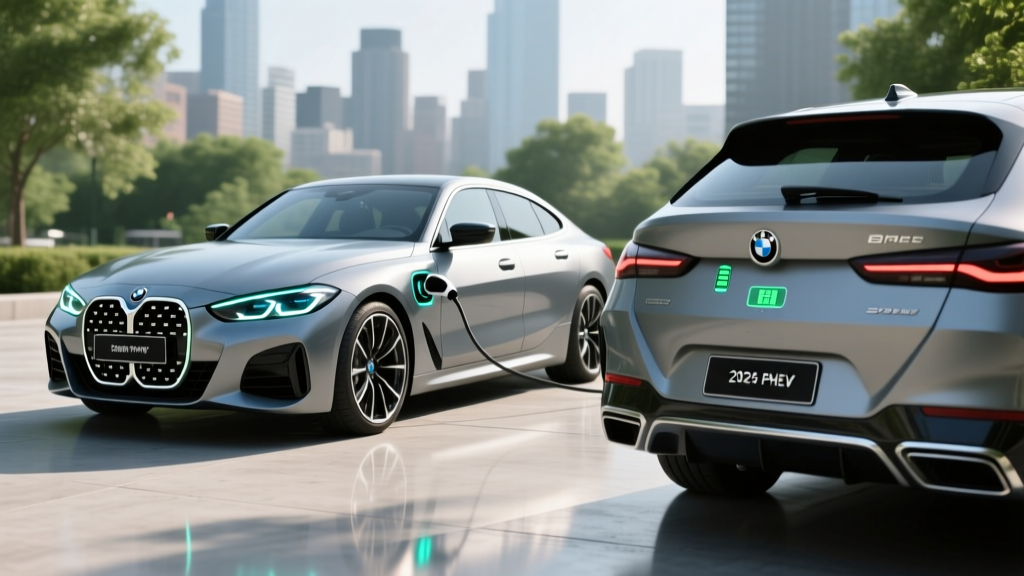
The 2026 Hybrid BMW Lineup at a Glance
BMW has fully committed to plug-in hybrid (PHEV) technology for its U.S. passenger-car and SUV lineup. Unlike a conventional hybrid (HEV) such as the Toyota Prius — which recharges its small battery solely through regenerative braking and the engine — every current BMW hybrid can plug into a wall or public charger and drive on electricity alone for roughly 35–40 miles before the gasoline engine fires up. That distinction matters enormously for both daily commuting and federal tax-credit eligibility.
For 2026, BMW offers PHEV variants across the 3 Series, 5 Series, 7 Series, X3, X5, and XM. The automaker has dropped the "45e" and "530e" badging in favor of a streamlined naming scheme: models ending in "50e" denote the latest-generation PHEV powertrain with a larger battery and more electric-only range than the outgoing 30e/45e cars. Below, we break down every model with exact EPA figures, real-world caveats, battery specs, and current pricing so you can decide which hybrid BMW fits your driveway.
HEV vs PHEV: Why BMW Went All-In on Plug-In
| Attribute | Conventional Hybrid (HEV) | Plug-In Hybrid (PHEV) — BMW's Approach |
|---|---|---|
| Plug-in charging | Not required; self-charging | Required to access electric-only range |
| Battery size | ~1–2 kWh | 18.7–25.7 kWh usable |
| Electric-only range | 0–1 mi at low speed | 35–40 mi EPA |
| Federal tax credit (§30D) | Not eligible | Up to $3,750 depending on sourcing |
| Best for | Apartment dwellers, no home charging | Home chargers + short commutes |
If you cannot install a Level 2 home charger or lack workplace charging, a PHEV still functions as a highly efficient hybrid once the battery depletes — you just forfeit the electric-only commute and most of the fuel-cost savings. BMW's decision to skip conventional hybrids means buyers without plug access should cross-shop the Toyota Camry Hybrid or Honda Accord Hybrid instead.
Spec Table: Every 2026 Hybrid BMW Compared
| Model | Battery (kWh usable) | EV Range (EPA) | Combined MPG (gas) | Combined HP | 0–60 mph | Base MSRP |
|---|---|---|---|---|---|---|
| 330e xDrive Sedan | 19.5 | ~36 mi | 28 MPG | 292 hp | 5.6 s | $46,895 |
| 550e xDrive Sedan | 18.7 | ~38 mi | 30 MPG | 483 hp | 4.1 s | $60,495 |
| 750e xDrive Sedan | 18.7 | ~34 mi | 27 MPG | 483 hp | 4.1 s | $107,995 |
| X3 xDrive50e | 19.7 | ~38 mi | 28 MPG | 295 hp | 5.9 s | $52,395 |
| X5 xDrive50e | 25.7 | ~40 mi | 24 MPG | 483 hp | 4.6 s | $69,895 |
| XM (PHEV SUV) | 25.7 | ~31 mi | 18 MPG | 644 hp (738 hp Label) | 3.7 s | $160,995 |
Sources: fueleconomy.gov, BMW USA official specifications. MPG figures reflect combined city/highway driving after the battery is depleted. EV range is the EPA-rated electric-only estimate.
Fuel Economy and Electric-Only Range in the Real World
The EPA's electric-range and MPG figures assume a mix of city and highway driving at moderate temperatures. In practice, PHEV efficiency varies dramatically based on how you use them.
Electric-only range reality: Expect 85–95% of the EPA electric range in mild weather (spring/fall) when driving below 55 mph. In winter, cabin heating and battery chemistry reduce electric-only range by 20–35%. A 550e rated for 38 electric miles might deliver only 25–28 miles on a 25°F morning commute. Highway driving at 75+ mph also erodes range faster than the EPA cycle suggests — plan on ~28–32 electric miles at sustained freeway speeds in the 550e.
MPG after battery depletion: Once the gasoline inline-six takes over, BMW PHEVs behave like well-tuned mild hybrids. The X5 xDrive50e, despite weighing over 5,400 lbs, returns a real-world 22–25 MPG on highway cruises — slightly above its 24 MPG EPA combined rating. The 330e sedan, lighter and more aerodynamic, often exceeds its 28 MPG combined EPA figure in city driving thanks to frequent regenerative braking. BMW's PHEVs use a preconditioning feature (accessible via the My BMW app) that warms or cools the battery while plugged in, preserving electric range and optimizing charge acceptance.
| Model | EPA City | EPA Highway | EPA Combined | Real-World City (observed) | Real-World Hwy (observed) |
|---|---|---|---|---|---|
| 330e xDrive | 29 | 27 | 28 | 30–33 | 26–28 |
| 550e xDrive | 31 | 29 | 30 | 32–35 | 27–29 |
| X5 xDrive50e | 25 | 23 | 24 | 26–28 | 22–24 |
Real-world estimates based on owner reports and independent testing. Your results will vary with climate, terrain, and driving style.
Charging: What It Takes to Plug In a BMW PHEV
Every 2026 BMW PHEV uses a J1772 connector for AC Level 2 charging and does not support DC fast charging. This is typical for PHEVs — the battery is too small to justify the cost and weight of DC fast-charge hardware. Here's what charging looks like in practice:
- Level 1 (120V household outlet): ~1.4 kW — a full charge takes 12–18 hours depending on battery size. Fine for overnight top-ups if your daily electric commute is under 20 miles.
- Level 2 (240V home or public charger): 7.4 kW onboard charger — a full 0–100% charge in approximately 2.5–3.5 hours. This is the sweet spot for PHEV owners.
- DC Fast Charging: Not available on any 2026 BMW PHEV. If you need DC fast-charge capability, you're looking at a full BEV like the BMW iX or i4.
Home charging cost: A Level 2 home charger installation (240V/40A circuit) typically costs $800–$2,000 including the charger unit and electrician labor, depending on your panel capacity and conduit run. A full overnight charge on the X5 xDrive50e's 25.7 kWh battery costs roughly $2.50–$4.00 at the U.S. average residential electricity rate of ~$0.16/kWh — that's about $0.06–$0.10 per electric mile, dramatically cheaper than gasoline at current prices.
Powertrain Deep Dive: Inline-Six Meets Electric Motor
BMW's fifth-generation PHEV system pairs a turbocharged inline-six gasoline engine with an electric motor integrated into the 8-speed Steptronic transmission. This architecture delivers seamless transitions between electric and gas power — you rarely feel the engine engage unless you floor the accelerator or deplete the battery.
330e xDrive: A 2.0L turbo four-cylinder (184 hp) plus a 113-hp electric motor yields 292 combined horsepower. It's the lightest and most affordable entry into BMW's PHEV lineup, and the only one using a four-cylinder engine. Adequate for most drivers, though enthusiasts may notice the four-cylinder's coarser sound under hard acceleration.
550e and X5 xDrive50e: Both use a 3.0L turbocharged inline-six (312 hp) paired with a 184-hp electric motor for 483 combined horsepower. The inline-six is one of BMW's signature engines — smooth, responsive, and well-suited to the PHEV's electric torque fill. The X5's heavier weight softens its performance edge, but the 550e sedan is genuinely quick.
XM: BMW's M Performance PHEV pairs a twin-turbo 4.4L V8 (483 hp) with a 197-hp electric motor for a combined 644 hp (738 hp in the Label Red variant). It's the most powerful BMW ever sold, but its 18 MPG combined rating and $160k+ price make it a niche proposition.
Pricing, Tax Credits, and Total Cost of Ownership
BMW PHEVs carry a $4,000–$8,000 premium over their gasoline counterparts, but the fuel savings and potential tax credit can narrow the gap significantly.
- Federal §30D tax credit: PHEVs with at least 7 kWh of battery capacity qualify for up to $3,750 (the critical-minerals half of the credit; most BMW PHEVs do not meet the battery-component sourcing requirement for the full $7,500 as of 2026). The buyer must meet income caps ($150K single / $300K joint) and the vehicle must be under the MSRP cap ($80K for SUVs, $55K for sedans).
- MSRP cap impact: The 330e ($46,895 sedan cap: $55K) and X3 xDrive50e ($52,395 SUV cap: $80K) qualify for the credit. The 550e ($60,495) qualifies. The 750e ($107,995) and XM ($160,995) exceed the MSRP cap and are not eligible.
- Point-of-sale transfer: As of 2024, the §30D credit can be transferred to the dealer at purchase, reducing your out-of-pocket cost immediately rather than waiting for a tax refund. Confirm eligibility with your tax professional and reference IRS guidelines.
- State incentives: Vary widely — check your state's energy office or DSIRE database for local rebates.
Pros
- 35–40 mi electric range covers most commutes gas-free
- No range anxiety — gas engine for road trips
- Up to $3,750 federal tax credit on qualifying models
- BMW driving dynamics preserved (RWD-biased AWD)
- Inline-six smoothness in 550e and X5 50e
- 8-year/80,000-mi battery warranty
Cons
- No DC fast charging — Level 2 only
- $4K–$8K premium over gas-only BMW trims
- Cargo space slightly reduced vs. non-PHEV (battery placement)
- 750e and XM don't qualify for federal credit (MSRP cap)
- Electric range drops 20–35% in cold weather
- Requires home charging to maximize value
Reliability and Battery Warranty: What Owners Should Know
Battery warranty: BMW covers the high-voltage PHEV battery for 8 years or 80,000 miles (whichever comes first) against defects and capacity loss below 70% of original capacity. This is mandated by federal emissions-warranty requirements for PHEVs and matches the industry standard set by Toyota, Hyundai, and others.
Battery replacement cost: Out-of-warranty PHEV battery replacement runs $8,000–$14,000 depending on the model, based on current dealer parts pricing. However, BMW's lithium-ion PHEV batteries have proven durable — there is no widespread pattern of premature failure in the current-generation (2023+) PHEV fleet.
Long-term degradation: Expect roughly 8–12% capacity loss over 8 years / 100,000 miles under normal use. BMW's battery management system maintains a ~10% buffer at the top and bottom of the pack to reduce stress on cells. Avoid routinely charging to 100% and leaving the car parked at full charge in extreme heat to maximize longevity.
Overall reliability: BMW's PHEV powertrains have been well-received since the 2023 refresh. The inline-six and 8-speed transmission are proven, and the electric motor adds fewer moving parts than a traditional drivetrain. IIHS crash-test ratings for the X5 and 5 Series remain strong. Consult owner forums and Consumer Reports for model-specific reliability data.
Hybrid BMW vs Full EV vs Gas: Which Should You Choose?
Choose a BMW PHEV if:
- Your daily commute is under 35 miles round-trip and you can charge at home
- You take road trips of 200+ miles several times a year and don't want to plan around charging
- You live in a region with limited public DC fast-charging infrastructure
- You want BMW performance and luxury but aren't ready for a full BEV
Choose a full BMW EV (i4, iX, i7) if:
- You have reliable home Level 2 charging and your daily driving is under 250 miles
- You want to eliminate gasoline entirely and minimize maintenance (no oil changes, fewer moving parts)
- You qualify for the full $7,500 federal credit on eligible BEVs (i4 qualifies; iX does not due to MSRP cap)
Choose a conventional gas BMW if:
- You cannot charge at home or work and drive more than 40 miles daily
- You want the lowest purchase price and don't care about electric driving
- You live in an apartment without charging access and have no plans to move
Frequently Asked Questions
How many MPG does a hybrid BMW get?
After the battery is depleted, BMW PHEVs return 24–30 MPG combined depending on the model. The 550e sedan leads at 30 MPG combined EPA. In city driving with frequent regen braking, real-world figures often exceed the EPA rating by 2–4 MPG. When driving within the electric-only range, fuel consumption is zero.
How far can a BMW PHEV go on electric only?
The 2026 BMW PHEV lineup delivers 31–40 miles of EPA-rated electric-only range. The X5 xDrive50e leads at ~40 miles thanks to its 25.7 kWh battery. In cold weather (below 32°F), expect a 20–35% reduction. Highway driving at 75+ mph also reduces electric range by roughly 15–20% versus the EPA estimate.
Does a hybrid BMW qualify for a tax credit?
Yes, but with limitations. Under current IRS §30D rules, qualifying BMW PHEVs (330e, 550e, X3 xDrive50e, X5 xDrive50e) are eligible for up to $3,750 — the critical-minerals portion of the credit. Most BMW PHEVs do not currently satisfy the battery-component sourcing requirement for the full $7,500. Models above the MSRP cap (750e, XM) are ineligible. Income limits apply: $150K single / $300K joint AGI. Always verify current rules at irs.gov and consult a tax professional.
Is a BMW PHEV reliable and what does battery replacement cost?
BMW's current-generation PHEV system (2023+) has no widespread reliability concerns. The high-voltage battery is warranted for 8 years / 80,000 miles against defects and capacity loss below 70%. Out-of-warranty replacement costs $8,000–$14,000. Real-world degradation is typically 8–12% over 8 years. The inline-six engine and 8-speed transmission are proven, low-risk components.
Can I charge a BMW PHEV at a Tesla Supercharger?
Not directly. BMW PHEVs use a J1772 connector for AC charging and do not support DC fast charging of any kind — including Tesla's NACS or CCS connectors. You can use any J1772 Level 2 public charger (ChargePoint, EVgo Level 2, workplace chargers). Tesla's Level 2 Wall Connector also offers a J1772 adapter option, but DC Superchargers are irrelevant for PHEVs.
What happens if I never plug in my BMW PHEV?
The car will still drive perfectly well as a conventional hybrid, using regenerative braking and the engine to maintain a small battery reserve. However, you'll miss out on the electric-only range, the fuel-cost savings, and the performance benefit of a fully charged battery. You're essentially paying a $4K–$8K premium for weight you're not utilizing. If you cannot plug in regularly, a conventional hybrid from Toyota or Honda is a better financial choice.