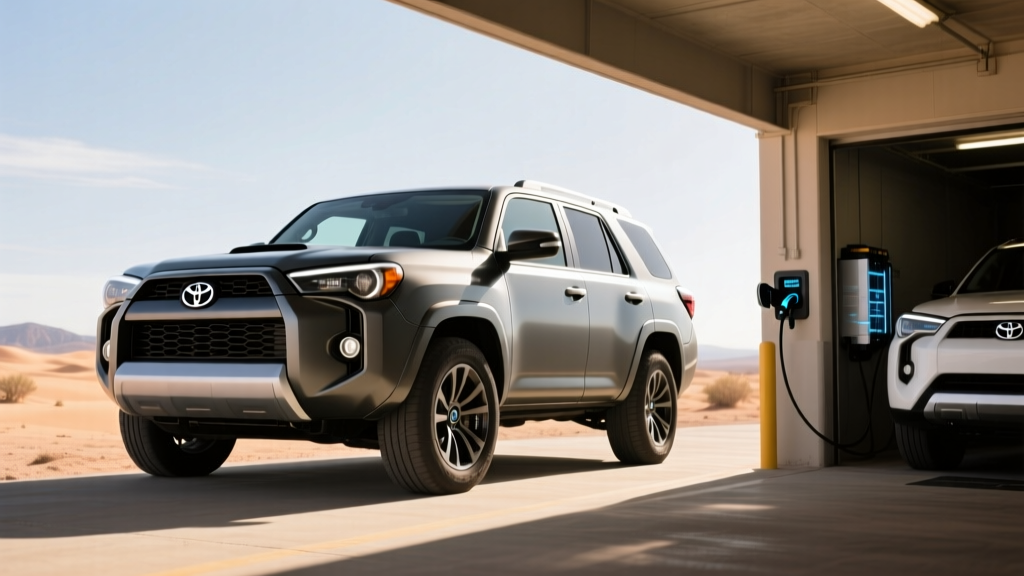
The Toyota 4Runner spent over a decade clinging to a thirsty 4.0-liter V6 while rivals went turbo, hybrid, or fully electric. For the 2025 model year, Toyota finally overhauled the 4Runner on the TNGA-F platform — and brought the turbocharged i-FORCE MAX hybrid powertrain along for the ride. That hybrid carries into the 2026 model year with the same stout output and a meaningful bump in efficiency over the outgoing generation.
If you've been searching for a hybrid 4Runner, this is the generation that delivers it. But "hybrid" in Toyota's truck lexicon means something very specific: a conventional, self-charging hybrid electric vehicle (HEV) — not a plug-in. You'll never need to find a charging station. Let's break down exactly what the 2026 hybrid 4Runner delivers in fuel economy, power, long-term reliability, and whether it's the right electrified choice for your driving life.
HEV vs. PHEV: What Kind of Hybrid Is the 4Runner?
Before we get into the numbers, it's critical to understand the distinction, because buyers often conflate the two:
Conventional Hybrid (HEV) — The 4Runner i-FORCE MAX
- No plug required. The battery recharges through regenerative braking and the gasoline engine.
- Small battery (~1.87 kWh usable) — assists the engine during acceleration and enables brief low-speed electric operation.
- No electric-only range to speak of in normal driving. You'll get short EV-mode bursts at parking-lot speeds, but the engine fires up under any real load.
- No federal EV tax credit under IRS §30D (that credit requires plug-in capability with a minimum battery capacity).
- Advantage: Simplicity — no home charger needed, no range planning, just gas up and go with better MPG than a conventional powertrain.
Plug-In Hybrid (PHEV) — Not Available on the 4Runner
- Requires plugging in to charge a larger battery (typically 12–20+ kWh).
- Delivers 25–50 miles of electric-only driving before the gas engine kicks in.
- May qualify for the federal §30D tax credit (up to $7,500) if MSRP, income, and battery-sourcing rules are met.
- Toyota offers PHEV powertrains on the RAV4 Prime and Prius Prime — but not on the 4Runner as of the 2026 model year.
The 4Runner's hybrid system is an HEV. If you want plug-in electric miles on a Toyota SUV, you'd need to look at the RAV4 Prime or wait for Toyota to potentially expand PHEV availability to the 4Runner in a future model year.
EPA Fuel Economy: 2026 Hybrid 4Runner MPG Breakdown
The i-FORCE MAX pairs a 2.4-liter turbocharged inline-four with an electric motor integrated into the transmission housing. The result is more power and better efficiency than the old V6 — a rare win-win. Here's how the EPA rates the hybrid 4Runner by drivetrain configuration, per fueleconomy.gov:
| Configuration | City MPG | Highway MPG | Combined MPG |
|---|---|---|---|
| i-FORCE MAX 4x2 (RWD) | 23 | 26 | 24 |
| i-FORCE MAX 4x4 | 23 | 25 | 24 |
| Gas-only i-FORCE 4x4 (baseline) | 19 | 25 | 21 |
The hybrid gains roughly 3 MPG combined over the gas-only turbo four-cylinder — a meaningful improvement for a body-on-frame SUV that weighs over 4,700 pounds. The city MPG benefit is particularly pronounced: the hybrid's electric motor assist shines in stop-and-go traffic where the gas-only version loses the most efficiency.
Real-World MPG: What to Actually Expect
EPA numbers are a starting point, not a guarantee. Based on real-world driving patterns common to 4Runner owners:
- City/suburban driving: Expect to meet or slightly exceed the EPA city figure. Hybrid systems recapture the most energy in stop-and-go conditions. Owners on enthusiast forums regularly report 24–26 MPG in mixed suburban driving.
- Highway cruising at 70–80 mph: Aerodynamics work against the 4Runner's boxy shape. Expect 22–24 MPG on flat interstate runs — slightly below the EPA highway rating at higher speeds.
- Towing: The 4Runner i-FORCE MAX is rated to tow up to 6,000 lbs. Hook up a travel trailer and expect fuel economy to drop to the mid-to-high teens. The hybrid system still assists under load, but physics dominate.
- Cold weather: Expect a 1–2 MPG dip in winter. Hybrid batteries are less efficient in cold temperatures, and the engine runs more frequently to provide cabin heat.
Powertrain Specs: i-FORCE MAX Hybrid Output
The hybrid 4Runner isn't just about efficiency — the i-FORCE MAX is the most powerful engine option in the lineup, outpunching the standard i-FORCE turbo four.
| Specification | i-FORCE MAX Hybrid | Gas-Only i-FORCE |
|---|---|---|
| Engine | 2.4L turbo I-4 + electric motor | 2.4L turbo I-4 |
| Combined Horsepower | 326 hp | 278 hp |
| Combined Torque | 465 lb-ft | 317 lb-ft |
| Transmission | 8-speed automatic | 8-speed automatic |
| 0–60 mph (est.) | ~5.8 sec | ~7.0 sec |
| Max Towing Capacity | 6,000 lbs | 6,000 lbs |
| Hybrid Battery | ~1.87 kWh, NiMH | N/A |
That 465 lb-ft of torque arrives low in the rev range thanks to the electric motor's instant output. The result is a 4Runner that feels significantly more responsive off the line and when merging onto highways than the gas-only version — a nearly 1.2-second advantage to 60 mph by most independent tests. For a truck-based SUV, that's a substantial difference in everyday drivability.
Pricing and Tax Credit Eligibility
The i-FORCE MAX hybrid is available across multiple 4Runner trims for 2026. Here's the approximate MSRP landscape (destination charges may add ~$1,495):
- TRD Off-Road Hybrid: ~$52,000–$54,000
- Limited Hybrid: ~$56,000–$58,000
- TRD Pro Hybrid: ~$62,000–$64,000
- Platinum Hybrid (if available): ~$58,000–$60,000
Federal Tax Credit: Does the Hybrid 4Runner Qualify?
No. The IRS §30D Clean Vehicle Credit requires a plug-in electric vehicle with a battery capacity of at least 7 kWh. The 4Runner's hybrid battery is approximately 1.87 kWh, and it cannot be plugged in. It does not qualify for the federal EV tax credit — which can offer up to $7,500 for eligible new PHEVs and BEVs that meet MSRP caps ($80,000 for SUVs), buyer income limits, and critical-mineral/battery-component sourcing requirements (per IRS.gov).
Some states offer their own incentives for conventional hybrids, though these are increasingly rare as state programs shift focus to plug-in vehicles. Check your state's energy or environmental agency website for current programs. A tax professional can advise on any applicable local credits.
Hybrid Battery Warranty and Long-Term Reliability
This is the question every hybrid buyer asks: how long will the battery last, and what does replacement cost?
Toyota Hybrid Battery Warranty
Toyota covers the 4Runner's hybrid battery with a 10-year / 150,000-mile warranty (whichever comes first), applicable in all 50 states. This is one of the longest hybrid battery warranties in the industry and has been Toyota's standard since the 2020 model year.
Real-World Hybrid Battery Longevity
Toyota's hybrid synergy drive system has been in production since the 1997 Prius. The data from millions of Toyota hybrids on the road tells a clear story:
- Most Toyota hybrid batteries last well beyond the warranty period. It's common to see Prius and Camry Hybrid batteries reaching 200,000+ miles without replacement.
- The 4Runner's NiMH battery is a proven chemistry for hybrid applications — less energy-dense than the lithium-ion packs in EVs, but extremely durable and tolerant of the frequent shallow charge/discharge cycles that define hybrid operation.
- If replacement is needed out of warranty: A new OEM hybrid battery for a Toyota truck-platform hybrid typically costs between $3,000 and $5,000 including labor. Refurbished or aftermarket options can reduce this to $1,500–$2,500. Individual module replacement (repairing only failed cells) can cost even less through specialized hybrid repair shops.
- The 4Runner's hybrid system is simpler than a PHEV or BEV — no large, expensive lithium-ion pack, no liquid cooling system for the traction battery, no high-voltage DC fast-charging hardware to maintain.
Toyota's hybrid reliability track record is among the best in the industry. The hybrid components add relatively few failure points compared to the complexity of a plug-in or fully electric powertrain.
Hybrid 4Runner vs. Full EV vs. Gas-Only: Which Fits You?
The 4Runner exists in a specific niche — body-on-frame, off-road capable, truck-based SUV. There's no direct full-electric equivalent at this price point yet (the upcoming electric trucks and SUVs from various manufacturers target different segments). But the decision framework still matters:
Choose the Hybrid 4Runner If:
- You need genuine off-road capability, 6,000-lb towing, and truck durability
- You don't have reliable access to home or workplace EV charging
- You want better fuel economy than a gas-only SUV without changing your refueling habits
- You take frequent road trips to areas with sparse charging infrastructure
- You want maximum power (326 hp / 465 lb-ft) in the 4Runner lineup
- You plan to keep the vehicle 10+ years and value Toyota's hybrid reliability record
Consider a Full EV Instead If:
- Your daily driving is under 250 miles and you can charge at home
- You want the lowest per-mile "fuel" cost (home electricity vs. gasoline)
- You want to qualify for the $7,500 federal tax credit (on eligible models)
- You don't need body-on-frame towing or serious off-road capability
- You prioritize instant torque, quiet operation, and zero tailpipe emissions
For many 4Runner buyers, the hybrid is the sweet spot. You get a real MPG improvement, substantially more power, and you never need to think about charging infrastructure. The trade-off is that you're still burning gasoline and paying gas prices — but at 24 MPG combined instead of 21, you're burning roughly 14% less fuel over the life of the vehicle.
Frequently Asked Questions
How many MPG does the hybrid 4Runner get?
The 2026 Toyota 4Runner i-FORCE MAX hybrid is EPA-rated at 23 city / 25–26 highway / 24 combined MPG depending on 4x2 or 4x4 configuration. Real-world mixed driving typically yields 23–26 MPG, with city driving often exceeding the EPA estimate thanks to regenerative braking. Highway driving at sustained high speeds may return slightly less than the EPA highway figure due to the 4Runner's boxy aerodynamics.
Can the hybrid 4Runner drive on electric power only?
Only briefly and at very low speeds. The i-FORCE MAX is a conventional hybrid (HEV), not a plug-in. It has an EV mode button that can sustain electric-only driving for roughly a mile or less at parking-lot speeds under light load. For any meaningful acceleration or highway driving, the gasoline engine engages. If you want substantial electric-only range, you'd need a PHEV like the Toyota RAV4 Prime (42 miles EV range) — which isn't available in the 4Runner lineup.
Does the hybrid 4Runner qualify for any tax credit?
The 4Runner hybrid does not qualify for the federal IRS §30D Clean Vehicle Credit, which requires plug-in capability and a minimum 7 kWh battery. The 4Runner's ~1.87 kWh NiMH battery and HEV configuration make it ineligible. Some states may offer minor hybrid incentives, but most state programs have shifted to plug-in vehicles. Consult your state's energy office or a tax professional for current local programs.
How long will the hybrid 4Runner battery last and what does replacement cost?
Toyota covers the hybrid battery for 10 years or 150,000 miles. Based on Toyota's extensive history with hybrid systems (over 25 years of production), most hybrid batteries last well beyond the warranty period, with many reaching 200,000+ miles. If replacement is needed out of warranty, expect to pay $3,000–$5,000 for a new OEM battery pack with labor, or $1,500–$2,500 for a refurbished unit. Module-level repair can cost less.
Is the hybrid 4Runner more reliable than the gas-only version?
Toyota's hybrid powertrains have demonstrated exceptional reliability across millions of vehicles. The i-FORCE MAX's 2.4-liter turbo engine is shared with the gas-only 4Runner and the broader Toyota truck lineup. The hybrid system adds an electric motor and a small NiMH battery — components with proven longevity and minimal maintenance needs. The hybrid actually eliminates the traditional starter motor and alternator (the motor-generator handles those functions), potentially reducing long-term service items. Based on Toyota's track record, the hybrid 4Runner should be at least as reliable as the gas version, with the added benefit of reduced brake wear from regenerative braking.
Is the hybrid 4Runner worth the price premium?
The i-FORCE MAX hybrid typically commands a $2,000–$4,000 premium over the equivalent gas-only trim. You gain 48 additional horsepower, 148 additional lb-ft of torque, roughly 3 MPG combined improvement, and a more responsive driving experience. At 15,000 miles per year and $3.50/gallon gas, the fuel savings alone are modest — around $150–$200 annually. The real value proposition is the power increase and the improved drivability, with the MPG gain as a bonus. If you plan to keep the 4Runner for 10+ years, the hybrid's proven reliability and stronger resale value for electrified Toyotas make the premium worthwhile for most buyers.