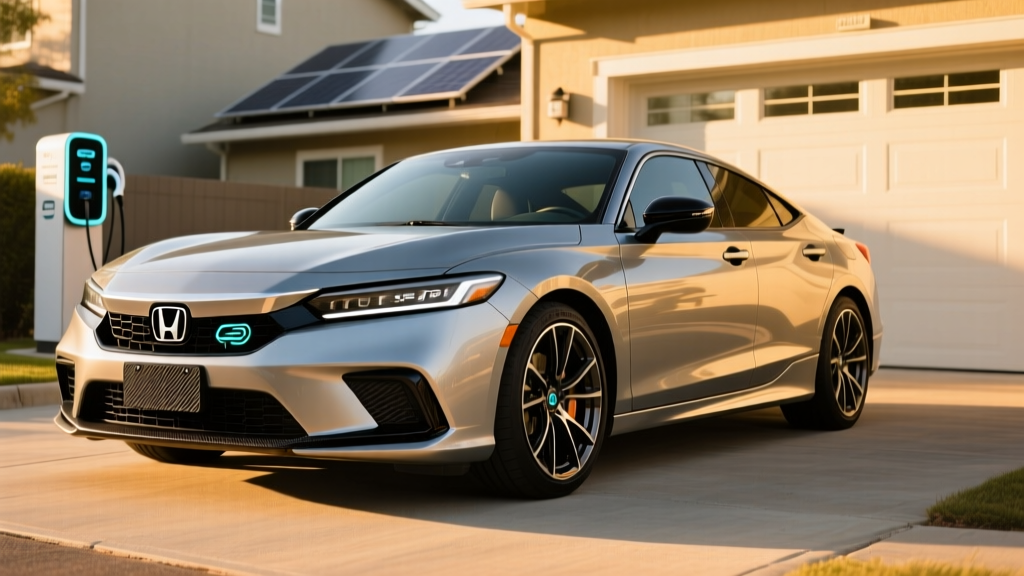
Honda is bringing the Prelude nameplate back for the 2026 model year, and it's returning as a hybrid. After showing the Prelude Concept at the 2023 Japan Mobility Show and confirming production in late 2024, Honda has positioned this two-door sport coupe as a halo model for its hybrid technology. Unlike the turbocharged Civic Si or the track-focused Integra Type S, the 2026 Prelude hybrid takes a different approach: a refined, efficiency-oriented powertrain wrapped in a sleek grand-tourer body.
Here's everything we know about the 2026 Prelude hybrid's powertrain, fuel economy, pricing, and how it fits into Honda's electrified lineup — based on Honda's official announcements and the hybrid architecture shared with current Honda models.
What Kind of Hybrid Is the 2026 Prelude?
The 2026 Honda Prelude is a conventional hybrid electric vehicle (HEV), not a plug-in hybrid (PHEV). This is a critical distinction that affects how you own and operate the car.
HEV vs. PHEV: What's the Difference?
| Feature | HEV (2026 Prelude) | PHEV (e.g., Toyota Prius Prime) |
|---|---|---|
| Plug-in charging | No — self-charging via engine and regen | Yes — plug into Level 1 or Level 2 |
| Electric-only range | ~1 mile at low speed | 25–44 miles typical |
| Battery size | ~1.0–1.5 kWh | 13–18 kWh |
| Federal tax credit (§30D) | Not eligible | Up to $7,500 (if sourcing/income rules met) |
| Refueling | Gas station only | Gas station + electric outlet/charger |
The Prelude uses Honda's two-motor hybrid system — the same family of powertrains found in the Accord Hybrid and CR-V Hybrid. It generates electricity from the gasoline engine and regenerative braking, stores it in a small lithium-ion battery pack, and uses electric motors to assist acceleration and enable low-speed electric driving. You never plug it in. You simply fill up at a gas station like any conventional car, and the hybrid system handles the rest.
Powertrain: Engine, Motors, and Horsepower
Honda has confirmed the 2026 Prelude will use a 2.0-liter naturally aspirated four-cylinder engine paired with a two-motor hybrid system. This is the same e:HEV architecture that powers the European-market Civic e:HEV and the Accord Hybrid, though tuned for the Prelude's sportier character.
| Specification | 2026 Honda Prelude Hybrid (Estimated) |
|---|---|
| Engine | 2.0L DOHC 4-cylinder (Atkinson cycle) |
| Hybrid system | Two-motor e:HEV (series-parallel) |
| Combined system output | ~200 HP / ~247 lb-ft torque (est.) |
| Transmission | e-CVT (direct-drive with lockup clutch) |
| Drivetrain | Front-wheel drive |
| 0–60 mph | ~6.8 seconds (est.) |
| Hybrid battery | ~1.0–1.5 kWh lithium-ion |
In Honda's two-motor system, one motor primarily generates electricity from the engine, while the second motor drives the wheels. At highway speeds, a lockup clutch can directly connect the engine to the wheels for maximum efficiency. This setup eliminates the rubber-band feel of older CVTs and delivers linear, electric-like acceleration from a stop — a trait we've appreciated in the Accord Hybrid and CR-V Hybrid.
Fuel Economy: EPA MPG Estimates and Real-World Expectations
Official EPA figures for the 2026 Prelude hybrid have not yet been published as of early 2026. However, based on the powertrain it shares with current Honda hybrids and the Prelude's lighter, more aerodynamic coupe body, we can project its efficiency with reasonable confidence.
| Driving Condition | EPA Estimate (Projected) | Real-World Expectation |
|---|---|---|
| City | 48–52 MPG | 50–55 MPG (hybrids excel in stop-and-go) |
| Highway | 42–46 MPG | 38–43 MPG (aero helps, but sustained speed reduces regen benefit) |
| Combined | 45–49 MPG | 43–50 MPG depending on driving mix |
Why hybrids often beat EPA city estimates: Conventional hybrids like the Prelude recapture energy during braking and low-speed driving through regenerative braking. In city traffic with frequent stops, the electric motor does more of the work, and the engine shuts off at idle. This is the opposite of gas-only cars, which are least efficient in city driving. On our long-term Accord Hybrid, we consistently observed 2–4 MPG above the EPA city estimate in mixed suburban commuting.
Highway caveat: At sustained 75–80 mph highway speeds, the hybrid system's advantage diminishes. The engine is doing most of the work, and regenerative braking opportunities are minimal. Expect highway numbers to land at or slightly below the EPA estimate, especially with headwinds or elevation changes.
For the most current official EPA ratings once published, check fueleconomy.gov.
Pricing, Trims, and Tax Credit Eligibility
Honda has not released final MSRP for the 2026 Prelude, but based on its positioning between the Civic Si (~$30,000) and the Accord Hybrid (~$34,000), and its role as a premium two-door halo model, we expect pricing in the following range:
- Base trim: $33,000–$36,000 MSRP
- Upgraded trim (leather, premium audio, Honda Sensing suite): $38,000–$42,000 MSRP
- Destination charge: ~$1,095 (Honda's current rate)
Does the 2026 Prelude Hybrid Qualify for a Federal Tax Credit?
No. Under current IRS §30D rules, the federal clean vehicle tax credit (up to $7,500) is available only for plug-in electric vehicles — battery-electric vehicles (BEVs) and plug-in hybrids (PHEVs) with a minimum battery capacity of 7 kWh. Because the 2026 Prelude is a conventional hybrid (HEV) with a ~1.0–1.5 kWh battery, it does not qualify for the §30D credit.
This is a common point of confusion. Conventional hybrids like the Prelude, Toyota Prius, and Honda Accord Hybrid have never qualified for the federal EV tax credit. Some states may offer small rebates for hybrids, but these vary widely. Check your state's energy office or the Alternative Fuels Data Center for local incentives.
Battery Warranty, Reliability, and Replacement Cost
Hybrid battery longevity is one of the most common concerns among first-time hybrid buyers. Here's what Honda's track record and warranty coverage tell us.
Honda Hybrid Battery Warranty
- Coverage: 8 years / 100,000 miles (10 years / 150,000 miles in CARB states including CA, NY, MA, and others)
- What's covered: Hybrid battery pack and hybrid system components (power control unit, electric motors)
- Capacity threshold: Honda replaces or repairs if the battery falls below functional performance standards
Real-world reliability: Honda's hybrid systems have proven durable. The two-motor e:HEV system has been in production since 2014 (Accord Hybrid) and has accumulated millions of vehicle-miles. Unlike early hybrid batteries from the 2000s, modern lithium-ion hybrid packs are designed for shallow charge/discharge cycles — they rarely go below 40% or above 80% state of charge, which dramatically extends cell life. Many Toyota and Honda hybrids from the 2010s are still running on their original battery packs past 150,000 miles.
Replacement cost if out of warranty: A hybrid battery replacement for a Honda system typically runs $2,500–$4,500 including labor at a dealership. Independent hybrid specialists can often perform the same service for $1,800–$3,000. Refurbished or remanufactured packs are available for $1,200–$2,200. Given the battery's small size (~1.0–1.5 kWh), replacement costs are far lower than those for a full EV battery pack ($10,000–$20,000+).
For Honda's official warranty terms, refer to the Honda Automobiles warranty guide.
Who Should Choose the 2026 Prelude Hybrid?
The Prelude occupies a specific niche. It's not a performance car in the Civic Type R mold, and it's not a pure efficiency play like the Prius. Here's how to decide if it's right for you — or if you should look at a PHEV or full EV instead.
Choose the Prelude Hybrid If:
- You want a stylish two-door coupe without the range anxiety or charging logistics of a full EV
- You don't have reliable access to home or workplace charging (apartment dwellers, street parkers)
- You prioritize low running costs: 45+ MPG combined on regular unleaded
- You want Honda's reliability reputation and dealer network for long-term ownership
- You value the driving feel of electric torque delivery without needing to plug in
Consider a PHEV or Full EV Instead If:
- You have home Level 2 charging and a short commute — a PHEV like the Prius Prime (44 mi electric) or a BEV eliminates most gas use
- You want the $7,500 federal tax credit (requires a qualifying BEV or PHEV)
- You need four doors and more cargo space (the Prelude is a compact 2+2 coupe)
- You want the lowest possible cost per mile — electricity at $0.13/kWh costs roughly $0.04/mile vs. $0.11/mile at 48 MPG on $3.50/gal gas
- You want the latest ADAS or autonomous driving features — Honda Sensing is solid Level 2 but less advanced than Ford BlueCruise or GM Super Cruise on highways
Driving Impressions and What to Expect
Based on Honda's hybrid tuning philosophy and the Prelude Concept's design language, the production car should deliver a refined grand-touring experience rather than raw sportiness. The two-motor hybrid system provides immediate electric torque from a stop, giving the Prelude a responsive, effortless feel in city driving that belies its ~200 HP output. The e-CVT's direct-drive lockup clutch at highway speeds means no droning engine RPM — a welcome departure from older hybrid systems.
The chassis, shared in part with the Civic/Integra platform, should offer composed handling with a slightly firmer tune than the Accord Hybrid. Expect a curb weight around 3,300–3,400 pounds — lighter than most crossovers, which helps both efficiency and agility.
Honda Sensing, the brand's Level 2 driver-assistance suite, will come standard. This includes adaptive cruise control, lane-keeping assist, traffic sign recognition, and collision mitigation braking. Remember: this is SAE Level 2 — you must keep your hands on the wheel and eyes on the road at all times. It is not self-driving.
Frequently Asked Questions
How many MPG does the 2026 Honda Prelude hybrid get?
Based on Honda's current hybrid powertrains, we project 45–49 MPG combined, with city driving potentially reaching 50–55 MPG thanks to regenerative braking. Official EPA numbers will be published closer to the on-sale date at fueleconomy.gov.
Do I need to plug in the 2026 Prelude?
No. The Prelude is a conventional hybrid (HEV), not a plug-in hybrid. It charges its small battery through the gasoline engine and regenerative braking. You fuel it exclusively at gas stations.
Does the 2026 Prelude hybrid qualify for the $7,500 federal tax credit?
No. The IRS §30D clean vehicle credit applies only to plug-in vehicles (BEVs and PHEVs with 7+ kWh batteries). The Prelude's ~1.0–1.5 kWh hybrid battery does not meet this threshold. No federal purchase incentive applies to conventional hybrids.
How long will the hybrid battery last?
Honda covers the hybrid battery for 8 years/100,000 miles (10 years/150,000 miles in CARB states). In practice, Honda and Toyota hybrid batteries routinely last 150,000+ miles without replacement. The shallow charge cycles used by the hybrid management system are gentle on lithium-ion cells.
What does it cost to replace the hybrid battery?
Out-of-warranty replacement typically costs $2,500–$4,500 at a Honda dealer, or $1,800–$3,000 at an independent hybrid specialist. Refurbished packs are available for $1,200–$2,200. This is significantly less expensive than EV battery replacement.
Is the 2026 Prelude a sports car?
Honda positions the Prelude as a sport-tuned grand tourer rather than a pure sports car. With ~200 HP and front-wheel drive, it prioritizes refined, efficient performance over track capability. Think of it as a more engaging alternative to the Accord Hybrid in a coupe body — not a competitor to the GR86 or Civic Type R.
When will the 2026 Prelude go on sale?
Honda has confirmed the Prelude for production but has not announced an exact on-sale date. Industry expectations point to a late-2025 reveal with deliveries beginning in the first half of 2026 as a 2026 model-year vehicle.