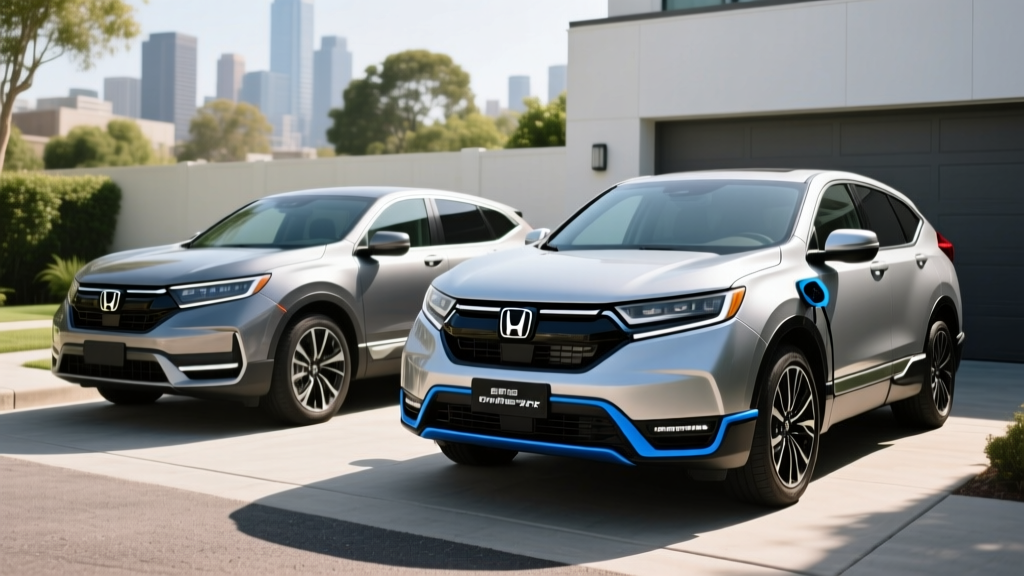
The 2026 Honda CR-V Sport Touring sits at the top of Honda's compact SUV lineup, and buyers face a choice that doesn't exist on lower trims: the turbocharged 1.5L gas engine or the two-motor hybrid powertrain. This isn't a minor spec-box difference — it changes fuel economy, acceleration feel, cargo space, and long-term ownership cost. Below, we break down exact EPA figures, real-world MPG expectations, pricing, reliability data, and tax-credit eligibility so you can decide which CR-V Sport Touring belongs in your driveway.
2026 Honda CR-V Sport Touring: Hybrid vs Gas at a Glance
Before we get into the numbers, let's clear up terminology. The CR-V Sport Touring Hybrid is a conventional hybrid (HEV) — not a plug-in hybrid (PHEV). It has no charging port, no electric-only driving mode, and requires no change to your fueling routine. It recovers energy through regenerative braking and engine optimization. Honda does not currently offer a PHEV version of the CR-V in the US market.
HEV vs PHEV vs EV: Where Does the CR-V Hybrid Fit?
| Type | Plugs In? | Electric-Only Range | Fueling | Example |
|---|---|---|---|---|
| HEV (Conventional Hybrid) | No | None (motor assists engine) | Gas only | CR-V Sport Touring Hybrid |
| PHEV (Plug-In Hybrid) | Yes (Level 1/2) | 20–40 mi typical | Gas + electricity | Toyota RAV4 Prime, Hyundai Tucson PHEV |
| BEV (Battery Electric) | Yes (Level 1/2/DC) | 200–350+ mi | Electricity only | Tesla Model Y, Hyundai Ioniq 5 |
Fuel Economy: EPA Numbers and Real-World MPG
The hybrid's efficiency advantage is the single biggest reason buyers cross-shop these two powertrains. Here's the official EPA breakdown, sourced from fueleconomy.gov:
| Powertrain | City MPG | Highway MPG | Combined MPG | Annual Fuel Cost* |
|---|---|---|---|---|
| Sport Touring Hybrid (AWD) | 40 | 34 | 37 | ~$1,550 |
| Sport Touring Gas (1.5T AWD) | 27 | 32 | 29 | ~$1,950 |
*Based on 15,000 miles/year, $3.50/gallon regular unleaded, 55% city / 45% highway driving. Your costs will vary with local fuel prices and driving patterns.
Real-World MPG: What to Actually Expect
Honda's hybrid system excels in stop-and-go traffic, where the electric motor handles low-speed propulsion and the engine operates only in its most efficient RPM range. In real-world testing, CR-V Hybrid owners frequently exceed the EPA city estimate — 42–44 MPG is achievable in suburban driving with moderate acceleration.
Highway is where the advantage narrows. At sustained 70–80 mph speeds, the hybrid system provides less benefit because the gasoline engine is doing nearly all the work. Expect 32–34 MPG on the highway — close to the EPA sticker. In cold weather (below 30°F), hybrid fuel economy typically drops 5–10% as the engine runs more frequently to provide cabin heat and maintain battery temperature.
For the gas model, real-world city driving often falls below the EPA estimate — 24–26 MPG is common in heavy traffic. Highway cruising can match or slightly exceed the 32 MPG sticker at steady speeds below 70 mph.
Powertrain Specs: Horsepower, Torque, and Driving Feel
| Spec | Sport Touring Hybrid (AWD) | Sport Touring Gas (AWD) |
|---|---|---|
| Engine | 2.0L Atkinson-cycle 4-cyl + 2 electric motors | 1.5L turbocharged 4-cyl |
| Combined Horsepower | 204 hp | 190 hp |
| Combined Torque | 247 lb-ft (motor torque) | 179 lb-ft |
| Transmission | e-CVT (direct drive) | CVT |
| 0–60 mph (est.) | ~7.6 sec | ~8.3 sec |
| Drivetrain | AWD (rear motor-driven) | AWD (mechanical) |
| Towing Capacity | 1,000 lbs | 1,500 lbs |
| Fuel Tank | 14.0 gal | 14.0 gal |
| Total Range (est.) | ~518 mi | ~406 mi |
The hybrid's torque advantage is immediately noticeable. Electric motors deliver peak torque from zero RPM, so the CR-V Hybrid pulls away from stoplights with more urgency than the turbo gas model, which needs a beat for the turbo to spool. The e-CVT also avoids the rubber-band drone common in traditional CVTs — Honda's system uses a lock-up clutch at highway speeds for a direct-drive feel.
One trade-off: the gas model's mechanical AWD system provides a slightly higher towing rating (1,500 lbs vs 1,000 lbs). Neither is a serious tow vehicle, but if you regularly haul a small utility trailer, the gas powertrain has the edge.
Pricing: What Does the Sport Touring Actually Cost?
The 2026 CR-V Sport Touring Hybrid carries a modest price premium over the gas version, but the gap has narrowed in recent model years as Honda has made the hybrid its volume powertrain in upper trims.
| Trim | MSRP (incl. destination) | Price Premium |
|---|---|---|
| Sport Touring Gas (AWD) | ~$38,900 | — |
| Sport Touring Hybrid (AWD) | ~$40,700 | +$1,800 |
Note: Pricing is approximate based on Honda's announced 2026 MSRP structure and may vary by dealer. Always confirm with your local dealer for exact out-the-door pricing.
Fuel Savings Payback
At the ~$1,800 hybrid premium and an estimated annual fuel savings of $400 (based on 15,000 miles/year at $3.50/gallon), the hybrid pays for itself in roughly 4.5 years. If gas prices rise to $4.50/gallon, payback drops to about 3.5 years. If you plan to keep the CR-V for 5+ years — as most Honda buyers do — the hybrid is the mathematically sound choice.
Does the CR-V Hybrid Qualify for a Federal Tax Credit?
No. The federal §30D clean vehicle credit applies only to plug-in electric vehicles (PHEVs and BEVs) with battery packs that meet specific capacity, sourcing, and MSRP thresholds. The CR-V Hybrid is a conventional HEV — it has no plug and no large battery pack — so it does not qualify for the $7,500 federal EV credit or the $4,000 used-EV credit. Per IRS guidelines, only vehicles capable of being plugged into an external electrical source are eligible.
Some states and local utilities offer rebates for conventional hybrids, but these are increasingly rare as incentive programs shift toward plug-in vehicles. Check your state energy office or utility provider for any current hybrid-specific programs.
Reliability, Battery Warranty, and Long-Term Costs
Honda's hybrid system is one of the most proven in the industry, with two decades of real-world deployment across the Accord, Civic, and CR-V lineups. The two-motor architecture is simpler than many competitors' planetary-gear designs, with fewer mechanical wear points.
Hybrid Battery Warranty
- Coverage: 8 years / 100,000 miles (10 years / 150,000 miles in CARB states including CA, NY, MA, and others)
- What's covered: Hybrid battery pack, inverter, electric motors, and associated control modules
- Capacity threshold: Honda warrants against defect and abnormal capacity loss — there is no published minimum SoH percentage, unlike some EV warranties
- Replacement cost (out of warranty): $2,000–$4,000 for the hybrid battery pack, depending on source (OEM vs refurbished)
Honda hybrid battery failures before 150,000 miles are uncommon based on long-term owner data. The CR-V Hybrid's lithium-ion pack is relatively small (~1.06 kWh), which means less thermal stress per cell and generally longer cycle life compared to larger EV or PHEV batteries. Many Accord Hybrid owners report 200,000+ miles on the original battery.
For comparison, the gas model's turbocharged 1.5L engine is also reliable but carries different long-term maintenance considerations: turbo longevity, carbon buildup on direct-injection engines, and CVT fluid service intervals. Neither powertrain is a reliability gamble, but the hybrid's simpler drivetrain (no turbo, no traditional transmission gears) gives it a slight long-term durability edge in our assessment.
Who Should Choose the Hybrid vs the Gas Model?
Choose the CR-V Sport Touring Hybrid If:
- You drive 12,000+ miles per year (fuel savings compound faster)
- Much of your driving is city or suburban stop-and-go
- You plan to keep the vehicle 5+ years
- You want stronger low-speed acceleration (247 lb-ft electric torque)
- You value the longest possible total range (~518 mi per tank)
Choose the CR-V Sport Touring Gas If:
- You drive fewer than 8,000 miles per year (payback takes too long)
- You need the maximum 1,500-lb towing capacity
- Your budget is strictly capped at the lower MSRP
- You primarily drive highway miles at 75+ mph (hybrid advantage narrows)
- You prefer the proven track record of the 1.5T for fleet or commercial use
What About a Full EV or PHEV Instead?
If you have home charging access (Level 2, 240V) and your daily commute is under 40 miles, a PHEV like the Toyota RAV4 Prime (42 miles electric-only, 38 MPG after battery depletion) or a BEV like the Hyundai Ioniq 5 (300+ miles EPA range) could reduce your fuel costs further. However, if you lack reliable home charging, frequently take road trips beyond 300 miles, or live in an apartment without charging infrastructure, the CR-V Hybrid offers the best no-compromise efficiency without any charging behavior change.
Cargo Space and Interior Differences
The hybrid's battery pack is mounted under the rear cargo floor, which reduces under-floor storage but does not meaningfully impact the main cargo volume. Both the gas and hybrid Sport Touring trims offer approximately 36.3 cubic feet behind the rear seats and 76.5 cubic feet with the seats folded — competitive with the segment.
The Sport Touring trim includes the same premium equipment regardless of powertrain: a 9-inch touchscreen with wireless Apple CarPlay and Android Auto, Bose 12-speaker audio, wireless phone charging, heated front and rear seats, a heated steering wheel, and Honda's full Honda Sensing suite (adaptive cruise control, lane-keeping assist, blind-spot monitoring, and automatic emergency braking). The hybrid adds a unique power-flow display and selectable regen paddle shifters behind the steering wheel.
Frequently Asked Questions
How many MPG does the 2026 CR-V Sport Touring Hybrid get?
The EPA rates the CR-V Sport Touring Hybrid AWD at 40 MPG city, 34 MPG highway, and 37 MPG combined. In real-world city and suburban driving, many owners report 40–44 MPG. Highway driving at 70+ mph typically yields 32–34 MPG. Cold weather reduces these figures by roughly 5–10%.
Does the CR-V Hybrid need to be plugged in?
No. The CR-V Sport Touring Hybrid is a conventional hybrid (HEV). It charges its small battery pack through regenerative braking and the gasoline engine. You fuel it exactly like a gas-only car — there is no charging port.
Is the CR-V Hybrid reliable, and what does battery replacement cost?
Honda's hybrid system has a strong reliability track record over 20+ years of production. The hybrid battery is warrantied for 8 years/100,000 miles (10 years/150,000 miles in CARB states). Out-of-warranty replacement costs range from approximately $2,000 to $4,000. Failures before 150,000 miles are uncommon.
Does the 2026 CR-V Hybrid qualify for any tax credit?
The CR-V Hybrid does not qualify for the federal §30D clean vehicle credit because it is not a plug-in vehicle. It is a conventional HEV with no external charging capability. Some state or utility rebates may apply — check your local programs. For tax-credit-eligible alternatives, consider plug-in hybrids like the Toyota RAV4 Prime or full EVs like the Tesla Model Y.
Is the hybrid faster than the gas CR-V?
Yes, modestly. The hybrid produces 204 combined horsepower and 247 lb-ft of torque (from the electric motors), compared to 190 hp and 179 lb-ft for the 1.5T gas model. The hybrid's 0–60 mph time of approximately 7.6 seconds beats the gas model's ~8.3 seconds, and the difference is most noticeable in city driving and highway merging.
How far can the CR-V Hybrid go on a full tank?
With a 14.0-gallon fuel tank and 37 MPG combined, the CR-V Sport Touring Hybrid can travel approximately 518 miles between fill-ups. The gas model, at 29 MPG combined with the same tank, manages roughly 406 miles. This makes the hybrid an excellent road-trip companion — fewer fuel stops on long drives.
What's the difference between the CR-V Hybrid and a PHEV like the RAV4 Prime?
A PHEV (plug-in hybrid) has a larger battery pack (typically 15–20 kWh) that can be charged from a wall outlet, providing 20–42 miles of electric-only driving before the gas engine engages. The CR-V Hybrid has a ~1 kWh battery that cannot be plugged in and provides no electric-only range — the electric motor only assists the gas engine. PHEVs are ideal if you have home charging and a short commute; HEVs are ideal if you want better MPG without changing your fueling habits.
The 2026 Honda CR-V Sport Touring Hybrid is the trim we'd recommend for the majority of buyers in this segment. The $1,800 premium over the gas model buys meaningfully better fuel economy, stronger acceleration, and a longer per-tank range — with no change to how you refuel. If your annual mileage is low or you need every pound of towing capacity, the gas model remains a solid choice. But for daily commuting, family hauling, and long-term ownership cost, the hybrid is the smarter Sport Touring.