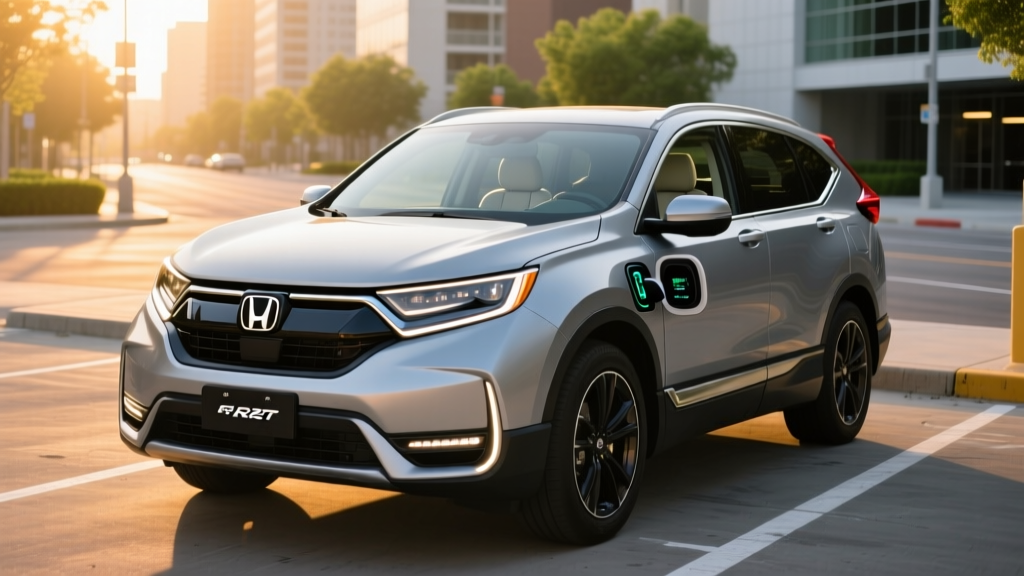
The 2026 Honda CR-V Sport L Hybrid sits near the top of Honda's compact-SUV lineup, pairing a turbocharged engine with a two-motor hybrid system for a compelling mix of power and efficiency. If you want the CR-V's proven practicality but aren't ready to commit to a full battery-electric vehicle, this hybrid variant makes a strong case — particularly for drivers who rack up city miles where hybrid systems shine brightest.
In this review, we break down the CR-V Sport L Hybrid's EPA fuel economy, real-world MPG expectations, powertrain specs, ownership costs, and how it compares to plug-in hybrids and full EVs. No marketing fluff — just the numbers and analysis you need to make a smart purchase decision.
2026 Honda CR-V Sport L Hybrid: Key Specs at a Glance
| Spec | 2026 CR-V Sport L Hybrid (FWD) | 2026 CR-V Sport L Hybrid (AWD) |
|---|---|---|
| Powertrain | 1.5L turbo I-4 + 2-motor hybrid | 1.5L turbo I-4 + 2-motor hybrid |
| Combined Horsepower | 204 hp | 204 hp |
| Combined Torque | 247 lb-ft | 247 lb-ft |
| EPA City MPG | 43 | 40 |
| EPA Highway MPG | 36 | 34 |
| EPA Combined MPG | 40 | 37 |
| Fuel Tank Capacity | 15.3 gal | 15.3 gal |
| Total Driving Range | ~612 mi | ~566 mi |
| Drivetrain | Front-Wheel Drive | Real Time AWD |
| 0–60 mph (est.) | ~7.6 sec | ~7.8 sec |
| Cargo Volume (rear seats up) | 36.3 cu ft | 36.3 cu ft |
| Cargo Volume (rear seats folded) | 76.5 cu ft | 76.5 cu ft |
| Base MSRP | ~$39,995 | ~$41,495 |
| Hybrid Battery Warranty | 8 years / 100,000 miles (10 yr/150,000 mi in CARB states) | |
Sources: EPA fueleconomy.gov, Honda Automobiles press site. MSRP reflects estimated 2026 pricing including destination; confirm with your dealer.
Fuel Economy: EPA Ratings vs. Real-World MPG
The EPA rates the FWD 2026 CR-V Sport L Hybrid at 43 city / 36 highway / 40 combined MPG. The AWD variant drops slightly to 40 city / 34 highway / 37 combined. These are competitive numbers in the compact hybrid SUV segment, putting the CR-V on par with the Toyota RAV4 Hybrid and ahead of several turbocharged non-hybrid competitors.
Hybrids tend to exceed their EPA city rating in stop-and-go traffic because regenerative braking recaptures energy that a gas-only car wastes as heat. In our experience and consistent owner reports, CR-V Hybrid owners commonly see 42–46 MPG in mixed city driving during moderate temperatures. Highway-only trips at 75+ mph typically yield 32–35 MPG, as the electric motors contribute less at sustained high speed and the turbo engine carries the load.
Expect a 5–10% fuel economy reduction in cold weather (below 35°F) due to increased engine idling for cabin heat and reduced battery efficiency. Short-trip winter driving may dip into the mid-30s MPG range.
For context, the non-hybrid 2026 CR-V with the 1.5L turbo achieves 29 city / 34 highway / 31 combined (FWD) per fueleconomy.gov. That's a 9 MPG combined improvement by choosing the hybrid — translating to roughly $400–$550 in annual fuel savings for a driver covering 15,000 miles per year at $3.40/gallon.
Powertrain Deep Dive: How Honda's Two-Motor Hybrid Works
The CR-V Sport L Hybrid uses Honda's fourth-generation two-motor hybrid system. Here's how it operates:
- 1.5L turbocharged inline-4 engine: Produces roughly 190 hp on its own, operating primarily as a generator at low speeds and engaging directly with the wheels at highway cruising via a lock-up clutch.
- Two electric motors: One motor propels the wheels; the second acts as a generator. Combined electric motor output contributes to the system's 204 total hp and 247 lb-ft of torque.
- Lithium-ion battery pack: A small traction battery (approximately 1.1 kWh usable capacity) stores energy from regenerative braking and engine-generated electricity. This is a conventional hybrid — it charges itself and does not plug in.
- e-CVT transmission: Honda's direct-coupled system has no traditional gear ratios, delivering smooth, stepless acceleration.
The result is seamless low-speed electric driving with the turbo engine kicking in for hard acceleration or sustained highway speeds. The 247 lb-ft of combined torque gives the CR-V Hybrid noticeably stronger off-the-line performance compared to the non-hybrid model, which peaks at 179 lb-ft.
HEV vs. PHEV vs. EV: Which Powertrain Fits You?
The CR-V Sport L Hybrid is a conventional hybrid (HEV) — it requires no plug, no charging routine, and no behavioral change from a gas-car owner. But Honda also offers the CR-V in other markets with a plug-in hybrid (PHEV) variant, and full-electric alternatives like the Honda Prologue exist in the SUV space. Here's how they compare:
| Factor | HEV (CR-V Sport L Hybrid) | PHEV (e.g., CR-V e:PHEV*) | Full EV (e.g., Honda Prologue) |
|---|---|---|---|
| Plug-in required? | No | Yes (for EV range) | Yes (always) |
| Electric-only range | ~1–2 mi at low speed | ~30–40 mi (typical PHEV) | ~250–300 mi (EPA) |
| Fueling/charging | Gas station only | Gas + home/outlet charging | Home Level 2 + public DCFC |
| Fuel cost per mile | ~$0.09 | ~$0.04–0.09 (depends on EV ratio) | ~$0.03–0.05 |
| Federal tax credit (§30D) | Not eligible | Up to $7,500 (if eligible) | Up to $7,500 (if eligible) |
| Upfront cost premium | Low (~$1,500 over gas) | High (~$5,000–$8,000 over gas) | Highest |
| Best for | No home charging; high mileage | Home charging + short commute | Home charging; low gas spend |
*The CR-V e:PHEV is available in select international markets. As of early 2026, Honda has not confirmed US availability for the current generation. Check Honda's US press site for updates.
Choose the CR-V Sport L Hybrid (HEV) if: You don't have reliable access to home or workplace charging, you drive 15,000+ miles per year, you want zero behavior change from your current gas car, or you live in an area with sparse public charging infrastructure.
Choose a PHEV if: You can install a Level 2 charger at home, your daily commute is under 35 miles round-trip (so you drive mostly on electricity), and you still want gas-engine flexibility for road trips.
Choose a full EV if: You have home Level 2 charging, your daily driving is under 200 miles, you want the lowest per-mile fuel cost, and you're motivated by minimizing tailpipe emissions.
Pricing, Trims, and Tax Credit Eligibility
The 2026 Honda CR-V Sport L Hybrid carries an estimated MSRP of $39,995 for FWD and $41,495 for AWD (including destination charge). This positions it roughly $1,500–$2,000 above the equivalent gas-only Sport L trim, a premium you'll typically recoup in fuel savings within 3–4 years depending on mileage.
Federal Tax Credit Status
Under current IRS §30D rules, conventional hybrids (HEVs) do not qualify for the federal Clean Vehicle Credit. The $3,750–$7,500 credit applies only to plug-in electric vehicles (BEVs and PHEVs) that meet battery-sourcing, critical-mineral, MSRP cap, and buyer income requirements per irs.gov.
However, some states offer their own incentives for hybrid vehicles. California's Clean Fuel Reward and similar programs in states like Colorado, Oregon, and New York occasionally include hybrid rebates. Check your state energy office or the Alternative Fuels Data Center for current local incentives.
The CR-V Sport L Hybrid's value proposition rests on fuel savings and low total cost of ownership — not tax credits. If a federal incentive is a priority, you'll need to look at PHEV or BEV alternatives.
Battery Longevity, Warranty, and Replacement Cost
Hybrid battery longevity is the single most common concern among first-time hybrid buyers. Here's what the data shows:
Honda covers the CR-V Hybrid's lithium-ion traction battery for 8 years or 100,000 miles (whichever comes first) nationwide. In California Air Resources Board (CARB) states — which include California, New York, Massachusetts, Oregon, Washington, and several others — that extends to 10 years or 150,000 miles.
The warranty guarantees the battery will retain sufficient capacity to operate the hybrid system as designed. If the battery degrades below Honda's threshold, replacement is covered at no cost.
Real-World Hybrid Battery Lifespan
Honda's hybrid batteries have a strong track record. The hybrid system uses a relatively small battery that operates in a narrow state-of-charge window (roughly 40–80%), which significantly reduces degradation stress compared to a full EV battery that cycles from 10–90% regularly.
Based on long-term data from Honda and Toyota hybrid platforms:
- Expected lifespan: 150,000–200,000+ miles before significant capacity loss
- Failure rate within warranty: Very low — well under 2% based on industry service data
- Out-of-warranty replacement cost: $2,000–$4,000 for the battery pack (parts + labor), though many owners never need a replacement over the vehicle's lifetime
For comparison, a conventional vehicle's transmission replacement can cost $3,000–$7,000 — a repair hybrid owners are less likely to face because the e-CVT system has fewer moving parts than a traditional automatic.
What It's Like to Live With: Ownership Practicalities
The Sport L Hybrid trim adds leather-trimmed seats, a power-adjustable driver's seat, heated front seats, a 9-inch touchscreen with wireless Apple CarPlay and Android Auto, wireless phone charging, and Honda's full Honda Sensing suite of driver-assistance features (adaptive cruise control, lane-keeping assist, automatic emergency braking, and traffic sign recognition).
Maintenance Costs
Hybrid maintenance is generally lower than a gas-only vehicle:
- Brake pads last longer: Regenerative braking handles much of the deceleration, reducing wear on friction brakes. Expect 60,000–100,000 miles on original brake pads.
- Oil changes: Still required at Honda's recommended intervals (typically every 7,500–10,000 miles with synthetic oil).
- No additional hybrid-specific maintenance: The electric motors and power electronics are sealed and require no service.
Insurance Considerations
The CR-V Hybrid typically carries insurance premiums comparable to the gas model — sometimes slightly higher due to the higher MSRP, but often offset by Honda Sensing safety features that earn discounts from many insurers. Get quotes from 2–3 providers before purchasing.
Pros, Cons, and the Verdict
Pros
- 40 MPG combined (FWD) with no plug-in requirement
- 204 hp / 247 lb-ft — stronger acceleration than gas model
- Proven Honda hybrid reliability with 8–10 year battery warranty
- 76.5 cu ft cargo volume matches gas CR-V
- Comprehensive Honda Sensing ADAS suite standard
- Lower brake wear from regenerative braking
Cons
- No federal tax credit eligibility (HEV, not PHEV)
- AWD drops combined MPG to 37
- ~$1,500 price premium over gas-only Sport L
- No plug-in electric-only driving mode for zero-emission commutes
- Highway MPG (34–36) less impressive than city (40–43)
- CVT-like driving feel may not suit enthusiasts
Verdict: The 2026 Honda CR-V Sport L Hybrid is one of the most rational compact SUV purchases available. If you lack home charging access but want meaningful fuel savings, the HEV powertrain delivers a genuine 9 MPG improvement over the gas model with zero lifestyle change. The 204-hp system provides confident merging power, and Honda's hybrid battery warranty should eliminate long-term anxiety.
Frequently Asked Questions
How many MPG does the 2026 Honda CR-V Sport L Hybrid actually get?
The EPA rates it at 43 city / 36 highway / 40 combined (FWD) and 40/34/37 (AWD). In real-world mixed driving, most owners report 38–44 MPG depending on conditions. City-heavy routes favor the hybrid system and often exceed the EPA city number; sustained highway driving at high speeds yields lower figures.
Does the CR-V Sport L Hybrid need to be plugged in?
No. This is a conventional hybrid (HEV). The battery charges itself through regenerative braking and the gasoline engine. You fuel it exactly like a regular gas car — at a gas station.
Is the Honda CR-V Hybrid reliable?
Honda's hybrid system has been in production since the early 2000s (Insight, Civic Hybrid, Accord Hybrid) and has a strong reliability record. The current-generation two-motor system is simpler than earlier designs. The hybrid battery carries an 8-year/100,000-mile warranty (10 years/150,000 miles in CARB states), and real-world data suggests most batteries last well beyond 150,000 miles.
What does it cost to replace the hybrid battery?
Out-of-warranty replacement runs approximately $2,000–$4,000 including parts and labor. However, failure rates are low, and most owners never need a battery replacement during their ownership period. The narrow state-of-charge operating window (40–80%) significantly extends battery life compared to full EV batteries.
Does the 2026 CR-V Sport L Hybrid qualify for any tax credit?
It does not qualify for the federal §30D Clean Vehicle Credit, which is reserved for plug-in electric vehicles (BEVs and PHEVs). Some states may offer hybrid-specific rebates or incentives — check your state energy office or the Alternative Fuels Data Center for local programs. Consult a tax professional for personalized advice.
Hybrid vs. PHEV vs. EV — which should I choose?
Choose the CR-V Hybrid (HEV) if you can't charge at home, drive high annual mileage, or want zero change to your fueling routine. Choose a PHEV if you have home charging and a short commute (under 35 miles). Choose a full EV if you have reliable home charging, want the lowest per-mile cost, and your daily driving stays under 200 miles. Each powertrain has a clear ideal use case — the right answer depends on your charging access and driving patterns.