Quick Verdict: Who the 2026 Honda CR-V Sport Hybrid Is For
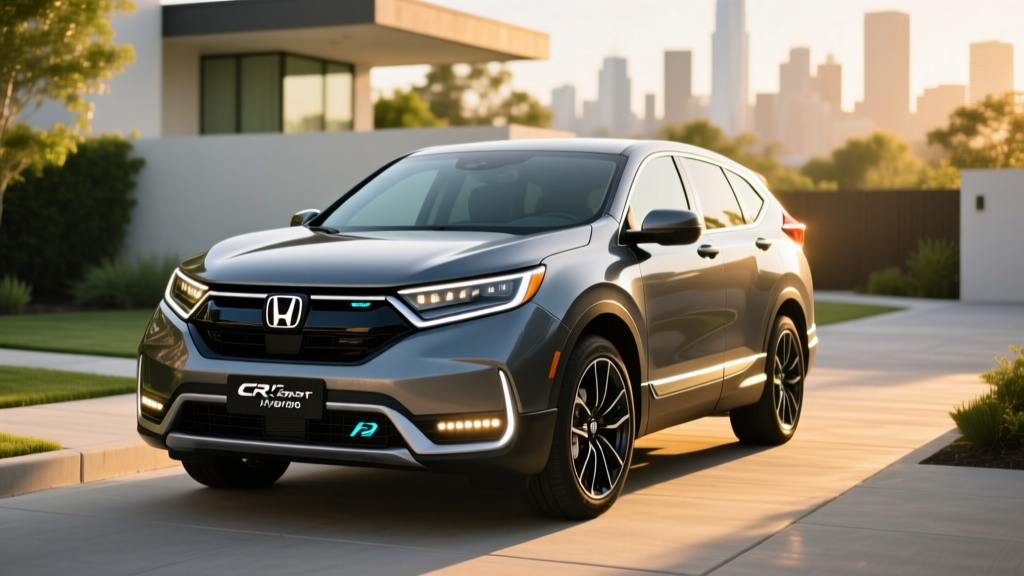
The 2026 Honda CR-V Sport Hybrid is a conventional hybrid (HEV) — not a plug-in — built for buyers who want SUV practicality and meaningful fuel savings without ever plugging in. With an EPA combined rating of 37 MPG and a combined output of 204 horsepower, the Sport Hybrid sits in the middle of the CR-V lineup as a value-oriented electrified option. It's the right pick if you lack reliable home charging access, drive a mix of city and highway miles, and want Honda's long-standing hybrid reliability without stepping into a full battery-electric vehicle (BEV).
If you're cross-shopping this against the CR-V e:FCEV (Honda's hydrogen fuel-cell variant), a Toyota RAV4 Hybrid, or a plug-in alternative like the Toyota RAV4 Prime, this guide breaks down exactly where the Sport Hybrid fits — and where it falls short.
HEV vs PHEV: Understanding What the CR-V Sport Hybrid Actually Is
Before diving into specs, it's critical to understand that the 2026 CR-V Sport Hybrid is a conventional hybrid (HEV). It has no plug, no electric-only driving mode, and no external charging port. The hybrid system recovers energy from braking and deceleration, stores it in a small onboard battery, and uses that energy to assist the gasoline engine and power the electric motors at low speeds.
| Feature | HEV (CR-V Sport Hybrid) | PHEV (e.g., RAV4 Prime) | BEV (e.g., Ioniq 5) |
|---|---|---|---|
| Plug-in charging | No — gas only | Yes — Level 1/2 AC | Yes — Level 2/DC fast |
| Electric-only range | 0 miles (motor assists engine) | ~35–42 miles | 250–320+ miles |
| Battery size | ~1.06 kWh (small buffer) | ~18.1 kWh usable | 58–77.4 kWh usable |
| Fuel/energy source | Gasoline | Gasoline + electricity | Electricity only |
| Federal tax credit (§30D) | Not eligible | Up to $7,500 (if sourcing/income rules met) | Up to $7,500 (if sourcing/income rules met) |
| Typical starting MSRP | ~$36,000 | ~$44,000+ | ~$42,000+ |
Honda does not currently offer a plug-in hybrid CR-V in the US market. If plug-in capability is a priority, you'll need to look at competitors like the Toyota RAV4 Prime or the Hyundai Tucson PHEV, or step up to a full BEV.
Fuel Economy: EPA Ratings and Real-World MPG
The 2026 Honda CR-V Sport Hybrid carries over Honda's fourth-generation two-motor hybrid system, pairing a 2.0-liter Atkinson-cycle four-cylinder engine with twin electric motors driving the front wheels (AWD is available on the Sport Touring Hybrid trim).
| Trim / Drivetrain | City MPG | Highway MPG | Combined MPG |
|---|---|---|---|
| Sport Hybrid FWD | 43 | 36 | 40 |
| Sport Hybrid AWD | 40 | 34 | 37 |
Source: EPA Fuel Economy (fueleconomy.gov)
Real-World MPG: What to Actually Expect
Conventional hybrids like the CR-V Sport Hybrid tend to exceed their EPA city ratings in stop-and-go traffic because regenerative braking recovers energy that a gas-only car wastes as heat. On the highway, however, the electric motor contributes less and the gasoline engine does most of the work — so highway MPG often falls slightly below the sticker.
Based on owner-reported data and independent testing of the current-generation CR-V Hybrid platform:
- City driving (stop-and-go): 40–45 MPG FWD; 38–42 MPG AWD
- Highway (70–75 mph sustained): 32–35 MPG FWD; 30–33 MPG AWD
- Cold weather (below 32°F): Expect a 5–10% reduction due to cabin heating demands and reduced battery efficiency. City MPG may drop to 36–40 FWD.
- Towing or heavy cargo: Significant MPG reduction; the CR-V Hybrid is rated for just 1,000 lbs towing capacity.
For a driver covering 15,000 miles per year with a 60/40 city/highway split, the AWD Sport Hybrid should deliver roughly 38 MPG on average — about 12 MPG better than a comparably equipped gas-only CR-V AWD (28 combined). At $3.40/gallon, that's approximately $740 in annual fuel savings versus the gas model.
Powertrain and Performance Specs
| Specification | 2026 CR-V Sport Hybrid |
|---|---|
| Engine | 2.0L Atkinson-cycle 4-cylinder |
| Engine output | 145 hp / 138 lb-ft torque |
| Electric motors | Twin-motor system (drive + generator) |
| Drive motor output | 181 hp / 247 lb-ft torque |
| Combined system output | 204 hp / 247 lb-ft torque |
| Drivetrain | FWD standard; AWD available (Sport Touring) |
| Transmission | e-CVT (no traditional gearbox) |
| 0–60 mph | ~7.6 seconds (FWD) |
| Hybrid battery | ~1.06 kWh lithium-ion |
| Towing capacity | 1,000 lbs |
| Cargo volume | 36.3 cu ft (behind 2nd row); 76.5 cu ft (seats folded) |
The two-motor system operates in three modes: EV Drive (electric motor only, at low speeds for short distances), Hybrid Drive (engine generates electricity, motor drives wheels), and Engine Drive (engine directly powers wheels at steady highway speeds via a lock-up clutch). The transitions are seamless — most drivers won't notice which mode is active.
The e-CVT isn't a belt-and-pulley CVT like older designs. It's a fixed-ratio gear reduction with the motors managing the effective "ratio" electronically, so there's no rubber-band sensation under acceleration. The 247 lb-ft of electric torque gives it strong off-the-line responsiveness that the gas-only CR-V (190 hp) can't match.
Pricing, Trims, and Tax Credit Eligibility
The 2026 CR-V Hybrid lineup includes multiple trims. Here's the approximate MSRP breakdown:
- Sport Hybrid FWD: ~$36,395
- Sport Hybrid AWD: ~$37,895
- Sport Touring Hybrid AWD: ~$41,895
Pricing is estimated based on Honda's published MSRP structure. Destination charges (~$1,350) apply to all trims.
Federal Tax Credit: Not Eligible
The 2026 Honda CR-V Sport Hybrid does not qualify for the IRS §30D Clean Vehicle Credit. That credit applies only to plug-in electric vehicles (BEVs and PHEVs) meeting battery-sourcing, critical-mineral, MSRP, and buyer-income requirements. Conventional hybrids are excluded entirely.
Some states offer their own incentives for hybrids, but these vary widely and change frequently. Check your state's energy or DMV website for current programs. No federal incentive applies to this vehicle.
Battery Warranty, Reliability, and Replacement Cost
Hybrid battery longevity is consistently one of the top concerns for first-time hybrid buyers. Honda's coverage is competitive with the rest of the industry.
Honda Hybrid Battery Warranty
- Hybrid battery: 8 years / 100,000 miles (10 years / 150,000 miles in CARB states — CA, CT, ME, MA, MD, NJ, NY, OR, RI, VT, WA, CO, and others adopting California emissions standards)
- Hybrid system components: 8 years / 100,000 miles
- Powertrain warranty: 5 years / 60,000 miles
Real-World Reliability
Honda's hybrid system has proven durable over multiple generations. The CR-V Hybrid uses a relatively small 1.06 kWh battery that rarely cycles to full depth — Honda's battery management system keeps the state of charge within a narrow operating window (roughly 20–80%), which dramatically reduces degradation. Unlike a BEV battery that cycles through large energy swings daily, the CR-V's hybrid battery experiences shallow, frequent micro-cycles that are far less stressful on lithium-ion chemistry.
Based on long-term data from Honda's hybrid platforms (Insight, Accord Hybrid, earlier CR-V Hybrid generations), battery failure before 150,000 miles is uncommon. Many owners report no measurable capacity loss at 100,000+ miles.
Battery Replacement Cost
If replacement is needed out of warranty, expect to pay:
- OEM hybrid battery pack: $2,000–$3,500 (parts + labor at a Honda dealer)
- Refurbished/third-party replacement: $1,200–$2,000
This is a fraction of BEV battery replacement costs ($8,000–$20,000+) because the hybrid battery is small (~1 kWh vs 60–80 kWh in a BEV). The smaller battery also means less environmental impact from eventual disposal.
Hybrid vs PHEV vs EV: Which Powertrain Fits You?
Choose the CR-V Sport Hybrid if:
- You don't have access to reliable home or workplace Level 2 charging
- You want fuel savings with zero behavior change — no plugging in, no range planning
- Your annual mileage is moderate (10,000–18,000 miles) and you want a lower purchase price than a PHEV or BEV
- You live in an apartment or rent and can't install a charger
- You frequently take road trips to areas with sparse charging infrastructure
Consider a PHEV instead if:
- You can install a Level 2 charger at home and most of your daily driving is under 35 miles
- You want electric-only commuting but gas-engine flexibility for long trips
- You're willing to pay ~$5,000–$8,000 more upfront to potentially qualify for the §30D tax credit (up to $7,500, subject to IRS sourcing and income rules)
Consider a full BEV instead if:
- You have home charging and want the lowest per-mile energy cost (~$0.04–$0.06/mile on residential electricity vs ~$0.10–$0.12/mile for the CR-V Hybrid on gas)
- You want to eliminate gasoline entirely and minimize maintenance (no oil changes, no spark plugs)
- Your daily driving is under 250 miles and you're comfortable planning DC fast-charge stops on road trips
Pros and Cons
Pros
- 40 MPG city (FWD) — strong real-world city economy that can exceed the EPA sticker
- No plug-in required — zero behavior change vs a gas car
- 204 hp combined with strong electric torque for confident merging
- 36.3 cu ft cargo — no battery-pack intrusion vs the gas CR-V
- Proven Honda hybrid reliability with 8 yr / 100k mi battery warranty
- Lower starting price than PHEV and BEV competitors
Cons
- No plug-in option — no electric-only driving, no federal tax credit eligibility
- Highway MPG (34–36) is only marginally better than some turbo-gas compact SUVs
- 1,000 lb towing capacity — far less than gas CR-V (1,500 lbs) or hybrid competitors
- Sport trim lacks some premium features found on Sport Touring (heated rear seats, Bose audio, wireless CarPlay)
- AWD only available on higher trims, pushing price above $41,000
How the CR-V Sport Hybrid Compares
| Spec | 2026 CR-V Sport Hybrid AWD | 2026 Toyota RAV4 Hybrid AWD | 2026 Hyundai Tucson Hybrid AWD |
|---|---|---|---|
| Combined MPG | 37 | 39 | 38 |
| Combined HP | 204 | 219 | 226 |
| 0–60 mph | ~7.8 sec | ~7.4 sec | ~7.1 sec |
| Cargo (rear seats up) | 36.3 cu ft | 37.6 cu ft | 38.7 cu ft |
| Starting MSRP (AWD) | ~$37,895 | ~$35,500 | ~$37,250 |
| Hybrid battery warranty | 8 yr / 100k mi | 10 yr / 150k mi | 10 yr / 100k mi |
The RAV4 Hybrid edges out the CR-V on combined MPG and cargo space, while the Tucson Hybrid offers more horsepower. The CR-V Sport Hybrid's advantage lies in its refined driving feel, strong build quality, and Honda's safety tech suite (Honda Sensing is standard on all trims). IIHS ratings for the current-generation CR-V have consistently earned Top Safety Pick status.
Frequently Asked Questions
How many MPG does the 2026 Honda CR-V Sport Hybrid get?
The FWD Sport Hybrid is EPA-rated at 43 city / 36 highway / 40 combined. The AWD version drops to 40 city / 34 highway / 37 combined. Real-world city driving often exceeds the EPA city number thanks to regenerative braking; highway driving tends to fall slightly below the sticker.
Does the CR-V Sport Hybrid need to be plugged in?
No. The CR-V Sport Hybrid is a conventional hybrid (HEV). It charges its small battery entirely through regenerative braking and the gasoline engine. There is no plug, no charging port, and no electric-only driving range.
Is there a plug-in hybrid version of the CR-V?
Honda does not currently sell a plug-in hybrid CR-V in the United States. If you want a compact SUV PHEV, the Toyota RAV4 Prime (42 miles electric-only), Hyundai Tucson PHEV (33 miles), and Kia Sportage PHEV (34 miles) are the main alternatives.
Does the 2026 CR-V Hybrid qualify for a tax credit?
No. The federal §30D Clean Vehicle Credit applies only to plug-in vehicles (BEVs and PHEVs). Conventional hybrids are not eligible. Some states may offer their own hybrid incentives — check your state energy office for current programs.
How long will the CR-V Hybrid battery last?
Honda warranties the hybrid battery for 8 years / 100,000 miles (10 years / 150,000 miles in CARB states). In practice, Honda's hybrid batteries are designed for shallow cycling and many last well beyond the warranty period — 150,000 to 200,000+ miles is common based on long-term ownership data from Honda's hybrid lineup.
What does it cost to replace the hybrid battery?
Out-of-warranty OEM replacement runs $2,000–$3,500 including labor at a Honda dealer. Refurbished or third-party batteries can reduce that to $1,200–$2,000. This is significantly cheaper than a BEV battery replacement due to the much smaller pack size (~1 kWh).
Is the CR-V Sport Hybrid faster than the gas CR-V?
Yes, modestly. The Sport Hybrid produces 204 combined horsepower and 247 lb-ft of electric torque vs the gas CR-V's 190 hp and 179 lb-ft. The 0–60 time is approximately 7.6 seconds for the FWD hybrid vs ~8.3 seconds for the gas model. The more noticeable difference is low-speed responsiveness — the electric motor delivers instant torque off the line.