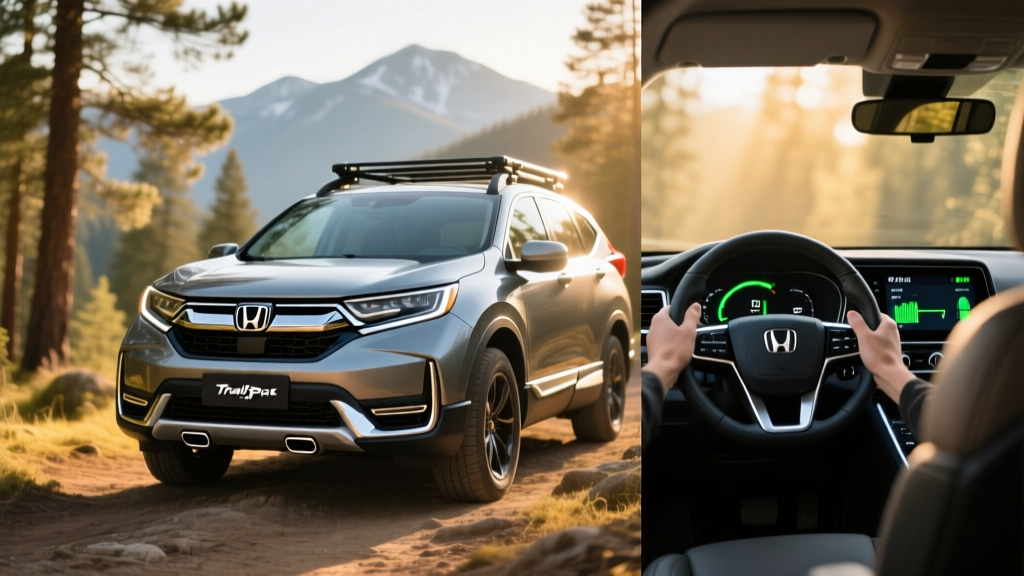
The 2026 Honda CR-V Hybrid TrailSport occupies a specific niche: a rugged-styled, all-wheel-drive compact hybrid SUV that never asks you to plug in. It's a conventional hybrid (HEV), not a plug-in hybrid (PHEV) or a battery-electric vehicle. That distinction matters enormously for buyers weighing fuel savings against charging logistics. Below, we break down the TrailSport Hybrid's real-world efficiency, powertrain behavior, warranty coverage, and whether its off-road aesthetic translates to genuine trail capability.
Quick Verdict: Who Is the CR-V Hybrid TrailSport For?
The 2026 CR-V Hybrid TrailSport is best suited for drivers who want 40+ MPG in daily commuting, standard all-wheel drive for snow or dirt roads, and zero lifestyle change from a gas car. You fuel it like any other vehicle. There's no plug, no range anxiety, and no home charger to install. If you need genuine off-road clearance or a plug-in electric commute mode, look elsewhere. If you want a practical, efficient AWD family hauler with rugged looks, this trim hits the mark.
HEV vs PHEV vs EV: Where the TrailSport Hybrid Fits
Honda does not currently offer a plug-in hybrid (PHEV) version of the CR-V in the US market. The CR-V lineup gives you two powertrain paths: a 1.5L turbocharged gas engine or the 2.0L hybrid system found in the TrailSport. Here's how those choices compare against a full EV like the Honda Prologue:
| Factor | CR-V Hybrid (HEV) | CR-V Gas (1.5T) | Honda Prologue (BEV) |
|---|---|---|---|
| Plug-in Required? | No | No | Yes |
| EPA Combined Efficiency | 40 MPG | 29 MPG | 87 MPGe |
| Total Range | ~540 miles | ~406 miles | ~296 miles |
| Fuel/Charge Cost per Mile | ~$0.09 | ~$0.12 | ~$0.04 (home) |
| Federal Tax Credit (§30D) | Not eligible | Not eligible | Up to $7,500* |
| Home Charging Needed? | No | No | Recommended |
*§30D eligibility depends on buyer income, MSRP caps, and battery-sourcing rules. See IRS.gov for current requirements.
The TrailSport Hybrid sacrifices the ultra-low per-mile cost of a BEV but eliminates charging dependency entirely. For apartment dwellers, street parkers, or frequent road-trippers, that tradeoff is often worth it.
Fuel Economy: EPA Ratings and Real-World MPG
The 2026 CR-V Hybrid AWD powertrain carries EPA ratings of 40 MPG city, 34 MPG highway, and 37 MPG combined according to fueleconomy.gov. The TrailSport trim, with its all-terrain tires and slightly raised suspension, may see a marginal 1-2 MPG penalty versus the Sport Touring Hybrid, but Honda has not published a separate TrailSport EPA sticker as of this writing. Expect TrailSport figures to land near 39 city / 33 highway / 36 combined.
| Driving Scenario | EPA Estimate (AWD Hybrid) | Real-World Expectation |
|---|---|---|
| City / Stop-and-Go | 40 MPG | 41-44 MPG (hybrids excel here) |
| Highway (70-75 mph) | 34 MPG | 31-34 MPG |
| Combined Mixed | 37 MPG | 36-39 MPG |
| Cold Weather (below 30°F) | — | 33-36 MPG (engine runs more for heat) |
Honda's two-motor hybrid system thrives in city driving, where regenerative braking and electric-only low-speed operation push actual MPG above the EPA city sticker. Highway driving is where the CR-V Hybrid loses its advantage — the 2.0L Atkinson-cycle engine must work harder at sustained speeds, and the TrailSport's all-terrain tires add rolling resistance. On a 300-mile interstate trip at 75 mph, expect closer to 31 MPG.
Powertrain: How the Hybrid System Delivers Power
The CR-V Hybrid uses Honda's fourth-generation two-motor hybrid system. A 2.0-liter Atkinson-cycle four-cylinder engine produces 145 hp on its own, while two electric motors combine with the engine to deliver a total system output of 204 hp and 247 lb-ft of torque. The TrailSport trim comes exclusively with real-time all-wheel drive, which uses a mechanical driveshaft to the rear axle rather than a dedicated rear electric motor.
| Specification | 2026 CR-V Hybrid TrailSport |
|---|---|
| Engine | 2.0L Atkinson-cycle 4-cylinder |
| System Horsepower | 204 hp combined |
| System Torque | 247 lb-ft |
| Drivetrain | Real-Time AWD |
| Transmission | e-CVT (no fixed gears) |
| 0-60 mph (est.) | ~7.8 seconds |
| Towing Capacity | 1,000 lbs |
| Ground Clearance | 8.2 inches |
| Hybrid Battery | ~1.1 kWh lithium-ion (self-charging) |
That small 1.1 kWh battery is critical to understand. It's a conventional hybrid battery — it charges via regenerative braking and the gas engine. You never plug it in. It enables roughly 1-2 miles of electric-only driving at low speeds (under 25 mph in stop-and-go traffic), but this is not a vehicle designed for an electric commute. The battery's job is to assist the engine during acceleration and recapture energy during braking, which is what delivers the 40 MPG city rating.
TrailSport Capability: Real Off-Road or Just Looks?
The TrailSport badge on the CR-V Hybrid adds all-terrain tires, orange recovery hooks, unique bumpers, and a slightly retuned AWD system with revised torque distribution for loose surfaces. Ground clearance sits at 8.2 inches — competitive with the Toyota RAV4 Hybrid Woodland Edition but below dedicated off-roaders like the Subaru Outback Wilderness.
What the TrailSport handles well: gravel fire roads, snowy driveways, sandy beach access, and muddy campgrounds. What it doesn't do: rock crawling, deep water fording, or serious trail running. The AWD system is reactive (it sends torque rearward when front wheels slip) rather than a locking system, and the 1,000-lb towing limit rules out most campers. Think of it as a "dirt-road and snow" upgrade, not a Jeep competitor.
Pricing, Tax Credits, and Ownership Cost
The 2026 Honda CR-V Hybrid TrailSport starts at an MSRP of approximately $39,845 including destination. That positions it between the Sport Hybrid ($36,545) and the Sport Touring Hybrid ($41,845). Key standard equipment includes a 9-inch touchscreen with wireless Apple CarPlay/Android Auto, heated front seats, Honda Sensing suite (adaptive cruise, lane-keeping, automatic emergency braking), and a power moonroof.
Tax credit reality: The CR-V Hybrid does not qualify for the federal §30D Clean Vehicle Credit. That credit applies only to plug-in electric vehicles (BEVs and PHEVs) meeting battery-sourcing and critical-mineral requirements. Conventional hybrids like this one are excluded. Some states offer modest hybrid rebates or reduced registration fees, but these vary widely — check your state's energy office or DMV for specifics.
Hybrid Battery Warranty & Replacement Cost
Honda covers the CR-V Hybrid's battery pack and hybrid system components with a 8-year / 100,000-mile warranty (10 years / 150,000 miles in CARB states including California, New York, Massachusetts, and others that follow California emissions standards). This is in line with industry norms for conventional hybrids.
Out-of-warranty hybrid battery replacement for the CR-V Hybrid typically runs $2,500–$4,000 including labor at a Honda dealer. However, fourth-generation Honda hybrid systems have shown strong longevity — many Accord Hybrid and CR-V Hybrid owners report 150,000+ miles with minimal capacity loss. The small battery in a conventional hybrid undergoes shallow charge cycles (rarely dropping below 40% or above 80% state of charge), which greatly extends cell life compared to a BEV or PHEV that regularly cycles through deeper ranges.
5-Year Ownership Cost Snapshot
Assuming 15,000 miles/year, $3.40/gallon regular unleaded, and national-average insurance rates:
| Cost Category | CR-V Hybrid TrailSport | CR-V Gas EX AWD | Honda Prologue Elite AWD |
|---|---|---|---|
| Purchase Price (MSRP) | $39,845 | $37,295 | $52,900 |
| Federal Tax Credit | $0 | $0 | Up to $7,500* |
| 5-Year Fuel/Energy | ~$6,375 | ~$8,775 | ~$3,000 (home charging) |
| 5-Year Insurance (est.) | ~$8,500 | ~$8,200 | ~$9,500 |
| 5-Year Maintenance (est.) | ~$2,800 | ~$3,200 | ~$1,500 |
| Estimated 5-Year Total | ~$57,520 | ~$57,470 | ~$59,400 |
*Prologue §30D eligibility varies by buyer income, sourcing rules, and point-of-sale transfer availability. Confirm at IRS.gov.
The Hybrid TrailSport and gas EX AWD land remarkably close on total 5-year cost. The hybrid's fuel savings (~$2,400 over five years) essentially offset its higher purchase price. The real financial win goes to the Prologue — but only if you have reliable home charging and qualify for the full credit.
Pros, Cons, and the Bottom Line
Pros
- 40 MPG city — real-world city driving often exceeds EPA sticker
- No plug-in required — zero lifestyle change from a gas car
- Standard AWD with 8.2" ground clearance handles snow and dirt roads
- Strong 8yr/100k hybrid battery warranty (10yr/150k in CARB states)
- Honda Sensing safety suite standard on all trims
- Spacious 76.5 cu-ft cargo area with rear seats folded
Cons
- Highway MPG drops to low 30s at 75+ mph
- No federal tax credit eligibility (HEV, not PHEV/BEV)
- 1,000-lb towing limit is restrictive for a compact SUV
- TrailSport off-road upgrades are cosmetic/light-duty only
- e-CVT drone under hard acceleration (no simulated shifts)
- No PHEV option available in US market
Frequently Asked Questions
How many MPG does the 2026 CR-V Hybrid TrailSport get?
The AWD CR-V Hybrid achieves EPA ratings near 40 city / 34 highway / 37 combined MPG. The TrailSport trim's all-terrain tires may reduce this by 1-2 MPG. In real-world city driving, many owners see 41-44 MPG thanks to frequent regenerative braking. Highway driving at 75+ mph typically yields 31-34 MPG.
Does the CR-V Hybrid TrailSport need to be plugged in?
No. The CR-V Hybrid is a conventional hybrid (HEV), not a plug-in hybrid. Its small ~1.1 kWh battery charges entirely through regenerative braking and the gas engine. You simply fill it with regular unleaded gasoline like any other car.
Is the CR-V Hybrid reliable and what does battery replacement cost?
Honda's hybrid system has a strong reliability track record, with the hybrid battery covered by an 8-year/100,000-mile warranty (10yr/150k in CARB states). Out-of-warranty battery replacement typically costs $2,500-$4,000, but real-world data suggests these batteries regularly exceed 150,000 miles with minimal degradation due to shallow charge cycling.
Does the CR-V Hybrid qualify for any tax credit?
No. The federal §30D Clean Vehicle Credit applies only to plug-in vehicles (BEVs and PHEVs). Conventional hybrids like the CR-V Hybrid are not eligible. Some states offer minor hybrid incentives, but these vary by jurisdiction — check your state's energy office for details.
Hybrid vs PHEV vs EV — which should I choose?
Choose the CR-V Hybrid if you lack home charging access, frequently drive long distances, or want zero behavior change. Choose a PHEV (not available in the CR-V lineup; consider a Toyota RAV4 Prime) if you want 30-40 miles of electric commuting plus a gas engine for road trips. Choose a full EV like the Honda Prologue if you have home charging, drive under 250 miles daily, and want the lowest per-mile cost and maximum tax incentives.
Can the CR-V Hybrid TrailSport actually go off-road?
It handles light-duty off-pavement driving well — gravel roads, snow, sand, and mild trails. The 8.2 inches of ground clearance and AWD system are adequate for most campsite and cabin access roads. It is not designed for rock crawling, deep mud, or technical trails. Think of it as an all-weather, all-surface commuter, not a dedicated off-roader.