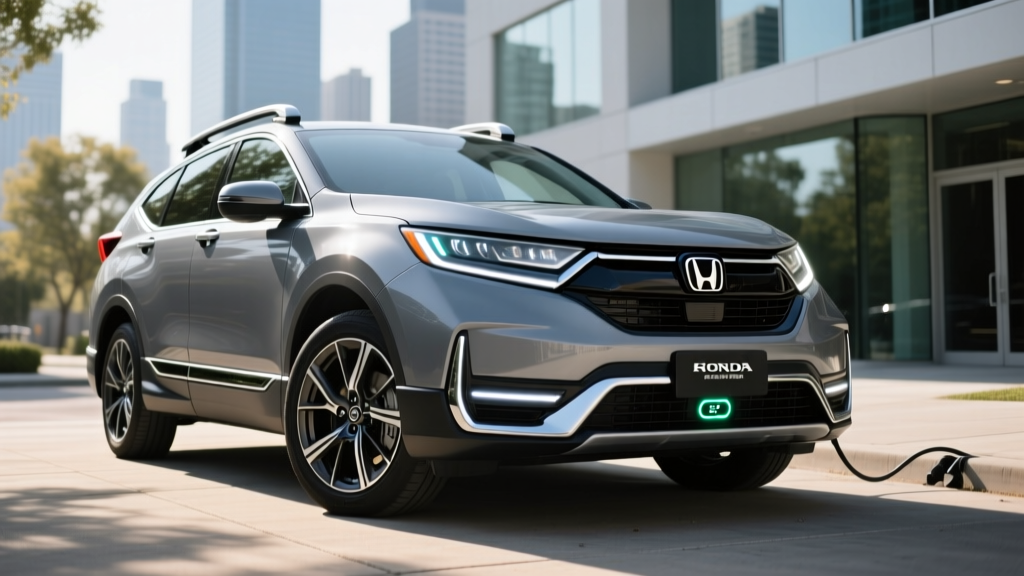
The 2026 Honda CR-V Hybrid Sport Touring sits at the top of Honda's compact hybrid SUV lineup, pairing a turbocharged 2.0-liter Atkinson-cycle engine with a two-motor hybrid system for 204 combined horsepower and an EPA-estimated 40 MPG combined. It is a conventional hybrid (HEV), not a plug-in — meaning it never needs to be plugged in and generates all its electricity through regenerative braking and the engine. For buyers who want electrified efficiency without charging infrastructure dependency, the Sport Touring trim adds premium features, standard AWD, and Honda's fullest tech suite at a sub-$40,000 starting price.
HEV vs PHEV: What the CR-V Hybrid Actually Is
Before diving into specs, it is critical to understand what the 2026 CR-V Hybrid is — and what it is not. Honda sells the CR-V in two electrified flavors in some markets, but in the US, the CR-V Hybrid is a conventional hybrid (HEV). There is no plug, no electric-only driving mode, and no external charging port.
| Feature | HEV (CR-V Hybrid) | PHEV (e.g., Toyota RAV4 Prime) |
|---|---|---|
| Plug-in charging | No — self-charging via engine + regen | Yes — plug into Level 1 or Level 2 |
| Electric-only range | None (EV mode at very low speeds only) | 25–42 miles typical |
| Battery size | ~1.06 kWh (small buffer) | 18–22 kWh usable |
| DC fast charging | N/A | Some models (not all) |
| Federal tax credit (§30D) | Not eligible | Up to $7,500 if eligible |
| Typical MPG combined | 38–40 MPG | 38–94 MPGe (electric + gas) |
If you were searching for a CR-V plug-in hybrid, Honda does not currently offer one in the US market. The closest Honda PHEV is the Clarity Plug-In Hybrid (discontinued after 2022). For a compact PHEV SUV competitor, look at the Toyota RAV4 Prime or the Hyundai Tucson PHEV.
Fuel Economy: EPA Ratings and Real-World MPG
| Driving Cycle | EPA Estimate | Real-World Expectation |
|---|---|---|
| City | 43 MPG | 44–48 MPG (hybrids excel in stop-and-go) |
| Highway | 36 MPG | 33–36 MPG (engine runs more at sustained speed) |
| Combined | 40 MPG | 38–44 MPG depending on driving mix |
The two-motor hybrid system shines in city driving, where the electric motors handle most low-speed propulsion and regenerative braking recaptures energy at every stop. On the highway, the gasoline engine takes over more directly, which is why the highway number drops to 36 MPG. According to fueleconomy.gov, the 2026 CR-V Hybrid AWD earns a combined 40 MPG rating.
In real-world mixed driving, owners consistently report that city mileage meets or exceeds the EPA estimate. Highway-heavy commutes at 75+ mph will see numbers closer to 33–34 MPG. Cold weather reduces efficiency by roughly 5–10% due to increased engine idling for cabin heat and reduced battery efficiency — expect 36–38 MPG combined in winter months for the AWD model.
Powertrain Specs: Engine, Motors, and Horsepower
| Specification | 2026 CR-V Hybrid Sport Touring |
|---|---|
| Engine | 2.0L turbocharged 4-cylinder (Atkinson cycle) |
| Engine output | 145 hp / 138 lb-ft torque |
| Electric motors | Dual-motor hybrid system |
| Combined system output | 204 hp / 247 lb-ft torque |
| Drivetrain | Real Time AWD™ (standard on Sport Touring) |
| Transmission | e-CVT (electronic continuously variable) |
| 0–60 mph | ~7.8 seconds (est.) |
| Towing capacity | 1,000 lbs |
| Fuel tank | 14.0 gallons |
| Total range | ~560 miles (EPA combined) |
Honda's fourth-generation two-motor hybrid system uses one motor primarily as a generator and the other as the primary drive motor. At highway speeds, a lock-up clutch allows the engine to mechanically drive the front wheels directly for efficiency. The 247 lb-ft of combined torque gives the CR-V Hybrid confident passing power, and the Real Time AWD system sends up to 50% of torque to the rear axle when slip is detected. This is not a performance SUV, but the powertrain is notably smoother and more responsive than the non-hybrid CR-V's turbo 1.5L with its conventional CVT.
Pricing, Trims, and Tax Credit Eligibility
The 2026 Honda CR-V Hybrid Sport Touring starts at an MSRP of approximately $39,695 (including destination charge). This positions it as the range-topping hybrid trim, sitting above the Sport-L ($37,695), Sport ($35,695), and the base Hybrid trims.
Federal Tax Credit Status: The 2026 CR-V Hybrid does not qualify for the IRS §30D Clean Vehicle Credit. That credit (up to $7,500) applies only to plug-in electric vehicles (BEVs and PHEVs) that meet battery sourcing, MSRP, and buyer income requirements. Since the CR-V Hybrid is a conventional HEV with no plug, it is ineligible for the federal EV tax credit.
Some states offer separate incentives for hybrids, but these are increasingly rare. Check your state's energy office or Alternative Fuels Data Center for current local programs.
What the Sport Touring does offer for the price is a well-equipped package: leather-trimmed seats, a 9-inch touchscreen with wireless Apple CarPlay and Android Auto, a 12-speaker Bose audio system, wireless phone charging, heated front seats, a heated steering wheel, a hands-free power tailgate, and the full Honda Sensing® ADAS suite (adaptive cruise, lane-keeping, collision mitigation, and traffic sign recognition). That equipment level rivals luxury compact SUVs costing $10,000 more.
Battery Warranty, Reliability, and Replacement Costs
Hybrid Battery Warranty: Honda covers the CR-V Hybrid's lithium-ion battery pack for 8 years or 100,000 miles (whichever comes first) under the hybrid system warranty. In California Air Resources Board (CARB) states, that extends to 10 years or 150,000 miles.
What's covered: Defects in the hybrid battery, electric motors, power control unit, and related hybrid components. If the battery drops below a functional threshold due to a defect, Honda will repair or replace it at no cost.
Honda's hybrid powertrains have a strong reliability track record. The two-motor system used in the CR-V Hybrid is a mature, fourth-generation design with no high-stress mechanical components like a traditional transmission. The hybrid battery is small (~1.06 kWh) and operates within a narrow state-of-charge window, which significantly reduces degradation compared to a full EV battery that cycles through a wide range daily.
Battery replacement cost: If the hybrid battery fails outside warranty, replacement typically runs $2,000–$4,000 including labor at a Honda dealer. Third-party hybrid battery rebuilders often offer refurbished packs for $1,000–$2,000. Given the 8–10 year warranty and the modest stress on the small battery, most owners will never face this expense.
For overall reliability ratings, the CR-V consistently scores well with IIHS Top Safety Pick status and strong predicted reliability from Consumer Reports for the hybrid powertrain.
Who Should Choose the CR-V Hybrid vs a Full EV or Gas Model
Choose the 2026 CR-V Hybrid Sport Touring if:
- You cannot install a Level 2 home charger (apartment, street parking, no garage)
- You regularly take long road trips (400+ miles) and don't want to plan around charging stops
- You want 40 MPG combined without changing your fueling habits at all
- You live in a region with extreme cold where EV range loss is a concern
- Your budget is $35,000–$42,000 and you want a fully loaded compact SUV
Choose a full EV (e.g., Hyundai Ioniq 5, Tesla Model Y) if:
- You have home Level 2 charging and want near-zero fuel maintenance
- Your daily commute is under 60 miles round-trip
- You want to qualify for the $7,500 federal tax credit (on eligible models)
- You want instant torque, one-pedal driving, and lower per-mile energy costs
Choose the gas-only CR-V (turbo 1.5L) if:
- Upfront price is the primary concern (starts ~$4,000 less than the hybrid)
- You drive mostly highway miles where the hybrid advantage shrinks
- You want the widest trim selection and don't value the smoother hybrid powertrain
The CR-V Hybrid's total cost of ownership is compelling. At 40 MPG combined and $3.40/gallon gas, annual fuel cost runs roughly $1,275 for 15,000 miles. A comparable gas-only CR-V at 28 MPG combined would cost about $1,821 per year — a $546 annual savings with the hybrid. Over a 5-year ownership period, that's roughly $2,700 in fuel savings, more than offsetting the hybrid's modest price premium over the gas model.
Pros and Cons at a Glance
Pros
- 40 MPG combined with no plug-in requirement
- Standard AWD on Sport Touring — confident in rain and snow
- Smooth, responsive two-motor hybrid system with 247 lb-ft torque
- Excellent city MPG (43 EPA, often exceeded in real driving)
- Top-tier safety ratings and Honda Sensing ADAS standard
- 8-year/100,000-mile hybrid battery warranty (10/150k in CARB states)
- Premium Sport Touring equipment at under $40K
Cons
- No plug-in hybrid option — cannot drive on electric-only for commutes
- Highway MPG drops to 36 — less advantage on long freeway drives
- 1,000-lb towing capacity is low for the segment
- No federal tax credit eligibility (HEV, not PHEV/BEV)
- e-CVT drone under hard acceleration (common to all hybrids)
- Cargo space slightly reduced vs gas model due to hybrid battery placement
Frequently Asked Questions
How many MPG does the 2026 Honda CR-V Hybrid get?
The EPA rates the 2026 CR-V Hybrid AWD at 43 MPG city, 36 MPG highway, and 40 MPG combined. Real-world city driving often exceeds the EPA estimate thanks to regenerative braking. Highway-heavy driving at speeds above 75 mph typically yields 33–36 MPG.
Is the 2026 CR-V Hybrid a plug-in hybrid?
No. The CR-V Hybrid is a conventional hybrid (HEV). It has no charging port and never needs to be plugged in. The hybrid battery charges itself through regenerative braking and the gasoline engine. Honda does not currently offer a CR-V plug-in hybrid in the United States.
Does the 2026 CR-V Hybrid qualify for any tax credit?
The CR-V Hybrid does not qualify for the federal §30D Clean Vehicle Credit, which is reserved for plug-in EVs and PHEVs. Some states may offer small hybrid incentives — check the Alternative Fuels Data Center for your state's current programs. The non-hybrid CR-V also does not qualify for federal credits.
How long will the CR-V Hybrid battery last?
Honda warranties the hybrid battery for 8 years/100,000 miles (10 years/150,000 miles in CARB states). In practice, Honda's hybrid batteries routinely last 150,000–200,000+ miles because the small pack operates in a narrow charge window, minimizing stress. Out-of-warranty replacement costs $2,000–$4,000 at a dealer.
Should I buy the CR-V Hybrid or a full electric SUV?
If you have home Level 2 charging, a commute under 60 miles, and want the lowest per-mile cost plus federal tax credit eligibility, a full EV like the Hyundai Ioniq 5 or Tesla Model Y may be a better fit. If you lack home charging, take frequent long road trips, or live in extreme cold, the CR-V Hybrid offers efficiency without range anxiety or charging dependency.
What is the difference between the CR-V Hybrid Sport and Sport Touring?
The Sport Touring adds leather seats, a Bose 12-speaker audio system, wireless phone charging, a heated steering wheel, a hands-free power tailgate, and upgraded interior trim over the Sport. Both share the same 204-hp hybrid powertrain and standard AWD. The Sport Touring is approximately $2,000–$3,000 more than the Sport depending on options.
The 2026 Honda CR-V Hybrid Sport Touring occupies a practical sweet spot: it delivers meaningful fuel savings over a gas SUV, requires zero behavioral change, and comes loaded with premium features at a competitive price. It won't qualify for EV incentives or let you commute on electric power alone, but for the millions of buyers who aren't ready to plug in, it remains one of the most capable and efficient hybrid SUVs on the market.