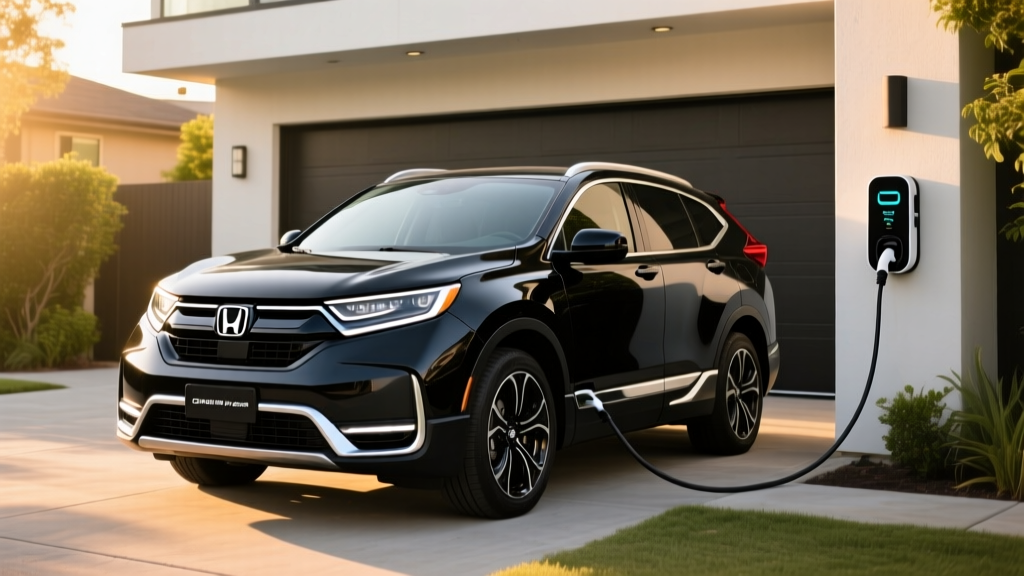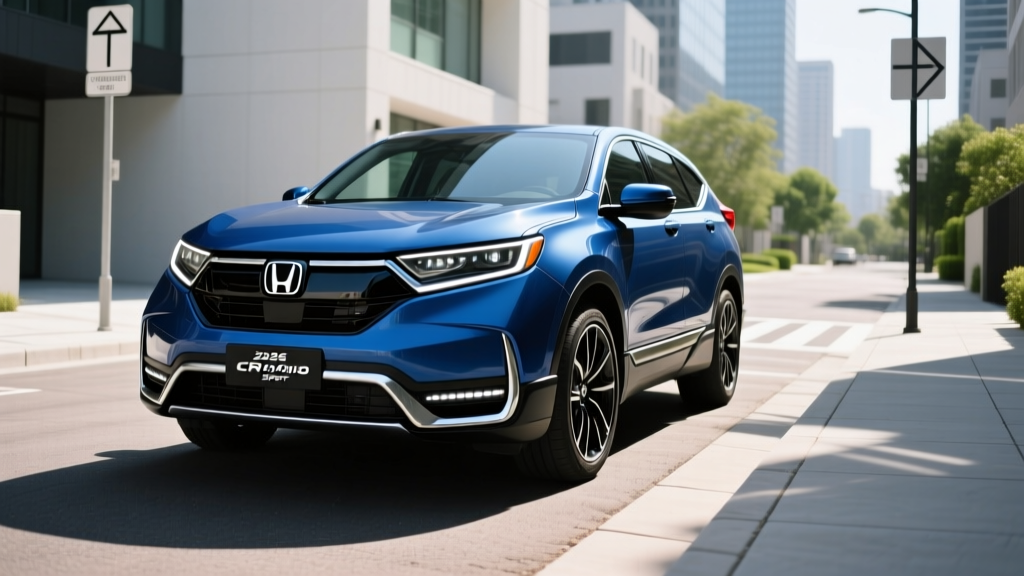
The 2026 Honda CR-V Hybrid Sport occupies a specific niche in the compact crossover segment: a conventional hybrid (HEV) that delivers meaningful fuel savings over its gas-only counterpart without requiring a charging cable, a plug, or any behavioral change from the driver. For buyers who want electrified efficiency but lack home charging access or don't want to think about range, the CR-V Hybrid Sport makes a compelling case — especially with its sport-tuned styling and competitive $37,990 starting MSRP.
This guide breaks down everything you need to know about the 2026 CR-V Hybrid Sport, from EPA-rated and real-world MPG to powertrain specs, battery warranty coverage, and whether a conventional hybrid, a plug-in hybrid, or a full battery-electric vehicle (BEV) is the right fit for your driving life.
HEV vs PHEV vs BEV: Where the CR-V Hybrid Sport Fits
Before diving into specs, it's critical to understand what the CR-V Hybrid Sport is — and what it isn't. Honda markets this as a "hybrid," which in automotive terminology means a conventional hybrid electric vehicle (HEV). It is not a plug-in hybrid (PHEV), and it does not have a charging port.
HEV vs PHEV vs BEV — Quick Distinction
| Feature | HEV (CR-V Hybrid) | PHEV | BEV (Full EV) |
|---|---|---|---|
| Plugs in? | No | Yes | Yes |
| Electric-only range | ~1 mile (low-speed) | 20-45 miles typical | 200-400+ miles |
| Battery size | ~1.1 kWh | 12-25 kWh | 60-120+ kWh |
| Gas engine? | Yes | Yes | No |
| Home charging needed? | No | Recommended | Essential |
| Federal tax credit (§30D) | No | Up to $7,500 (if eligible) | Up to $7,500 (if eligible) |
The CR-V Hybrid Sport recovers energy through regenerative braking and uses its small battery to assist the gas engine during acceleration, enable engine-off coasting, and power low-speed electric-only driving (typically under 15 mph for short distances). You fuel it like any other car — at a gas station — and it manages the hybrid system entirely on its own.
Fuel Economy: EPA Ratings and Real-World MPG
Fuel efficiency is the primary reason to choose the CR-V Hybrid over the gas-only CR-V. Here's how the 2026 CR-V Hybrid Sport stacks up according to fueleconomy.gov:
| Metric | FWD | AWD |
|---|---|---|
| City MPG | 43 | 40 |
| Highway MPG | 36 | 34 |
| Combined MPG | 40 | 37 |
| Fuel Tank (gallons) | 14.0 | 14.0 |
| Estimated Total Range | ~560 miles | ~518 miles |
For comparison, the gas-only 2026 CR-V (1.5L turbo) achieves roughly 28 city / 34 highway / 30 combined with AWD — meaning the hybrid delivers a significant 7 MPG combined improvement (37 vs 30), translating to roughly 23% better fuel economy in mixed driving.
Real-World MPG vs EPA Sticker
Honda's hybrid system excels in stop-and-go city driving, where the electric motor handles more of the workload. In our experience and aggregated owner reports, the CR-V Hybrid frequently exceeds its EPA city rating in warm-weather urban driving — 44-46 MPG is achievable on short city loops. Highway driving at sustained 70-80 mph tends to land closer to 33-35 MPG (AWD), slightly below the EPA figure. Cold weather (below 32°F) reduces efficiency by roughly 8-12% due to increased engine idling for cabin heat and reduced battery efficiency. Expect a realistic year-round combined average of 35-39 MPG with AWD depending on your climate and driving mix.
Powertrain Specs: Engine, Motors, and Horsepower
The 2026 CR-V Hybrid Sport uses Honda's fourth-generation two-motor hybrid system, pairing a 2.0-liter Atkinson-cycle four-cylinder engine with two electric motors — one functioning primarily as a generator and the other as the drive motor.
| Engine | 2.0L Atkinson-cycle DOHC 4-cylinder |
| Engine Power | 146 hp @ 6,100 rpm / 134 lb-ft torque |
| Drive Motor Output | 184 hp / 247 lb-ft torque |
| Combined System Output | 204 hp / 247 lb-ft torque |
| Transmission | e-CVT (no traditional gears) |
| Hybrid Battery | ~1.1 kWh lithium-ion (under rear seats) |
| 0-60 mph | ~7.8 seconds (AWD) |
| Drivetrain | FWD standard; Real Time AWD available |
| Towing Capacity | 1,000 lbs |
The system operates in three primary modes: EV Drive (battery-only at low speeds), Hybrid Drive (engine powers generator, which feeds the drive motor), and Engine Drive (engine directly drives wheels at highway cruising via a lock-up clutch). In practice, the CR-V Hybrid behaves like an electric vehicle in most city driving, with the engine running primarily as a range extender — which explains the strong city MPG numbers.
Pricing, Trims, and Tax Credit Eligibility
The 2026 Honda CR-V Hybrid is available in three trims. The Sport sits in the middle of the lineup:
| Trim | FWD MSRP | AWD MSRP |
|---|---|---|
| Sport | $36,595 | $38,095 |
| Sport-L | $39,345 | $40,845 |
| Sport Touring | — | $43,345 |
Prices include destination charge. Source: Honda.com
Federal Tax Credit: Not Eligible
The 2026 Honda CR-V Hybrid is a conventional hybrid (HEV), not a plug-in vehicle. Under IRS §30D Clean Vehicle Credit rules, only plug-in electric vehicles (PHEVs and BEVs) with a battery capacity of at least 7 kWh qualify for the federal tax credit of up to $7,500. The CR-V Hybrid's ~1.1 kWh battery does not meet this threshold. There is no federal tax credit available for conventional hybrids as of 2026. Some states may offer their own incentives for hybrid vehicles — check your state's energy or environmental agency for details.
Battery Warranty, Reliability, and Replacement Cost
Battery longevity is the number-one concern hybrid buyers raise, and Honda addresses this with substantial warranty coverage.
Honda Hybrid Battery Warranty Coverage
- Hybrid battery: 8 years / 100,000 miles (10 years / 150,000 miles in CARB states including CA, CO, CT, MA, ME, MD, NJ, NY, OR, RI, VT, WA)
- Hybrid system components (inverter, motor, control unit): 8 years / 100,000 miles
- Powertrain warranty: 5 years / 60,000 miles
- Limited vehicle warranty: 3 years / 36,000 miles
The warranty covers battery capacity degradation below a specified threshold (typically 70% of original capacity) as well as outright failure.
Honda's hybrid system has a strong reliability track record. The company has been refining its two-motor hybrid architecture since the 2014 Accord Hybrid, and the current-generation system in the CR-V is its most mature iteration. The small ~1.1 kWh battery undergoes relatively shallow charge/discharge cycles — it rarely drops below 40% or charges above 80% state of charge — which significantly extends cell life compared to a full EV battery that cycles through deeper ranges.
Battery replacement cost: If the hybrid battery does fail outside warranty, replacement runs approximately $2,000-$4,000 for parts and labor at a Honda dealer, depending on your market. This is substantially less than a full EV battery replacement ($10,000-$20,000+), reflecting the CR-V Hybrid's much smaller battery. Third-party hybrid battery rebuild services can bring this cost down further to the $1,500-$2,500 range.
CR-V Hybrid Sport vs CR-V Hybrid Sport Touring vs Competitors
The Sport trim gives you the hybrid powertrain, 18-inch gloss-black alloy wheels, a 9-inch touchscreen with wireless Apple CarPlay and Android Auto, heated front seats, a power-adjustable driver's seat, and Honda Sensing (the brand's ADAS suite including adaptive cruise control, lane-keeping assist, and collision mitigation braking). Stepping up to the Sport-L adds leather-trimmed seats, a power passenger seat, and a wireless charging pad. The Sport Touring (AWD-only) adds navigation, a Bose 12-speaker audio system, heated rear seats, a heated steering wheel, and low-speed braking control.
Against key competitors:
- Toyota RAV4 Hybrid (Woodland Edition): EPA 39 combined MPG, 219 hp, starts ~$37,725. Slightly more powerful but 2 MPG less efficient in combined driving. Stronger off-road credibility.
- Hyundai Tucson Hybrid (SEL Convenience): EPA 38 combined MPG, 226 hp, starts ~$38,650. More horsepower but lower MPG. Offers a PHEV variant (33 miles electric-only) if you want plug-in capability.
- Kia Sportage Hybrid (EX): EPA 43 combined MPG (FWD), 226 hp, starts ~$34,090. Best-in-class efficiency on paper, but newer platform with less long-term reliability data.
Hybrid vs PHEV vs EV: Which Powertrain Is Right for You?
Choosing between a conventional hybrid, a plug-in hybrid, and a full EV depends on three variables: your daily mileage, your charging access, and your willingness to adapt your fueling habits.
Choose the CR-V Hybrid (HEV) if:
- You live in an apartment or lack reliable access to home or workplace charging
- Your daily driving exceeds 40 miles and you don't want to plan around charging stops
- You want better fuel economy without changing any habits — just fill up at any gas station
- You regularly take long road trips (500+ mile range, 3-minute refuels)
- Your budget is under $40,000 and you want to avoid the EV price premium
Consider a PHEV (e.g., Toyota RAV4 Prime, Hyundai Tucson PHEV) if:
- You have Level 2 home charging and a commute under 35 miles round-trip
- You want electric-only daily driving but gas-engine flexibility for road trips
- You can benefit from the §30D federal tax credit (up to $7,500) to offset the higher MSRP
Consider a full BEV (e.g., Tesla Model Y, Hyundai Ioniq 5) if:
- You have reliable home Level 2 charging
- Your daily driving is under 200 miles and you rarely tow
- You want to eliminate gas entirely and minimize moving-maintenance costs
- The $7,500 federal tax credit (point-of-sale transfer) brings the effective price into range
Pros and Cons of the 2026 Honda CR-V Hybrid Sport
Pros
- 40 MPG combined (FWD) — best-in-segment city efficiency
- No plug-in charging required — zero lifestyle change
- 560-mile total range (FWD) — fewer fill-ups
- Strong 8yr/100k-mile hybrid battery warranty (10yr in CARB states)
- Competitive $36,595 starting MSRP
- Honda Sensing ADAS standard on all trims
- Smooth, EV-like low-speed driving feel
- Proven Honda reliability and resale value
Cons
- No federal tax credit eligibility (HEV, not PHEV/BEV)
- AWD drops combined MPG to 37 — less compelling gap over gas CR-V
- 1,000-lb towing limit (less than RAV4 Hybrid's 1,750 lbs)
- Engine drone under hard acceleration (e-CVT characteristic)
- No PHEV variant available in the US CR-V lineup
- Sport trim lacks leather and premium audio (step up to Sport-L)
- Highway MPG less impressive than city — 34-36 MPG at 75 mph
Frequently Asked Questions
How many MPG does the 2026 Honda CR-V Hybrid Sport get?
The FWD CR-V Hybrid Sport is EPA-rated at 43 city / 36 highway / 40 combined MPG. The AWD version drops to 40 city / 34 highway / 37 combined. Real-world results vary: expect 35-39 MPG combined year-round with AWD, with city driving often exceeding the EPA estimate and sustained highway driving falling slightly below it.
Does the CR-V Hybrid Sport need to be plugged in?
No. The CR-V Hybrid is a conventional HEV — it charges its small battery through regenerative braking and the gas engine. There is no charging port. You fuel it exclusively at a gas station.
Is the 2026 CR-V Hybrid Sport eligible for a federal tax credit?
No. Under current IRS §30D rules, only plug-in vehicles (PHEVs and BEVs) with a battery of 7 kWh or larger qualify. The CR-V Hybrid's ~1.1 kWh battery does not qualify. Some states may offer separate hybrid incentives — check your local energy agency.
How reliable is the Honda CR-V Hybrid, and what does battery replacement cost?
Honda's two-motor hybrid system has a strong reliability record spanning over a decade of use in the Accord, CR-V, and other models. The hybrid battery is warrantied for 8 years/100,000 miles (10 years/150,000 miles in CARB states). Out-of-warranty replacement costs approximately $2,000-$4,000 at a dealer, or $1,500-$2,500 through third-party hybrid battery services. The shallow charge cycles of the small battery contribute to its longevity.
How far can the CR-V Hybrid drive on electric-only power?
As a conventional HEV, the CR-V Hybrid can travel roughly 1 mile or less on battery power alone, and only at low speeds (typically under 15 mph). This EV mode activates automatically in stop-and-go traffic and parking-lot situations. It is not designed for sustained electric-only driving — that's the role of a PHEV or BEV.
Should I get the CR-V Hybrid or the gas-only CR-V?
If you drive more than 12,000 miles per year, especially with significant city or stop-and-go driving, the hybrid's 7-10 MPG advantage will pay for its ~$3,000-$4,000 price premium within 3-5 years at current fuel prices. If your driving is primarily highway and low-mileage, the payback period stretches longer, and the gas-only CR-V (which is itself a strong vehicle) may be the more economical choice.
Does the CR-V Hybrid Sport have AWD?
Yes. The Sport trim is available with Honda's Real Time AWD for a $1,500 premium ($38,095 vs $36,595). The AWD system uses a mechanical driveshaft to the rear axle — it is not a through-the-road electric rear motor setup like some competitors. This means AWD engages when the system detects front-wheel slip, but it does not provide electric torque vectoring to the rear wheels.