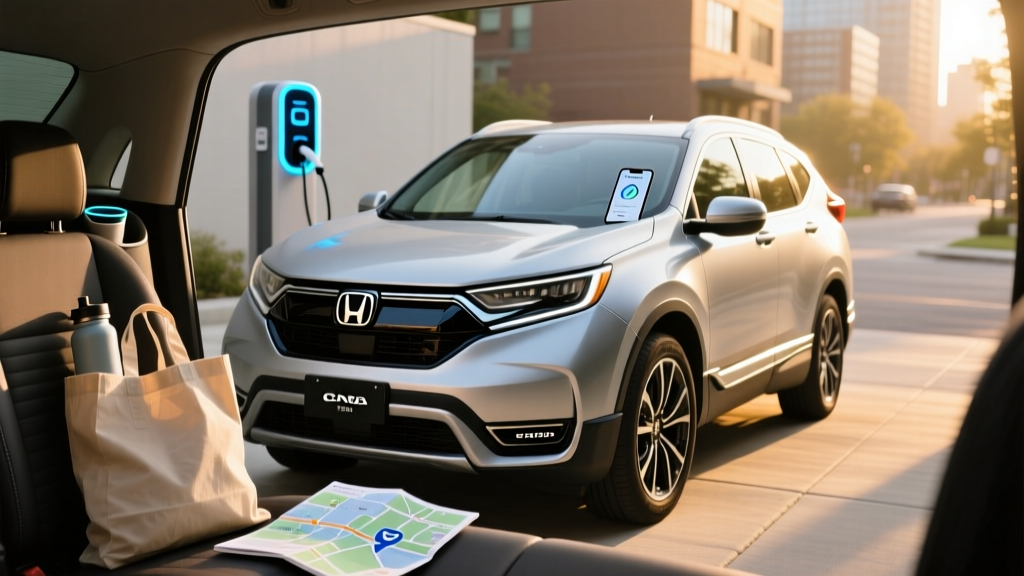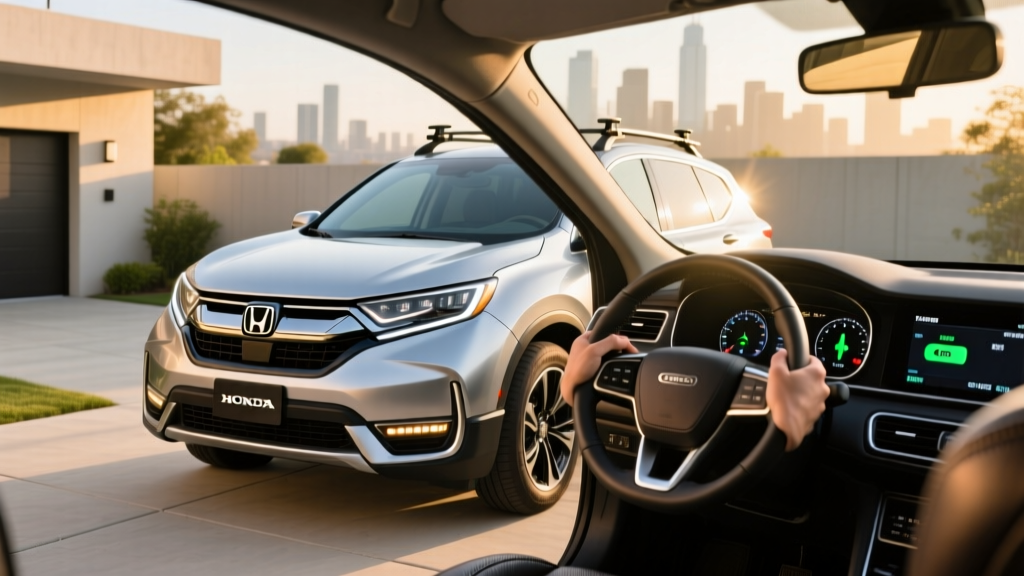
The Honda CR-V has long been the default compact SUV for practical buyers, and its hybrid variant has become the volume seller. For 2026, the CR-V Hybrid continues with Honda's proven two-motor hybrid system, delivering class-leading fuel economy without requiring a plug. If you're researching the 2026 Honda CR-V Hybrid, this guide covers every number that matters — EPA MPG, real-world efficiency, powertrain specs, pricing by trim, battery warranty, and how it stacks up against plug-in hybrid and full-electric alternatives.
HEV vs PHEV: What the 2026 CR-V Hybrid Actually Is
Before diving into specs, it's critical to understand what you're buying. The 2026 Honda CR-V Hybrid is a conventional hybrid electric vehicle (HEV). It does not plug in. It has no electric-only driving range to speak of. Instead, it uses a small battery buffer and two electric motor-generators to recapture braking energy and assist the gasoline engine, dramatically improving fuel economy over the gas-only CR-V.
Honda does not currently offer a plug-in hybrid (PHEV) version of the CR-V in the US market. If you need electric-only commuting range and the ability to charge at home, you'll need to look at competitors like the Toyota RAV4 Prime or the Hyundai Tucson PHEV.
| Factor | CR-V Hybrid (HEV) | PHEV (e.g., RAV4 Prime) | Full EV (e.g., Ioniq 5) |
|---|---|---|---|
| Plugs in? | No | Yes | Yes |
| Electric-only range | ~1 mi at low speed | 35–42 mi | 250–320 mi |
| Home charging needed? | No | Recommended (Level 2) | Essential |
| Best for | No garage/outlet access; wants simplicity | Short commute + home charging | Home charging + mostly electric driving |
| Fuel cost savings vs gas | Moderate (~30%) | High if charging daily | Highest |
| Tailpipe emissions | Reduced | Very low (when charged) | Zero |
EPA Fuel Economy: 2026 CR-V Hybrid MPG Breakdown
The headline number for the 2026 CR-V Hybrid is its EPA-estimated fuel economy. Front-wheel-drive (FWD) models achieve the highest ratings, while all-wheel-drive (AWD) — which Honda calls Real Time AWD — costs you roughly 2–3 MPG across the board.
| Drivetrain | City MPG | Highway MPG | Combined MPG |
|---|---|---|---|
| FWD (Sport, Sport Touring) | 43 | 36 | 40 |
| AWD (Sport, Sport Touring) | 40 | 34 | 37 |
For reference, the gas-only 2026 CR-V with AWD returns an EPA-estimated 28 MPG combined. The hybrid's 37 MPG combined with AWD represents a 32% improvement in fuel efficiency — translating to roughly 150 fewer gallons per year at 15,000 miles driven.
Real-World MPG vs EPA Estimates
One of the most consistent findings across owner reports and independent testing: Honda's two-motor hybrid system tends to exceed its EPA city rating in real-world driving. The system operates as a series hybrid at low speeds (the engine acts as a generator while the electric motor drives the wheels), which is exceptionally efficient in stop-and-go traffic.
In real-world mixed driving, expect the following:
- City-heavy commuting: 41–45 MPG (FWD) — the hybrid system shines here
- Highway cruising at 70+ mph: 33–36 MPG (AWD) — aerodynamic drag reduces the hybrid advantage
- Cold weather (below 30°F): Expect a 5–10% reduction as the engine runs more frequently for cabin heat
- Mountainous terrain: Highly variable; regen recovers energy on descents but climbing demands more fuel
According to data compiled by fueleconomy.gov, the CR-V Hybrid's combined rating places it among the most efficient compact SUVs available without a plug.
Powertrain Specs: Engine, Motors, and Horsepower
The 2026 CR-V Hybrid uses Honda's fourth-generation two-motor hybrid system paired with a 2.0-liter Atkinson-cycle four-cylinder engine. Here are the exact figures:
| Engine | 2.0L DOHC Atkinson-cycle 4-cylinder |
| Engine output | 145 hp @ 6,100 rpm / 134 lb-ft torque |
| Electric motors | Two (one propulsion, one generator) |
| Propulsion motor output | 181 hp / 247 lb-ft torque |
| Combined system output | 204 hp / 247 lb-ft torque |
| Transmission | e-CVT (single-speed direct drive with lock-up clutch) |
| 0–60 mph (est.) | ~7.6 seconds |
| Drivetrain | FWD or Real Time AWD |
| Towing capacity | 1,000 lbs |
The combined 204 hp is a meaningful upgrade over the gas-only CR-V's 190 hp from its 1.5L turbo. More importantly, the electric motor delivers peak torque from zero RPM, giving the hybrid noticeably better low-speed responsiveness — the kind you feel merging onto highways or pulling away from stoplights.
The e-CVT is not a traditional belt-and-pulley CVT. Honda's system uses a fixed gear ratio with a lock-up clutch that engages at highway speeds to directly connect the engine to the wheels, eliminating the "rubber band" feel common in older CVT designs.
2026 CR-V Hybrid Pricing by Trim
Honda restricts the hybrid powertrain to the Sport and Sport Touring trims for 2026. Here is the MSRP breakdown (destination charge included):
- CR-V Hybrid Sport FWD: ~$36,395
- CR-V Hybrid Sport AWD: ~$37,895
- CR-V Hybrid Sport Touring AWD: ~$41,895
The Sport trim includes a 9-inch touchscreen with wireless Apple CarPlay and Android Auto, Honda Sensing safety suite, heated front seats, and dual-zone climate control. The Sport Touring adds leather upholstery, a Bose 12-speaker audio system, wireless phone charging, a heated steering wheel, and a hands-free power tailgate.
Does the 2026 CR-V Hybrid Qualify for a Federal Tax Credit?
No. The 2026 Honda CR-V Hybrid is a conventional HEV, not a plug-in vehicle. Under IRS §30D Clean Vehicle Credit rules, only battery electric vehicles (BEVs) and plug-in hybrid electric vehicles (PHEVs) with a minimum battery capacity of 7 kWh qualify for the federal tax credit of up to $7,500. The CR-V Hybrid's small battery (approximately 1.1 kWh) does not meet this threshold.
Some states and local utilities offer rebates for conventional hybrids, but these vary significantly by jurisdiction. Check with your state energy office or utility provider for current programs. Do not rely on dealer claims about hybrid tax credits — verify eligibility against IRS guidelines or consult a tax professional.
Battery Warranty, Lifespan, and Replacement Cost
2026 CR-V Hybrid Battery Warranty: Honda covers the hybrid battery pack for 8 years or 100,000 miles (whichever comes first) under the federal emissions warranty. In California Air Resources Board (CARB) states — which include CA, CO, CT, ME, MD, MA, NJ, NY, OR, RI, VT, and WA — the warranty extends to 10 years or 150,000 miles.
Honda's hybrid battery is a lithium-ion pack rated at approximately 1.1 kWh. Because conventional hybrids keep the battery in a narrow state-of-charge window (typically 40–80%), degradation is minimal compared to full EVs that regularly cycle from 10% to 90%+.
Real-World Battery Longevity
Honda's two-motor hybrid system has been in production since 2014 (Accord Hybrid), and field data is encouraging. High-mileage owner reports and fleet data suggest these batteries routinely last 150,000–200,000+ miles before requiring replacement. Unlike early-generation hybrids from two decades ago, modern lithium-ion packs with active thermal management degrade far more slowly.
If replacement is needed out of warranty, expect the following costs:
- OEM battery pack: $2,000–$3,500 (parts)
- Labor: $500–$900
- Total out-of-pocket: $2,500–$4,400 at a dealership
Independent hybrid specialists and refurbished battery options can reduce this to $1,500–$2,500. For context, this is roughly equivalent to a major transmission service on a conventional vehicle — not the catastrophic five-figure expense that early hybrid adopters feared.
Who Should Buy the 2026 CR-V Hybrid?
Choose the CR-V Hybrid If:
- You lack access to home or workplace charging (no plug needed)
- Your driving is city-heavy, where the hybrid system delivers 40+ MPG
- You want maximum fuel savings with zero behavioral change
- You need AWD for snow/rain but want better efficiency than a gas SUV
- You plan to own the vehicle 8+ years and value Honda's reliability record
Look Elsewhere If:
- You want electric-only commuting (consider the RAV4 Prime or Tucson PHEV)
- You tow more than 1,000 lbs (hybrid towing is limited)
- You want a federal tax credit (only PHEVs/BEVs qualify under §30D)
- You drive predominantly highway miles at 80+ mph (hybrid advantage shrinks)
- You want the lowest possible fuel cost and have home charging (a BEV wins)
CR-V Hybrid vs Full EV: The Honest Math
If you're cross-shopping the CR-V Hybrid against a full EV like the Hyundai Ioniq 5 or Tesla Model Y, the decision hinges on charging access and driving patterns. The CR-V Hybrid at 37 MPG (AWD) costs roughly $1,620/year in fuel at 15,000 miles and $4.00/gallon. A comparable EV charged at the national average of $0.16/kWh costs roughly $640/year in electricity — a savings of ~$980/year.
However, the EV requires home charging infrastructure ($500–$2,000 for Level 2 installation), carries higher insurance premiums in most states, and may present range challenges on road trips depending on your route. The CR-V Hybrid eliminates all of these friction points while still cutting your fuel bill by ~30% versus the gas-only CR-V.
Frequently Asked Questions
How many MPG does the 2026 CR-V Hybrid actually get in real driving?
The EPA rates the FWD model at 43 city / 36 highway / 40 combined, and AWD at 40 city / 34 highway / 37 combined. In real-world city-heavy driving, many owners report exceeding the EPA city figure by 2–5 MPG thanks to the hybrid system's efficiency at low speeds. Highway-only driving at 75+ mph will fall below the EPA highway estimate.
Does the CR-V Hybrid need to be plugged in?
No. The 2026 CR-V Hybrid is a conventional HEV. It charges its battery entirely through regenerative braking and the gasoline engine. There is no plug, no charging cable, and no electric-only range to manage. You fuel it like any other gas vehicle and simply enjoy better MPG.
Is the CR-V Hybrid available with all-wheel drive?
Yes. Honda's Real Time AWD is available on both the Sport and Sport Touring hybrid trims. AWD reduces combined fuel economy from 40 to 37 MPG — a modest penalty that most buyers in snow-belt states consider worthwhile.
How reliable is the Honda CR-V Hybrid system?
Honda's two-motor hybrid powertrain has been in continuous production since 2014 and is among the most proven hybrid systems on the market. The hybrid battery carries an 8-year/100,000-mile warranty (10-year/150,000-mile in CARB states). Long-term data from Accord Hybrid and CR-V Hybrid fleets shows battery replacement is rarely needed before 150,000 miles. According to IIHS, the 2026 CR-V also earns top safety ratings, contributing to lower insurance costs and long-term ownership peace of mind.
What is the difference between the CR-V Hybrid and the CR-V gas model?
The gas-only CR-V uses a 1.5L turbocharged engine producing 190 hp and achieves 28 MPG combined (AWD). The Hybrid uses a 2.0L engine plus two electric motors for 204 hp and 37 MPG combined (AWD). The hybrid costs roughly $3,000–$4,000 more upfront but recovers that premium in fuel savings within 3–5 years for an average driver, while also delivering smoother acceleration and quieter low-speed operation.
Does the 2026 CR-V Hybrid qualify for any tax credits?
The CR-V Hybrid does not qualify for the federal §30D Clean Vehicle Credit, which requires plug-in capability and a minimum 7 kWh battery. Some state and utility programs offer hybrid rebates, but these vary by location. Always verify current incentive eligibility through official state and IRS sources before making a purchase decision.