Quick Verdict: The TrailSport Hybrid Is the CR-V to Get
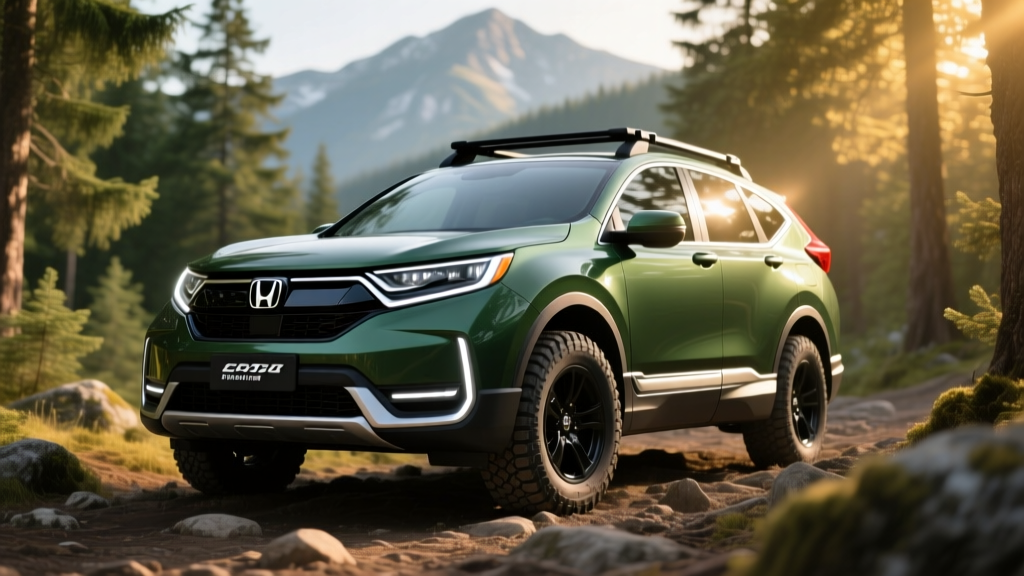
The 2026 Honda CR-V TrailSport Hybrid pairs Honda's proven two-motor hybrid system with genuine off-road styling cues, 8.3 inches of ground clearance, and all-wheel drive as standard. It isn't a plug-in hybrid — it's a conventional hybrid (HEV) that never needs to be plugged in, yet delivers up to 40 MPG combined on the EPA cycle. For buyers who want the ruggedness of the TrailSport badge without the fuel-economy penalty that typically comes with all-terrain tires and lifted suspensions, this is the trim that makes the most sense in the CR-V lineup.
Below, we break down the exact EPA numbers, real-world expectations, powertrain specs, pricing, tax-credit eligibility, and battery longevity so you can decide whether the TrailSport Hybrid fits your daily driving and weekend adventures.
HEV vs PHEV: What the TrailSport Hybrid Actually Is
Before we get into the numbers, it's critical to understand what you're buying. The 2026 CR-V TrailSport Hybrid is a conventional hybrid electric vehicle (HEV), not a plug-in hybrid (PHEV). Here's the practical difference:
| Feature | HEV (CR-V TrailSport Hybrid) | PHEV (e.g., CR-V e:PHEV — not sold in US) |
|---|---|---|
| Plugs in to charge? | No — regenerative braking + engine charges the battery | Yes — Level 1/Level 2 charging |
| Electric-only range | Less than 1 mile at very low speeds | Typically 25–35 miles |
| Battery size | ~1.06 kWh (small, self-charging) | ~17 kWh (larger, grid-chargeable) |
| Federal tax credit (§30D) | Not eligible | May qualify (if sold in US) |
| Best for | Drivers without home charging who want better MPG | Drivers with home charging who want short EV commutes |
Honda does not currently sell a plug-in hybrid version of the CR-V in the United States. If you see "CR-V PHEV" referenced online, that model is available in China and Europe but not in the US market. The TrailSport Hybrid is strictly a self-charging HEV.
Fuel Economy: EPA Ratings and Real-World MPG
The 2026 CR-V TrailSport Hybrid carries over the same powertrain tune as the rest of the CR-V Hybrid lineup, with EPA-estimated fuel economy that puts it among the most efficient compact SUVs with all-wheel drive.
| Driving Cycle | EPA Estimate | Real-World Expectation |
|---|---|---|
| City | 40 MPG | 38–43 MPG (hybrids often beat EPA city) |
| Highway | 34 MPG | 30–33 MPG (all-terrain tires add rolling resistance) |
| Combined | 37 MPG | 34–38 MPG |
Why real-world city MPG can exceed the EPA sticker: Honda's two-motor hybrid system relies heavily on the electric motor at low speeds, with the gasoline engine acting primarily as a generator. In stop-and-go traffic, regenerative braking recaptures energy that would otherwise be lost, and the engine shuts off entirely at stops. Owners who do mostly city and suburban driving frequently report 39–42 MPG on forums and fuel-tracking apps.
Why highway MPG falls short: The TrailSport's all-terrain tires (P235/60R18) create more rolling resistance and road noise than the all-season tires on the Sport Hybrid or EX-L Hybrid trims. At sustained highway speeds above 70 mph, the gasoline engine drives the wheels directly through a lockup clutch, and there's no electric assist to optimize efficiency. Expect 30–33 MPG on long road trips, especially with a roof rack or cargo box.
Total driving range: With a 15.3-gallon fuel tank and 37 MPG combined, the TrailSport Hybrid offers approximately 566 miles of total range. In real-world mixed driving, plan on 480–540 miles between fill-ups.
Powertrain: 204 Horsepower, Two Motors, and AWD
The TrailSport Hybrid uses Honda's fourth-generation two-motor hybrid system, shared across the CR-V Hybrid range. Here's the exact hardware:
| Specification | Detail |
|---|---|
| Gasoline engine | 2.0L DOHC Atkinson-cycle 4-cylinder |
| Engine power | 145 hp @ 6,100 rpm |
| Engine torque | 138 lb-ft @ 4,500 rpm |
| Drive motor | Permanent-magnet synchronous (front axle) |
| Drive motor power | 181 hp / 247 lb-ft |
| Combined system output | 204 hp / 247 lb-ft |
| Transmission | Electronically controlled CVT (e-CVT) |
| Drivetrain | Real-Time AWD with torque vectoring (standard on TrailSport) |
| 0–60 mph | ~7.7 seconds |
| Towing capacity | 1,000 lbs |
| Ground clearance | 8.3 inches |
| Battery type | Lithium-ion, ~1.06 kWh usable |
The e-CVT here is not a traditional belt-and-pulley CVT. It's a direct-drive system where the engine and motor are coupled through a planetary gearset. Under light loads, the motor drives the wheels alone. Under hard acceleration, both the engine and motor contribute. At highway cruising speeds, a lockup clutch engages to connect the engine directly to the wheels, bypassing the generator-motor loop for better efficiency.
The Real-Time AWD system sends up to 50% of torque to the rear axle when slip is detected. The TrailSport trim adds unique tuning for low-traction surfaces, including revised traction control mapping for mud, sand, and snow.
Pricing, Trims, and Tax Credit Eligibility
The 2026 CR-V TrailSport Hybrid sits near the top of the CR-V lineup. Pricing reflects the off-road equipment and standard AWD:
| Item | Amount |
|---|---|
| MSRP (TrailSport Hybrid AWD) | $42,350 (including destination) |
| Available options | Radiant Red Metallic paint (+$395), cargo package (+$300) |
| As-tested typical price | $42,350–$43,045 |
Federal tax credit status: The CR-V TrailSport Hybrid is a conventional hybrid (HEV), not a plug-in hybrid or battery-electric vehicle. Under current IRS §30D rules, only vehicles with a battery capacity of at least 7 kWh that can be plugged into an external power source qualify for the federal clean vehicle credit. The TrailSport Hybrid's ~1.06 kWh battery does not meet this threshold.
- ❌ Not eligible for the §30D new clean vehicle credit (up to $7,500)
- ❌ Not eligible for the §25E used clean vehicle credit (up to $4,000)
- ✅ May qualify for certain state-level hybrid incentives (varies by state — check your state energy office)
If the lack of a federal tax credit is a dealbreaker and you want an electrified Honda with plug-in capability, consider the Honda Clarity PHEV (discontinued but available used) or look at competitors like the Toyota RAV4 Prime PHEV, which does qualify for partial credits depending on battery sourcing.
Reliability and Battery Warranty
Honda's hybrid system has matured significantly since its introduction. The fourth-generation two-motor setup used in the 2026 CR-V Hybrid has been in production since the 2023 model year, giving Honda several years of field data and refinement.
Hybrid Battery and Powertrain Warranty
| Hybrid battery warranty | 8 years / 100,000 miles (10 years / 150,000 miles in CARB states) |
| Powertrain warranty | 5 years / 60,000 miles |
| Basic vehicle warranty | 3 years / 36,000 miles |
| Hybrid battery replacement cost (out of warranty) | Estimated $2,000–$3,500 (based on prior-gen CR-V Hybrid pricing) |
Honda's hybrid batteries are designed to last the life of the vehicle. The ~1.06 kWh battery in the CR-V Hybrid operates in a narrow state-of-charge window (roughly 40–60% SoC most of the time), which minimizes degradation. The battery management system prevents deep discharges and full charges — the two conditions that accelerate lithium-ion wear.
In IIHS testing, the CR-V continues to earn top safety marks, and NHTSA ratings (when published) typically follow suit. For long-term reliability data, Consumer Reports and J.D. Power vehicle dependability studies consistently place Honda hybrids above average.
Battery replacement reality: While out-of-pocket replacement costs $2,000–$3,500, the vast majority of CR-V Hybrid owners will never need one. Honda's 8-year/100,000-mile warranty (extended in California Air Resources Board states to 10 years/150,000 miles) covers capacity loss below a defined threshold. If you plan to keep the vehicle beyond the warranty period, budgeting for a potential replacement is prudent but statistically unlikely to be needed before 150,000+ miles.
TrailSport-Specific Equipment: What You Get for the Premium
The TrailSport badge on the CR-V Hybrid isn't just an appearance package. Here's what distinguishes it from the Sport Touring Hybrid and other trims:
- All-terrain tires: P235/60R18 all-terrain tires on exclusive 18-inch Berlina Black wheels
- Increased ground clearance: 8.3 inches (0.6 inches more than standard CR-V Hybrid trims)
- Revised suspension tuning: Softer damping for rough-road compliance
- Unique drive modes: Trail-specific traction control mapping for mud, sand, and gravel
- Underbody skid plates: Engine and fuel tank protection
- Orange accent stitching: Interior contrast stitching and TrailSport badging
- Heated front seats and steering wheel: Standard (leather-trimmed interior)
- Wireless Apple CarPlay and Android Auto: On the 9-inch touchscreen
- Honda Sensing suite: Adaptive cruise control, lane-keeping assist, collision mitigation braking, road sign recognition — all standard
One trade-off worth noting: the all-terrain tires generate noticeably more road noise on pavement compared to the Sport Touring Hybrid's all-season tires. If your driving is 95% highway commuting and 5% light trails, the Sport Touring Hybrid may be the quieter, slightly more efficient choice. If you regularly drive on unpaved roads, campgrounds, or snow, the TrailSport's tires and ground clearance justify the trade-off.
Who Should Choose the TrailSport Hybrid vs a Full EV or Gas CR-V?
Choose the 2026 CR-V TrailSport Hybrid if:
- You don't have access to home or workplace Level 2 charging (apartment, street parking)
- You want 37+ MPG combined without changing any habits — no plugging in, no range planning
- You regularly drive on unpaved roads, fire roads, or in deep snow and need 8.3 inches of ground clearance
- You want AWD and plan to keep the vehicle 8+ years (hybrid battery warranty coverage)
- You tow occasionally (1,000-lb capacity covers a small utility trailer or dirt bikes)
Choose a full EV (e.g., Hyundai Ioniq 5, Tesla Model Y) instead if:
- You have reliable home Level 2 charging and want zero tailpipe emissions
- Your daily commute is under 50 miles round-trip and you rarely tow
- You want to qualify for the $7,500 federal tax credit (subject to IRS §30D eligibility)
- You want lower per-mile energy costs (~$0.04/mile on electricity vs ~$0.12/mile on gas at 37 MPG and $3.50/gal)
Choose the gas-only CR-V (EX AWD, ~$36,000) instead if:
- Your budget is tight and you drive fewer than 8,000 miles per year (the hybrid fuel savings won't offset the ~$6,000 price premium quickly)
- You want maximum towing capacity (gas CR-V AWD: 1,500 lbs vs hybrid's 1,000 lbs)
Pros and Cons
Pros
- 40 MPG city / 37 MPG combined with AWD standard
- 8.3 inches of ground clearance with real all-terrain tires
- No plug-in charging required — zero behavior change
- 204 hp combined output is responsive for merging and passing
- 8-year / 100,000-mile hybrid battery warranty (10/150k in CARB states)
- Honda Sensing ADAS suite standard on all trims
- 566-mile total range eliminates range anxiety entirely
Cons
- No federal tax credit eligibility (HEV, not PHEV or BEV)
- All-terrain tires create more road noise on highway
- 1,000-lb towing capacity (gas CR-V AWD tows 1,500 lbs)
- MSRP near $42,500 is a significant premium over base CR-V
- Highway MPG drops to ~30–33 with roof cargo or high speeds
- No plug-in hybrid CR-V available in the US market
Frequently Asked Questions
How many MPG does the 2026 Honda CR-V TrailSport Hybrid get?
The EPA rates it at 40 MPG city, 34 MPG highway, and 37 MPG combined. In real-world city driving, many owners report 38–43 MPG. Highway driving typically yields 30–33 MPG, especially with all-terrain tire rolling resistance and speeds above 70 mph.
Does the CR-V TrailSport Hybrid need to be plugged in?
No. It is a conventional hybrid (HEV). The battery charges through regenerative braking and the gasoline engine. You fuel it like any other car — just with fewer stops at the pump.
Is the CR-V TrailSport Hybrid reliable, and what does a battery replacement cost?
Honda's fourth-generation hybrid system has a strong reliability track record. The hybrid battery is covered by an 8-year/100,000-mile warranty (10 years/150,000 miles in CARB states). Out-of-warranty replacement is estimated at $2,000–$3,500, though most owners will never need one before 150,000+ miles.
Does the 2026 CR-V TrailSport Hybrid qualify for any tax credit?
It does not qualify for the federal §30D clean vehicle credit because it is a conventional hybrid with a battery below the 7 kWh minimum and no plug-in capability. Some state-level incentives may apply — check with your state energy office or a tax professional.
How does the TrailSport Hybrid compare to the Toyota RAV4 Hybrid Woodland Edition?
The RAV4 Hybrid Woodland Edition is the closest competitor, offering similar all-terrain tires and AWD at a comparable price. The RAV4 Hybrid is EPA-rated at 39 MPG combined (2 MPG higher), but the CR-V TrailSport Hybrid offers more interior cargo volume (76.5 cu ft vs 69.8 cu ft behind front seats) and a more refined e-CVT driving experience. Both are strong choices — test-drive both before deciding.
Can the TrailSport Hybrid run on electric power alone?
Only at very low speeds (under ~15 mph) for short distances (a few hundred feet), such as creeping through a parking lot or in heavy stop-and-go traffic. The battery is too small (~1.06 kWh) to sustain electric-only driving at any meaningful speed or distance. This is normal for conventional hybrids.
What is the real-world highway fuel economy on a road trip?
On a flat, 70-mph highway drive in moderate temperatures, expect 32–34 MPG. With a roof cargo box, headwinds, mountain grades, or speeds above 75 mph, expect 28–31 MPG. The all-terrain tires are the primary efficiency penalty versus the Sport Touring Hybrid, which achieves 34 MPG highway on all-season rubber.