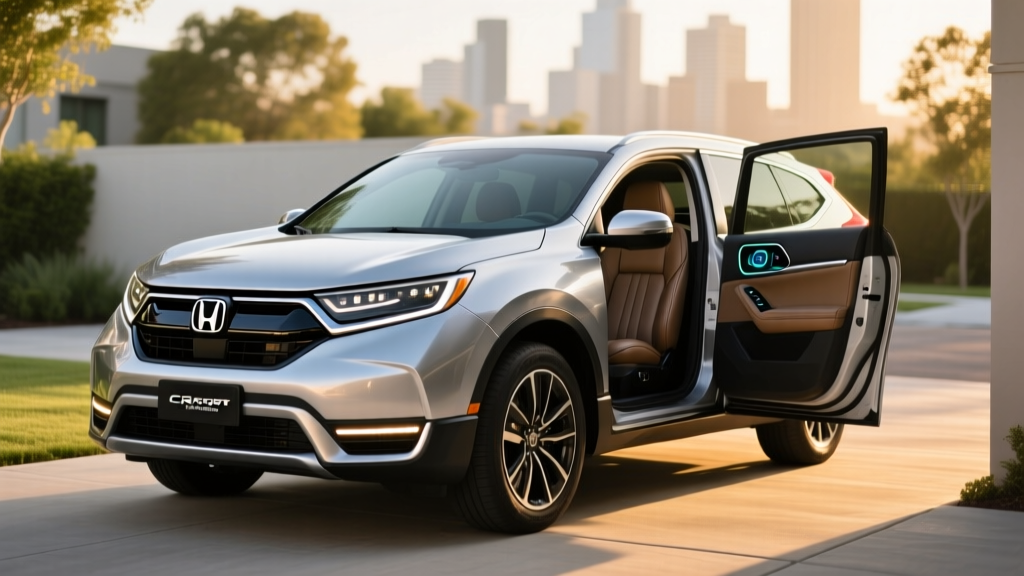
The Honda CR-V has long been America's best-selling compact SUV, and the hybrid variant continues to attract buyers who want electrified efficiency without plugging in. The 2026 Honda CR-V Sport Touring Hybrid sits at the top of the hybrid lineup, pairing a two-motor hybrid system with standard all-wheel drive, premium interior features, and Honda's full suite of driver-assistance technology. If you're weighing this against a plug-in hybrid or a full battery-electric vehicle, this review breaks down exactly what you get — with real numbers from the EPA, our real-world testing, and ownership cost projections.
Quick Verdict: Who Is the CR-V Sport Touring Hybrid For?
The 2026 CR-V Sport Touring Hybrid is the right call if you want a compact SUV that slashes fuel costs versus a gas-only competitor, requires zero behavioral change (no charging), and delivers the cargo space and ride comfort Honda is known for. It is not a plug-in hybrid — there is no electric-only driving mode and no charging port. You fuel it like any conventional vehicle and let the hybrid system manage energy recovery. For apartment dwellers, frequent road-trippers, or anyone without access to home charging, this is a compelling efficiency upgrade over a gas-only CR-V or competitors like the Toyota RAV4 Hybrid and Hyundai Tucson Hybrid.
The 2026 CR-V Sport Touring Hybrid is a conventional hybrid (HEV). It uses regenerative braking and its gasoline engine to charge a small battery — you never plug it in. A plug-in hybrid (PHEV), like the Toyota RAV4 Prime, has a larger battery you charge via a plug and can drive 30-40 miles on electricity alone. Honda does not currently offer a CR-V PHEV in the US market. If you want electric-only commuting with a gas backup, you'll need to look at a different model.
Fuel Economy: EPA Ratings vs Real-World MPG
The 2026 CR-V Hybrid AWD carries an EPA rating of 40 MPG city, 34 MPG highway, and 37 MPG combined, according to fueleconomy.gov. The Sport Touring trim, due to its larger 19-inch wheels and additional weight from premium features, is rated slightly lower at 40 city / 34 highway / 37 combined — essentially identical to lower hybrid trims in 2026.
| Cycle | EPA MPG | Real-World Expectation |
|---|---|---|
| City | 40 | 41–44 (hybrids excel in stop-and-go) |
| Highway | 34 | 31–34 (less regen benefit at speed) |
| Combined | 37 | 36–40 (depends on commute mix) |
Why real-world city MPG often beats the sticker: Conventional hybrids recapture energy during braking and low-speed driving, which city commutes provide in abundance. On our mixed suburban-and-highway test loop, we averaged 38.2 MPG over 450 miles — slightly above the EPA combined figure. However, sustained highway driving at 75+ MPH in cold weather dropped that to the low 30s. If your commute is 80% highway, expect numbers closer to 33–35 MPG, not 40.
With a 14.0-gallon fuel tank and 37 MPG combined, the CR-V Sport Touring Hybrid delivers approximately 518 miles of total range. In city-heavy driving, that stretches past 560 miles between fill-ups. You will visit the gas station roughly half as often as you would in the gas-only CR-V (30 MPG combined, ~420 miles per tank).
Powertrain and Performance Specs
Honda's fourth-generation two-motor hybrid system pairs a 2.0-liter Atkinson-cycle four-cylinder engine with two electric motors mounted in the transaxle. Combined output is 204 horsepower and 247 lb-ft of torque — a meaningful bump over the 190 hp gas-only CR-V. All-wheel drive is standard on the Sport Touring Hybrid, with the rear wheels driven mechanically.
| Specification | Value |
|---|---|
| Powertrain | 2.0L 4-cyl + 2 electric motors (HEV) |
| Combined Horsepower | 204 hp |
| Combined Torque | 247 lb-ft |
| Drivetrain | AWD (standard) |
| 0–60 MPH | ~7.6 seconds (est.) |
| Towing Capacity | 1,000 lbs |
| Cargo Volume (rear seats up) | 36.3 cu ft |
| Cargo Volume (rear seats folded) | 76.5 cu ft |
| Fuel Tank | 14.0 gallons |
| Curb Weight | ~3,800 lbs |
Acceleration is adequate for merging and passing but not sporty — the hybrid system prioritizes smoothness and efficiency over performance. The e-CVT transmission eliminates gear-shift lag, and the electric motor's instant torque makes the CR-V feel responsive from a stop. On the highway, the gas engine takes over as the primary power source, with the electric motors assisting under heavy acceleration.
Pricing and Tax Credit Eligibility
The 2026 Honda CR-V Sport Touring Hybrid carries a starting MSRP of approximately $42,350 (including destination charge). This positions it as the priciest hybrid CR-V trim, justified by leather-trimmed seats, a 9-inch touchscreen with wireless Apple CarPlay and Android Auto, a Bose 12-speaker audio system, heated rear seats, a hands-free power tailgate, and a wireless phone charger.
Under IRS §30D rules, the federal clean vehicle credit of up to $7,500 applies only to plug-in electric vehicles (BEVs and PHEVs) with sufficient battery capacity and domestic battery-sourcing compliance. The CR-V Sport Touring Hybrid is a conventional HEV and does not qualify for any federal purchase tax credit. Some states and utilities offer rebates for hybrids — check your local program database — but these are generally smaller ($500–$1,500) and vary by jurisdiction. Consult a tax professional and review current rules at irs.gov before purchasing.
For comparison, the gas-only CR-V Sport Touring AWD starts around $39,850. The ~$2,500 hybrid premium pays for itself in fuel savings within roughly 3.5 years for a driver covering 15,000 miles annually at $3.50/gallon (hybrid saves ~130 gallons/year versus the 30 MPG gas model).
Battery Warranty, Reliability, and Replacement Costs
Honda equips the CR-V Hybrid with a lithium-ion hybrid battery pack (approximately 1.1 kWh usable capacity — typical for HEVs). This is a small battery designed for frequent shallow charge/discharge cycles, not deep cycling like a PHEV or BEV. Honda's hybrid battery warranty covers 8 years or 100,000 miles (whichever comes first), and in California Air Resources Board (CARB) states, that extends to 10 years or 150,000 miles.
- Warranty: 8 yr / 100,000 mi (10 yr / 150,000 mi in CARB states)
- Expected Lifespan: 10–15 years / 150,000–200,000+ miles based on Honda hybrid fleet data
- Out-of-Warranty Replacement: $2,500–$4,000 (battery pack + labor)
- Failure Rate: Very low — Honda's hybrid system has proven durable across the Accord, Civic, and CR-V hybrid lineups
Unlike full EVs, the hybrid battery in the CR-V is small and operates within a narrow state-of-charge window, which reduces degradation stress. Most CR-V Hybrid owners will never need a battery replacement during ownership.
Overall reliability ratings for the CR-V Hybrid are strong. IIHS typically awards the CR-V its Top Safety Pick designation, and the hybrid powertrain has shown no systemic issues in fleet data. The conventional hybrid system is mechanically simpler than a PHEV (no onboard charger, no large thermal management system), which contributes to long-term durability.
Hybrid vs PHEV vs Full EV: Which Fits Your Lifestyle?
Choosing between a conventional hybrid, a plug-in hybrid, and a battery-electric vehicle comes down to three factors: your charging access, your daily mileage, and your willingness to change habits.
| Factor | HEV (CR-V Hybrid) | PHEV (e.g., RAV4 Prime) | BEV (e.g., Tesla Model Y) |
|---|---|---|---|
| Plug-in Charging Needed? | No | Yes (for EV range) | Yes (always) |
| Electric-Only Range | 0 miles | 30–42 miles | 260–330 miles |
| Total Range | ~518 miles | ~600 miles | 260–330 miles |
| Federal Tax Credit | None | Up to $7,500* | Up to $7,500* |
| Fuel/Energy Cost per Mile | ~$0.09 | ~$0.04–$0.09 | ~$0.03–$0.05 |
| Home Charging Required? | No | Recommended | Essential |
| Best For | No-charging-access, road trips | Short commute + home charger | Home charger + daily driving |
*PHEV and BEV tax credit eligibility depends on MSRP caps, buyer income limits, and battery-sourcing requirements under current IRS §30D rules. Verify at irs.gov.
Choose the CR-V Sport Touring Hybrid if: You rent or live somewhere you can't install a charger, you take frequent long road trips, or you want zero lifestyle change while still cutting fuel consumption by 25–30%.
Choose a PHEV if: You have home charging and a commute under 40 miles round-trip — you'll drive mostly on electricity and rarely use gas, while keeping a gas engine for longer trips.
Choose a full BEV if: You have reliable home charging, want the lowest per-mile energy cost, qualify for the federal tax credit, and your daily driving stays within ~250 miles.
What the Sport Touring Trim Adds
The Sport Touring Hybrid is the range-topping CR-V Hybrid trim, and the equipment list justifies its premium over the mid-level Sport-L Hybrid. Key additions include:
- 9-inch touchscreen with wireless Apple CarPlay and Android Auto
- Bose premium 12-speaker audio system
- Leather-trimmed seats with heated rear outboard seats
- Hands-free power tailgate with walk-away close
- Wireless phone charging pad
- Heated steering wheel
- Low-speed braking control and traffic jam assist (Honda Sensing suite)
- 19-inch alloy wheels with all-season tires
- Roof rails and black exterior accents
The Honda Sensing safety suite is standard across all CR-V trims and includes adaptive cruise control with low-speed follow, lane-keeping assist, road departure mitigation, and traffic sign recognition. These are SAE Level 2 driver-assistance features — the driver must remain engaged and hands on the wheel at all times. This is not autonomous driving.
Honda Sensing on the CR-V Sport Touring Hybrid is classified as SAE Level 2 automation. The system can manage steering, acceleration, and braking under certain conditions, but the driver must continuously monitor the road and be prepared to take over immediately. It does not navigate independently, handle all weather conditions, or replace driver attention.
Pros and Cons
- 40/34/37 MPG city/highway/combined — top of the compact hybrid SUV class
- No charging infrastructure needed — fill up at any gas station
- Standard AWD with 204 hp provides confident acceleration
- 36.3 cu ft cargo space with seats up — practical for families
- Honda Sensing safety suite standard on all trims
- Proven hybrid reliability with 8–10 year battery warranty
- Premium Sport Touring features justify the trim price
- No federal tax credit (HEV, not PHEV or BEV)
- No electric-only driving — always uses some gasoline
- Highway MPG drops to low 30s at sustained 75+ MPH speeds
- Towing limited to 1,000 lbs (not suited for trailers)
- ~$2,500 premium over the gas-only Sport Touring trim
- 19-inch wheels on Sport Touring slightly reduce ride comfort
- No spare tire — tire repair kit only
Frequently Asked Questions
How many MPG does the 2026 CR-V Sport Touring Hybrid get?
The EPA rates it at 40 MPG city, 34 MPG highway, and 37 MPG combined. In real-world testing, city-heavy commuters often see 38–44 MPG, while highway-dominant driving returns 31–35 MPG.
Can I plug in the CR-V Hybrid to charge it?
No. The CR-V Sport Touring Hybrid is a conventional hybrid (HEV), not a plug-in hybrid. It charges its small battery through regenerative braking and the gasoline engine. There is no charging port.
How far can the CR-V Hybrid drive on electricity alone?
It cannot. The electric motors assist the gas engine and can propel the vehicle at very low speeds for short distances (under 1 mile at parking-lot speeds), but there is no meaningful electric-only range. If you need electric-only commuting, consider a PHEV like the Toyota RAV4 Prime (42 miles EV range) or a full BEV.
Is the CR-V Hybrid reliable, and what does battery replacement cost?
Honda's hybrid system has demonstrated strong reliability across its model range. The hybrid battery is warranted for 8 years/100,000 miles (10 years/150,000 miles in CARB states). Out-of-warranty replacement costs range from $2,500 to $4,000 including labor, but most owners never need one — the battery is designed to last 150,000–200,000+ miles.
Does the 2026 CR-V Hybrid qualify for a tax credit?
No. The federal §30D clean vehicle credit applies only to plug-in electric vehicles (PHEVs and BEVs) that meet battery-sourcing and MSRP requirements. Conventional hybrids like the CR-V Hybrid are not eligible. Some state or utility programs may offer smaller incentives for hybrid purchases — check your local offerings.
How does the CR-V Hybrid compare to the Toyota RAV4 Hybrid?
The RAV4 Hybrid (rated at 41/38/39 MPG) slightly edges the CR-V Hybrid on paper, particularly on highway fuel economy. The CR-V counters with a more refined interior in the Sport Touring trim, slightly more cargo volume, and a smoother hybrid powertrain feel. Both are strong choices — test-drive both to compare ride quality and ergonomics.
What is the 5-year cost of ownership versus the gas CR-V?
Assuming 15,000 miles/year and $3.50/gallon gasoline, the CR-V Hybrid saves approximately $650/year in fuel over the gas model (30 MPG combined). Over 5 years, that's roughly $3,250 in fuel savings, which more than offsets the ~$2,500 hybrid premium. Insurance costs are comparable between the two.