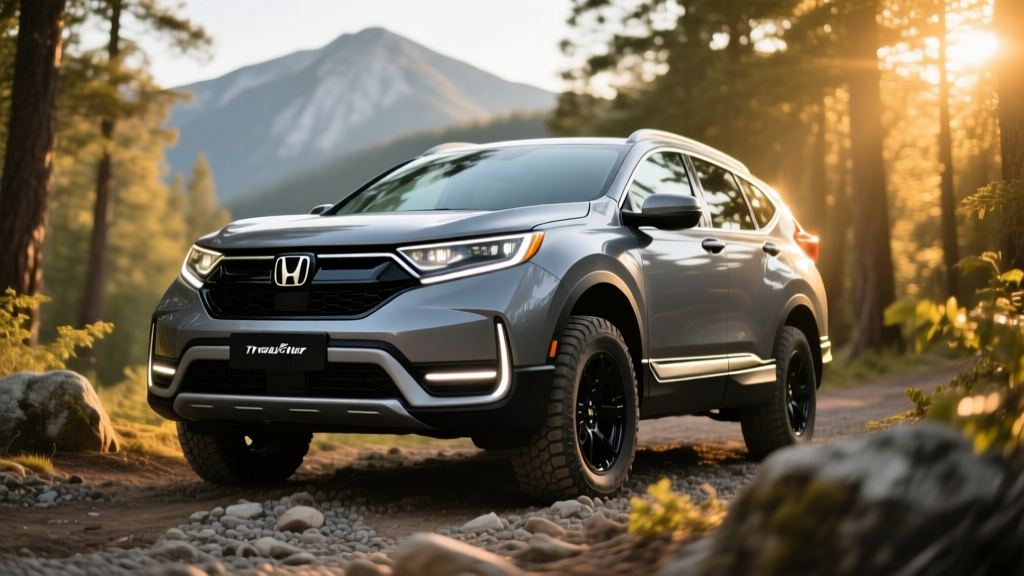
The Honda CR-V Hybrid has carved out a dominant position in the compact hybrid SUV segment, and the 2026 Honda CR-V Sport-L Hybrid sits at a compelling point in the lineup. It pairs Honda's fourth-generation two-motor hybrid system with the upscale Sport-L trim—offering leather-trimmed seating, a power tailgate, and wireless smartphone integration—without stepping all the way up to the Sport Touring. For buyers weighing fuel savings against a full EV's charging demands, this conventional hybrid (HEV) eliminates the plug entirely while still delivering substantial efficiency gains over the gas-only CR-V.
Below, we break down every number that matters: EPA fuel economy, real-world MPG expectations, powertrain output, pricing by trim, battery warranty coverage, and how the Sport-L Hybrid stacks up against both plug-in hybrid (PHEV) rivals and full battery-electric alternatives.
2026 Honda CR-V Sport-L Hybrid: Key Specifications
| Specification | 2026 CR-V Sport-L Hybrid (FWD) | 2026 CR-V Sport-L Hybrid (AWD) |
|---|---|---|
| Powertrain | 2.0L Atkinson-cycle I-4 + 2-motor hybrid system | 2.0L Atkinson-cycle I-4 + 2-motor hybrid system |
| Combined Horsepower | 204 hp | 204 hp |
| Combined Torque | 247 lb-ft (motor) | 247 lb-ft (motor) |
| EPA City MPG | 43 | 40 |
| EPA Highway MPG | 36 | 34 |
| EPA Combined MPG | 40 | 37 |
| Fuel Tank Capacity | 14.0 gal | 14.0 gal |
| Total Driving Range | ~560 miles | ~518 miles |
| 0–60 mph | ~7.6 sec | ~7.8 sec |
| Cargo Volume (behind rear seats) | 36.3 cu ft | 36.3 cu ft |
| Cargo Volume (rear seats folded) | 76.5 cu ft | 76.5 cu ft |
| Towing Capacity | 1,000 lbs | 1,000 lbs |
| Base MSRP | ~$37,295 | ~$38,795 |
| Hybrid Battery Warranty | 8 years / 100,000 miles | 8 years / 100,000 miles |
Sources: EPA fueleconomy.gov, Honda CR-V Hybrid official page. Pricing reflects estimated 2026 MSRP including destination; verify with your dealer.
Fuel Economy: EPA Ratings vs. Real-World MPG
The front-wheel-drive 2026 CR-V Sport-L Hybrid earns an EPA-estimated 43 city / 36 highway / 40 combined MPG. Opting for all-wheel drive drops those figures to 40 city / 34 highway / 37 combined. These are strong numbers for a compact SUV, but real-world results depend heavily on your driving profile.
City-heavy commuting (under 45 mph): Expect 41–46 MPG. Honda's hybrid system excels here—the electric motor handles low-speed propulsion while the gas engine acts primarily as a generator, avoiding inefficient low-RPM operation. Many owners report beating the EPA city estimate in stop-and-go traffic.
Highway cruising (70–80 mph): Expect 32–36 MPG. At sustained highway speeds, the engine drives the wheels directly via a lock-up clutch, but aerodynamic drag and the SUV's weight work against efficiency. Highway MPG typically falls below the EPA sticker.
Cold weather (below 35°F): Expect a 10–15% reduction across the board. The engine runs more frequently to provide cabin heat and maintain catalytic converter temperature, reducing the hybrid system's electric-only operation windows.
The critical takeaway: if your commute is primarily urban or suburban at moderate speeds, the CR-V Hybrid's real-world economy will likely meet or exceed the EPA combined figure. If you drive mostly highway miles at high speeds, plan for numbers closer to the low-to-mid 30s.
How Honda's Hybrid Powertrain Works
The CR-V Sport-L Hybrid uses Honda's fourth-generation two-motor hybrid system, which operates differently from Toyota's planetary-gear power-split design. Here's how it functions across driving conditions:
- EV Drive (low speed, light load): The lithium-ion battery powers the propulsion motor alone. The gas engine stays off. This mode covers parking lots, residential streets, and gentle acceleration up to roughly 25–35 mph depending on battery state of charge.
- Hybrid Drive (normal acceleration): The 2.0L Atkinson-cycle engine spins a generator motor that produces electricity. That electricity feeds the propulsion motor, which drives the wheels. The engine never mechanically connects to the wheels in this mode—it operates at its most efficient RPM regardless of vehicle speed.
- Engine Drive (steady highway cruising): Above approximately 45–55 mph under light load, a lock-up clutch engages, connecting the engine directly to the front wheels through a single fixed gear ratio. This avoids the efficiency losses of generating electricity just to convert it back to mechanical energy.
- Regenerative Braking: During deceleration, the propulsion motor acts as a generator, recovering kinetic energy back into the battery. Paddle shifters behind the steering wheel let you select from four levels of regen intensity, though the CR-V does not offer true one-pedal driving to a complete stop like some EVs.
The combined system output is 204 horsepower, with the propulsion motor delivering 247 lb-ft of torque from near zero RPM. That torque figure is what makes the CR-V Hybrid feel genuinely responsive around town—it doesn't wait for a downshift or turbo spool-up. The AWD model adds a rear-mounted electric motor that provides torque to the rear axle when traction demands it, though this is not a full-time AWD system.
Hybrid (HEV) vs. Plug-In Hybrid (PHEV): What's the Difference?
A common source of confusion for SUV shoppers is the distinction between a conventional hybrid like the CR-V Sport-L Hybrid and a plug-in hybrid (PHEV) like the Toyota RAV4 Prime or Hyundai Tucson PHEV. Here's a clear breakdown:
| Feature | HEV (CR-V Sport-L Hybrid) | PHEV (e.g., RAV4 Prime) | BEV (e.g., Tesla Model Y) |
|---|---|---|---|
| Plug-in charging required? | No — self-charging via engine & regen | Yes — plug in for electric-only range | Yes — sole energy source |
| Battery size | ~1.1 kWh (small buffer) | ~18.1 kWh | 60–82 kWh |
| Electric-only range | ~0.5–1 mile at low speed | 35–42 miles | 250–330 miles |
| Total range | ~520–560 miles | ~550–600 miles | 250–330 miles |
| Fuel/energy cost per mile | ~$0.10–$0.12 (gas at $3.50/gal) | ~$0.04 electric / ~$0.10 gas | ~$0.04–$0.06 (electricity) |
| Federal tax credit (§30D) | Not eligible | Up to $7,500 (if eligible) | Up to $7,500 (if eligible) |
| Home charging install needed? | No | Recommended (Level 2) | Essential (Level 2) |
| Starting MSRP range | ~$37,000–$41,000 | ~$44,000–$50,000 | ~$38,000–$55,000 |
The bottom line: The CR-V Sport-L Hybrid is a conventional hybrid. You never plug it in. It charges its own small battery through regenerative braking and the gasoline engine. If you want electric-only commuting, you need a PHEV or BEV. If you want zero lifestyle change with meaningfully better fuel economy, the HEV is the right call.
Does the 2026 CR-V Hybrid Qualify for Any Tax Credits?
No. The Honda CR-V Sport-L Hybrid is a conventional hybrid (HEV), not a plug-in vehicle. It does not qualify for the federal §30D Clean Vehicle Credit, which is reserved for battery-electric vehicles (BEVs) and plug-in hybrids (PHEVs) with battery capacities of at least 7 kWh.
The federal hybrid tax credit that once existed for vehicles like the original Honda Insight expired years ago. Currently, there is no federal purchase incentive for conventional hybrids. Some states or municipalities may offer minor incentives for high-efficiency vehicles—check your state's energy office or Alternative Fuels Data Center for local programs—but these are uncommon and typically modest.
If a dealer tells you the CR-V Hybrid qualifies for a $7,500 federal credit, they are mistaken or referring to a different vehicle. The §30D credit applies only to plug-in vehicles meeting battery sourcing, MSRP caps ($55,000 for SUVs), and buyer income limits. The CR-V Hybrid's efficiency comes at the pump, not on your tax return. Consult a tax professional or IRS.gov for current credit rules.
Pricing: 2026 CR-V Sport-L Hybrid Trim Breakdown
The Sport-L Hybrid occupies a strategic middle-ground in the CR-V Hybrid lineup. Here's how the 2026 pricing structure shapes up (estimated MSRP including destination charge):
| Trim | FWD MSRP | AWD MSRP | Key Additions over Sport Hybrid |
|---|---|---|---|
| Sport Hybrid | ~$35,395 | ~$36,895 | Base hybrid sport trim |
| Sport-L Hybrid | ~$37,295 | ~$38,795 | Leather-trimmed seats, power tailgate, wireless CarPlay/Android Auto, heated front seats |
| Sport Touring Hybrid | ~$40,895 | ~$40,895 | AWD standard, Bose 12-speaker audio, navigation, heated steering wheel, front parking sensors |
The $1,900 premium from Sport to Sport-L is justified by the leather interior and power tailgate alone—features most buyers in this price bracket expect. The jump to Sport Touring adds roughly $2,100–$3,600 depending on drivetrain, primarily for premium audio and navigation, which are nice-to-haves rather than essentials for most buyers.
Reliability, Battery Lifespan, and Warranty Coverage
Hybrid battery longevity remains the top concern for buyers considering their first hybrid. Here's what the data and warranty terms tell us:
Warranty: Honda covers the hybrid battery for 8 years or 100,000 miles (whichever comes first) in all 50 states. In CARB-adopting states (CA, NY, MA, and others), the warranty extends to 10 years or 150,000 miles under emissions component coverage.
Real-world lifespan: Honda's lithium-ion hybrid battery is significantly smaller (~1.1 kWh) than an EV battery and cycles far less aggressively. Based on data from prior-generation CR-V Hybrids (2020–2025) and Accord Hybrids using similar systems, hybrid battery failures before 150,000 miles are rare. Most hybrid batteries outlast the vehicle itself.
Replacement cost (out of warranty): If a replacement is needed, expect $2,000–$3,500 for the battery pack, plus labor. This is substantially less than an EV battery replacement ($8,000–$20,000+) because the pack is far smaller.
General reliability: Honda's hybrid system has proven durable. The 2.0L Atkinson-cycle engine is underworked (it rarely operates at high load), and the e-CVT transmission has no traditional gears, belts, or clutch packs to wear out. IIHS crash-test ratings should be verified once published for the 2026 model year.
For context, the hybrid system's simplicity works in its favor. There's no starter motor, no alternator, and no traditional transmission—components that commonly fail on gas-only vehicles. The regenerative braking system also reduces wear on the friction brake pads, which routinely last 60,000–80,000+ miles on Honda Hybrids.
Who Should Buy the CR-V Sport-L Hybrid — and Who Shouldn't?
Choose This Hybrid If:
- You want 37–40 MPG without changing any habits—no plugging in, no range planning, no charging apps
- Your daily commute is 20–60 miles of mixed city/suburban driving where the hybrid system shines
- You need a compact SUV with real cargo space (36.3 cu ft) and occasional AWD traction
- You plan to own the vehicle 8+ years and value Honda's long-term reliability record
- You want to spend under $40,000 on a well-equipped hybrid SUV without waiting for tax-credit eligibility
Look Elsewhere If:
- You want electric-only commuting — consider a PHEV like the RAV4 Prime (42 mi EV range) or Tucson PHEV
- You want zero tailpipe emissions and have home charging — a BEV like the Ioniq 5 or Model Y offers lower operating costs
- You need to tow more than 1,000 lbs — the hybrid's towing capacity is limited; the gas CR-V AWD tows 1,500 lbs
- You drive predominantly highway miles at 75+ mph — the efficiency advantage narrows, and a diesel or turbo-gas SUV may match real-world MPG
- You want the latest Level 2+ driver-assist features — Honda Sensing is competent but less advanced than GM Super Cruise or Ford BlueCruise
Frequently Asked Questions
How many MPG does the 2026 Honda CR-V Sport-L Hybrid actually get?
The EPA rates the FWD model at 43 city / 36 highway / 40 combined MPG, and the AWD model at 40 city / 34 highway / 37 combined. In real-world city driving, expect 41–46 MPG. On the highway at 75 mph, expect 32–36 MPG. Cold weather reduces these figures by roughly 10–15%.
Do I need to plug in the CR-V Sport-L Hybrid?
No. This is a conventional hybrid (HEV), not a plug-in hybrid (PHEV). The battery charges itself through regenerative braking and the gasoline engine. There is no charging port, no plug, and no electric-only driving range to manage.
How far can the CR-V Hybrid drive on electric power alone?
Only about 0.5–1 mile at very low speeds (under 25 mph) on a fully charged hybrid battery. This is normal for conventional hybrids—the electric motor assists the gas engine rather than replacing it. If you want meaningful electric-only range (30–40 miles), you need a PHEV.
Is the Honda CR-V Hybrid reliable? What about battery replacement costs?
Honda's hybrid system has a strong reliability track record. The hybrid battery is warranted for 8 years/100,000 miles (10 years/150,000 miles in CARB states). Out-of-warranty replacement costs approximately $2,000–$3,500, though failures before 150,000 miles are uncommon based on prior-generation data.
Does the CR-V Sport-L Hybrid qualify for any federal tax credit?
No. The federal §30D Clean Vehicle Credit applies only to plug-in vehicles (BEVs and PHEVs). As a conventional hybrid, the CR-V Hybrid does not qualify. Your fuel savings come at the pump—roughly $500–$700 per year compared to the gas-only CR-V, depending on mileage and fuel prices.
How does the CR-V Hybrid compare to the Toyota RAV4 Hybrid?
The RAV4 Hybrid (LE AWD: 41 city / 38 highway / 40 combined) is the closest competitor. The RAV4 has slightly better highway MPG and standard AWD, while the CR-V Hybrid FWD edges ahead in city MPG. Both are excellent choices—the decision typically comes down to interior preference, infotainment usability, and local dealer pricing. The CR-V's cargo area is slightly larger, and its hybrid powertrain delivers more low-end torque (247 lb-ft vs. the RAV4's combined 163 lb-ft).
What's the annual fuel cost savings vs. the gas CR-V?
At 15,000 miles per year and $3.50/gallon gasoline, the gas-only CR-V AWD (28 combined MPG) costs approximately $1,875 per year in fuel. The CR-V Sport-L Hybrid AWD (37 combined MPG) costs approximately $1,419. That's a savings of roughly $456 per year, or $2,280 over five years. The hybrid premium over the gas EX-L AWD is typically $1,500–$2,000, so the fuel savings pay back the price difference in about 3–4 years.