Quick Verdict: The TrailSport Hybrid Sweet Spot
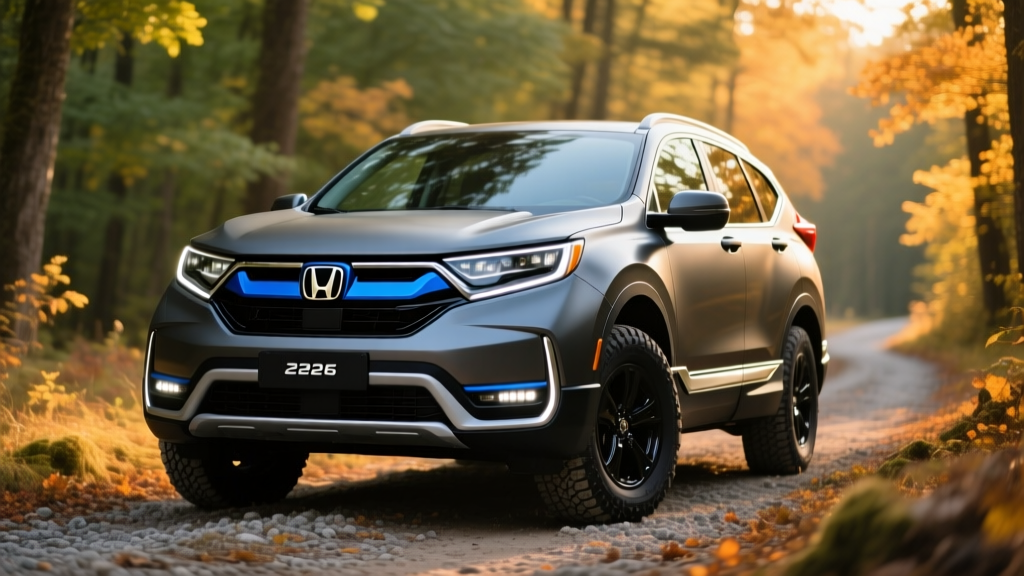
The 2026 Honda CR-V Hybrid TrailSport occupies a precise niche in the compact SUV segment: a conventional hybrid (HEV) with off-road styling cues, standard all-wheel drive, and real efficiency — no plug required. For buyers who want the fuel savings of electrification without the infrastructure demands of a plug-in hybrid or full EV, this trim is arguably the most compelling CR-V in Honda's 2026 lineup.
Honda pairs its proven fourth-generation two-motor hybrid system with a 1.5-liter Atkinson-cycle engine and a torque-vectoring AWD setup, producing a combined 204 horsepower. The TrailSport trim adds rugged body cladding, all-terrain tires, and revised suspension tuning, but the powertrain remains the efficiency-focused unit found across the CR-V Hybrid range. That means EPA-estimated fuel economy that holds strong in real-world driving, particularly in city traffic where the hybrid system recovers the most energy through regenerative braking.
| Spec | Value |
|---|---|
| Powertrain | 2.0L Atkinson-cycle 4-cyl + 2-motor hybrid system |
| Combined Horsepower | 204 hp |
| Combined Torque | 247 lb-ft (electric motor peak) |
| Drivetrain | AWD (standard on TrailSport) |
| EPA MPG (City / Hwy / Combined) | 40 / 34 / 37 |
| Fuel Tank Capacity | 14.0 gallons |
| Total Driving Range | ~518 miles |
| 0–60 mph | ~7.8 seconds (est.) |
| Towing Capacity | 1,000 lbs |
| Cargo Volume (behind 2nd row) | 36.3 cu ft |
| Starting MSRP | $40,850 (incl. destination) |
| Hybrid Battery Warranty | 8 years / 100,000 miles |
HEV vs. PHEV: What the CR-V Hybrid TrailSport Is (and Isn't)
A critical distinction for shoppers cross-referencing electrified SUVs: the 2026 CR-V Hybrid TrailSport is a conventional hybrid electric vehicle (HEV), not a plug-in hybrid (PHEV). You never plug it in. The small lithium-ion battery pack (approximately 1.1 kWh usable) charges exclusively through regenerative braking and the gasoline engine. The system uses that stored energy to assist acceleration, enable brief low-speed electric-only crawling, and smooth out stop-start traffic — but it cannot sustain highway speeds on battery alone.
| Factor | HEV (CR-V Hybrid) | PHEV (e.g., Toyota RAV4 Prime) | BEV (e.g., Tesla Model Y) |
|---|---|---|---|
| Plug-in Required? | No | Yes (Level 1 or 2) | Yes (Level 2 + DC fast) |
| Electric-Only Range | <1 mile at low speed | 30–42 miles typical | 250–330 miles (EPA) |
| Combined MPG / MPGe | 37 MPG combined | 38 MPG + 94 MPGe | 120+ MPGe |
| Battery Size | ~1.1 kWh | ~18 kWh | 60–82 kWh |
| Federal Tax Credit (§30D) | Not eligible | Up to $7,500 (if qualified) | Up to $7,500 (if qualified) |
| Home Charging Needed? | No | Recommended | Essential |
| Upfront Cost Premium | +$1,500–$2,500 over gas | +$5,000–$8,000 over gas | +$8,000–$15,000 over gas |
Honda does not currently offer a PHEV variant of the CR-V in the U.S. market for 2026. If you want plug-in capability from Honda, you'd need to look at the discontinued Clarity PHEV on the used market or wait for future product announcements. For now, the CR-V Hybrid is strictly an HEV — and for many buyers, that's the right call. No charging logistics, no range anxiety, and a lower purchase price than any PHEV or BEV competitor.
Fuel Economy: EPA Numbers and Real-World MPG
The EPA rates the 2026 CR-V Hybrid AWD at 40 mpg city, 34 mpg highway, and 37 mpg combined. The TrailSport trim, with its all-terrain tires and slightly increased ride height, carries the same EPA ratings as other CR-V Hybrid AWD trims per fueleconomy.gov, though real-world results may vary slightly due to the more aggressive tire compound.
| Driving Condition | EPA Estimate | Real-World Expectation |
|---|---|---|
| City | 40 MPG | 38–43 MPG (hybrids often exceed EPA in stop-and-go) |
| Highway (70 mph) | 34 MPG | 31–34 MPG (less regen benefit at sustained speed) |
| Combined | 37 MPG | 35–39 MPG |
| Cold Weather (below 30°F) | — | 30–34 MPG combined (engine runs more for cabin heat) |
The hybrid system's city advantage is substantial. In stop-and-go traffic, the electric motor handles initial acceleration while regenerative braking recovers kinetic energy that a gas-only vehicle wastes as heat. On the highway, the 2.0L engine operates more directly, and the efficiency gap between the hybrid and a conventional CR-V AWD (28/34 mpg) narrows considerably. In cold weather, expect a 10–15% fuel economy drop — the engine must run more frequently to provide cabin heat and maintain battery temperature, reducing electric-motor assist time.
Compared to the gas-only 2026 CR-V AWD (rated at 28 city / 34 highway / 30 combined), the hybrid saves approximately 7 mpg combined. At 15,000 miles per year and $3.40/gallon regular unleaded, that translates to roughly $430 in annual fuel savings, recouping the hybrid powertrain's price premium in approximately 4–5 years before accounting for any resale-value premium hybrids typically command.
Powertrain and Performance: 204 hp with Hybrid Smoothness
Honda's two-motor hybrid system in the 2026 CR-V pairs a 2.0-liter Atkinson-cycle four-cylinder engine (145 hp, 134 lb-ft) with a drive motor (181 hp, 247 lb-ft) and a generator motor that manages energy flow. Combined system output is 204 horsepower. The transmission is an e-CVT — not a traditional belt-driven CVT, but a direct-drive system that uses the generator motor to modulate engine speed. The result is smooth, linear acceleration without the rubber-band drone associated with older CVT designs.
The TrailSport's AWD system uses a rear-mounted electric motor to send up to 50% of torque to the rear axle when needed. Unlike mechanical AWD systems with a driveshaft, this setup adds no parasitic loss when front-wheel traction is sufficient. Honda's torque-vectoring logic can shift rear-axle torque side-to-side, improving cornering stability on pavement and traction on loose surfaces.
The 0–60 mph time of approximately 7.8 seconds won't win drag races, but the electric motor's instant torque (available from 0 rpm) makes the CR-V Hybrid feel responsive in everyday driving — merging onto highways, pulling away from stoplights, and climbing grades all feel more urgent than the horsepower figure suggests. The TrailSport's all-terrain tires add a small amount of rolling resistance and road noise compared to the Sport Touring Hybrid's highway tires, but the trade-off is improved grip on gravel, snow, and wet grass.
Pricing, Trims, and Tax Credit Eligibility
The 2026 Honda CR-V Hybrid TrailSport starts at an MSRP of $40,850 including destination charges. It sits near the top of the CR-V Hybrid lineup, above the Sport Hybrid ($36,350) and Sport Touring Hybrid ($40,850), differentiated primarily by its off-road appearance package, all-terrain tires, and TrailSport-specific suspension tuning.
Standard equipment on the TrailSport Hybrid includes:
- Honda Sensing suite (adaptive cruise, lane-keeping, automatic emergency braking, traffic sign recognition)
- 9-inch touchscreen with wireless Apple CarPlay and Android Auto
- Wireless phone charging pad
- Heated front seats and heated steering wheel
- Power tailgate with hands-free operation
- 18-inch TrailSport wheels with all-terrain tires
- Orange-finished recovery hooks (front)
- Roof rails with integrated crossbar mounting points
Does the CR-V Hybrid TrailSport Qualify for a Federal Tax Credit?
No. Under current IRS §30D rules, the federal clean vehicle credit applies only to plug-in electric vehicles (PHEVs and BEVs) with battery capacities of at least 7 kWh. The CR-V Hybrid's ~1.1 kWh battery does not meet this threshold. No federal purchase incentive is available for conventional hybrids in 2026.
Some states offer their own hybrid incentives — for example, certain utility companies provide rebates for hybrid purchases, and a handful of states have reduced registration fees for high-efficiency vehicles. Check your state's energy office or utility provider for local programs. These vary widely by jurisdiction and change frequently, so always verify with official sources.
Hybrid Battery Warranty, Reliability, and Replacement Cost
Honda covers the CR-V Hybrid's lithium-ion battery pack with an 8-year / 100,000-mile warranty (extended to 10 years / 150,000 miles in California Air Resources Board states, which include CA, CO, CT, ME, MD, MA, NJ, NY, OR, RI, VT, and WA). The warranty covers defects and capacity loss below a defined threshold — typically 70% of original capacity, though Honda's specific retention guarantee should be confirmed in your purchase documentation.
| Component | Warranty Period | Coverage Detail |
|---|---|---|
| Hybrid Battery (Li-ion) | 8 yr / 100,000 mi (10/150k in CARB states) | Defects, premature capacity loss |
| Hybrid System Components | 8 yr / 100,000 mi | Inverter, drive motor, generator, e-CVT |
| Powertrain (engine) | 5 yr / 60,000 mi | Internal engine components |
| Bumper-to-Bumper | 3 yr / 36,000 mi | Comprehensive vehicle coverage |
Real-world reliability data is encouraging. Honda's hybrid system, now in its fourth generation, has accumulated millions of fleet miles across the Accord Hybrid, CR-V Hybrid, and Civic Hybrid lineups. The small battery pack (~1.1 kWh) undergoes relatively shallow charge-discharge cycles — the system never fully depletes or fully charges the pack, which significantly extends cell life. Most Honda hybrid owners report no battery-related issues within the first 150,000+ miles.
If replacement is needed out of warranty, a new OEM hybrid battery for the CR-V Hybrid typically costs between $2,000 and $3,500 including labor at a Honda dealer. Independent hybrid specialists and refurbished battery options can reduce this to $1,200–$2,000. This is a fraction of the cost of a full EV battery replacement, which can exceed $10,000–$15,000, because the CR-V Hybrid's pack is small and accessible.
TrailSport Capability: What Off-Road Really Means Here
The TrailSport badge on the CR-V Hybrid signals light-duty off-road readiness, not Wrangler-class rock crawling. The all-terrain tires (235/60R18) provide genuine traction advantages on gravel fire roads, snow-covered driveways, muddy campsite approaches, and sandy beach access routes. The suspension retuning adds approximately 0.4 inches of ground clearance over standard CR-V Hybrid trims, bringing total clearance to roughly 8.5 inches — competitive with the Subaru Forester Wilderness and Toyota RAV4 TRD Off-Road.
What the TrailSport does not include: a locking rear differential, skid plates, low-range gearing, or a disconnecting sway bar. The AWD system relies on brake-based torque vectoring and traction control to manage wheel slip. For the vast majority of buyers who encounter unpaved roads on the way to trailheads, ski resorts, or rural properties, this is more than adequate. For technical off-road use, a body-on-frame SUV remains the appropriate tool.
The 1,000-pound towing capacity is a limitation worth noting. This is sufficient for a small utility trailer or a pair of dirt bikes on a hitch-mounted rack, but it falls well short of the gas-only CR-V's 1,500-pound rating and cannot handle most camping trailers or small boats. Honda limits hybrid towing due to thermal management considerations for the battery and electric motor under sustained heavy load.
Who Should Choose the CR-V Hybrid TrailSport?
Choose the CR-V Hybrid TrailSport If:
- You want 35–40 MPG without changing your fueling habits (no plugs, no charging apps)
- You drive primarily in city and suburban conditions where the hybrid system excels
- You need AWD for snow, rain, or light unpaved roads but don't need serious off-road hardware
- You plan to keep the vehicle 8+ years (hybrid fuel savings compound over time)
- You value Honda's safety tech suite and strong IIHS ratings
- You want a higher ride height and rugged aesthetics without the fuel penalty of a truck-based SUV
Look Elsewhere If:
- You want electric-only commuting range (consider a PHEV like the RAV4 Prime or Tucson PHEV)
- You need to tow more than 1,000 lbs (gas CR-V or a midsize SUV)
- You want the lowest possible emissions (a BEV eliminates tailpipe emissions entirely)
- You drive mostly highway miles at 75+ mph (the hybrid advantage shrinks at high sustained speeds)
- You're counting on a federal tax credit to offset purchase price (HEVs don't qualify under §30D)
The decision framework is straightforward: if you have access to home charging and a commute under 35 miles, a PHEV gives you the best of both worlds — daily electric driving with a gas engine for road trips. If you lack charging access, live in an apartment, or simply don't want to think about plugging in, the CR-V Hybrid delivers meaningful fuel savings with zero behavioral change. And if you're ready to go fully electric, the Honda Prologue or a Tesla Model Y offer 280–320 miles of range with lower per-mile energy costs — but at a higher purchase price and with charging logistics to plan.
Frequently Asked Questions
How many MPG does the 2026 Honda CR-V Hybrid TrailSport get?
The EPA rates it at 40 mpg city, 34 mpg highway, and 37 mpg combined. In real-world driving, expect 38–43 mpg in city traffic (where regenerative braking recovers the most energy) and 31–34 mpg on the highway. Cold weather below 30°F can reduce combined fuel economy to 30–34 mpg due to increased engine runtime for cabin heating.
Do I need to plug in the CR-V Hybrid TrailSport?
No. The 2026 CR-V Hybrid TrailSport is a conventional hybrid (HEV), not a plug-in hybrid. The battery charges automatically through regenerative braking and the gasoline engine. You fuel it like any other vehicle — at a gas station, with regular unleaded.
Does the CR-V Hybrid TrailSport qualify for any federal tax credit?
No. The federal §30D clean vehicle credit requires a battery capacity of at least 7 kWh and plug-in capability. The CR-V Hybrid's ~1.1 kWh battery does not qualify. Some state or utility incentives may apply — check your local jurisdiction and utility provider for current programs.
How long will the hybrid battery last, and what does replacement cost?
Honda warranties the hybrid battery for 8 years / 100,000 miles (10 years / 150,000 miles in CARB states). Based on Honda's track record with prior-generation hybrid systems, most packs last well beyond the warranty period with minimal degradation. Out-of-warranty replacement costs approximately $2,000–$3,500 at a dealer, or $1,200–$2,000 through an independent hybrid specialist.
How does the CR-V Hybrid TrailSport compare to the Toyota RAV4 Hybrid?
The 2026 RAV4 Hybrid (Woodland Edition for off-road styling) is the CR-V TrailSport Hybrid's closest rival. The RAV4 Hybrid is rated at 41/38/39 mpg (city/highway/combined) — slightly better on the highway — and offers a slightly higher 1,750-pound tow rating. The CR-V Hybrid counters with a more refined interior, newer infotainment hardware, and a roomier rear seat. Both carry 8-year/100,000-mile hybrid battery warranties. The choice typically comes down to styling preference, dealer proximity, and which brand's driving dynamics you prefer.
Is the TrailSport Hybrid good in snow?
Yes, within its design intent. The standard AWD system with torque-vectoring rear axle, combined with all-terrain tires, provides confident traction on packed snow and icy pavement. The hybrid system's electric motor delivers smooth, controllable torque from a stop — an advantage over turbocharged gas engines that can deliver power abruptly on low-grip surfaces. For deep snow or unplowed mountain passes, dedicated winter tires would further improve capability.
What's the difference between the TrailSport Hybrid and the Sport Touring Hybrid?
Both share the same 204-hp hybrid powertrain and AWD system, and both are priced near $40,850. The TrailSport trades the Sport Touring's highway-oriented tires, leather-trimmed seats, and premium audio for all-terrain tires, TrailSport-specific suspension tuning, rugged exterior cladding, and recovery hooks. The Sport Touring is the comfort-and-tech play; the TrailSport is the adventure-aesthetics play. Fuel economy ratings are identical.
Sources: EPA fuel economy data via fueleconomy.gov; federal tax credit rules via IRS.gov §30D Clean Vehicle Credits; Honda specifications via Honda.com.