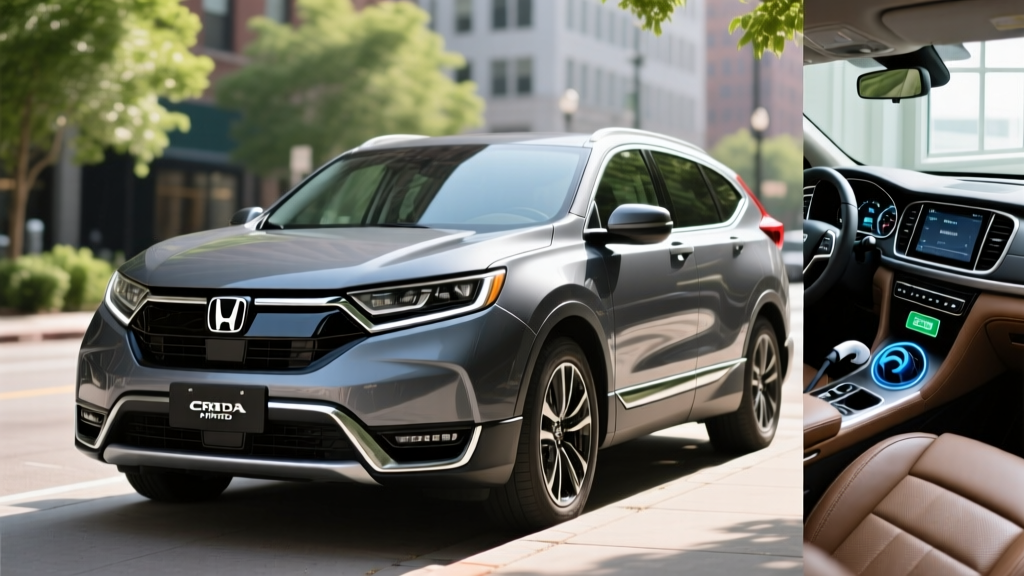
The Honda CR-V Hybrid has become one of the best-selling electrified compact SUVs in America, and for the 2026 model year it carries forward the proven two-motor powertrain that made the sixth-generation CR-V a segment benchmark. If you're researching 2026 Honda CR-V Hybrid specs, you're likely weighing this SUV against full EVs, plug-in hybrids, and conventional gas competitors. This guide covers every number that matters — EPA fuel economy, real-world MPG expectations, powertrain output, battery warranty, pricing, and whether it qualifies for federal tax credits.
HEV vs. PHEV: What the 2026 CR-V Hybrid Actually Is
Before diving into specs, it's essential to understand what the CR-V Hybrid is — and what it isn't. The 2026 Honda CR-V Hybrid is a conventional hybrid electric vehicle (HEV). It pairs a gasoline engine with electric motors and a small battery pack that recharges through regenerative braking and the engine itself. You never plug it in. There is no electric-only driving mode for meaningful distances, and no charging port.
Honda does not currently offer a plug-in hybrid (PHEV) version of the CR-V in the United States. If you need plug-in capability with electric-only range, you'd need to look at competitors like the Toyota RAV4 Prime (42 miles electric-only) or the Hyundai Tucson PHEV (33 miles electric-only).
HEV vs. PHEV — Key Differences
| Feature | HEV (CR-V Hybrid) | PHEV (e.g., RAV4 Prime) |
|---|---|---|
| Plug-in charging | No — never plugs in | Yes — Level 1 or Level 2 |
| Electric-only range | ~1 mile at low speed | 25–42 miles typical |
| Battery size | ~1.06 kWh | 13–18 kWh |
| Federal tax credit (§30D) | Not eligible | Up to $7,500 if eligible |
| Best for | No home charging access | Home charging + short commutes |
2026 Honda CR-V Hybrid Fuel Economy: EPA MPG and Real-World Expectations
Fuel economy is the primary reason buyers choose the CR-V Hybrid over the standard turbocharged gas model. Here's what the EPA rates and what you can actually expect.
| Trim / Drivetrain | City MPG | Highway MPG | Combined MPG |
|---|---|---|---|
| Sport / Sport Touring (FWD) | 43 | 36 | 40 |
| Sport / Sport Touring (AWD) | 40 | 34 | 37 |
Source: EPA Fuel Economy
Real-World MPG vs. EPA Sticker
Honda's two-motor hybrid system excels in stop-and-go city driving, where the electric motor handles most low-speed propulsion. In real-world testing, CR-V Hybrid owners frequently report exceeding the EPA city rating — 42–45 MPG is common in urban driving. Highway driving is a different story: at sustained 70–80 mph speeds, expect 32–35 MPG for AWD models, slightly below the sticker. Cold weather (below 35°F) can reduce combined efficiency by 10–15% due to increased engine operation for cabin heating and reduced battery efficiency. Overall, most owners report 36–40 MPG combined in mixed driving, consistent with or slightly above EPA estimates.
Powertrain Specs: Engine, Motors, and Horsepower
The 2026 CR-V Hybrid uses Honda's fourth-generation two-motor hybrid system, which is fundamentally different from a traditional planetary-gear hybrid like Toyota's. Here, the gasoline engine primarily acts as a generator, while the electric drive motor handles most propulsion. At highway speeds, a lock-up clutch connects the engine directly to the wheels for efficiency.
| Specification | 2026 CR-V Hybrid |
|---|---|
| Engine | 2.0L Atkinson-cycle 4-cylinder (145 hp) |
| Drive Motor | Permanent-magnet AC synchronous (184 hp / 247 lb-ft) |
| Combined System Output | 204 hp / 247 lb-ft torque |
| Transmission | e-CVT (single-speed direct drive + engine lock-up clutch) |
| Hybrid Battery | ~1.06 kWh lithium-ion |
| 0–60 mph | ~7.6 seconds (AWD) |
| Drivetrain | FWD or Real Time AWD™ |
| Towing Capacity | 1,000 lbs |
| Fuel Tank | 14.0 gallons |
| Total Range (AWD, est.) | ~518 miles (37 MPG × 14.0 gal) |
The 204-horsepower combined output gives the CR-V Hybrid adequate passing power and confident highway merging. It's not quick by performance-SUV standards, but the electric motor's instant 247 lb-ft of torque makes it feel responsive around town — noticeably more responsive than the 190-hp turbocharged gas CR-V at low speeds.
Battery Warranty and Long-Term Reliability
Hybrid battery longevity is consistently the top concern for buyers considering their first hybrid. Honda backs the CR-V Hybrid's battery system with strong warranty coverage.
Honda Hybrid Battery Warranty
- Hybrid Battery: 8 years / 100,000 miles (10 years / 150,000 miles in CARB states including CA, CO, CT, ME, MA, NJ, NY, OR, RI, VT, WA)
- Hybrid System Components: 8 years / 100,000 miles
- Powertrain Warranty: 5 years / 60,000 miles
- Limited Vehicle Warranty: 3 years / 36,000 miles
The battery warranty covers capacity loss below a functional threshold — not just complete failure. Honda's lithium-ion hybrid batteries in the CR-V are small (~1.06 kWh) and operate within a narrow state-of-charge window, which significantly reduces degradation stress compared to a full EV battery.
Hybrid Battery Replacement Cost
If the hybrid battery does require replacement outside of warranty, expect a cost of approximately $2,000–$4,000 for the battery pack itself, plus labor. However, real-world data from Honda's hybrid fleet (Accord Hybrid, CR-V Hybrid) shows that battery failures before 150,000 miles are rare. The small battery size and conservative charge management mean most CR-V Hybrid batteries will outlast the vehicle's useful life. This is fundamentally different from EV battery replacement, which can exceed $10,000–$20,000.
Overall Reliability
Honda's hybrid system has proven durable across multiple model generations. The CR-V Hybrid carries strong reliability ratings from major testing organizations. Check the latest scores at IIHS for crash-test performance and NHTSA for federal safety ratings. The simpler e-CVT design (no traditional multi-gear transmission) eliminates a common failure point found in conventional automatics.
2026 CR-V Hybrid Pricing by Trim
The CR-V Hybrid is available exclusively in the Sport and Sport Touring trims for 2026. Here's the MSRP breakdown:
| Trim | Drivetrain | MSRP |
|---|---|---|
| Sport | FWD | $36,395 |
| Sport | AWD | $37,895 |
| Sport Touring | FWD | $40,395 |
| Sport Touring | AWD | $41,895 |
Prices include destination charge. Verify current pricing at Honda's official site.
Tax Credit Eligibility
The 2026 Honda CR-V Hybrid does not qualify for the federal §30D Clean Vehicle Credit. Under current IRS rules, the §30D credit applies only to plug-in electric vehicles (BEVs and PHEVs) with battery capacities of at least 7 kWh. The CR-V Hybrid's ~1.06 kWh battery falls well below this threshold. This is a key trade-off: you get the simplicity of never needing to plug in, but you forgo up to $7,500 in federal incentives that a PHEV or EV competitor might offer.
Some states and utilities offer rebates for conventional hybrids, but these vary widely by jurisdiction. Check your state energy office or utility provider for current programs.
CR-V Hybrid vs. Full EV vs. Gas: Which Should You Choose?
The right powertrain depends on your driving patterns, charging access, and budget. Here's a decision framework:
Choose the CR-V Hybrid (HEV) If:
- You don't have access to home or workplace charging
- You want better fuel economy without changing your refueling habits
- You drive a mix of city and highway with no single pattern dominating
- You want lower upfront cost than a PHEV or EV
- You live in an area with limited public charging infrastructure
Choose a PHEV (RAV4 Prime, Tucson PHEV) If:
- You have home Level 2 charging and a commute under 35 miles
- You want electric-only daily driving with gas-engine flexibility for road trips
- You want to qualify for the §30D federal tax credit (up to $7,500)
- You want to reduce fuel consumption to near-zero on most weekday driving
Choose a Full EV (Ioniq 5, Model Y, EV6) If:
- You have reliable home charging (Level 2)
- Your daily driving is under 250 miles and you can plan road-trip charging
- You want the lowest per-mile fuel cost and zero tailpipe emissions
- You want to maximize federal and state incentives
5-Year Fuel Cost Comparison
Assuming 15,000 miles/year, $3.50/gallon gas (CR-V Hybrid at 37 MPG combined AWD; gas CR-V AWD at 29 MPG combined), and $0.14/kWh electricity (for a comparable EV at 3.5 miles/kWh):
- CR-V Hybrid (AWD): ~$2,128/year in fuel
- Gas CR-V (AWD): ~$2,714/year in fuel
- Comparable EV: ~$600/year in electricity
The Hybrid saves approximately $2,930 over five years versus the gas CR-V. An EV saves roughly $7,640 over the same period — but requires charging access and a higher purchase price before incentives.
Pros
- 40 MPG city (FWD) — best-in-class for the segment
- No plug-in charging required — zero lifestyle change
- Strong low-speed torque from electric motor
- Spacious interior: 36.3 cu ft cargo (rear seats up)
- 8-year/100,000-mile hybrid battery warranty
- Proven, durable powertrain with low maintenance costs
Cons
- No federal tax credit eligibility
- Highway MPG drops below EPA estimate at 75+ mph
- AWD model loses 3 MPG combined vs. FWD
- Hybrid only available in Sport/Sport Touring trims (higher entry price)
- 1,000-lb towing capacity — lower than some competitors
- No plug-in hybrid option in the US lineup
Frequently Asked Questions
How many MPG does the 2026 Honda CR-V Hybrid get?
The EPA rates the 2026 CR-V Hybrid at 43 city / 36 highway / 40 combined MPG for FWD models, and 40 city / 34 highway / 37 combined MPG for AWD models. In real-world driving, owners commonly report exceeding city EPA estimates while highway fuel economy at sustained high speeds may fall slightly below the sticker.
Does the CR-V Hybrid need to be plugged in?
No. The CR-V Hybrid is a conventional HEV. The battery recharges through regenerative braking and the gasoline engine. There is no charging port and no plug-in capability. You fuel it exactly like a conventional gas car.
Does the 2026 CR-V Hybrid qualify for a federal tax credit?
No. The federal §30D Clean Vehicle Credit requires a minimum 7 kWh battery and plug-in capability. The CR-V Hybrid's ~1.06 kWh battery does not qualify. Only BEVs and PHEVs meeting IRS sourcing, MSRP, and income requirements are eligible for up to $7,500.
How long will the CR-V Hybrid battery last?
Honda's hybrid batteries are designed to last the life of the vehicle under normal use. The battery is covered by an 8-year/100,000-mile warranty (10 years/150,000 miles in CARB states). Real-world data from Honda's hybrid lineup shows battery failures before 150,000 miles are uncommon. Replacement cost, if needed out of warranty, is approximately $2,000–$4,000.
Is the CR-V Hybrid faster than the gas CR-V?
The CR-V Hybrid produces 204 combined horsepower versus 190 hp for the turbocharged gas model. The hybrid's 0–60 mph time of approximately 7.6 seconds (AWD) is slightly quicker, but the more noticeable difference is low-speed responsiveness — the electric motor's 247 lb-ft of instant torque makes the hybrid feel more eager in city driving and during initial acceleration.
Hybrid vs. PHEV vs. EV — which is right for me?
If you can't charge at home, the CR-V Hybrid is the best choice — it requires zero behavior change and delivers 37–40 MPG. If you have home charging and a short commute, a PHEV gives you electric-only daily driving plus gas-engine road-trip flexibility and may qualify for the $7,500 federal credit. If you have reliable home charging and want the lowest operating cost, a full EV offers the best long-term economics but requires charging planning for longer trips.
What is the CR-V Hybrid's total driving range?
With a 14.0-gallon fuel tank and 37 MPG combined (AWD), the CR-V Hybrid delivers approximately 518 miles of total range. The FWD model, rated at 40 MPG combined, can reach roughly 560 miles per tank — among the longest ranges in the compact SUV segment.