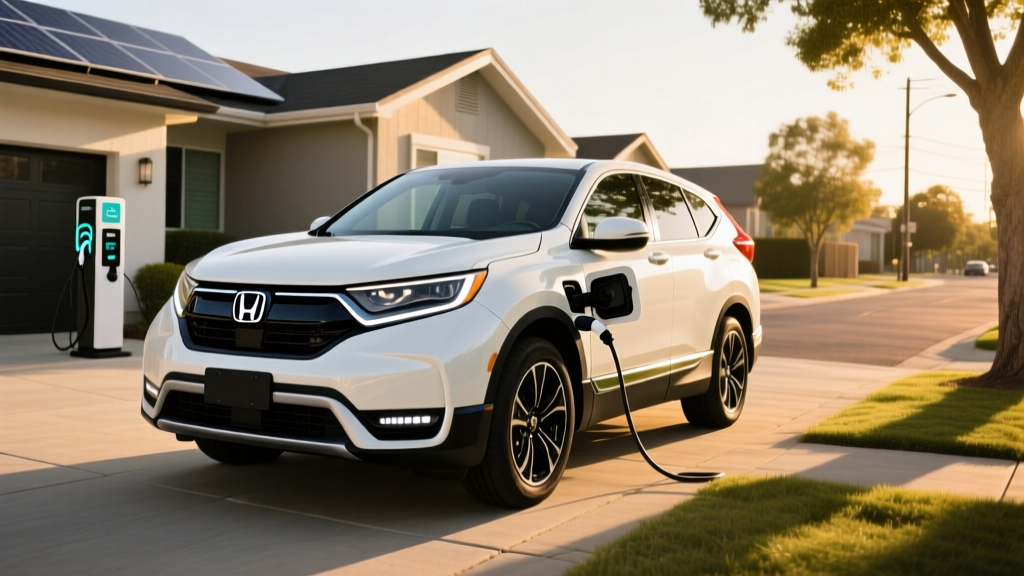
The Honda CR-V has long been the compact SUV benchmark for practicality, and the hybrid powertrain has become the volume seller in the lineup. For 2026, Honda continues to refine the CR-V Hybrid with incremental updates to efficiency, technology, and trim availability. If you're researching the 2026 Honda CR-V Hybrid offers currently on dealer lots, this guide gives you every number you need — EPA MPG, real-world fuel economy expectations, powertrain output, pricing by trim, warranty coverage, and whether any federal tax credits apply.
Before we get into specifics, one clarification is critical: the CR-V Hybrid sold in the United States is a conventional hybrid (HEV), not a plug-in hybrid. It does not have a charging port, it does not drive on electric power alone for meaningful distances, and it never needs to be plugged in. Honda discontinued the CR-V Plug-In Hybrid in the U.S. market several years ago. If you're looking for a PHEV compact SUV from Honda, it isn't currently available stateside. We'll address what that means for your buying decision below.
HEV vs. PHEV: Why the CR-V Hybrid Is a Conventional Hybrid
Understanding the distinction between a conventional hybrid (HEV) and a plug-in hybrid (PHEV) prevents costly confusion at the dealership:
| Feature | Conventional Hybrid (HEV) | Plug-In Hybrid (PHEV) |
|---|---|---|
| Plug-in charging | No — refuels with gas only | Yes — charges via Level 1/Level 2 |
| Electric-only range | Less than 1 mile at low speed | 20–45 miles typical |
| Battery size | ~1.0–1.5 kWh (small buffer) | 12–25 kWh usable |
| Regenerative braking | Yes — recharges battery while driving | Yes — plus grid charging |
| Federal tax credit (§30D) | Not eligible | Up to $7,500 if requirements met |
| Best for | Drivers who want better MPG without lifestyle change | Drivers with home charging who want short EV commutes |
The 2026 CR-V Hybrid falls firmly in the HEV column. Its lithium-ion battery pack is small — roughly 1.06 kWh — and exists to buffer energy captured from regenerative braking and the gasoline engine. You will never plug this vehicle in, and you should not expect any meaningful electric-only driving. What you do get is substantially better fuel economy than the gas-only CR-V, especially in city driving where the electric motor assists most frequently.
EPA MPG and Real-World Fuel Economy
Fuel efficiency is the primary reason buyers choose the CR-V Hybrid over its gasoline counterpart. Here is the EPA-estimated fuel economy breakdown for the 2026 model year, sourced from fueleconomy.gov:
| Drivetrain | City MPG | Highway MPG | Combined MPG |
|---|---|---|---|
| FWD (Sport, Sport Touring) | 43 | 36 | 40 |
| AWD (Sport, Sport-L, Sport Touring) | 40 | 34 | 37 |
For comparison, the gasoline-only 2026 CR-V with AWD achieves an EPA-estimated 27 city / 32 highway / 29 combined MPG. The hybrid powertrain delivers a roughly 28% improvement in combined fuel economy with AWD — a meaningful difference that compounds over years of ownership.
Real-World MPG: What to Actually Expect
One of the most pleasant surprises with Honda's two-motor hybrid system is that real-world city MPG often exceeds the EPA estimate. In stop-and-go traffic, the electric motor handles a larger share of propulsion, and regenerative braking recaptures energy that a gas car would waste as heat. Owners and independent testers consistently report 42–45 MPG in urban driving with the FWD model.
Highway driving tells a different story. At sustained speeds above 70 mph, the gasoline engine does most of the work, and aerodynamic drag dominates. Expect highway fuel economy to land in the 33–36 MPG range with AWD — close to the EPA sticker, but not dramatically above it. In cold weather (below 30°F), plan for a 5–10% reduction in fuel economy as the engine runs more frequently to generate cabin heat and the battery operates less efficiently.
Powertrain Specs: Horsepower, Engine, and Motors
The 2026 CR-V Hybrid uses Honda's fourth-generation two-motor hybrid system, pairing a 2.0-liter Atkinson-cycle four-cylinder engine with two electric motors. Here are the exact figures:
| Specification | 2026 CR-V Hybrid |
|---|---|
| Engine | 2.0L Atkinson-cycle DOHC i-VTEC 4-cylinder |
| Engine horsepower | 145 hp @ 6,100 rpm |
| Drive motor output | 181 hp / 247 lb-ft torque |
| Combined system output | 204 hp / 247 lb-ft torque |
| Transmission | Electronic continuously variable (e-CVT) |
| 0–60 mph (est.) | ~7.5 seconds (AWD) |
| Battery type | Lithium-ion, ~1.06 kWh |
| Drivetrain options | FWD or Real Time AWD |
| Towing capacity | 1,000 lbs |
The 204 combined horsepower figure represents a meaningful advantage over the gas-only CR-V's 190 hp. More importantly, the electric drive motor's 247 lb-ft of torque is available from near-zero RPM, giving the hybrid noticeably stronger low-speed acceleration — the kind you use merging onto highways or pulling away from stoplights. The e-CVT avoids the rubber-band feel that plagued older CVT designs; Honda's system uses a lock-up clutch at highway speeds to create a direct mechanical connection between engine and wheels.
2026 CR-V Hybrid Trim Pricing and Tax Credit Eligibility
Honda positions the hybrid powertrain exclusively in the sport-oriented trims for 2026. Here is the MSRP breakdown (destination charge included):
| Trim | Drivetrain | MSRP (incl. destination) |
|---|---|---|
| Sport Hybrid | FWD | $36,395 |
| Sport Hybrid | AWD | $37,895 |
| Sport-L Hybrid | AWD | $40,695 |
| Sport Touring Hybrid | AWD | $43,695 |
Note: Pricing reflects 2026 model-year MSRP as published by Honda. Dealer pricing, incentives, and availability vary. Confirm with your local dealer.
Does the 2026 CR-V Hybrid Qualify for a Federal Tax Credit?
No. The federal Clean Vehicle Credit under IRS §30D applies exclusively to plug-in electric vehicles — battery-electric vehicles (BEVs) and plug-in hybrids (PHEVs) with a minimum battery capacity of 7 kWh. Because the CR-V Hybrid is a conventional HEV with a ~1.06 kWh battery and no plug, it does not qualify for the federal EV tax credit.
- IRS §30D Clean Vehicle Credit (up to $7,500) — requires plug-in EV or PHEV
- Most state EV rebates — typically require plug-in capability
- Utility EV charging rate discounts — requires an EV or PHEV
- Some state or local clean-air vehicle decals or HOV lane access (varies by jurisdiction)
- Employer commuter benefits for fuel-efficient vehicles
- Honda dealer incentives or loyalty discounts — check current offers
For the latest federal tax credit rules, consult the IRS Clean Vehicle Credits page. If a plug-in hybrid is a priority for tax credit eligibility, you'll need to look outside the Honda lineup — competitors like the Toyota RAV4 Prime (PHEV) may qualify, though credit availability depends on battery sourcing and MSRP caps under current §30D rules.
Reliability, Battery Warranty, and Replacement Cost
Hybrid reliability is a top concern for buyers investing in a battery-equipped vehicle. Honda's hybrid system has been in production across multiple models for over two decades, and the fourth-generation two-motor architecture used in the CR-V Hybrid has been in service since the 2023 model year refresh.
- Hybrid battery (IMA battery): 8 years / 100,000 miles (10 years / 150,000 miles in CARB states including CA, NY, MA, and others)
- Hybrid system components: 8 years / 100,000 miles
- Powertrain warranty: 5 years / 60,000 miles
- Limited vehicle warranty: 3 years / 36,000 miles
Honda's hybrid battery warranty aligns with the industry standard of 8 years/100,000 miles. In states that follow California Air Resources Board (CARB) emissions rules, that extends to 10 years/150,000 miles — covering the vast majority of the vehicle's practical lifespan.
How Long Will the CR-V Hybrid Battery Last?
Real-world data from Honda hybrids in service suggests the lithium-ion battery pack typically lasts well beyond the warranty period. Unlike full EV batteries, which cycle deeply every day, the CR-V Hybrid's small battery operates within a narrow state-of-charge window — typically between 40% and 80%. This shallow cycling dramatically reduces degradation. Most Honda hybrid owners report no meaningful battery capacity loss within the first 150,000 miles.
What Does Hybrid Battery Replacement Cost?
If the hybrid battery does fail outside of warranty, replacement costs for the CR-V Hybrid typically fall in the $2,000 to $4,000 range including parts and labor at a Honda dealership. Independent hybrid specialists may offer refurbished battery packs for $1,500–$2,500. This is substantially less than a full EV battery replacement ($10,000–$20,000+) because the pack is small (~1 kWh vs. 60–100 kWh in an EV). For context, a conventional gas car's transmission replacement often costs more.
Who Should Choose the CR-V Hybrid vs. a Full EV or Gas Car
The CR-V Hybrid occupies a specific niche. Here's a practical decision framework:
- You want 37–40 MPG combined without changing your fueling habits
- You lack access to home or workplace charging (apartment, street parking)
- You take frequent road trips and don't want to plan around charging stops
- You want a proven, low-risk powertrain with strong resale value
- Your daily commute involves stop-and-go city driving where hybrids shine
- You have reliable Level 2 home charging
- Your daily driving is under 250 miles and you want zero tailpipe emissions
- You want to qualify for the $7,500 federal tax credit (eligibility varies)
- You want lower per-mile fuel costs (electricity vs. gasoline)
- Your budget is strictly under $34,000 MSRP
- You drive mostly highway miles where the hybrid advantage narrows
- You plan to keep the vehicle under 5 years and want the lowest upfront cost
The financial case for the hybrid is strongest when you drive 12,000+ miles per year in mixed or city-heavy conditions. At 37 MPG combined versus 29 MPG for the gas AWD model, and with gasoline averaging $3.50/gallon, the hybrid saves roughly $775 per year in fuel costs over the gas model at 15,000 miles/year. The hybrid's ~$4,000 MSRP premium over a comparably equipped gas trim pays back in approximately 5 years — and you get stronger low-end acceleration as a bonus.
Pros and Cons of the 2026 CR-V Hybrid
- 40 MPG combined (FWD) — best in the compact hybrid SUV segment
- 247 lb-ft of electric motor torque gives strong city acceleration
- No plug-in required — zero lifestyle change from a gas car
- 8-year/100,000-mile hybrid battery warranty (10yr in CARB states)
- Spacious cargo area: 36.3 cu ft behind rear seats, 76.5 cu ft folded
- Honda Sensing ADAS suite standard on all trims
- Real Time AWD available for snow and rain confidence
- No federal tax credit eligibility (HEV, not PHEV)
- Hybrid only available in Sport trims — no base LX hybrid option
- Highway MPG advantage over gas model is modest (34 vs 32)
- 1,000-lb towing capacity — less than some turbo-gas competitors
- No plug-in hybrid option in the U.S. Honda lineup
- e-CVT drone under hard acceleration (improved but still present)
Frequently Asked Questions
How many MPG does the 2026 Honda CR-V Hybrid get?
The EPA rates the FWD CR-V Hybrid at 43 city / 36 highway / 40 combined MPG. The AWD version is rated at 40 city / 34 highway / 37 combined. In real-world city driving, many owners report exceeding the EPA city estimate by 2–5 MPG thanks to the hybrid system's regenerative braking.
Does the CR-V Hybrid need to be plugged in?
No. The CR-V Hybrid is a conventional hybrid (HEV). It recharges its small lithium-ion battery through regenerative braking and the gasoline engine. There is no charging port and no plug-in capability.
How far can the CR-V Hybrid drive on electric power alone?
Less than one mile at very low speeds (under 15 mph). The hybrid system uses the electric motor to assist the gasoline engine and enable brief engine-off coasting, but it cannot sustain electric-only driving at normal road speeds. If you want 30+ miles of electric-only range, you need a plug-in hybrid (PHEV) or a full EV.
Is the Honda CR-V Hybrid reliable?
Honda's hybrid powertrain has a strong reliability track record. The hybrid battery is warrantied for 8 years/100,000 miles (10 years/150,000 miles in CARB states), and the shallow-cycling design of the small battery pack contributes to long service life. Independent reliability surveys from Consumer Reports and J.D. Power consistently rate Honda hybrids favorably. See NHTSA for safety and recall information.
What does it cost to replace the CR-V Hybrid battery?
Out-of-warranty hybrid battery replacement typically costs $2,000–$4,000 at a Honda dealership, or $1,500–$2,500 through an independent hybrid specialist. This is significantly less than EV battery replacement because the pack is small (~1 kWh). Most hybrid batteries last well beyond the 8–10 year warranty period.
Does the 2026 CR-V Hybrid qualify for any tax credit?
No federal tax credit is available. The IRS §30D Clean Vehicle Credit requires a plug-in vehicle with at least 7 kWh of battery capacity. The CR-V Hybrid's ~1.06 kWh battery and lack of a charging port disqualify it. Some local utility or municipal programs may offer minor incentives for high-efficiency vehicles — check your jurisdiction.
Is the CR-V Hybrid better than the gas CR-V?
For most buyers, yes. The hybrid delivers 28% better combined fuel economy (AWD), stronger low-speed torque (247 lb-ft vs. 179 lb-ft), and a smoother stop-start experience. The trade-off is a higher starting price (roughly $4,000 more than a comparable gas trim) and the unavailability of the hybrid in the base LX trim. If you drive over 12,000 miles per year, the fuel savings offset the price premium within 5–6 years.
How does the CR-V Hybrid compare to the Toyota RAV4 Hybrid?
The RAV4 Hybrid (AWD) is EPA-rated at 41 city / 38 highway / 39 combined — very close to the CR-V Hybrid AWD's 40/34/37. The RAV4 offers a slightly wider trim selection including a dedicated off-road trim (Woodland Edition) and the RAV4 Prime PHEV variant with 42 miles of electric-only range. The CR-V Hybrid counters with a more refined interior, slightly more rear-seat legroom, and a more intuitive infotainment system. Both are segment leaders — test-driving both back-to-back is the best way to decide.