Quick Verdict: The Civic Hybrid That Makes the Most Sense
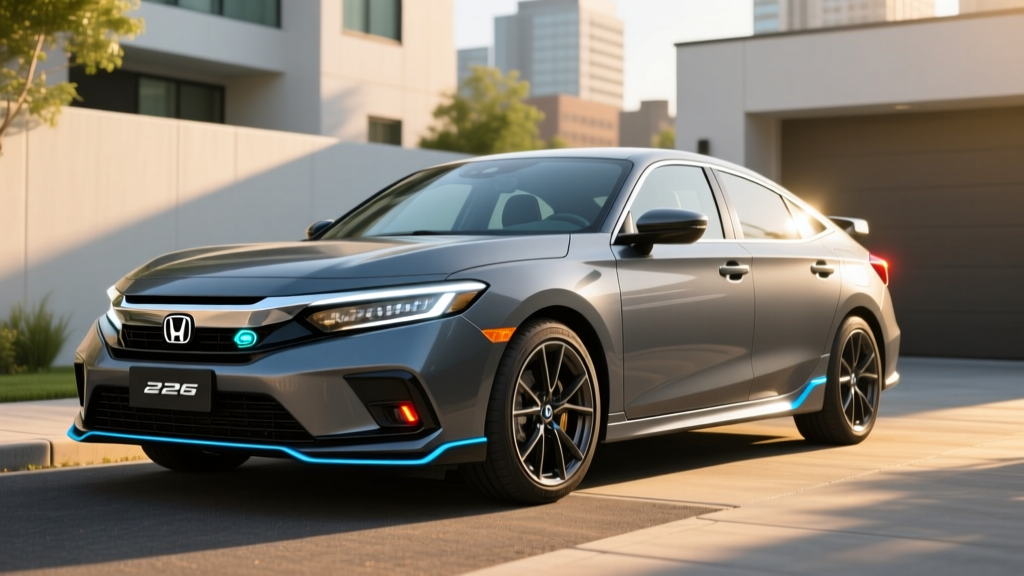
The 2026 Honda Civic Sport Touring Hybrid Sedan sits at the top of Honda's compact hybrid lineup, pairing a 2.0-liter Atkinson-cycle four-cylinder with Honda's fourth-generation two-motor hybrid system. The result is a 200-horsepower powertrain that returns an EPA-estimated 50 MPG combined — while delivering genuinely engaging driving dynamics that most hybrid compacts can't match. At a starting MSRP of approximately $32,350 (including destination), it undercuts the Toyota Prius Limited on price while offering more interior volume and a more sophisticated chassis.
This is a conventional hybrid (HEV), not a plug-in. You never plug it in. The system recovers energy through regenerative braking and the gasoline engine to keep its small 1.06 kWh lithium-ion battery charged. If you're looking for electric-only driving range, you'll want a PHEV like the Toyota Prius Prime — we cover that distinction below.
A conventional hybrid (HEV) like this Civic uses a small battery and electric motor to assist the gas engine. You never plug it in. It captures energy from braking and the engine. A plug-in hybrid (PHEV) has a larger battery (typically 10–20 kWh), can drive 25–45 miles on electricity alone, and requires plugging in to realize its full benefit. The Civic Hybrid is an HEV — zero plug-in required.
Fuel Economy: EPA Estimates and Real-World MPG
Honda's fourth-generation two-motor hybrid system is optimized for city driving, where the electric motor handles most low-speed propulsion and the gas engine acts primarily as a generator. This is why the Civic Hybrid actually achieves higher MPG in the city than on the highway — the opposite of a conventional gas car.
| Cycle | EPA Estimate | Real-World Expectation |
|---|---|---|
| City | 53 MPG | 50–55 MPG |
| Highway | 47 MPG | 43–48 MPG |
| Combined | 50 MPG | 47–52 MPG |
Data sourced from fueleconomy.gov. Real-world figures reflect mixed driving with moderate climate-control use. In cold weather (below 30°F), expect a 3–5 MPG reduction as the engine runs more frequently for cabin heat and the battery operates less efficiently. On sustained highway trips above 75 mph, the engine drives the wheels directly through a lock-up clutch, and fuel economy settles around 43–45 MPG.
The Civic Hybrid's total driving range on a single 12.4-gallon tank is approximately 620 miles at the combined EPA rate — enough for most drivers to visit a gas station once every two to three weeks.
Powertrain and Performance Specs
The Sport Touring Hybrid uses Honda's e:HEV two-motor system, which is fundamentally different from the parallel-hybrid setups in older Civic Hybrids. Here, the propulsion motor does most of the work, and the engine primarily generates electricity. At highway speeds, a lock-up clutch connects the engine directly to the front wheels for efficiency.
| Specification | Value |
|---|---|
| Engine | 2.0L DOHC Atkinson-cycle 4-cylinder |
| Combined System Horsepower | 200 hp |
| Combined System Torque | 232 lb-ft (motor) |
| Propulsion Motor Output | 184 hp / 232 lb-ft |
| Hybrid Battery | 1.06 kWh lithium-ion |
| Drivetrain | Front-wheel drive (FWD) |
| 0–60 mph | ~7.2 seconds |
| Transmission | e-CVT (single-speed direct drive + engine lock-up clutch) |
The 232 lb-ft of electric torque is available from zero RPM, which gives the Civic Hybrid a responsive, punchy feel in city driving that belies its 200-hp headline number. The Sport Touring trim also adds sport-tuned suspension dampers and 18-inch alloy wheels, contributing to noticeably sharper handling than the base Sport Hybrid.
Pricing, Trims, and Tax Credit Eligibility
The 2026 Civic Sport Touring Hybrid Sedan starts at an MSRP of $32,350 (including $1,095 destination charge). It is the top-of-line Civic Hybrid trim and comes well-equipped: leather-trimmed seats, a 9-inch touchscreen with wireless Apple CarPlay and Android Auto, a 12-speaker Bose audio system, wireless phone charging, heated front seats, and Honda's full Honda Sensing suite of driver-assistance features.
| 2026 Civic Hybrid Trim | MSRP | Key Additions |
|---|---|---|
| Sport Hybrid | $29,845 | Base hybrid, 18" wheels, sport styling |
| Sport Touring Hybrid | $32,350 | Leather, Bose audio, navigation, wireless charging |
The 2026 Honda Civic Hybrid is a conventional hybrid (HEV), not a plug-in electric vehicle. It does not qualify for the federal §30D Clean Vehicle Credit (up to $7,500), which is reserved for battery electric vehicles (BEVs) and plug-in hybrids (PHEVs) meeting battery-sourcing and critical-mineral requirements per IRS guidelines. Some states and utilities offer modest rebates for conventional hybrids — check your local programs. If a federal tax credit is a priority, consider a PHEV like the Toyota Prius Prime or a BEV like the Chevrolet Equinox EV.
Reliability, Battery Warranty, and Long-Term Ownership
Honda's hybrid system has proven durable across multiple generations, from the Insight to the Accord Hybrid and CR-V Hybrid. The fourth-generation two-motor system in the 2026 Civic uses a smaller, more energy-dense battery pack and fewer mechanical switching components than earlier designs, which reduces potential failure points.
Honda covers the Civic Hybrid's lithium-ion battery pack for 8 years or 100,000 miles (whichever comes first). In California-emission states (CA, CO, CT, ME, MA, NJ, NY, OR, RI, VT, WA), the warranty extends to 10 years or 150,000 miles. If the battery degrades below approximately 60–70% of its original capacity within the warranty period, Honda will replace it at no cost.
Out-of-warranty hybrid battery replacement for the Civic Hybrid typically runs $2,000–$3,500 including labor at a Honda dealer, based on the relatively small 1.06 kWh pack. This is significantly less than a full EV battery replacement. Independent hybrid specialists often offer refurbished packs for $1,200–$2,000. In practice, Honda hybrid batteries routinely last 150,000–200,000+ miles before significant degradation, based on long-term fleet data from the Accord Hybrid and Insight.
The Civic carries a standard 3-year/36,000-mile bumper-to-bumper warranty and a 5-year/60,000-mile powertrain warranty. Honda Sensing ADAS components (camera, radar) are covered under the powertrain warranty.
Hybrid vs. PHEV vs. EV: Which Is Right for You?
The Civic Sport Touring Hybrid competes in a segment where buyers are also cross-shopping plug-in hybrids and full electric vehicles. Here's a decision framework based on your driving habits and charging access:
| Factor | HEV (Civic Hybrid) | PHEV (e.g., Prius Prime) | BEV (e.g., Equinox EV) |
|---|---|---|---|
| Plug-in required? | No | Yes (for full benefit) | Yes |
| Electric-only range | ~1 mile (low speed) | 35–45 miles | 250–320 miles |
| Total range | ~620 miles | ~600+ miles | 250–320 miles |
| Home charging install | Not needed | Level 2 recommended ($500–$2,000) | Level 2 required ($500–$2,500) |
| Federal tax credit | None | Up to $7,500 (if eligible) | Up to $7,500 (if eligible) |
| Best for | No home charging, long commutes | Short commute + home charging | Home charging + shorter trips |
| Fuel cost per mile | ~$0.07 (at $3.50/gal) | ~$0.04 (electric) / $0.08 (gas) | ~$0.04 (at $0.14/kWh) |
- You don't have access to home or workplace Level 2 charging
- You regularly drive more than 45 miles one-way (where PHEV electric range runs out)
- You want the lowest possible upfront cost with no charging infrastructure investment
- You take frequent road trips and don't want to plan around charging stops
- You want near-EV refinement in city driving with zero range anxiety
Choose a PHEV or BEV instead if:
- You have reliable home Level 2 charging and a commute under 40 miles
- The $7,500 federal tax credit (if you qualify) would meaningfully reduce your net cost
- You want to minimize or eliminate gasoline use for environmental or cost reasons
Sport Touring Trim: What You Get for the Premium
The Sport Touring Hybrid commands roughly $2,500 over the Sport Hybrid trim. That premium buys meaningful upgrades that justify the cost for most buyers:
- Interior: Leather-trimmed seats (vs. cloth/leatherette), 4-way power passenger seat, heated rear seats, ambient LED lighting
- Technology: 9-inch touchscreen with embedded navigation, wireless Apple CarPlay/Android Auto (vs. wired on Sport), 12-speaker Bose premium audio, wireless Qi phone charger
- Driver assistance: Low-speed braking control, traffic sign recognition, and Honda Sensing full suite (adaptive cruise, lane-keeping, collision mitigation) — identical to Sport Hybrid
- Exterior: 18-inch Berlina Black alloy wheels, LED fog lights, chrome exterior accents, sport-tuned suspension
The Honda Sensing suite is a SAE Level 2 driver-assistance system. It provides adaptive cruise control with stop-and-go, lane-centering assist, and collision-mitigation braking — but the driver must remain fully engaged with hands on the wheel and eyes on the road at all times. This is not autonomous driving.
Pros and Cons
Pros
- 50 MPG combined EPA — among the best in the compact segment
- 200 hp and 232 lb-ft electric torque feel genuinely quick in city driving
- No plug-in charging required — zero lifestyle change from a gas car
- 620-mile total range eliminates range anxiety entirely
- Top-tier Sport Touring trim loaded at $32,350 undercuts competitors
- Strong IIHS safety ratings and Honda Sensing standard on all trims
- Sport-tuned suspension gives sharper handling than Prius or Corolla Hybrid
Cons
- No federal tax credit eligibility (HEV, not PHEV/BEV)
- Engine drone under hard acceleration (e-CVT characteristic)
- FWD only — no AWD option (the CR-V Hybrid offers AWD)
- Highway MPG drops to 43–45 at sustained 75+ mph speeds
- Small 1.06 kWh battery means minimal electric-only creeping ability
- Cargo space slightly reduced vs. non-hybrid Civic (~14.8 cu ft trunk)
Frequently Asked Questions
How many MPG does the 2026 Honda Civic Sport Touring Hybrid get?
The EPA rates it at 53 MPG city, 47 MPG highway, and 50 MPG combined. In real-world mixed driving, most owners report 47–52 MPG combined. City driving typically yields the best results because the electric motor handles low-speed propulsion, while sustained highway speeds above 70 mph reduce efficiency to the mid-40s.
Does the Civic Hybrid need to be plugged in?
No. The Civic Hybrid is a conventional hybrid (HEV). It charges its own 1.06 kWh battery through regenerative braking and the gasoline engine. You simply fill it with gas like any other car. If you want plug-in capability with electric-only range, look at a PHEV like the Toyota Prius Prime.
Is the Honda Civic Hybrid reliable, and what does battery replacement cost?
Honda's hybrid systems have demonstrated strong long-term reliability across multiple model lines. The hybrid battery is covered for 8 years/100,000 miles (10 years/150,000 miles in CARB states). Out-of-warranty replacement typically costs $2,000–$3,500 at a dealer, or $1,200–$2,000 through an independent hybrid specialist. Based on historical data, Honda hybrid batteries commonly exceed 150,000 miles before notable degradation.
Does the 2026 Civic Hybrid qualify for any tax credit?
It does not qualify for the federal §30D Clean Vehicle Credit, which applies only to plug-in vehicles (BEVs and PHEVs) meeting specific battery-sourcing and critical-mineral requirements. Some state utilities and local programs offer small rebates for conventional hybrids — check AFDC's state incentive database for your area. Consult a tax professional for eligibility specifics.
How does the Civic Hybrid compare to the Toyota Prius?
The Prius (LE FWD) achieves a higher 57 MPG combined EPA, but the Civic Hybrid delivers 200 hp versus the Prius's 194 hp, a more spacious rear seat, a larger trunk, and more engaging driving dynamics. The Prius offers an AWD option (54 MPG combined) that the Civic lacks. On price, the Civic Sport Touring Hybrid at $32,350 competes closely with the Prius Limited at $36,565, giving the Honda a value advantage at the top trim level.
What is the total driving range?
With its 12.4-gallon fuel tank and 50 MPG combined EPA rating, the Civic Sport Touring Hybrid can travel approximately 620 miles between fill-ups. Conservative highway-heavy driving yields closer to 540–560 miles; city-dominant driving can push past 650 miles.