The Honda Civic Hybrid has long occupied a specific niche: a mainstream compact that delivers genuine fuel savings without asking buyers to change their habits. For 2026, Honda continues the Civic Hybrid as a conventional hybrid electric vehicle (HEV) — meaning no plug, no range anxiety, and no charging infrastructure dependency. But buyers searching for the 2026 Honda Civic Hybrid interior are also asking whether this car's cabin, technology, and efficiency package still hold up against rising competition from Toyota's Corolla Hybrid, Hyundai's Elantra Hybrid, and an expanding field of plug-in hybrids and full EVs.
This review covers the 2026 Civic Hybrid's interior quality and layout, EPA and real-world fuel economy, the two-motor hybrid powertrain, battery warranty and longevity, pricing by trim, and where it fits in the broader electrified-vehicle landscape.
2026 Honda Civic Hybrid Interior: Cabin, Tech, and Space
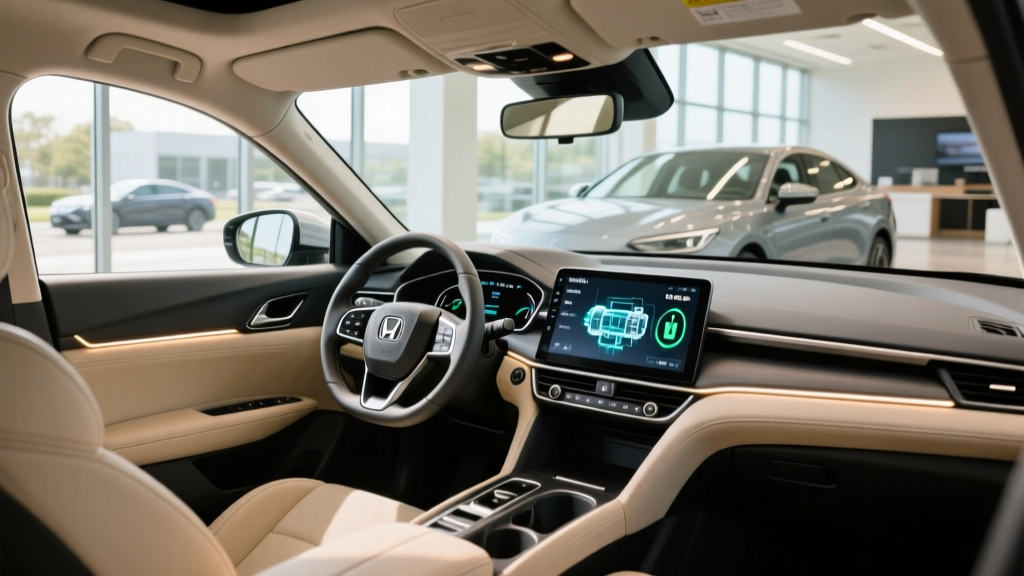
The Civic Hybrid shares its interior architecture with the standard 11th-generation Civic lineup, but Honda has made selective upgrades for the Hybrid trims. The dashboard follows Honda's honeycomb-mesh honeycomb air vent design with a freestanding touchscreen — a 7-inch display on the Sport Hybrid and a 9-inch unit on the Sport Touring Hybrid. Both support wireless Apple CarPlay and Android Auto on the upper trim; the base Sport Hybrid uses a wired connection.
Material quality is a step above what you'll find in most compact hybrids. Soft-touch surfaces cover the upper dashboard and door panels, while the Sport Touring Hybrid adds leather-trimmed seats, a heated steering wheel, and a 12-speaker Bose premium audio system. The digital instrument cluster is standard across Hybrid trims and includes a dedicated hybrid power-flow display, energy monitoring, and battery state-of-charge readout.
Practical dimensions remain generous for the class:
- Front headroom: 39.3 inches
- Rear legroom: 37.4 inches — competitive with the Corolla Hybrid's 35.0 inches and noticeably more usable than most EVs with floor-mounted battery packs
- Trunk volume: 14.8 cubic feet (sedan) — the hybrid battery is packaged under the rear seats, so cargo space is unchanged from the non-hybrid Civic
- Rear seat fold: 60/40 split-folding standard
The key interior advantage of the Civic Hybrid over many EVs is packaging. Because the lithium-ion hybrid battery is compact (approximately 1.0 kWh usable capacity for the HEV system), Honda avoids the floor-raising and trunk intrusion that plague some electrified vehicles. The result is a cabin that feels identical to the gas Civic in terms of seating position and cargo flexibility.
HEV vs. PHEV: Where the Civic Hybrid Fits
A common point of confusion for hybrid shoppers is the difference between a conventional hybrid (HEV) and a plug-in hybrid (PHEV). The 2026 Honda Civic Hybrid is an HEV — it cannot be plugged in and has no meaningful electric-only driving range. Instead, its electric motor assists the gasoline engine and recovers energy during braking and deceleration.
| Feature | HEV (Civic Hybrid) | PHEV (e.g., Toyota Prius Prime) |
|---|---|---|
| Plugs in? | No | Yes (Level 1 or Level 2) |
| Electric-only range | ~1 mile at low speed | 25–44 miles typical |
| Battery capacity | ~1.0 kWh usable | 10–14 kWh usable |
| Federal tax credit (§30D) | Not eligible | Up to $7,500 (if eligible) |
| Home charging needed? | No | Yes, for full benefit |
If you have access to home or workplace charging and a short commute, a PHEV like the Prius Prime or the Hyundai Tucson PHEV can eliminate most weekday gasoline use. If you lack reliable charging access — apartment dwellers, street parkers, frequent road-trippers — the Civic Hybrid's HEV system delivers strong efficiency without any infrastructure requirement.
EPA Fuel Economy and Real-World MPG
The 2026 Honda Civic Hybrid is rated by the EPA at 50 mpg city / 47 mpg highway / 49 mpg combined for the sedan in Sport trim. The Sport Touring Hybrid, with its larger wheels and additional equipment, drops slightly to 49 mpg city / 46 mpg highway / 48 mpg combined. These figures place the Civic Hybrid at the top of the compact hybrid sedan segment, edging out the Toyota Corolla Hybrid (50/43/47 mpg) on highway and combined cycles.
| Model | City | Highway | Combined |
|---|---|---|---|
| Honda Civic Hybrid Sport | 50 | 47 | 49 |
| Toyota Corolla Hybrid LE | 50 | 43 | 47 |
| Hyundai Elantra Hybrid Limited | 49 | 52 | 50 |
| Kia Niro FE (crossover) | 53 | 54 | 53 |
Source: fueleconomy.gov — EPA estimates. Your mileage will vary.
In mixed suburban and city driving, the Civic Hybrid frequently exceeds its EPA city rating — a common trait of series-parallel hybrids that lean heavily on electric-motor assist at low speeds. Owners regularly report 51–54 mpg in stop-and-go commuting. Highway driving at sustained 70–75 mph, however, typically drops to 42–45 mpg, as the gasoline engine shoulders more of the load. In cold weather (below 35°F), expect a 5–10% efficiency reduction due to engine warm-up cycles and reduced battery assist. Overall real-world combined driving settles around 46–50 mpg for most owners — closely matching or slightly exceeding the EPA sticker.
Powertrain: Two-Motor Hybrid System
The 2026 Civic Hybrid uses Honda's fourth-generation two-motor hybrid system, pairing a 2.0-liter Atkinson-cycle four-cylinder engine with two electric motors and an e-CVT (electronic continuously variable transmission). This is not a traditional belt-driven CVT — it uses a clutch-based system that can mechanically couple the engine to the wheels at highway speeds for improved efficiency.
| Specification | Value |
|---|---|
| Engine | 2.0L Atkinson-cycle DOHC 4-cylinder |
| Engine power | 146 hp @ 6,000 rpm / 134 lb-ft torque |
| Drive motor output | 184 hp / 232 lb-ft torque |
| Combined system output | 200 hp / 232 lb-ft torque |
| Transmission | e-CVT (clutch-based two-motor system) |
| Drivetrain | Front-wheel drive |
| 0–60 mph | ~7.1 seconds |
| Hybrid battery | Lithium-ion, ~1.0 kWh usable (HEV) |
| Fuel tank | 10.6 gallons |
The 200 combined horsepower is a standout in the compact hybrid segment — the Corolla Hybrid produces 138 hp, and the Elantra Hybrid makes 139 hp. That extra output translates to confident highway merging and passing, and the Civic Hybrid's electric-motor-dominant low-speed behavior gives it a responsive, almost EV-like feel from a stop.
Because this is an HEV, there is no plug and no external charging. The system recovers energy through regenerative braking (with selectable regen paddles behind the steering wheel) and engine-driven generation. Total driving range on a single tank is approximately 519 miles (10.6 gal × 49 mpg combined).
Battery Warranty, Reliability, and Replacement Cost
Honda covers the Civic Hybrid's lithium-ion battery pack under its hybrid system warranty for 8 years or 100,000 miles (whichever comes first). In California Air Resources Board (CARB) states — which include California, New York, Massachusetts, Colorado, and several others — the hybrid battery warranty extends to 10 years or 150,000 miles. This covers defects and capacity loss below a functional threshold.
Honda's hybrid systems have demonstrated strong long-term reliability. The two-motor architecture has been in production since the 2014 Accord Hybrid and has accumulated hundreds of thousands of real-world miles across the Honda lineup. Unlike early nickel-metal-hydride (NiMH) packs from the first-generation Insight and Civic Hybrid, the current lithium-ion batteries show minimal degradation over normal ownership periods because they operate in a narrow state-of-charge window — typically between 40% and 60% — which minimizes cycle wear.
Should the hybrid battery require replacement outside of warranty, expect a cost between $2,000 and $4,000 for a new OEM pack, depending on labor rates. Third-party refurbished packs are available for $1,200–$2,500. However, based on failure-rate data from Honda's hybrid fleet, most hybrid batteries last well beyond 150,000 miles under normal use. The hybrid system's inverter and power control unit are also covered under the 8-year/100,000-mile warranty.
For broader vehicle reliability, the Civic nameplate consistently earns strong marks. The 2026 Civic carries a 5-star overall safety rating from NHTSA and has historically earned IIHS Top Safety Pick+ designations. Honda Sensing — the brand's suite of adaptive cruise control, lane-keeping assist, automatic emergency braking, and traffic-sign recognition — is standard on all Hybrid trims.
Pricing, Trims, and Tax Credit Eligibility
The 2026 Honda Civic Hybrid is offered in two trims for the sedan:
| Trim | MSRP (incl. destination) | Key Features |
|---|---|---|
| Sport Hybrid | ~$30,650 | 7-inch touchscreen, wireless CarPlay/Android Auto (wired), heated front seats, 18-inch alloy wheels |
| Sport Touring Hybrid | ~$34,350 | 9-inch touchscreen, wireless CarPlay/Android Auto, leather seats, Bose 12-speaker audio, wireless charging, heated steering wheel, Honda Sensing 2.0 |
The 2026 Honda Civic Hybrid is a conventional hybrid (HEV) and does not qualify for the federal §30D Clean Vehicle Credit, which applies only to plug-in electric vehicles (BEVs and PHEVs) meeting battery-sourcing, MSRP, and buyer-income requirements. There is currently no federal tax credit for conventional hybrids. Some states and local utilities may offer rebates for hybrid purchases — check your state energy office or utility provider for current programs. For federal PHEV/BEV credit rules, see the IRS Clean Vehicle Credits page.
While the lack of a federal credit stings compared to eligible PHEVs (like the Prius Prime, which can qualify for up to $7,500 depending on sourcing and income), the Civic Hybrid's lower base price partially offsets this. A fully loaded Sport Touring Hybrid at ~$34,350 is still less expensive than many PHEV competitors before any credits, and it carries no home-charging installation cost.
Hybrid vs. PHEV vs. Full EV: Which Should You Choose?
The Civic Hybrid competes in a landscape where buyers have three electrified paths. Here's how to decide:
- You lack home or workplace charging access
- You want maximum simplicity — no plug, no apps, no charging planning
- Your driving is a mix of city and highway with frequent long road trips
- You want strong MPG without paying a PHEV or BEV premium
- You can charge at home (Level 1 or Level 2)
- Your daily commute is under 40 miles round-trip
- You want electric-only daily driving but gas flexibility for road trips
- You qualify for the §30D federal credit, which narrows the price gap
- You have reliable home Level 2 charging
- Your daily driving is under 250 miles and you can plan road-trip charging
- You want to eliminate gasoline entirely and minimize maintenance
- The §30D credit and lower fuel/maintenance costs offset the higher MSRP
For the majority of US drivers who lack dedicated home charging — roughly 30–40% of households, according to DOE estimates — the Civic Hybrid represents the highest-efficiency option that requires zero lifestyle change. You fuel it like any gas car, but you'll visit the station roughly half as often.
Pros and Cons at a Glance
- Class-leading 200 hp combined — significantly more powerful than Corolla or Elantra hybrids
- Up to 49 mpg combined EPA, with real-world city MPG often exceeding the sticker
- No plug required — zero charging dependency
- Trunk space unaffected by hybrid battery (14.8 cu ft)
- Generous rear legroom (37.4 in)
- Honda Sensing ADAS suite standard on all trims
- 8-year/100,000-mile hybrid battery warranty (10/150k in CARB states)
- No federal tax credit eligibility (HEV, not PHEV/BEV)
- No AWD option (Toyota Corolla Hybrid offers electronic AWD)
- Sport Hybrid base trim uses a 7-inch screen — undersized for 2026
- Highway MPG trails the Elantra Hybrid's 52 mpg rating
- ~$30,650 starting price is higher than a base Corolla Hybrid LE (~$24,000)
- Not available as a PHEV — Honda offers no plug-in Civic
Frequently Asked Questions
How many MPG does the 2026 Honda Civic Hybrid get?
The EPA rates the Civic Hybrid Sport sedan at 50 mpg city, 47 mpg highway, and 49 mpg combined. The Sport Touring Hybrid is rated at 49/46/48 mpg. In real-world city driving, owners commonly report 51–54 mpg thanks to the hybrid system's electric-motor-dominant behavior at low speeds. Highway cruising at 70+ mph typically returns 42–45 mpg.
Can the Civic Hybrid drive on electric power alone?
Only for very short distances at low speeds — roughly 1 mile or less below 25 mph in EV mode. The Civic Hybrid is an HEV with a small (~1.0 kWh) battery, not a PHEV. It is designed to assist the gasoline engine, not replace it. If electric-only commuting is your goal, you need a PHEV like the Toyota Prius Prime (up to 44 miles electric-only) or a full BEV.
Is the 2026 Civic Hybrid reliable? What about battery replacement?
Honda's fourth-generation two-motor hybrid system has been in production since 2014 and has demonstrated strong reliability across the Accord, CR-V, and Civic lineups. The hybrid battery is warrantied for 8 years/100,000 miles (10 years/150,000 miles in CARB states). Out-of-warranty replacement costs range from $2,000–$4,000 for an OEM pack, but most hybrid batteries last well beyond 150,000 miles due to the system's conservative state-of-charge management.
Does the Civic Hybrid qualify for any federal tax credit?
No. The federal §30D Clean Vehicle Credit applies only to plug-in vehicles (BEVs and PHEVs) that meet battery-component and critical-mineral sourcing requirements, MSRP caps, and buyer income limits. The Civic Hybrid, as a conventional HEV, is not eligible. Some state or utility programs may offer hybrid rebates — check local resources. For current federal rules, consult the IRS Clean Vehicle Credits page.
How does the Civic Hybrid compare to the Toyota Corolla Hybrid?
The Civic Hybrid is more powerful (200 hp vs. 138 hp), offers more rear legroom (37.4 in vs. 35.0 in), and has a slightly higher combined EPA rating in Sport Touring trim. The Corolla Hybrid offers electronic AWD (not available on the Civic) and starts at a lower MSRP. On highway MPG, the Corolla Hybrid's 43 mpg trails the Civic's 47 mpg, though the Corolla's city rating matches at 50 mpg. If power and interior space matter, the Civic Hybrid wins. If AWD and budget are priorities, the Corolla Hybrid is the stronger pick.
Should I buy the Civic Hybrid or wait for a plug-in version?
Honda has not announced a Civic PHEV for the US market as of 2026. If plug-in capability is essential for your situation — short commute, home charging access, desire for the §30D credit — consider the Toyota Prius Prime, Hyundai Elantra PHEV (if available), or a compact BEV like the Chevrolet Equinox EV or Hyundai Kona Electric. If you need a car now and don't have reliable charging access, the Civic Hybrid is one of the most efficient and practical HEVs available.