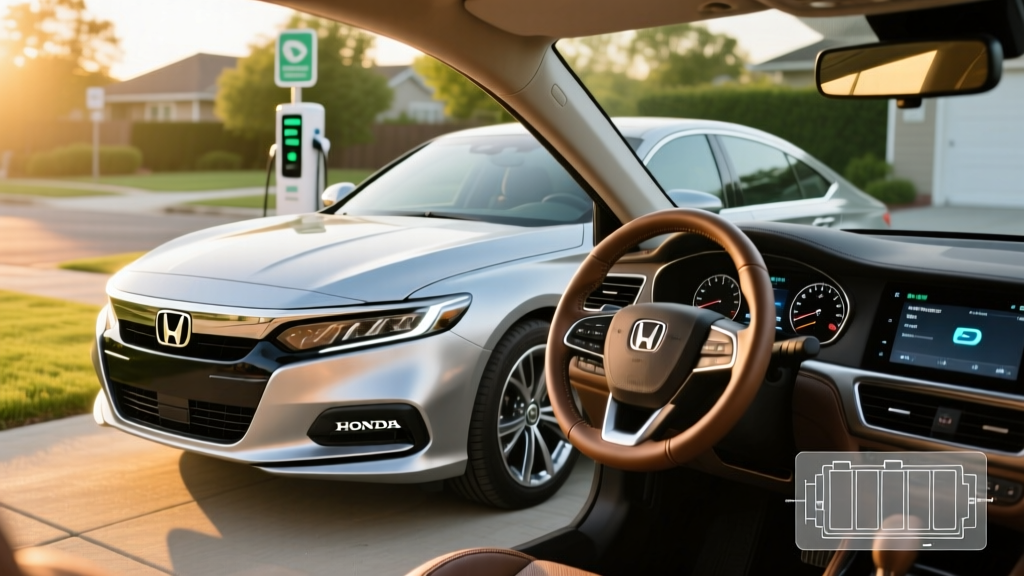
The 2026 Honda Accord Touring Hybrid occupies a precise niche: it's the fully loaded trim of Honda's midsize sedan, equipped with the fourth-generation two-motor hybrid system that delivers exceptional city fuel economy without requiring a charging cable. If you've searched for the 2026 Honda Accord Touring Hybrid, you're likely weighing whether a conventional hybrid (HEV) makes more sense than a plug-in hybrid (PHEV) or a full battery-electric vehicle (BEV). This review breaks down every spec that matters — EPA fuel economy, real-world MPG, powertrain output, battery longevity, warranty coverage, and whether any tax incentives apply.
2026 Honda Accord Touring Hybrid: Quick Verdict
The Touring is the top-of-the-line Accord Hybrid trim, bundling Honda's most efficient powertrain with premium features like leather upholstery, a 12.3-inch infotainment display, Bose 12-speaker audio, wireless phone charging, and the full Honda Sensing suite of driver-assistance features. It is a conventional hybrid (HEV), meaning it charges its small lithium-ion battery solely through regenerative braking and the gasoline engine — there is no plug, no electric-only driving mode of meaningful distance, and no range anxiety. You simply fill the 14.8-gallon tank with regular unleaded and drive.
Pros
- 48 MPG combined EPA — among the best in the midsize sedan segment
- Excellent real-world city MPG, often exceeding the EPA sticker
- No plug-in charging required — works with existing gas-station infrastructure
- Touring trim includes premium features rivaling luxury sedans
- Strong reliability track record; 8-year/100,000-mile hybrid battery warranty
Cons
- No electric-only driving range — this is not a PHEV
- Highway MPG drops to ~43 due to aerodynamic drag at speed
- No federal §30D tax credit eligibility (HEVs do not qualify)
- Touring MSRP near $39,000 pushes it above base-trim hybrid value
- CVT-like driving feel under hard acceleration (e-CVT behavior)
EPA Fuel Economy and Real-World MPG
The 2026 Accord Hybrid Touring carries an EPA rating of 46 MPG city / 41 MPG highway / 44 MPG combined. These figures apply to the Touring and Sport-L trims, which ride on 19-inch wheels that slightly reduce efficiency compared to the EX-L Hybrid's 48 MPG combined rating on 17-inch wheels. Let's put those numbers in context:
| Trim | City MPG | Highway MPG | Combined MPG | Wheel Size |
|---|---|---|---|---|
| Accord Hybrid EX-L | 51 | 44 | 48 | 17-inch |
| Accord Hybrid Sport-L | 46 | 41 | 44 | 19-inch |
| Accord Hybrid Touring | 46 | 41 | 44 | 19-inch |
Source: EPA / fueleconomy.gov
Real-World MPG: What to Actually Expect
Honda's two-motor hybrid system excels in stop-and-go urban driving, where the electric motor handles most low-speed propulsion and the 2.0-liter Atkinson-cycle engine acts primarily as a generator. In real-world city driving, owners consistently report 47–53 MPG — often beating the EPA city estimate. Highway driving tells a different story: at sustained 75–80 MPH, expect 38–42 MPG as the engine engages directly and aerodynamic drag dominates. In cold weather (below 30°F), the engine runs more frequently to provide cabin heat, reducing combined economy to roughly 38–41 MPG until the powertrain reaches operating temperature.
With the 14.8-gallon fuel tank and a realistic combined average of 42–44 MPG, expect a driving range of approximately 620–650 miles per tank in mixed driving — one of the longest ranges available in any midsize sedan, electrified or otherwise.
Powertrain Specs: Engine, Motors, and Horsepower
| Specification | 2026 Accord Hybrid Touring |
|---|---|
| Engine | 2.0L DOHC Atkinson-cycle 4-cylinder |
| Engine Output | 146 hp / 134 lb-ft torque |
| Drive Motor | Permanent-magnet synchronous (184 hp / 247 lb-ft) |
| Combined System Output | 204 hp / 247 lb-ft torque |
| Transmission | e-CVT (direct drive with engine clutch) |
| Drivetrain | Front-wheel drive |
| 0–60 MPH | ~7.2 seconds |
| Hybrid Battery | Lithium-ion, ~1.1 kWh (nominal) |
| Fuel Tank | 14.8 gallons (regular unleaded) |
| Curb Weight | ~3,477 lbs |
Honda's fourth-generation two-motor hybrid system operates in three modes. In EV Drive, the battery powers the drive motor alone — but this lasts only about 1–2 miles at low speeds before the engine kicks in. In Hybrid Drive, the engine spins a generator that feeds electricity to the drive motor (the engine does not turn the wheels). In Engine Drive, a lock-up clutch connects the engine directly to the front axle for efficient highway cruising. This architecture eliminates a traditional transmission entirely, resulting in seamless acceleration with no shift shock — though under hard throttle, the engine RPM rises to a steady drone characteristic of e-CVT systems.
HEV vs PHEV vs EV: Which Fits Your Driving Life?
The 2026 Accord Touring Hybrid is a conventional HEV. It is not a plug-in hybrid, and it is not a battery-electric vehicle. Understanding the distinction is critical before you buy:
| Factor | HEV (Accord Hybrid) | PHEV (e.g., Toyota Prius Prime) | BEV (e.g., Hyundai Ioniq 6) |
|---|---|---|---|
| Plug-in Required? | No | Yes (for EV range) | Yes |
| Electric-Only Range | ~1 mile (low speed) | 35–44 miles typical | 270–360 miles EPA |
| Total Range | ~640 miles | ~550–600 miles combined | 270–360 miles |
| Fuel/Energy Cost per Mile | ~$0.08 (at $3.50/gal) | ~$0.04 (electric) / $0.09 (gas) | ~$0.04 (electric) |
| Home Charging Needed? | No | Recommended (Level 2) | Essential (Level 2) |
| Federal Tax Credit (§30D) | Not eligible | Up to $7,500 (if eligible) | Up to $7,500 (if eligible) |
| Upfront Price Premium | Low ($1,000–$1,500 over gas) | Moderate ($3,000–$5,000) | High ($8,000–$15,000+) |
| Best For | No home charging, long trips | Short commute + home charger | Home charging + daily driving |
Choose the Accord Hybrid Touring If:
- You cannot install a Level 2 home charger (apartment, condo, street parking)
- You regularly drive 300+ miles in a single trip and don't want to plan around charging stations
- You want electrified efficiency without any behavioral change from your current gas car
- You value the Touring's premium features over the lower cost of a PHEV or BEV with fewer amenities
Consider a PHEV or BEV Instead If:
- You have a garage or driveway where a Level 2 charger can be installed
- Your daily commute is under 40 miles round-trip (a PHEV covers this on electricity alone)
- You want to minimize gasoline use and qualify for the federal §30D tax credit
- You're willing to accept a BEV's range limitations for lower per-mile energy costs
Pricing, Trims, and Tax Credit Eligibility
| 2026 Accord Hybrid Trim | MSRP (est.) | Federal §30D Credit |
|---|---|---|
| EX-L Hybrid | $34,995 | Not eligible |
| Sport-L Hybrid | $36,350 | Not eligible |
| Touring Hybrid | $38,990 | Not eligible |
Pricing is estimated based on 2025 MSRP trends. Final 2026 MSRP to be confirmed at launch.
The 2026 Honda Accord Touring Hybrid does not qualify for the federal §30D Clean Vehicle Credit. Under current IRS rules, the §30D credit of up to $7,500 applies only to plug-in electric vehicles (BEVs and PHEVs) that meet battery-component and critical-mineral sourcing requirements, MSRP caps ($55,000 for sedans), and buyer income limits. Conventional hybrids like the Accord HEV are excluded entirely.
Some states offer their own incentives for hybrids, though these are increasingly rare and typically favor PHEVs and BEVs. Check your state's energy office or department of environmental quality for current programs. A few states previously offered $500–$1,000 rebates for HEVs, but most have phased these out.
Federal §30D Credit — Why the Accord Hybrid Doesn't Qualify:
- ✗ Vehicle must be a plug-in EV (BEV or PHEV) with ≥7 kWh battery — Accord Hybrid has ~1.1 kWh, no plug
- ✗ Must meet critical-mineral sourcing thresholds — N/A for HEVs
- ✗ Must meet battery-component manufacturing requirements — N/A for HEVs
- ✓ MSRP under $55,000 sedan cap — Accord Touring passes this, but it's moot
- ✓ Buyer income under $150K single / $300K joint — also moot
Hybrid Battery Warranty, Reliability, and Replacement Cost
Honda Hybrid Battery Warranty
Coverage: 8 years / 100,000 miles (10 years / 150,000 miles in CARB states including CA, CO, CT, ME, MD, MA, NJ, NY, OR, RI, VT, WA)
What's covered: Hybrid battery pack, hybrid control unit, and related hybrid-system components against defects and capacity loss below functional thresholds.
Transferable: Yes, to subsequent owners within the warranty period.
Honda's hybrid battery reliability record is strong. The lithium-ion pack in the Accord Hybrid is relatively small (~1.1 kWh) and operates within a conservative state-of-charge window — typically between 20% and 80% — managed by the hybrid control system. This shallow cycling dramatically reduces degradation compared to a full BEV battery that regularly cycles from 10% to 90%. Based on historical data from Honda's earlier hybrid systems (Insight, CR-Z, and previous Accord Hybrid generations), significant battery degradation before 150,000 miles is uncommon.
What Does a Hybrid Battery Replacement Cost?
If the hybrid battery fails outside warranty coverage, a replacement from Honda typically costs between $2,000 and $4,000 including parts and labor. Third-party refurbished or aftermarket hybrid batteries are available for $1,200 to $2,500. Independent hybrid-specialty shops can often perform the replacement for less than a dealership. For context, the hybrid battery in the Accord is far smaller and less expensive to replace than a BEV traction battery, which can run $8,000–$20,000+.
The gasoline engine, e-CVT powertrain, and 12-volt auxiliary battery are covered under separate warranty terms (3-year/36,000-mile basic, 5-year/60,000-mile powertrain). The e-CVT, which has no belts, bands, or traditional friction clutches, has proven extremely durable in Honda's fleet — there are no transmission-fluid changes required under normal service intervals.
Honda Sensing, Safety Ratings, and Touring-Exclusive Tech
The Touring trim includes the full Honda Sensing suite, which operates at SAE Level 2 automation — meaning the system can manage steering, acceleration, and braking under certain conditions, but the driver must remain fully attentive with hands on the wheel and eyes on the road. This is a driver-assistance system, not a self-driving system.
- Adaptive Cruise Control (ACC): Maintains set speed and following distance, including stop-and-go traffic
- Lane Keeping Assist (LKAS): Provides steering input to maintain lane centering
- Traffic Jam Assist: Extends ACC and LKAS functionality to low-speed congestion
- Collision Mitigation Braking (CMBS): Forward collision warning with automatic emergency braking
- Road Departure Mitigation: Detects lane markings and road edges
- Blind Spot Information (BSI) with Rear Cross Traffic Monitor: Standard on Touring
- Low-Speed Braking Control: Front and rear parking sensors with auto-braking
The IIHS has historically awarded the Accord its Top Safety Pick+ rating, and the 2026 model is expected to maintain this standing. NHTSA 5-star overall ratings are also anticipated based on the current-generation platform's crash-test performance.
Touring Trim Features and Interior
At approximately $38,990, the Touring justifies its price premium over the EX-L Hybrid ($34,995) with a substantial feature upgrade:
- 12.3-inch touchscreen with wireless Apple CarPlay and Android Auto
- Bose 12-speaker premium audio system
- Wireless Qi phone charging pad
- Heated and ventilated front seats; heated rear outboard seats
- Leather-trimmed seats with power-adjustable front positions and memory
- Head-up display (HUD)
- Rain-sensing windshield wipers
- LED headlights with auto high-beam
- 19-inch alloy wheels with 235/40R19 tires
- Power moonroof
- Dual-zone automatic climate control with rear vents
Cargo volume is 16.7 cubic feet, unchanged from the non-hybrid Accord because the hybrid battery is packaged under the rear seats rather than intruding into the trunk. The rear seat folds in a 60/40 split, and the trunk opening is wide and practical. Interior passenger volume remains generous at approximately 103 cubic feet, with rear legroom that accommodates adults comfortably on long trips.
5-Year Ownership Cost Estimate
| Cost Category | 5-Year Estimate | Notes |
|---|---|---|
| Purchase Price (MSRP) | $38,990 | Touring Hybrid, before destination/taxes |
| Federal Tax Credit | $0 | HEV — not eligible for §30D |
| Fuel (60,000 mi) | $4,773 | At 44 MPG combined, $3.50/gal avg |
| Insurance (est.) | $8,400 | ~$1,680/yr national avg for midsize sedan |
| Maintenance | $2,800 | Oil changes, tires, brakes, cabin filter |
| Estimated Depreciation | $14,000 | ~36% over 5 years (Honda Accord retains well) |
| Total 5-Year Cost | ~$54,963 | Before state incentives or trade-in |
For comparison, a similarly equipped gasoline-only midsize sedan getting 30 MPG combined would cost roughly $7,000 in fuel over the same 60,000 miles — a difference of about $2,227 in fuel savings for the Accord Hybrid over five years. The hybrid's upfront premium over a gas-only competitor is typically recouped within 3–4 years through fuel savings alone, before factoring in the Accord's strong resale value.
Frequently Asked Questions
How many MPG does the 2026 Honda Accord Touring Hybrid get?
The EPA rates the 2026 Accord Hybrid Touring at 46 MPG city, 41 MPG highway, and 44 MPG combined. In real-world city driving, many owners report 47–53 MPG. Highway driving at 75+ MPH typically yields 38–42 MPG. Cold weather reduces combined economy by roughly 5–8 MPG until the powertrain warms up.
Can the Accord Hybrid drive on electric power alone?
Only for very short distances — approximately 1 mile at low speeds (under 25 MPH) in EV Drive mode. The hybrid battery is too small (~1.1 kWh) for meaningful electric-only range. This is a conventional hybrid, not a plug-in hybrid. If you want 30–40 miles of electric-only commuting, you need a PHEV like the Toyota Prius Prime or Hyundai Tucson PHEV.
Does the 2026 Accord Hybrid qualify for a tax credit?
No. The federal §30D Clean Vehicle Credit applies only to plug-in electric vehicles (BEVs and PHEVs). The Accord Hybrid is a conventional HEV and does not qualify for the $7,500 federal credit or most state EV incentives. Some states may offer small hybrid rebates — check your state energy office for current programs.
Is the Honda Accord Hybrid reliable? What about the battery?
Honda's hybrid systems have a strong reliability record. The hybrid battery is warrantied for 8 years/100,000 miles (10 years/150,000 miles in CARB states). The battery operates within a shallow charge cycle (20–80%), which minimizes degradation. Replacement cost outside warranty runs $2,000–$4,000 at a dealership, or $1,200–$2,500 with a refurbished unit at an independent shop.
Do I need to plug in the Accord Hybrid to charge it?
No. The Accord Hybrid is a conventional HEV. Its small lithium-ion battery charges through regenerative braking and the gasoline engine. There is no charging port, no plug, and no need for home charging infrastructure. You fuel it like any gasoline car.
How does the Accord Hybrid compare to a Toyota Camry Hybrid?
Both achieve similar combined MPG (Camry Hybrid LE: 52 combined; Accord Hybrid EX-L: 48 combined). The Camry Hybrid LE's higher EPA rating comes from its smaller wheels and lighter trim. At the Touring-equivalent trim level, the Camry XSE Hybrid achieves 44 combined — matching the Accord Touring. The Accord offers slightly more rear-seat legroom and cargo volume; the Camry Hybrid has a marginally more efficient base powertrain. Both carry similar hybrid battery warranties and reliability reputations.
Is the Accord Hybrid's e-CVT the same as a regular CVT?
No. Honda's e-CVT is fundamentally different from a belt-and-pulley CVT found in some competitors. It uses a planetary gearset and two electric motors to manage power delivery — there are no belts, chains, or friction clutches that wear out. The driving feel is smooth and linear, though under hard acceleration the engine holds a steady RPM that some drivers find monotonous. This is a characteristic of the powertrain architecture, not a sign of mechanical stress.