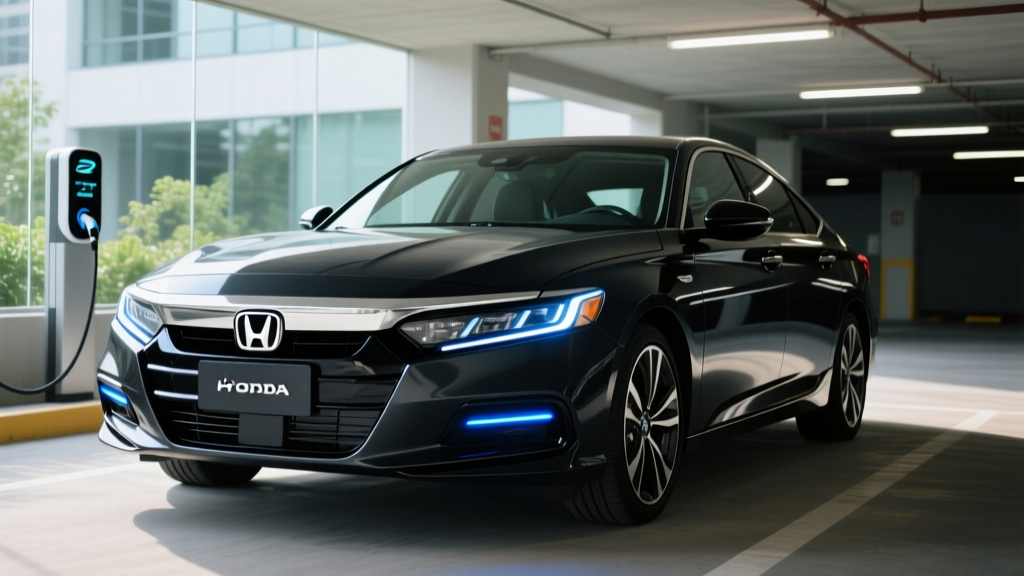
The 2026 Honda Accord Hybrid Touring sits at the top of Honda's midsize sedan lineup, pairing a proven two-motor hybrid system with the brand's most luxurious trim. For buyers who want near-EV efficiency in city driving without ever plugging in, the Accord Hybrid remains one of the most compelling choices in a segment that has thinned considerably. This review breaks down the exact fuel economy figures, powertrain specs, ownership costs, and battery longevity data you need before signing the paperwork.
Quick Verdict: Who Is the Accord Hybrid Touring For?
The Touring trim is Honda's fully loaded offering, bundling leather seats, a 12-speaker Bose audio system, wireless Apple CarPlay and Android Auto, a head-up display, and the full Honda Sensing suite of driver-assistance features. The hybrid powertrain is standard on Touring — there is no gas-only Touring for 2026. If you drive 12,000–15,000 miles annually with a mix of city and highway commutes, this sedan delivers roughly 48 MPG combined without requiring any lifestyle change: no charging, no range planning, no plug. It simply sips fuel and goes.
Fuel Economy: EPA Ratings and Real-World MPG
The EPA rates the 2026 Honda Accord Hybrid at 51 MPG city / 44 MPG highway / 48 MPG combined for the Sport, EX-L, and Touring trims equipped with 19-inch wheels. The Sport-L and lower trims with 17-inch wheels achieve slightly higher figures at 51/44/48 as well, though minor differences can appear depending on tire compound and aerodynamic drag.
| Trim | City MPG | Highway MPG | Combined MPG | Est. Annual Fuel Cost* |
|---|---|---|---|---|
| Sport (17" wheels) | 51 | 44 | 48 | $1,250 |
| EX-L (19" wheels) | 51 | 44 | 48 | $1,250 |
| Touring (19" wheels) | 51 | 44 | 48 | $1,250 |
*Based on 15,000 miles/year at $3.50/gallon regular unleaded. Source: fueleconomy.gov
Real-World MPG Expectations
Hybrid sedans typically exceed their EPA city rating in stop-and-go traffic, where regenerative braking recaptures the most energy. Owners regularly report 52–55 MPG in urban commutes. Highway driving is where hybrids lose their edge relative to the sticker: expect 40–43 MPG at sustained 70–75 mph speeds, since the electric motor contributes less at constant velocity. In cold weather (below 30°F), fuel economy can dip 5–10% as the engine runs longer to generate cabin heat. On balance, most Accord Hybrid owners average 46–50 MPG combined in mixed driving — closely tracking the EPA estimate.
Powertrain Specs: Two-Motor Hybrid System
The 2026 Accord Hybrid uses Honda's fourth-generation two-motor hybrid system, which is fundamentally different from the Toyota-style planetary gearset approach. Here, a 2.0-liter Atkinson-cycle four-cylinder engine acts primarily as a generator, producing electricity that feeds either a drive motor or a small lithium-ion battery pack. At highway speeds, a lock-up clutch can mechanically connect the engine to the front wheels for improved efficiency.
| Engine | 2.0L Atkinson-cycle DOHC i-VTEC 4-cylinder |
| Engine Output | 146 hp / 134 lb-ft torque |
| Drive Motor Output | 181 hp / 247 lb-ft torque |
| Combined System Output | 204 hp / 247 lb-ft torque |
| Transmission | Electronic continuously variable (e-CVT) |
| Drivetrain | Front-wheel drive |
| 0–60 mph | ~6.5 seconds (est.) |
| Battery Type | Lithium-ion (approx. 1.1 kWh usable) |
| Curb Weight | ~3,477 lbs |
| Fuel Tank | 12.8 gallons |
| Total Driving Range | ~614 miles (EPA est.) |
| Base MSRP (Touring) | $40,695 (incl. destination) |
The system's 204 combined horsepower provides confident passing power, and the 247 lb-ft of electric torque delivers immediate throttle response off the line — something no turbocharged gas-only sedan in this class can match. The e-CVT is smooth and drone-free, a marked improvement over earlier Honda hybrid generations.
HEV vs. PHEV vs. EV: Which Powertrain Fits You?
The Accord Hybrid is a conventional hybrid (HEV). It charges its own small battery through regenerative braking and the gasoline engine. You never plug it in. Honda does not currently offer a plug-in hybrid (PHEV) version of the Accord in the United States.
| Factor | HEV (Accord Hybrid) | PHEV (e.g., Toyota Prius Prime) | BEV (e.g., Tesla Model 3) |
|---|---|---|---|
| Plug-in Required? | No | Yes (for EV range) | Yes (always) |
| Electric-Only Range | ~1 mile at low speed | 25–44 miles | 250–360 miles |
| Total Range | ~614 miles | ~400–600 miles | 250–360 miles |
| Fuel/Energy Cost (per mile) | ~$0.07 | ~$0.04 (EV) / $0.07 (gas) | ~$0.04 |
| Home Charging Needed? | No | Recommended (Level 2) | Yes (Level 2 ideal) |
| Federal Tax Credit (§30D) | Not eligible | Up to $7,500 (if eligible) | Up to $7,500 (if eligible) |
| Best For | No plug access; long trips | Short commutes + road trips | Home charging; daily driving |
Choose the Accord Hybrid If:
- You live in an apartment or lack access to home/workplace charging.
- Your commute mixes city and highway driving without a predictable short-distance pattern.
- You regularly take road trips exceeding 300 miles and don't want to plan charging stops.
- You want minimal powertrain complexity — no cables, no charging apps, no range calculations.
Consider a PHEV or BEV Instead If:
- You can install a Level 2 home charger and your daily commute is under 40 miles (PHEV covers this on electricity alone).
- You want to maximize per-mile savings and qualify for the federal tax credit.
- You want the instant torque and silence of pure electric driving for most of your miles.
Pricing, Trim Breakdown, and Tax Credit Eligibility
The 2026 Honda Accord Hybrid is available in four trims. The Touring is the range-topper:
| Trim | MSRP (incl. destination) | Key Additions Over Base Hybrid |
|---|---|---|
| Sport | $34,295 | 19" wheels, sport styling, heated front seats |
| Sport-L | $35,295 | Leather-trimmed seats, heated rear seats |
| EX-L | $36,695 | Power moonroof, leather, wireless charging |
| Touring | $40,695 | BOSE 12-speaker audio, HUD, heated/ventilated front seats, heated rear seats, rain-sensing wipers |
Does the Accord Hybrid Qualify for a Federal Tax Credit?
No. Under current IRS §30D Clean Vehicle Credit rules, only plug-in electric vehicles (PHEVs and BEVs) with a battery capacity of at least 7 kWh qualify. The Accord Hybrid's ~1.1 kWh battery is far below that threshold. It is a conventional hybrid and does not qualify for any federal purchase incentive.
Some states offer their own rebates or HOV-lane access for hybrids, but these vary by jurisdiction and change frequently. Check your state's energy or environmental agency website for current programs. Do not rely on dealer claims about credit eligibility — always verify against official IRS and state sources.
Battery Longevity, Warranty, and Replacement Costs
Hybrid battery longevity is consistently the top concern among first-time hybrid buyers. Honda addresses this with robust warranty coverage and a proven track record.
Honda Hybrid Battery Warranty
- Coverage: 8 years / 100,000 miles (10 years / 150,000 miles in CARB states including CA, CO, CT, ME, MA, NJ, NY, OR, RI, VT, WA)
- What's covered: Defects in materials/workmanship; capacity loss below a defined threshold (typically ~60–70% of original capacity)
- Transferable: Yes, to subsequent owners
The Accord Hybrid's lithium-ion pack is small (~1.1 kWh usable) and operates within a narrow state-of-charge window — typically between 20% and 80% SoC. Honda's battery management system never fully charges or fully depletes the pack, which dramatically reduces stress and extends cycle life. Real-world data from previous-generation Accord Hybrids and Insights shows that hybrid battery packs routinely last 150,000–200,000+ miles before any meaningful degradation.
If replacement is eventually needed outside of warranty, a refurbished Honda hybrid battery pack costs approximately $2,000–$3,500 installed at a dealership. Independent hybrid specialists can often perform the replacement for $1,500–$2,500 using reconditioned modules. This is a fraction of the cost of a full EV battery replacement, and far less frequent.
Reliability and Safety Ratings
Honda's two-motor hybrid system has been in production since 2014 (Accord Hybrid) and has demonstrated excellent long-term reliability. The system has fewer moving parts than a conventional automatic transmission — there are no traditional gearsets, torque converter, or multi-speed shifting mechanisms. Consumer Reports and J.D. Power have consistently rated the Accord Hybrid at or above average for predicted reliability.
For safety, the 2026 Accord carries the full Honda Sensing suite as standard on every trim:
- Collision Mitigation Braking System (CMBS)
- Adaptive Cruise Control with Low-Speed Follow
- Lane Keeping Assist System (LKAS)
- Road Departure Mitigation
- Traffic Sign Recognition
- Blind Spot Information (BSI) with Cross Traffic Monitor (Touring standard)
The previous-generation Accord earned the IIHS Top Safety Pick+ award and a 5-star overall rating from NHTSA. The 2026 model is expected to maintain or improve on these results given Honda's incremental safety enhancements. Note that Honda Sensing is a Level 2 driver-assistance system per SAE classification — the driver must remain fully engaged and is responsible for the vehicle at all times. This is not autonomous driving.
Ownership Costs: 5-Year Projection
One of the Accord Hybrid Touring's strongest arguments is its low cost of operation. Here's a five-year estimate assuming 15,000 miles per year:
| Category | 5-Year Cost | Notes |
|---|---|---|
| Purchase Price | $40,695 | MSRP incl. destination; before taxes/fees |
| Fuel (75,000 mi) | $6,250 | @ 48 MPG, $3.50/gal, 15k mi/yr |
| Insurance | $8,500 | ~$1,700/yr national avg. for Touring trim |
| Maintenance | $2,800 | Oil changes, filters, brakes (regen extends pad life) |
| Tires | $1,600 | One set of replacement tires (19" Touring) |
| Depreciation (est.) | $16,000 | ~40% over 5 years (Honda retains value well) |
| Total 5-Year Cost | ~$75,845 | Incl. purchase price |
For comparison, a similarly equipped gas-only midsize sedan averaging 30 MPG combined would cost roughly $8,750 in fuel over the same period — a $2,500 fuel savings for the Accord Hybrid. The hybrid also benefits from reduced brake wear, as regenerative braking handles most deceleration, allowing brake pads to last 80,000–100,000+ miles in many cases.
Pros and Cons
Pros
- 48 MPG combined EPA — real-world often higher in city driving
- No plug-in required; zero lifestyle change from a gas car
- Smooth, responsive e-CVT with instant electric torque
- Touring trim loaded with premium features at a sub-$41K price
- Excellent battery warranty (8yr/100k mi; 10yr/150k mi CARB)
- Proven hybrid reliability with low maintenance costs
- Spacious rear seat and 16.7 cu-ft trunk (no battery intrusion)
Cons
- No federal tax credit eligibility (HEV, not PHEV)
- Highway MPG drops to low 40s at sustained 70+ mph
- No all-wheel-drive option (FWD only)
- Touring trim pushes $41K — a premium for a midsize sedan
- Infotainment still uses a physical knob/touchscreen hybrid — some prefer pure touchscreen or pure buttons
- No spare tire (tire repair kit only)
Frequently Asked Questions
How many MPG does the 2026 Honda Accord Hybrid Touring get?
The EPA rates it at 51 MPG city, 44 MPG highway, and 48 MPG combined. In real-world city driving with frequent stops, owners often see 52–55 MPG. Highway cruising at 70–75 mph typically yields 40–43 MPG.
Does the Accord Hybrid need to be plugged in?
No. The Accord Hybrid is a conventional hybrid (HEV), not a plug-in hybrid (PHEV). Its small lithium-ion battery recharges through regenerative braking and the gasoline engine. You fuel it like any other car at a gas station.
How far can the Accord Hybrid drive on electric power alone?
Only about 1 mile at very low speeds (under 25 mph) in EV mode. The battery is too small (~1.1 kWh) for meaningful electric-only driving. The electric motor assists the engine continuously but does not power the car independently for any significant distance. If you want 25–40 miles of electric-only range, you need a PHEV like the Toyota Prius Prime.
Is the Accord Hybrid reliable, and what does battery replacement cost?
Honda's two-motor hybrid system has a strong reliability record since 2014. The hybrid battery is warrantied for 8 years/100,000 miles (10 years/150,000 miles in CARB states). Real-world data suggests these packs last 150,000–200,000+ miles. Out-of-warranty replacement runs $2,000–$3,500 at a dealer or $1,500–$2,500 at an independent hybrid specialist.
Does the 2026 Accord Hybrid qualify for a federal tax credit?
No. Under IRS §30D rules, only plug-in vehicles (PHEVs and BEVs) with batteries of 7 kWh or larger qualify for the Clean Vehicle Credit. The Accord Hybrid's ~1.1 kWh battery does not meet this threshold. Check your state's energy agency for any local hybrid incentives, but do not expect a federal credit.
How does the Accord Hybrid compare to a full EV like the Tesla Model 3?
The Accord Hybrid costs less upfront, needs no charging infrastructure, and offers 614 miles of total range. A Model 3 offers lower per-mile energy costs (~$0.04/mi vs. ~$0.07/mi), qualifies for up to $7,500 in federal credits (if eligible), and delivers a pure-EV driving experience. If you can charge at home and your daily driving is under 300 miles, the EV saves more long-term. If you lack charging access or take frequent long trips, the Accord Hybrid eliminates all range and charging concerns.
Does the Touring trim have all-wheel drive?
No. The 2026 Accord Hybrid is front-wheel drive only across all trims. Honda does not offer AWD on the Accord. If AWD is essential, consider the Toyota Camry Hybrid (available with AWD) or a crossover like the Honda CR-V Hybrid.
Sources: fueleconomy.gov, Honda Accord Hybrid official page, IRS Clean Vehicle Tax Credits, NHTSA Safety Ratings.