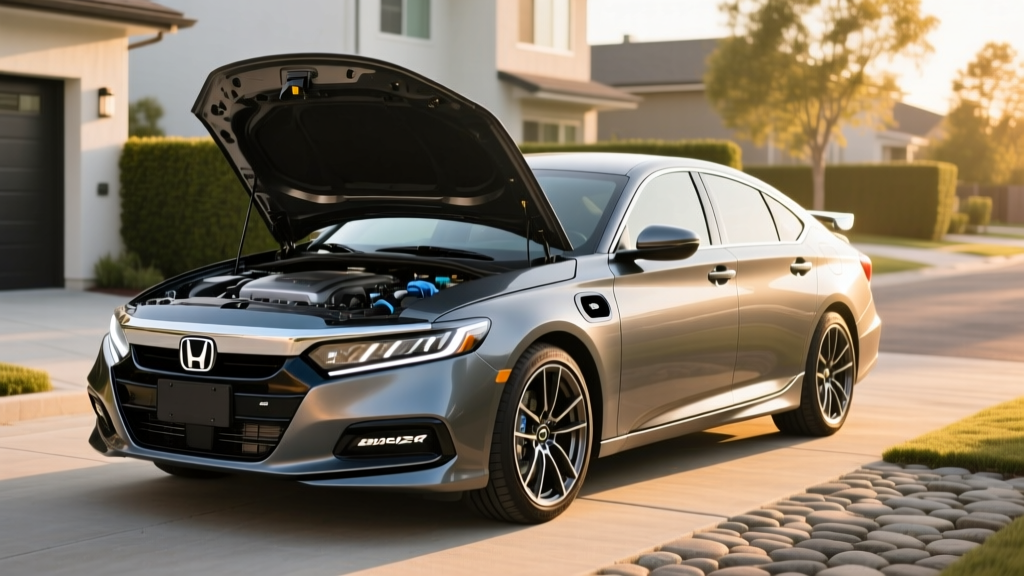
The midsize sedan segment has thinned out, but the Honda Accord remains a staple — and the hybrid variant is now the volume seller. The 2026 Honda Accord Hybrid Sport sits in the sweet spot of the lineup: sport-tuned suspension, a 204-horsepower two-motor hybrid system, and EPA-estimated fuel economy that makes it one of the most efficient non-plug-in sedans you can buy. This is a conventional hybrid (HEV), not a plug-in — you never need to charge it. You just fill up with gas and drive.
Below, we break down the exact EPA numbers, real-world fuel economy expectations, powertrain specs, warranty coverage, and whether the Accord Hybrid Sport is the right pick versus a PHEV or full EV.
EPA Fuel Economy and Real-World MPG
The 2026 Accord Hybrid Sport carries EPA estimates of 46 MPG city, 41 MPG highway, and 44 MPG combined. These figures apply to the Sport and Sport-L trims, which ride on 19-inch wheels. The EX-L Hybrid trim, with smaller 17-inch wheels and lower rolling resistance, edges slightly higher at 51/44/48 MPG (city/highway/combined), per fueleconomy.gov.
| Trim | City MPG | Highway MPG | Combined MPG |
|---|---|---|---|
| Sport / Sport-L (19" wheels) | 46 | 41 | 44 |
| EX-L Hybrid (17" wheels) | 51 | 44 | 48 |
Real-world expectations: Honda's two-motor hybrid system excels in stop-and-go city driving, where regenerative braking recaptures energy and the electric motor handles low-speed propulsion. In mixed suburban and city driving, owners consistently report meeting or slightly exceeding the EPA combined number — 45 to 50 MPG is achievable without hypermiling. On sustained highway trips at 75+ MPH, expect the number to dip closer to 38–41 MPG, as aerodynamic drag dominates and the engine runs more frequently. Cold weather (below 35°F) typically knocks 3–5 MPG off combined figures due to increased engine idling for cabin heat and reduced battery efficiency.
HEV vs. PHEV: What the Accord Hybrid Is (and Isn't)
A common question we field: can you plug in the Accord Hybrid? No. This is a self-charging conventional hybrid (HEV). It has a small lithium-ion battery (approximately 1.3 kWh) that charges exclusively through regenerative braking and the gasoline engine. There is no plug, no electric-only driving range to speak of, and no eligibility for the federal §30D EV tax credit.
HEV (Accord Hybrid): No plug. Small battery. Electric motor assists the gas engine. Never needs charging. ~44–48 MPG combined. No federal tax credit.
PHEV (e.g., Toyota Prius Prime, Hyundai Tucson PHEV): Has a plug. Larger battery (12–18 kWh). 25–44 miles of electric-only driving before the gas engine kicks in. Qualifies for up to $3,750–$7,500 federal credit depending on battery sourcing and buyer income.
The Accord does not offer a PHEV variant in the U.S. market for 2026. If electric-only commuting is a priority, you'll need to look at competitors like the Toyota Prius Prime (44 miles electric-only) or consider a full BEV.
Powertrain: Two-Motor Hybrid System
The Accord Hybrid uses Honda's fourth-generation two-motor hybrid system, which pairs a 2.0-liter Atkinson-cycle inline-four engine with two electric motors — one functioning primarily as a generator and the other as the drive motor.
| Specification | Value |
|---|---|
| Engine | 2.0L Atkinson-cycle I-4 |
| Engine Output | 146 hp / 134 lb-ft torque |
| Drive Motor Output | 181 hp / 247 lb-ft torque |
| Combined System Output | 204 hp / 247 lb-ft torque |
| Transmission | e-CVT (single-speed direct drive) |
| Drivetrain | Front-wheel drive |
| 0–60 MPH | ~7.2 seconds |
| Battery Chemistry | Lithium-ion |
| Battery Capacity | ~1.3 kWh (gross) |
The system operates in three modes: EV Drive (electric motor only, at low speeds and light loads), Hybrid Drive (engine spins the generator motor to feed electricity to the drive motor), and Engine Drive (a lock-up clutch connects the engine directly to the wheels at steady highway cruising). In practice, the Accord Hybrid drives more like an EV than a traditional hybrid around town — the electric motor provides immediate torque and smooth, gearless acceleration. The engine engagement is noticeable but well-damped, and Honda's sound insulation keeps cabin noise reasonable.
Pricing, Trims, and Tax Credit Eligibility
The 2026 Honda Accord Hybrid is available in three trims:
| Trim | MSRP (incl. destination) |
|---|---|
| Sport | $34,990 |
| Sport-L | $36,690 |
| EX-L | $38,390 |
Federal tax credit: The Accord Hybrid does not qualify for the IRS §30D Clean Vehicle Credit. That credit applies exclusively to plug-in electric vehicles (BEVs and PHEVs) with sufficient battery capacity. As a conventional HEV, the Accord Hybrid is ineligible regardless of buyer income or MSRP.
State incentives: A handful of states offer modest rebates or HOV-lane access for hybrids, but these vary by jurisdiction and change frequently. Check your state's energy or DMV website for current programs. Some utility companies also offer off-peak electricity rates or rebates — though these primarily benefit EV and PHEV owners who plug in.
Reliability and Battery Warranty
Honda's hybrid system has a strong reliability track record spanning two decades, dating back to the original Insight and Civic Hybrid. The fourth-generation two-motor system in the current Accord has been in production since the 2023 model year refresh and has shown no systemic failure patterns in NHTSA complaint data or major reliability surveys.
Hybrid Battery: 10 years / 150,000 miles (whichever comes first) in all 50 states. This covers capacity loss and component failure.
Powertrain: 5 years / 60,000 miles.
New Vehicle (bumper-to-bumper): 3 years / 36,000 miles.
Battery replacement cost: If the hybrid battery fails outside warranty, expect a dealer replacement to cost between $2,000 and $4,000, including labor. Independent hybrid specialists often offer refurbished or reconditioned battery packs for $1,200–$2,000. However, Honda's lithium-ion hybrid batteries have proven durable — most last well beyond 150,000 miles without significant degradation, largely because the system never deeply cycles the small battery (it operates in a narrow state-of-charge window to preserve longevity).
Who Should Buy the Accord Hybrid Sport?
- 44–48 MPG combined — among the best in the midsize segment
- Smooth, EV-like low-speed driving feel
- Spacious interior with 16.7 cu-ft trunk (no battery intrusion)
- Strong reliability history and 10-year hybrid battery warranty
- No charging infrastructure needed — works for apartment dwellers
- Standard Honda Sensing safety suite (IIHS Top Safety Pick+)
- No plug-in option — zero electric-only range
- No federal tax credit eligibility
- Sport trim's 19" wheels reduce MPG vs. EX-L
- Engine drone under hard acceleration (e-CVT characteristic)
- FWD only — no AWD option unlike Toyota Camry Hybrid
- Infotainment lag reported in some owner reviews
Accord Hybrid vs. PHEV vs. Full EV: Which Fits You?
| Factor | Accord Hybrid (HEV) | PHEV (e.g., Prius Prime) | Full EV (e.g., Tesla Model 3) |
|---|---|---|---|
| Home charging needed? | No | Yes (Level 2 recommended) | Yes (Level 2 essential) |
| Electric-only range | None (EV assist only) | 25–44 miles | 250–350+ miles |
| Fuel/energy cost per mile | ~$0.09 (gas) | ~$0.04 (electric) / ~$0.09 (gas) | ~$0.03–0.05 (electric) |
| Federal tax credit | $0 | Up to $7,500* | Up to $7,500* |
| Road-trip convenience | Excellent (5-min gas stop) | Excellent (gas backup) | Good (30-min DC fast charge) |
| Upfront price premium | Low ($1,000–$1,500 over gas) | Medium ($4,000–$6,000) | Higher ($8,000–$15,000) |
* §30D credit subject to MSRP caps, buyer income limits, and battery sourcing requirements. See IRS.gov for current eligibility rules.
Choose the Accord Hybrid if: you want maximum fuel economy with zero lifestyle change — no charging, no range planning, no electrical upgrades. It's ideal for drivers without home charging access, frequent road-trippers, and anyone who wants a proven, low-complexity path to lower fuel costs.
Choose a PHEV if: you have home charging and a short commute (under 40 miles round-trip) but also take regular road trips. A PHEV gives you daily electric driving with a gas-engine safety net.
Choose a full EV if: you have reliable home Level 2 charging, want the lowest per-mile energy cost, and your road trips are manageable with DC fast-charging stops. A BEV also eliminates oil changes and reduces brake wear through regen.
Frequently Asked Questions
How many MPG does the 2026 Honda Accord Hybrid Sport get?
The EPA rates the Sport and Sport-L trims at 46 city / 41 highway / 44 combined MPG. The EX-L trim achieves 51/44/48 MPG due to smaller wheels and lower rolling resistance. In real-world mixed driving, expect 42–50 MPG depending on conditions.
Does the Accord Hybrid need to be plugged in?
No. The Accord Hybrid is a conventional HEV. The battery charges through regenerative braking and the gasoline engine. There is no plug and no electric-only driving mode of meaningful distance.
Is the Honda Accord Hybrid reliable?
Yes. Honda's two-motor hybrid system has over 20 years of development history. The current fourth-generation system has shown no widespread reliability issues. The hybrid battery is warranted for 10 years / 150,000 miles.
How much does it cost to replace the Accord Hybrid battery?
Dealer replacement runs $2,000–$4,000. Refurbished options from independent shops cost $1,200–$2,000. In practice, most Honda hybrid batteries last well beyond 150,000 miles without needing replacement.
Does the 2026 Accord Hybrid qualify for a tax credit?
No. The federal §30D Clean Vehicle Credit applies only to plug-in vehicles (BEVs and PHEVs). The Accord Hybrid, as a conventional HEV, is not eligible. Check your state's energy office for any local hybrid incentives.
Is the Accord Hybrid Sport AWD?
No. All Accord Hybrid trims are front-wheel drive. If AWD is a priority in a hybrid sedan, the Toyota Camry Hybrid offers electronic AWD as an option across most trims.