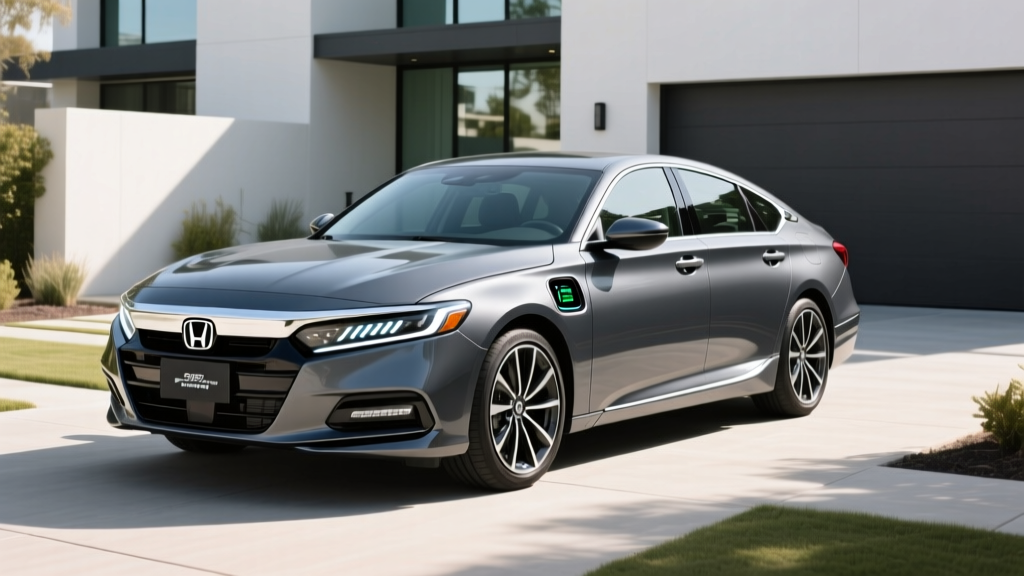
The Honda Accord Hybrid has anchored the midsize sedan segment for years, and the 2026 model continues that tradition with a refined two-motor hybrid system that prioritizes efficiency without sacrificing the driving dynamics Honda is known for. If you're researching the new Honda Accord Hybrid, you're likely weighing it against plug-in hybrids, full electric sedans, and conventional gas cars. This guide breaks down exactly what you're getting — EPA numbers, real-world MPG behavior, powertrain specs, warranty coverage, and a clear framework for deciding whether a conventional hybrid (HEV) is the right electrified choice for your garage.
2026 Honda Accord Hybrid: Quick Verdict
The 2026 Accord Hybrid delivers an EPA-estimated 48 MPG combined across Sport, Sport-L, and EX-L trims, powered by a 2.0-liter Atkinson-cycle four-cylinder paired with Honda's fourth-generation two-motor hybrid system producing 204 combined horsepower. Starting at $34,290 (including destination), it undercuts most PHEV competitors by $8,000–$12,000 while requiring no plug, no home charger installation, and no range-anxiety calculus. For drivers covering 12,000–15,000 miles annually without reliable home charging access, the Accord Hybrid remains one of the most pragmatic electrified vehicles on the market.
| Spec | Value |
|---|---|
| Powertrain | 2.0L Atkinson I-4 + two-motor hybrid system |
| Combined Horsepower | 204 hp |
| Combined Torque | 247 lb-ft (electric motor) |
| Transmission | e-CVT (no traditional gears) |
| EPA MPG (City / Hwy / Combined) | 51 / 44 / 48 MPG |
| Fuel Tank Capacity | 12.8 gallons |
| Total Driving Range | ~614 miles (EPA est.) |
| 0–60 mph | ~7.3 seconds |
| Drivetrain | Front-wheel drive |
| Starting MSRP (Sport trim) | $34,290 |
| Hybrid Battery Warranty | 8 years / 100,000 miles |
HEV vs. PHEV: Why the Accord Hybrid Doesn't Plug In
A common point of confusion for first-time hybrid shoppers is the distinction between a conventional hybrid (HEV) and a plug-in hybrid (PHEV). The 2026 Honda Accord Hybrid is a conventional HEV — it has no plug, no charging port, and no meaningful electric-only range. Honda discontinued the Accord Plug-In Hybrid after the 2015 model year, and as of 2026, there is no PHEV variant in the Accord lineup.
| Feature | HEV (Accord Hybrid) | PHEV (e.g., Toyota Prius Prime) | BEV (e.g., Tesla Model 3) |
|---|---|---|---|
| Plug-in Charging? | No — regenerative braking only | Yes — Level 1 or Level 2 | Yes — Level 1, 2, and DC fast |
| Battery Size | ~1.1 kWh (small buffer) | ~13.6 kWh usable | 57–82 kWh usable |
| Electric-Only Range | ~1 mile at low speed | ~40–44 miles | 270–360+ miles |
| Gas Engine? | Yes (primary + generator) | Yes (backup after battery depletes) | No |
| Federal Tax Credit (§30D) | Not eligible | Up to $7,500 (if sourcing/income rules met) | Up to $7,500 (if sourcing/income rules met) |
| Home Charger Needed? | No | Recommended for daily EV driving | Essential |
| Typical Starting Price | $34,290 | $33,000–$43,000 | $38,990–$52,990 |
The Accord Hybrid's small lithium-ion battery (approximately 1.1 kWh) is recharged entirely through regenerative braking and the gas engine. You never plug it in. The system uses electric torque to smooth acceleration and enable brief low-speed electric-only creeping (roughly under 25 mph for very short distances), but the gasoline engine is the primary energy source at all times.
Fuel Economy: EPA Numbers and Real-World MPG
The EPA rates the 2026 Honda Accord Hybrid at 51 MPG city, 44 MPG highway, and 48 MPG combined for the Sport, Sport-L, and EX-L trims. These figures come from fueleconomy.gov, the official EPA source.
| Trim | City MPG | Highway MPG | Combined MPG |
|---|---|---|---|
| Sport | 51 | 44 | 48 |
| Sport-L | 51 | 44 | 48 |
| EX-L | 51 | 44 | 48 |
Real-World MPG: What to Actually Expect
Honda's two-motor hybrid system behaves differently from traditional powertrains in ways that affect real-world efficiency:
- City driving often exceeds EPA estimates. Hybrids thrive in stop-and-go traffic where regenerative braking recaptures energy. Owners frequently report 52–56 MPG in urban commuting, particularly in warm weather. This is the opposite of gas cars, which get their worst mileage in the city.
- Highway driving may fall slightly below EPA estimates. At sustained 70–80 mph speeds, the electric motor contributes less and the 2.0L engine does most of the work. Expect 40–44 MPG on flat interstate stretches, potentially dipping to 36–38 MPG in hilly terrain or against strong headwinds.
- Cold-weather impact is moderate. Unlike full EVs, which can lose 20–30% of range in freezing temperatures, the Accord Hybrid typically sees a 5–10% MPG reduction in winter. The gas engine runs more frequently to provide cabin heat (there's no heat pump drawing from a large battery), but overall efficiency remains strong. Expect 42–45 MPG combined in sub-30°F conditions.
At 12,000 miles per year and a national average of $3.40/gallon for regular unleaded, the Accord Hybrid's 48 MPG combined translates to roughly $850 in annual fuel costs — about $900 less than a comparable 30 MPG gas-only midsize sedan.
Powertrain Deep Dive: Honda's Two-Motor Hybrid System
The 2026 Accord Hybrid uses Honda's fourth-generation Intelligent Multi-Mode Drive (i-MMD) system, which operates in three distinct modes depending on driving conditions:
- EV Drive: The electric propulsion motor drives the wheels using battery energy alone. This occurs at low speeds and light loads — typically from a stop up to ~25 mph for short distances. The gas engine is off.
- Hybrid Drive: The gas engine spins a generator motor that produces electricity to power the propulsion motor. The engine is not mechanically connected to the wheels. This is the predominant mode during city and moderate-speed driving, and it's why the Accord Hybrid feels like an EV in everyday acceleration — the electric motor delivers instant torque (247 lb-ft) without waiting for engine revs or transmission shifts.
- Engine Drive: At steady highway cruising speeds (typically above 50–55 mph), a lock-up clutch mechanically connects the 2.0L engine directly to the front wheels. This is more efficient than converting mechanical energy to electrical and back again at constant speeds.
The 2.0-liter Atkinson-cycle inline-four produces 146 hp and 134 lb-ft of torque on its own, but the propulsion motor adds significant electric torque for a combined system output of 204 hp and 247 lb-ft. The e-CVT isn't a traditional continuously variable transmission with belts and pulleys — it's a direct-drive system with fixed gear ratios for each mode, which eliminates the rubber-band revving sensation common in older CVTs.
The result is a 0–60 mph time of approximately 7.3 seconds — adequate for confident highway merging and passing, though not sporty. The Accord Hybrid prioritizes smoothness and efficiency over acceleration, and the powertrain calibration is well-suited to its role as a daily commuter and road-trip sedan.
Pricing, Trims, and Tax Credit Eligibility
The 2026 Honda Accord Hybrid is offered in three trims:
- Sport: $34,290 MSRP (includes $1,095 destination)
- Sport-L: $35,290 MSRP
- EX-L: $37,290 MSRP
All trims share the same 204-hp hybrid powertrain, front-wheel drive, and 48 MPG combined rating. The differences are in interior materials, wheel size, audio systems, and convenience features — not in efficiency or power.
Federal Tax Credit: Does the Accord Hybrid Qualify?
No. The 2026 Honda Accord Hybrid is a conventional HEV and does not qualify for the IRS §30D Clean Vehicle Credit. Under current federal rules, only plug-in electric vehicles (BEVs and PHEVs) with sufficient battery capacity and compliant battery sourcing are eligible for the up-to-$7,500 credit. The Accord Hybrid's ~1.1 kWh battery is far below the 7 kWh minimum threshold, and the vehicle has no plug.
Hybrid Battery Warranty Coverage
Honda covers the Accord Hybrid's lithium-ion battery pack for 8 years or 100,000 miles (whichever comes first), in compliance with CARB-emissions-state requirements that apply nationwide for Honda. In California and states that follow CARB standards, the hybrid system components carry a 10-year/150,000-mile warranty. This warranty covers defects and capacity loss that causes the system to malfunction — not gradual, normal degradation.
Some states offer their own incentives for hybrid purchases, though these are less common than EV incentives. Check your state's energy office or department of environmental quality for current programs, as these vary by jurisdiction and change frequently.
Battery Longevity, Reliability, and Replacement Cost
Hybrid battery longevity is the single most common concern among first-time hybrid buyers. Here's what the data shows for Honda's hybrid systems:
- Expected lifespan: Honda's hybrid battery packs are designed to last the life of the vehicle. Real-world data from earlier-generation Accord and Insight Hybrids shows most packs retaining functional capacity well beyond 150,000 miles. Individual cell failures can occur but rarely require a full pack replacement.
- Degradation pattern: Unlike EV batteries that gradually lose range as capacity declines, the Accord Hybrid's small battery operates within a narrow state-of-charge window (roughly 40–80% SoC) managed by the hybrid control system. This shallow cycling dramatically reduces wear. You may notice slightly less electric-only creeping ability after 100,000+ miles, but overall MPG impact is typically negligible.
- Replacement cost: If a full battery pack replacement is needed out of warranty, expect $2,000–$4,000 for the part and labor at a Honda dealer. Third-party reconditioned packs are available for $1,200–$2,500. Individual cell module replacement (more common than full-pack failure) runs $200–$600.
- Overall reliability: The Accord Hybrid's powertrain has consistently earned strong reliability ratings. Honda's hybrid system has fewer wear components than a traditional automatic transmission — there's no torque converter, no multi-speed gearset, and the regenerative braking system reduces wear on the friction brake pads (many owners report 60,000+ miles on original brake pads). IIHS has historically rated the Accord as a Top Safety Pick, and the 2026 model carries Honda Sensing (ADAS suite) as standard equipment across all trims.
Who Should Buy the Accord Hybrid — and Who Shouldn't
Pros
- 48 MPG combined with no plug required — zero infrastructure dependency
- Strong city MPG (51) that exceeds EPA in real-world stop-and-go driving
- 614-mile total range — fewer fill-ups than any gas sedan in the class
- Smooth, EV-like acceleration feel from electric motor torque
- Lower starting price than PHEV and BEV competitors
- Honda Sensing ADAS standard on all trims
- Proven hybrid reliability with 8-year/100,000-mile battery warranty
Cons
- No electric-only commuting — 100% gasoline-powered at highway speeds
- Not eligible for the §30D federal tax credit (unlike PHEVs and BEVs)
- ~7.3-second 0–60 is adequate, not quick
- Front-wheel drive only — no AWD option for snow-belt buyers
- Highway MPG (44) is less impressive than city MPG (51)
- No DC fast charging capability (not applicable — HEV has no plug)
Decision Framework: Is the Accord Hybrid Right for You?
Choose the Honda Accord Hybrid if:
- You don't have access to home or workplace charging (apartment, street parking, no garage outlet)
- Your commute is primarily city and suburban driving where the 51 MPG city rating shines
- You want to reduce fuel costs without changing your refueling habits
- You want electrified efficiency at the lowest possible purchase price
- You regularly take long road trips and want 600+ mile range without charging stops
Choose a PHEV (like the Toyota Prius Prime) instead if:
- You have home Level 2 charging and a commute under 40 miles — you could drive months without using gas
- You qualify for the §30D federal tax credit (income and sourcing requirements met), which can offset the PHEV price premium
- You want electric-only driving for daily errands with a gas backup for road trips
Choose a full BEV (like the Tesla Model 3 or Hyundai Ioniq 6) instead if:
- You have reliable home charging and want zero tailpipe emissions
- You want the lowest per-mile "fuel" cost (electricity at $0.04–0.06/mile vs. gasoline at $0.07–0.09/mile for the Accord Hybrid)
- You qualify for the full $7,500 federal credit, narrowing the price gap
- Your daily driving is under 250 miles and you're comfortable with public DC fast charging for road trips
Frequently Asked Questions
How many MPG does the 2026 Honda Accord Hybrid get?
The EPA rates the 2026 Accord Hybrid at 51 MPG city, 44 MPG highway, and 48 MPG combined. In real-world city driving, many owners report 52–56 MPG thanks to regenerative braking. Highway driving typically yields 40–44 MPG at 70–80 mph.
Does the Honda Accord Hybrid need to be plugged in?
No. The Accord Hybrid is a conventional HEV, not a plug-in hybrid. Its small battery is recharged by the gas engine and regenerative braking. There is no charging port — you fuel it exclusively at gas stations like any conventional car.
Is there a plug-in hybrid version of the Honda Accord?
Not for 2026. Honda discontinued the Accord Plug-In Hybrid after the 2015 model year. The current Accord lineup offers only the conventional hybrid (HEV) alongside the 1.5L turbocharged gas model. If you want a Honda plug-in, the closest current option is the Honda Clarity Plug-In Hybrid (discontinued after 2022) on the used market, or look to competitors like the Toyota Prius Prime or Hyundai Sonata PHEV.
Does the 2026 Accord Hybrid qualify for a federal tax credit?
No. The IRS §30D Clean Vehicle Credit applies only to plug-in electric vehicles (BEVs and PHEVs) that meet battery capacity, sourcing, MSRP, and buyer income requirements. The Accord Hybrid's conventional HEV powertrain does not qualify. See IRS.gov's Clean Vehicle Tax Credits page for current eligibility rules.
How long will the Accord Hybrid battery last, and what does replacement cost?
Honda's hybrid battery pack is warranted for 8 years or 100,000 miles (10 years/150,000 miles in CARB states). Real-world data suggests most packs last well beyond 150,000 miles without significant issues. Full replacement out of warranty costs approximately $2,000–$4,000 at a dealer, though individual cell module repairs are often $200–$600.
How does the Accord Hybrid compare to the Toyota Camry Hybrid?
Both are strong choices. The 2026 Camry Hybrid (with standard AWD) is rated at 51 MPG combined and starts around $33,995, making it a close competitor. The Camry offers AWD (the Accord does not), while the Accord offers slightly more rear-seat legroom and cargo volume. Both use proven two-motor hybrid systems with excellent reliability records. The choice often comes down to AWD needs (Camry) vs. interior space and driving refinement (Accord).
Is the Accord Hybrid good for highway road trips?
Yes, with a caveat. The 12.8-gallon fuel tank and 48 MPG combined rating give the Accord Hybrid a total range of approximately 614 miles — one of the longest ranges of any midsize sedan, gas or hybrid. However, highway-only MPG drops to around 40–44, so pure-interstate trips will yield closer to 510–560 miles per tank. The ride is composed, road noise is well-managed, and Honda Sensing's adaptive cruise control with lane centering reduces fatigue on long drives.