Quick Verdict: The Accord Hybrid EX-L in 2026
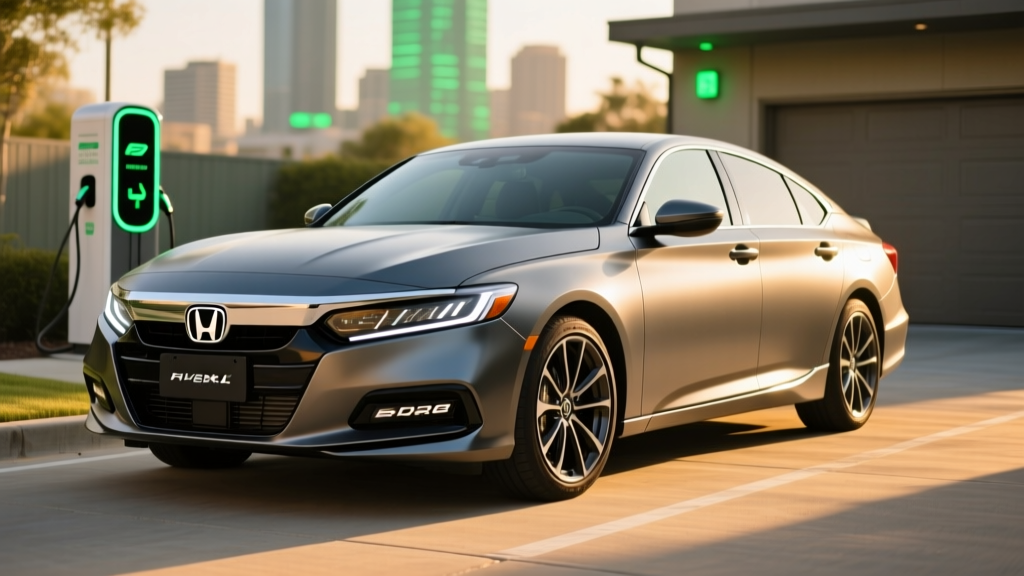
The 2026 Honda Accord Hybrid EX-L sits near the top of the midsize sedan segment for buyers who want electrified efficiency without plugging in. Honda's two-motor hybrid system pairs a 2.0-liter Atkinson-cycle four-cylinder with dual electric motors for a combined 204 horsepower and an EPA-estimated 48 MPG combined. The EX-L trim adds leather upholstery, a power moonroof, heated front seats, and Honda's full Honda Sensing safety suite — all for an MSRP starting around $35,895 (including destination).
For shoppers cross-referencing plug-in hybrids and full EVs, the Accord Hybrid occupies a clear niche: no charging infrastructure required, no range anxiety, and fuel economy that handily beats any conventional gas-only midsize sedan. Let's break down exactly what you get.
HEV vs. PHEV: Where the Accord Hybrid Fits
Before diving into specs, it's essential to distinguish between the two hybrid categories — because Honda does not offer a plug-in variant of the Accord in the U.S. market.
Conventional Hybrid (HEV) — This Is the Accord Hybrid
- No plug required. The battery recharges through regenerative braking and the gasoline engine.
- Small battery (~1.1 kWh usable). Enough to assist acceleration and enable brief low-speed electric-only driving, but not sustained EV mode.
- Range: Limited only by the 12.8-gallon fuel tank — roughly 600+ miles per fill-up.
- Federal tax credit: Does not qualify for the IRS §30D new clean vehicle credit (that credit applies only to plug-in vehicles with ≥7 kWh battery capacity).
Plug-In Hybrid (PHEV) — e.g., Toyota Prius Prime, Hyundai Tucson PHEV
- Plugs in to charge. Larger battery (typically 10–20 kWh) enables 25–45 miles of electric-only driving.
- Gas engine kicks in after the battery depletes, operating as a conventional hybrid.
- May qualify for the §30D tax credit (up to $7,500) if battery sourcing, MSRP caps, and buyer income limits are met.
Bottom line: The 2026 Accord Hybrid is a conventional HEV. You fuel it at a gas station, never plug it in, and the hybrid system handles energy recovery automatically.
Fuel Economy: EPA Ratings and Real-World MPG
| Driving Cycle | EPA Estimate | Real-World Expectation |
|---|---|---|
| City | 51 MPG | 48–54 MPG (hybrids often beat EPA in stop-and-go) |
| Highway | 44 MPG | 40–44 MPG (sustained 75+ mph reduces regen benefit) |
| Combined | 48 MPG | 44–50 MPG depending on driving mix |
Honda's two-motor hybrid system excels in city driving, where frequent deceleration feeds energy back into the battery and the electric motor handles low-speed propulsion. On the highway, the gasoline engine takes over directly, and efficiency drops — a pattern consistent across all conventional hybrids.
Real-World Range Note: With a 12.8-gallon tank and 48 MPG combined, expect roughly 550–610 miles between fill-ups in mixed driving. Pure city commuting can push past 650 miles. Cold weather (below 30°F) typically reduces hybrid efficiency by 5–10% due to increased engine warm-up cycles and cabin heating load.
Compared to the non-hybrid 2026 Accord (1.5T turbo, EPA 32 MPG combined), the hybrid saves roughly 175 gallons per year at 15,000 miles — approximately $525 annually at $3.00/gallon, according to fueleconomy.gov methodology.
Powertrain and Performance Specs
| Specification | 2026 Accord Hybrid EX-L |
|---|---|
| Engine | 2.0L Atkinson-cycle 4-cylinder |
| Electric Motors | Dual-motor hybrid system |
| Combined Horsepower | 204 hp |
| Combined Torque | 247 lb-ft (electric motor peak) |
| Transmission | e-CVT (direct-drive with lock-up clutch) |
| 0–60 mph | ~7.2 seconds |
| Drivetrain | Front-wheel drive |
| Fuel Tank | 12.8 gallons |
| Battery Type | Lithium-ion, ~1.1 kWh |
| Curb Weight | ~3,477 lbs |
| Towing Capacity | Not rated for towing |
The Accord Hybrid's e-CVT is not a traditional belt-and-pulley CVT. Honda uses a direct-drive system where the electric motor handles most propulsion duties, with the gas engine acting primarily as a generator at low speeds and engaging a lock-up clutch for efficient highway cruising. The result is smoother acceleration than a conventional CVT and none of the "rubber-band" drone associated with older hybrid systems.
At 204 hp, the EX-L has adequate passing power and merges confidently. It's not a performance sedan — the electric motor's instant torque (247 lb-ft) gives it a responsive feel around town, but the system prioritizes efficiency over outright speed.
Pricing, Trims, and Tax Credit Eligibility
The 2026 Honda Accord Hybrid is available in four trims. The EX-L sits in the middle-upper tier:
| Trim | MSRP (incl. destination) | Key Additions Over Base |
|---|---|---|
| Sport Hybrid | ~$33,895 | Base hybrid trim, cloth seats, 19" wheels |
| Sport-L Hybrid | ~$34,395 | Leather-trimmed seats, heated front seats |
| EX-L Hybrid | ~$35,895 | Leather, moonroof, power passenger seat, wireless CarPlay/Android Auto |
| Touring Hybrid | ~$39,895 | Navigation, premium audio, ventilated front seats, heated rear seats, wireless charging |
Federal Tax Credit: Does the Accord Hybrid Qualify?
IRS §30D New Clean Vehicle Credit — Accord Hybrid Eligibility:
- ❌ Battery capacity: §30D requires a minimum 7 kWh battery. The Accord Hybrid's ~1.1 kWh battery does not meet this threshold.
- ❌ Plug-in capability: The credit applies only to vehicles that can be recharged from an external power source.
- ❌ Result: The 2026 Accord Hybrid does not qualify for the federal §30D tax credit ($0).
Source: IRS §30D guidelines. Tax rules are subject to change — consult a tax professional for your specific situation.
Some states and municipalities offer separate incentives for conventional hybrids (e.g., reduced registration fees, HOV lane access, or utility rebates). These vary widely by jurisdiction — check your state's energy office or DMV for current programs.
Battery Warranty, Reliability, and Replacement Cost
Honda Hybrid Battery Warranty
- Coverage: 8 years / 100,000 miles (10 years / 150,000 miles in CARB states including CA, NY, MA, and others)
- What's covered: Defects and capacity loss below a defined threshold (typically ~60–70% of original capacity)
- Powertrain warranty: 5 years / 60,000 miles (covers the hybrid system's electric motors, inverter, and e-CVT)
How Long Do Honda Hybrid Batteries Last?
Honda's lithium-ion hybrid batteries are engineered for the life of the vehicle. Real-world data from earlier-generation Accord and Civic Hybrids shows most batteries lasting 150,000–200,000+ miles before any significant capacity loss. Because the battery is small (~1.1 kWh) and the system never fully depletes or fully charges it (a built-in buffer protects longevity), degradation is minimal compared to full EV batteries.
Battery Replacement Cost
If a hybrid battery does fail outside warranty, replacement costs for the Accord Hybrid typically range from $2,000 to $4,000 including labor at a Honda dealer. Independent hybrid specialists may offer refurbished units for $1,200–$2,500. This is substantially less than EV battery replacements ($8,000–$20,000+) because the hybrid battery is much smaller.
Reliability Track Record
Honda's hybrid powertrain has a strong reliability record across the Accord, CR-V, and Civic lineups. The two-motor system has fewer moving parts than a conventional automatic transmission (no torque converter, no multi-gear shifting). IIHS typically rates the Accord highly for crashworthiness, and Honda Sensing (standard on all trims) includes adaptive cruise control, lane-keeping assist, automatic emergency braking, and traffic sign recognition.
Accord Hybrid vs. PHEV vs. Full EV: Which Is Right for You?
Choose the 2026 Accord Hybrid (HEV) If:
- You don't have access to home or workplace charging (apartment, street parking, no garage outlet).
- You want maximum simplicity — fuel at any gas station, no apps, no charging cards.
- Your annual mileage is moderate (10,000–15,000 miles) and fuel savings alone justify the hybrid premium.
- You frequently take long road trips where charging infrastructure is sparse.
- You want a midsize sedan with a large trunk (16.7 cu ft) and strong resale value.
Choose a Plug-In Hybrid (PHEV) If:
- You can charge at home (even a standard 120V outlet works for overnight PHEV charging).
- Your daily commute is under 30–40 miles and you want to drive mostly on electricity.
- You want eligibility for the §30D federal tax credit (up to $7,500, subject to income and sourcing rules).
- You still want a gas engine for long trips without charging stops.
Choose a Full EV (BEV) If:
- You have reliable home Level 2 charging (240V) and want the lowest per-mile "fuel" cost.
- You want zero tailpipe emissions and minimal maintenance (no oil changes, no spark plugs).
- Your daily driving is under 250 miles and you're comfortable planning DC fast-charging stops on road trips.
- You want the §30D credit and qualify based on income, MSRP caps, and battery sourcing.
5-Year Cost of Ownership Snapshot
| Cost Category | Accord Hybrid EX-L | Accord 1.5T EX-L (Gas) | Comparable EV (e.g., Tesla Model 3) |
|---|---|---|---|
| MSRP (approx.) | $35,895 | $34,395 | $42,380 |
| Federal Tax Credit | $0 | $0 | Up to $7,500 (if eligible) |
| Fuel/Energy (5 yr, 75K mi) | ~$4,700 | ~$7,500 | ~$2,200 (electricity) |
| Maintenance (5 yr) | ~$2,500 | ~$3,200 | ~$1,500 |
| Insurance (5 yr est.) | ~$7,500 | ~$7,200 | ~$8,500 |
| Estimated Depreciation | ~$14,000 | ~$15,000 | ~$18,000 |
| Approx. 5-Yr Total | ~$54,595 | ~$57,295 | ~$55,580 (after credit) |
Estimates based on 15,000 miles/year, $3.00/gallon gasoline, $0.14/kWh electricity, and average national insurance rates. Your actual costs will vary by location, driving habits, and insurance profile. Depreciation estimates are approximations based on historical segment trends.
The Accord Hybrid EX-L saves roughly $2,700 over five years compared to its gas-only counterpart, primarily through fuel savings. The break-even point on the ~$1,500 hybrid premium over the gas model occurs in approximately 2.5 to 3 years of typical driving.
Pros and Cons
Pros
- 48 MPG combined — among the best in the midsize sedan class
- No plug-in charging needed — works with any gas station
- 600+ mile range per tank eliminates refueling stops on road trips
- Smooth, responsive electric-motor torque around town
- Strong Honda Sensing safety suite standard on every trim
- 8-year/100K-mile hybrid battery warranty (10 yr in CARB states)
- Spacious cabin with 16.7 cu ft trunk (no battery intrusion)
- Excellent reliability track record for Honda's hybrid system
Cons
- No federal tax credit eligibility (HEV, not PHEV)
- Highway MPG drops to 44 — less advantage on long interstate trips
- No all-wheel-drive option (FWD only)
- Not a PHEV — no electric-only commuting capability
- EX-L trim at ~$36K is priced above some competitors' hybrid offerings
- Cabin noise at highway speeds is noticeable (engine drone under hard acceleration)
- Infotainment system is functional but not class-leading in responsiveness
Frequently Asked Questions
How many MPG does the 2026 Honda Accord Hybrid EX-L get?
The EPA rates the 2026 Accord Hybrid at 51 MPG city, 44 MPG highway, and 48 MPG combined. In real-world driving, city commuters often see 48–54 MPG thanks to regenerative braking, while sustained highway driving at 75+ mph typically yields 40–44 MPG.
Does the Accord Hybrid need to be plugged in?
No. The Accord Hybrid is a conventional hybrid (HEV), not a plug-in hybrid (PHEV). The battery recharges automatically through regenerative braking and the gasoline engine. You simply fill up at a gas station as you would with any car.
Does the 2026 Accord Hybrid qualify for any federal tax credit?
No. The IRS §30D New Clean Vehicle Credit requires a plug-in vehicle with a battery capacity of at least 7 kWh. The Accord Hybrid's ~1.1 kWh battery and lack of plug-in capability make it ineligible. Some state-level incentives may apply — check your local programs.
How long will the hybrid battery last, and what does replacement cost?
Honda's hybrid batteries are designed to last the life of the vehicle, with real-world data showing 150,000–200,000+ miles before significant degradation. The battery is covered by an 8-year/100,000-mile warranty (10 years/150,000 miles in CARB states). Out-of-warranty replacement costs $2,000–$4,000 at a dealer, or $1,200–$2,500 through independent hybrid specialists.
Is the Accord Hybrid better than a full EV for my situation?
It depends on your charging access. If you can't install a home charger or lack reliable workplace charging, the Accord Hybrid is the better choice — it requires zero infrastructure changes. If you have Level 2 home charging and a daily commute under 250 miles, a full EV will have lower per-mile energy costs and lower maintenance, but at a higher purchase price.
How does the Accord Hybrid compare to the Toyota Camry Hybrid?
The 2026 Toyota Camry Hybrid (53 MPG combined, ~$30,495 starting) is slightly more fuel-efficient and less expensive at the base trim. The Accord Hybrid offers more rear-seat legroom, a larger trunk, and a more refined driving experience at higher trims. Both have excellent reliability records. The choice often comes down to budget (Camry) vs. space and refinement (Accord).
Does the Accord Hybrid have all-wheel drive?
No. The 2026 Accord Hybrid is front-wheel drive only. If AWD is a priority in a hybrid sedan, the Toyota Camry Hybrid offers an available electronic AWD system, or you might consider a hybrid SUV like the Honda CR-V Hybrid (AWD standard, 40 MPG combined).
Specs and pricing based on Honda's 2026 model-year information as published on Honda's official site. Fuel economy data sourced from fueleconomy.gov. Tax credit rules per IRS §30D — eligibility varies by buyer income, vehicle MSRP, and battery component sourcing. Verify all figures with your local Honda dealer and a qualified tax professional before purchasing.