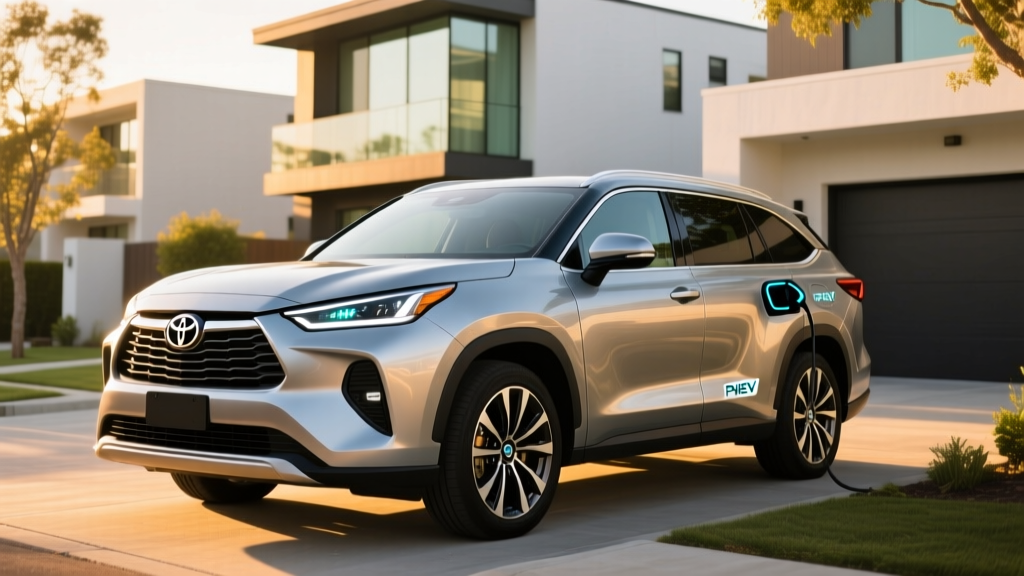
Toyota's three-row SUV lineup has long been dominated by the conventional hybrid Highlander, but the introduction of the Highlander Plug-In Hybrid (PHEV) changes the calculus for families who want electric commuting without range anxiety on road trips. For 2026, the Highlander PHEV slots between the standard Highlander Hybrid (HEV) and the all-electic bZ4X-based three-row concepts, offering a bridge solution that leverages Toyota's proven hybrid synergy drive with a larger battery and plug-in capability.
If you're searching for a Highlander PHEV, you likely want the utility of three rows, the efficiency of electric-only driving for daily errands, and the security of a gas engine for longer hauls. This guide breaks down exactly what the 2026 Highlander PHEV delivers — and where the conventional hybrid or a full BEV might serve you better.
HEV vs PHEV: Which Highlander Is Which?
Before diving into specs, it's critical to understand the difference between the two electrified Highlander variants, because they serve fundamentally different use cases.
| Feature | Highlander Hybrid (HEV) | Highlander PHEV |
|---|---|---|
| Plug-in charging | No — charges via regenerative braking and engine | Yes — plug in for electric-only driving |
| Electric-only range | ~1 mile at low speed | 32 miles (EPA est.) |
| Battery capacity | 1.87 kWh (NiMH) | 18.1 kWh (lithium-ion, usable ~14.5 kWh) |
| Combined MPG / MPGe | 35 MPG combined | 94 MPGe (electric+gas) / 35 MPG (gas only) |
| DC fast charging | N/A | No — Level 2 AC only |
| Starting MSRP | ~$42,290 | ~$49,650 |
The conventional HEV never needs to be plugged in. Its small battery captures energy from braking and the engine, providing electric assist but not meaningful electric-only driving. The PHEV's larger battery enables genuine zero-tailpipe-emission commuting for most daily trips under 30 miles, then seamlessly transitions to hybrid operation once the battery depletes.
Powertrain, Horsepower, and Driving Dynamics
The 2026 Highlander PHEV pairs a 2.5-liter four-cylinder Atkinson-cycle engine with front and rear electric motors, producing a combined 308 horsepower — a meaningful bump over the HEV's 243 hp. The rear motor provides electronic on-demand AWD without a mechanical driveshaft.
| Specification | 2026 Highlander PHEV |
|---|---|
| Engine | 2.5L 4-cyl Atkinson-cycle + dual electric motors |
| Combined horsepower | 308 hp |
| 0-60 mph | ~6.6 seconds (est.) |
| Drivetrain | Electronic AWD (eAWD) |
| Battery chemistry | Lithium-ion (NMC) |
| Total battery capacity | 18.1 kWh (14.5 kWh usable) |
| EPA electric-only range | 32 miles |
| Total combined range | ~440 miles (electric + gas) |
| EPA MPGe (blended) | 94 MPGe |
| EPA MPG (charge-sustaining) | 35 combined / 36 city / 35 highway |
| Towing capacity | 3,500 lbs |
| Charging (Level 2, 240V) | ~2.5 hours (0-100%) |
| DC fast charging | Not supported |
The 308 hp output makes the PHEV the most powerful Highlander in the lineup. In EV mode, acceleration is immediate and quiet — ideal for school drop-offs and neighborhood driving. When the gas engine engages, the transition is smooth thanks to Toyota's e-CVT planetary gearset, which avoids the rubber-band feeling of traditional CVTs.
Electric-Only Range and Charging: The Daily Commute Test
The EPA rates the 2026 Highlander PHEV at 32 miles of electric-only range. In real-world testing, expect closer to 27-30 miles in mixed driving with moderate climate control use, and as low as 22-24 miles in cold weather (below 35°F) when the battery is less efficient and cabin heating draws additional power.
Real-world expectation: 27-30 miles (mild weather), 22-24 miles (cold weather / highway speeds)
Total range (gas + electric): ~440 miles
Charging is straightforward but limited to AC. A standard 120V Level 1 outlet will fully recharge the battery in approximately 8 hours — fine for overnight topping off. A 240V Level 2 home charger (at 6.6 kW, the onboard charger's maximum) reduces that to about 2.5 hours.
Critically, the Highlander PHEV does not support DC fast charging. This is common among PHEVs — the smaller battery makes DCFC infrastructure unnecessary for most owners, but it does mean you won't be topping up quickly on road trips. For a PHEV buyer, this is rarely a dealbreaker since the gas engine takes over seamlessly.
Real-World MPG: How Does It Compare to the EPA Sticker?
| Driving Scenario | Expected MPG | Notes |
|---|---|---|
| EPA combined (charge-sustaining) | 35 MPG | After battery depletion |
| EPA city | 36 MPG | Hybrids excel in stop-and-go |
| EPA highway | 35 MPG | Less regen benefit at steady speed |
| Real-world city (mild weather) | 36-38 MPG | Hybrids often beat EPA in city driving |
| Real-world highway (75 mph) | 30-33 MPG | Higher speeds reduce efficiency |
| Real-world cold weather (city) | 30-33 MPG | Engine runs more for cabin heat |
According to fueleconomy.gov, the Highlander Hybrid (HEV) achieves 35/36/35 city/highway/combined MPG. The PHEV matches these figures in charge-sustaining mode — once the battery is depleted, it operates essentially as a conventional hybrid.
The real magic is in the first 32 miles. If your daily commute is under 30 miles and you charge nightly, you may go weeks without burning gas. A household with two short commutes could see effective "MPG" figures well into the triple digits when measured as miles driven per gallon consumed over a month.
Pricing, Trims, and Tax Credit Eligibility
The 2026 Highlander PHEV is offered in XLE and Limited trims:
- XLE PHEV: ~$49,650 MSRP
- Limited PHEV: ~$54,300 MSRP
Both trims carry a significant premium over the conventional HEV (which starts around $42,290), but the PHEV's electric capability, extra horsepower, and potential fuel savings narrow the gap for the right buyer.
Does the Highlander PHEV Qualify for a Federal Tax Credit?
This is where PHEV buyers must pay close attention. Under current IRS §30D rules for 2026, the Highlander PHEV's eligibility depends on several factors:
- Battery capacity: Must be ≥7 kWh — the Highlander PHEV's 18.1 kWh pack qualifies ✓
- MSRP cap: SUVs must be under $80,000 — both trims qualify ✓
- Buyer income cap: AGI ≤ $150,000 (single) / $300,000 (joint) — varies by buyer
- Battery component sourcing: Must meet North American assembly and critical-mineral thresholds — this is the variable that changes by model year and can disqualify otherwise eligible vehicles
- Point-of-sale transfer: If eligible, the credit can be applied at purchase rather than waiting for tax filing
For the most current eligibility status, always check the IRS qualified vehicles list before purchasing. Battery sourcing requirements have disqualified several PHEVs that otherwise meet the technical criteria, and these rules are subject to change.
Even without the federal credit, many states offer additional PHEV incentives. Check your state's energy office or Alternative Fuels Data Center for local programs.
Battery Longevity, Warranty, and Replacement Cost
• 10 years / 150,000 miles (federal emissions warranty states)
• 8 years / 100,000 miles (non-CARB states)
• Covers battery capacity below 70% of original
Hybrid Powertrain Warranty: 5 years / 60,000 miles
Toyota's hybrid battery track record is among the best in the industry. The original Prius batteries routinely exceed 200,000 miles before significant degradation. The PHEV's larger lithium-ion pack is liquid-cooled and conservatively buffered (only ~14.5 kWh of the 18.1 kWh total is usable), which reduces stress on individual cells and extends lifespan.
Should the battery require replacement outside of warranty, expect a cost between $4,000 and $7,000 for the pack, plus labor. However, based on Toyota's historical data, most hybrid batteries outlast the vehicle's useful life. Third-party refurbishment options are also emerging at lower price points.
Is the Highlander PHEV reliable? Toyota's hybrid systems have consistently ranked at the top of Consumer Reports reliability surveys, and the PHEV powertrain shares its core architecture with the proven RAV4 Prime. The main risk factor is the added complexity of a larger battery and charging system compared to the HEV, but Toyota's warranty coverage mitigates this significantly.
Who Should Choose the Highlander PHEV (and Who Shouldn't)?
- Your daily driving is under 30 miles and you can charge at home nightly
- You need three rows but want to minimize gas consumption on weekdays
- You take regular road trips where a full EV's range would cause anxiety
- You want the extra 65 hp over the HEV for highway merging and towing
- You don't have reliable home charging access (apartment, street parking)
- Your daily commute exceeds 35 miles — the PHEV advantage diminishes
- The $7,000+ price premium over the HEV doesn't pencil out for your mileage
- You have home Level 2 charging and rarely drive more than 250 miles in a day
- You want zero tailpipe emissions and lower maintenance (no oil changes, no gas engine)
- You qualify for the full $7,500 federal credit on an eligible BEV
The Highlander PHEV occupies a specific niche: families who want electric daily driving without sacrificing the go-anywhere flexibility of a gas tank. It's not the most efficient option if you can charge and never drive far, and it's not the cheapest option if you can't charge at all. But for the household that does a 20-mile school run Monday through Friday and a 400-mile camping trip on weekends, it's arguably the most practical three-row vehicle on the market.
- 32 miles electric-only covers most daily commutes
- 308 hp makes it the most powerful Highlander
- 440-mile total range eliminates road-trip anxiety
- Proven Toyota hybrid reliability with 10-year battery warranty
- 3,500-lb towing capacity with eAWD
- ~$7,400 premium over the conventional HEV
- No DC fast charging capability
- Third row is tight for adults on long trips
- Electric range drops significantly in cold weather
- Tax credit eligibility depends on sourcing rules
Frequently Asked Questions
How many MPG does the Highlander PHEV get?
The 2026 Highlander PHEV achieves 94 MPGe when combining electric and gas operation, and 35 MPG combined (36 city / 35 highway) once the battery is depleted and it operates as a conventional hybrid. Real-world city driving often yields 36-38 MPG thanks to regenerative braking, while sustained highway driving at 75 mph drops to around 30-33 MPG.
How far can the Highlander PHEV go on electric only?
The EPA rates it at 32 miles of electric-only range. Real-world expectations are 27-30 miles in mild conditions and 22-24 miles in cold weather or at highway speeds. This covers the majority of American daily commutes, which average around 16 miles each way according to FHWA data.
Does the Highlander PHEV qualify for the $7,500 federal tax credit?
It may, depending on your income, the vehicle's battery sourcing compliance for the current model year, and MSRP limits. The PHEV meets the battery capacity and MSRP requirements, but critical-mineral and battery-component sourcing rules change frequently. Always verify on the IRS qualified vehicles list before purchasing. The credit can be transferred at point of sale if eligible.
Is the Highlander PHEV reliable, and what does battery replacement cost?
Toyota's hybrid systems have an outstanding reliability record spanning two decades. The PHEV battery is warrantied for 8-10 years / 100,000-150,000 miles depending on your state. Out-of-warranty replacement runs $4,000-$7,000, but Toyota hybrid batteries routinely exceed 200,000 miles before requiring service.
Do I need to plug in the Highlander Hybrid (HEV)?
No. The conventional Highlander Hybrid (HEV) charges its small battery entirely through regenerative braking and the gas engine. Only the PHEV variant requires (or benefits from) plug-in charging. If you see "Highlander Hybrid" without "Plug-In" or "PHEV," it does not need to be plugged in.
How long does it take to charge the Highlander PHEV at home?
On a 240V Level 2 charger (6.6 kW onboard charger), the battery charges from empty to full in approximately 2.5 hours. On a standard 120V household outlet (Level 1), expect about 8 hours. There is no DC fast charging capability, which is typical for PHEVs in this class.