Quick Verdict: The Family Hauler That Sips Fuel Like a Sedan
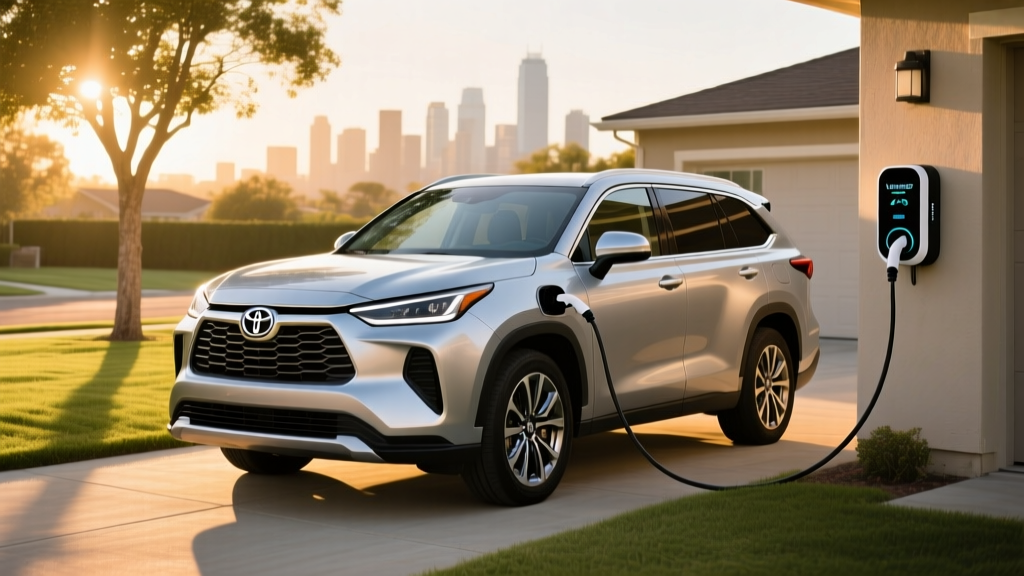
The 2026 Toyota Highlander Hybrid XLE occupies a narrow but valuable lane in the three-row SUV market: it delivers genuine hybrid fuel savings without requiring a plug, a lifestyle change, or a premium price tag. With an EPA-estimated 35 MPG combined, 243 combined horsepower from Toyota's fourth-generation hybrid system, and a starting MSRP around $43,170, the XLE trim hits the sweet spot between the base LE and the loaded Limited.
This is a conventional hybrid (HEV), not a plug-in hybrid (PHEV). You never plug it in. The 1.86 kWh nickel-metal hydride battery recharges through regenerative braking and the gasoline engine. If you want electric-only driving, you'll need to look at Toyota's RAV4 Prime or the discontinued Prius Prime — the Highlander lineup does not currently offer a PHEV variant in the US market.
HEV (Hybrid Electric Vehicle): Charges its own small battery via regen braking and the gas engine. No plug needed. Examples: Highlander Hybrid, RAV4 Hybrid.
PHEV (Plug-in Hybrid): Has a larger battery you charge via a plug, offering 20-45 miles of electric-only range before the gas engine kicks in. Examples: RAV4 Prime, Chrysler Pacifica Hybrid.
The 2026 Highlander Hybrid is strictly an HEV.
Fuel Economy: EPA Numbers and Real-World MPG
The 2026 Highlander Hybrid XLE with front-wheel drive carries EPA estimates of 36 MPG city, 35 MPG highway, and 35 MPG combined. Opt for the electronic all-wheel drive (AWD-i) and those figures dip slightly to 35/34/35 MPG city/highway/combined. These numbers are sourced from fueleconomy.gov and represent the official EPA testing cycle.
| Drivetrain | City MPG | Highway MPG | Combined MPG |
|---|---|---|---|
| FWD | 36 | 35 | 35 |
| AWD-i | 35 | 34 | 35 |
Real-World MPG: What Owners Actually See
Toyota's hybrid system excels in stop-and-go city driving where regenerative braking recaptures energy constantly. In real-world mixed driving, many Highlander Hybrid owners report 33-37 MPG, closely tracking the EPA combined estimate. On pure highway trips at 75+ MPH, expect a slight drop to around 30-33 MPG — hybrids lose their city advantage at sustained high speeds where the engine runs continuously and aerodynamic drag dominates.
In cold weather (below 30°F), expect a 5-10% reduction in fuel economy. The engine runs more frequently to heat the cabin and bring the catalytic converter up to operating temperature, reducing the time the vehicle can spend in electric-only mode at low speeds.
Powertrain: 243 HP From Toyota's Fourth-Gen Hybrid System
The 2026 Highlander Hybrid uses a 2.5-liter inline-four Atkinson-cycle gasoline engine paired with two electric motor-generators (three on AWD-i models, which add a rear-axle motor). Combined system output is 243 horsepower. The gasoline engine alone produces 186 hp and 175 lb-ft of torque.
| Component | Specification |
|---|---|
| Engine | 2.5L inline-4 Atkinson cycle |
| Engine Power | 186 hp / 175 lb-ft |
| Front Electric Motors | 2x motor-generators (MG1, MG2) |
| Rear Motor (AWD-i) | 40 kW electric motor |
| Combined System Output | 243 hp |
| Transmission | eCVT (planetary gearset) |
| Hybrid Battery | 1.86 kWh NiMH (sealed, self-charging) |
| 0-60 MPH | ~7.8 seconds (est.) |
| Towing Capacity | 3,500 lbs |
The eCVT is not a belt-driven CVT like those found in some competitors. Toyota uses a planetary gearset that seamlessly blends engine and motor power with no rubber-band effect. Acceleration is linear and adequate for highway merging, though the 243 hp figure won't thrill anyone coming from a turbocharged V6 rival.
Pricing: 2026 Highlander Hybrid XLE MSRP and Trim Value
The 2026 Highlander Hybrid XLE starts at an MSRP of approximately $43,170 for the FWD configuration, with AWD-i adding roughly $1,600. Key XLE-standard features include SofTex-trimmed heated front seats, a power liftgate, wireless Apple CarPlay and Android Auto on a 12.3-inch touchscreen, Toyota Safety Sense 3.0 (adaptive cruise, lane-keeping, automatic emergency braking), and a 7-inch multi-information display in the instrument cluster.
Compared to the base LE Hybrid (~$40,670), the XLE adds the premium seating, power liftgate, blind-spot monitoring with rear cross-traffic alert, and second-row sunshades. The step up to the Limited (~$48,000) brings leather, ventilated front seats, a panoramic moonroof, and a premium JBL audio system.
Does the 2026 Highlander Hybrid Qualify for a Federal Tax Credit?
No. Under current IRS §30D rules, the federal clean vehicle credit applies only to plug-in electric vehicles (BEVs and PHEVs) with a minimum battery capacity of 7 kWh. The Highlander Hybrid's 1.86 kWh NiMH battery does not qualify. This is consistent across all conventional hybrids — HEVs are not eligible for the federal EV tax credit. Some states may offer their own incentives for hybrid purchases; check your state's energy office or department of revenue for current programs. For federal rules, see irs.gov clean vehicle credits.
Battery Warranty, Reliability, and Replacement Cost
Coverage: 10 years / 150,000 miles (whichever comes first) on all hybrid battery components, including the battery pack, inverter, and control module.
Transferable: Yes — the hybrid warranty transfers to subsequent owners.
What's covered: Defects, capacity loss below functional thresholds, and hybrid system component failures.
Toyota's hybrid battery track record is among the best in the industry. The NiMH pack in the Highlander Hybrid is smaller and less stressed than the lithium-ion packs in full EVs, and it operates within a narrow state-of-charge window (roughly 40-80% SoC) managed by the vehicle's computer. This shallow cycling dramatically extends cell life. Many Toyota hybrids from the early 2000s Prius era are still running on original batteries past 200,000 miles.
What If the Battery Does Need Replacement?
Out-of-warranty hybrid battery replacement for the Highlander Hybrid typically costs between $3,000 and $5,000 at a Toyota dealer, including parts and labor. Independent hybrid specialists may offer refurbished or reconditioned packs for $2,000-$3,500. This is a fraction of EV battery replacement costs, which can exceed $10,000-$20,000, because the hybrid pack is much smaller (1.86 kWh vs. 60-100+ kWh in a BEV).
The broader hybrid powertrain — including the eCVT and electric motor-generators — carries the same 10-year/150,000-mile warranty. Toyota's hybrid systems have proven exceptionally reliable, with the eCVT planetary gearset being mechanically simpler than a conventional automatic or belt-driven CVT.
Interior, Cargo, and Daily Practicality
The XLE's cabin balances utility with the upgraded touches that justify its mid-tier position. The 12.3-inch infotainment screen supports wireless phone mirroring, and physical knobs for volume and tuning remain — a practical win over touch-only interfaces. Three-zone automatic climate control keeps all rows comfortable.
Cargo volume measures approximately 16.1 cubic feet behind the third row, 48.4 cubic feet with the third row folded, and 84.3 cubic feet with both rear rows down. The second row slides and reclines, which helps with third-row access. That third row is best suited for children on longer trips — adults will find it tight on legroom beyond short drives.
The hybrid powertrain does not compromise cargo space versus the gas-only Highlander, as the battery pack is mounted under the second-row seat and does not intrude on the cargo floor. There is no spare tire; Toyota provides a tire repair kit.
Hybrid vs PHEV vs EV: Which Powertrain Fits Your Life?
Choosing between a conventional hybrid, a plug-in hybrid, and a full battery-electric vehicle depends on your daily routine, charging access, and budget. Here's a practical framework:
| Factor | HEV (Highlander Hybrid) | PHEV (e.g., RAV4 Prime) | BEV (e.g., Tesla Model Y) |
|---|---|---|---|
| Plug-in required? | No | Yes (for EV range) | Yes (always) |
| Electric-only range | ~1 mi (low speed) | 25-42 mi | 250-330 mi |
| Home charging install | Not needed | $500-$2,000 (L2) | $500-$2,500 (L2) |
| Federal tax credit | None | Up to $7,500* | Up to $7,500* |
| Fuel cost (per mile) | ~$0.10-$0.12 | ~$0.04-$0.10 | ~$0.03-$0.05 |
| Road-trip ease | Gas station, 5 min | Gas station, 5 min | DC charger, 20-40 min |
*Federal tax credit eligibility for PHEVs and BEVs depends on MSRP caps, buyer income limits, battery sourcing requirements, and point-of-sale transfer rules under IRS §30D. Verify current eligibility at irs.gov.
- You want three-row family capacity with minimal fuel cost
- You lack access to home or workplace charging (apartment, street parking)
- You take frequent long road trips and don't want to plan around chargers
- You want Toyota's proven hybrid reliability with a 10-year battery warranty
- Your budget is under $45K and you don't want to stretch for a PHEV or BEV
- You have reliable Level 2 home charging and a short daily commute
- You want to maximize electric-only driving and minimize gas use
- You qualify for the $7,500 federal credit, which can offset a PHEV/BEV price premium
- You want the quiet, instant-torque driving experience of electric propulsion
Ownership Costs: 5-Year Projection
Over five years and 75,000 miles, the 2026 Highlander Hybrid XLE's fuel savings are meaningful compared to a gas-only three-row SUV. At an average gas price of $3.40/gallon and 35 MPG combined, annual fuel cost runs approximately $1,940. A comparable gas-only SUV averaging 24 MPG combined would cost roughly $2,830 per year — a difference of about $890 annually, or $4,450 over five years.
Maintenance costs are modest. The hybrid system eliminates the traditional starter motor and alternator (the motor-generators handle those functions), and regenerative braking extends pad life significantly — many owners report original brake pads past 60,000 miles. Toyota recommends standard oil changes every 10,000 miles. Insurance premiums typically run 5-10% higher than the gas Highlander due to the hybrid system's replacement cost.
Pros and Cons
- 35 MPG combined in a three-row SUV — class-leading efficiency
- No plug-in charging required — works with any lifestyle
- 10-year/150,000-mile hybrid battery warranty
- 3,500-lb towing capacity matches gas models
- Strong resale value and Toyota reliability reputation
- Smooth eCVT with no belt-driven CVT drone
- No federal tax credit eligibility (HEV)
- AWD-i drops highway MPG to 34
- 243 hp feels adequate, not quick — ~7.8s 0-60
- Third row tight for adults on long trips
- No spare tire (tire repair kit only)
- No PHEV option in the Highlander lineup for EV-range seekers
Frequently Asked Questions
How many MPG does the 2026 Highlander Hybrid XLE get?
The FWD model achieves an EPA-estimated 36 city / 35 highway / 35 combined MPG. The AWD-i model rates at 35/34/35. Real-world mixed driving typically yields 33-37 MPG, with highway-only trips at 75+ MPH dropping to roughly 30-33 MPG.
Can I plug in the 2026 Highlander Hybrid to charge it?
No. The Highlander Hybrid is a conventional hybrid (HEV), not a plug-in. Its 1.86 kWh battery charges exclusively through regenerative braking and the gasoline engine. There is no charge port and no electric-only driving range beyond very low-speed maneuvering.
Is the Highlander Hybrid battery reliable, and what does replacement cost?
Toyota's hybrid batteries are among the most reliable in the industry, with many lasting well past 150,000 miles. The battery is covered by a 10-year/150,000-mile warranty. Out-of-warranty replacement runs $3,000-$5,000 at a dealer, or $2,000-$3,500 through an independent hybrid specialist.
Does the 2026 Highlander Hybrid qualify for any tax credit?
It does not qualify for the federal §30D clean vehicle credit, which requires a plug-in vehicle with at least 7 kWh of battery capacity. Some states may offer separate hybrid incentives — check your state's energy office. The IRS maintains current federal credit rules at irs.gov.
Hybrid vs PHEV vs EV — which should I choose?
Choose the Highlander Hybrid if you need three rows, lack home charging access, and want simple gas-station refueling with strong MPG. Choose a PHEV (like the RAV4 Prime) if you have home charging and want 30-40 miles of daily electric commuting with gas-engine backup. Choose a full EV (like the Kia EV9 or Tesla Model Y) if you want maximum fuel savings, have reliable charging, and don't need the Highlander's specific three-row packaging.
How does the AWD-i system affect fuel economy and performance?
The electronic AWD adds a 40 kW rear electric motor that engages automatically for traction in rain, snow, or hard acceleration. The highway MPG drops by 1 (from 35 to 34) compared to FWD, but combined MPG remains 35. The rear motor also provides more confident launches from a stop and better stability in low-grip conditions.