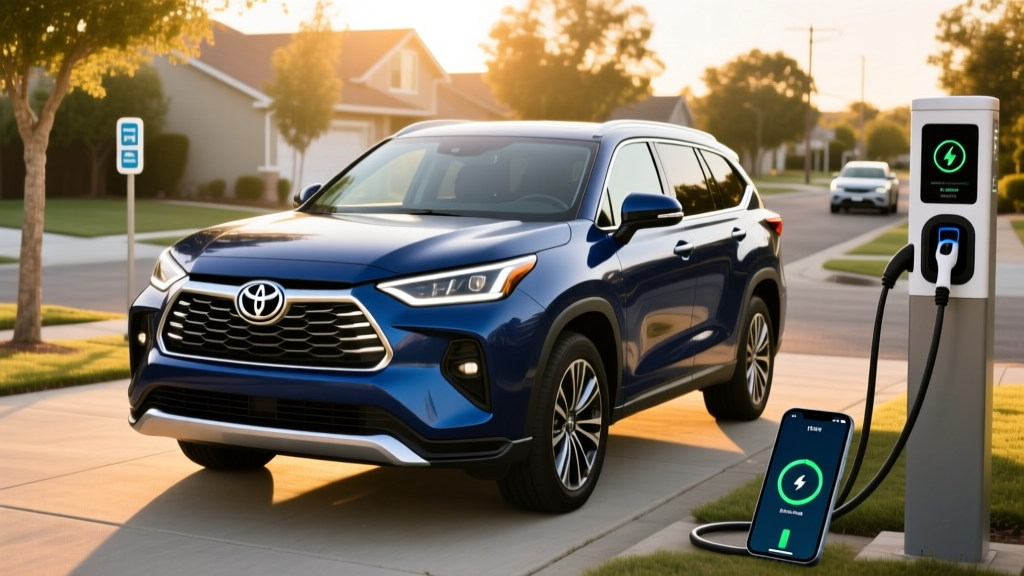
The Toyota Highlander has been a three-row family hauler staple for over two decades, and the 2026 Highlander Hybrid continues that tradition with a proven fourth-generation hybrid powertrain that prioritizes fuel efficiency without sacrificing passenger space. If you're researching the 2026 Highlander Hybrid to decide whether it's the right electrified SUV for your family — versus a plug-in hybrid or a full battery-electric vehicle — this guide breaks down every number that matters.
Let's be clear upfront: the Highlander Hybrid is a conventional hybrid electric vehicle (HEV). It does not plug in. It recovers energy through regenerative braking and uses its gasoline engine to charge the battery. If you're looking for electric-only driving, you'll want to look at a PHEV like the Toyota RAV4 Prime or a full EV. But if you want a three-row SUV that achieves 35 MPG combined without changing any habits, the 2026 Highlander Hybrid deserves serious consideration.
HEV vs PHEV: Where the Highlander Hybrid Fits
Before diving into specs, it's critical to understand what you're buying. The 2026 Highlander Hybrid is a conventional hybrid (HEV), not a plug-in hybrid (PHEV). Here's what that means in practice:
| Feature | Highlander Hybrid (HEV) | Typical PHEV (e.g., RAV4 Prime) | Full EV (e.g., Kia EV9) |
|---|---|---|---|
| Plugs in to charge? | No | Yes | Yes |
| Electric-only range | ~1 mile at low speed | 35–42 miles | 250–310 miles |
| Fuel required | Yes (regular unleaded) | Yes (regular unleaded) | No |
| EPA combined efficiency | 35 MPG | 38 MPGe (EV mode) / 27 MPG (gas) | 85–89 MPGe |
| Home charging install needed | No | Recommended (Level 2) | Required (Level 2) |
| Federal tax credit (§30D) | Not eligible | Up to $7,500 (if eligible) | Up to $7,500 (if eligible) |
| Three-row seating | Yes (up to 8) | No (RAV4 is 2-row) | Yes (EV9, etc.) |
The key tradeoff: the Highlander Hybrid requires zero lifestyle change. You fuel it like any gas car, and it delivers roughly 40% better fuel economy than the gas-only Highlander. A PHEV gives you electric-only commuting but currently doesn't come in a three-row Toyota SUV format. A full EV like the Kia EV9 offers three rows and zero tailpipe emissions, but requires home charging infrastructure and a higher upfront investment.
2026 Highlander Hybrid Fuel Economy: EPA and Real-World MPG
The headline number for the 2026 Highlander Hybrid is its EPA-estimated fuel economy. According to fueleconomy.gov, the front-wheel-drive (FWD) Highlander Hybrid achieves:
| Drivetrain | City MPG | Highway MPG | Combined MPG |
|---|---|---|---|
| FWD (LE, XLE, Limited) | 36 | 35 | 36 |
| AWD (all trims) | 35 | 34 | 35 |
| Gas-only Highlander (AWD, for comparison) | 21 | 28 | 24 |
That's a 46% improvement in combined fuel economy over the gas-only model. On a 15,000-mile annual driving cycle, the hybrid saves roughly 250 gallons of fuel per year — about $750–$900 at current gas prices.
Real-World MPG: What Owners Actually See
Toyota's hybrid system excels in stop-and-go city driving, where the electric motor handles low-speed propulsion and the regenerative braking system recaptures energy that a gas-only vehicle wastes as heat. In real-world driving, many Highlander Hybrid owners report matching or slightly exceeding EPA city estimates — a rarity among vehicles. On suburban commutes with moderate traffic, 37–38 MPG is achievable.
Highway driving is where all hybrids lose their advantage. At sustained 70–80 MPH speeds, the gasoline engine does most of the work, and the Highlander Hybrid's aerodynamic profile (it's a tall, boxy three-row SUV) limits efficiency. Expect 30–32 MPG on flat interstate driving at 75 MPH, and potentially 28–29 MPG in mountainous terrain or when fully loaded with passengers and cargo. Cold weather (below 30°F) will reduce fuel economy by 5–10% as the engine runs more frequently to provide cabin heat.
Powertrain Specs: Engine, Motors, and Horsepower
The 2026 Highlander Hybrid uses Toyota's well-proven hybrid synergy drive system, pairing a 2.5-liter inline-four engine with front and rear electric motors (on AWD models). Here's the full breakdown:
| Specification | Detail |
|---|---|
| Engine | 2.5L DOHC 4-cylinder (Atkinson cycle) |
| Engine horsepower | 186 HP @ 6,000 RPM |
| Front electric motor | 134 HP |
| Rear electric motor (AWD only) | 54 HP |
| Net combined system horsepower | 243 HP |
| Transmission | Electronically controlled CVT (eCVT) |
| 0–60 MPH | ~7.7 seconds (AWD) |
| Towing capacity | 3,500 lbs (AWD) |
| Drivetrain options | FWD or electronic on-demand AWD |
| Fuel type | Regular unleaded (87 octane) |
The 243 combined horsepower is adequate for daily driving and highway merging, though it won't feel quick with a full load of passengers. The eCVT operates smoothly — there are no fixed gear shifts — and the electric motor provides instant torque from a stop, making the Highlander Hybrid feel responsive in city driving despite its 4,500-pound curb weight.
The electronic on-demand AWD system uses the rear electric motor to power the rear wheels only when needed (acceleration, slippery conditions). This means there's no mechanical driveshaft connecting the front and rear axles, reducing weight and parasitic loss compared to a traditional AWD system.
Battery, Warranty, and Long-Term Reliability
Hybrid battery longevity is the single most common concern among first-time hybrid buyers. Here's what you need to know about the 2026 Highlander Hybrid's battery system:
| Battery Spec | Detail |
|---|---|
| Battery type | Nickel-metal hydride (NiMH) |
| Battery capacity | ~1.6 kWh (small, self-charging) |
| Hybrid battery warranty | 10 years / 150,000 miles |
| Powertrain warranty | 5 years / 60,000 miles |
| Basic warranty | 3 years / 36,000 miles |
| Estimated replacement cost (out of warranty) | $3,000–$5,000 |
Toyota's 10-year/150,000-mile hybrid battery warranty is one of the most comprehensive in the industry and covers capacity loss below a defined threshold. In practice, Toyota's NiMH hybrid batteries have demonstrated exceptional longevity — many first-generation Prius batteries lasted well beyond 200,000 miles before requiring replacement.
The NiMH chemistry used in the Highlander Hybrid is less energy-dense than the lithium-ion packs in PHEVs and EVs, but it's extremely durable and tolerant of the frequent shallow charge/discharge cycles that define hybrid operation. Unlike a full EV battery, the hybrid battery never deeply discharges or charges to true 100% — the system maintains a narrow state-of-charge window (roughly 40–80%) to maximize cycle life.
Reliability Track Record
Toyota's hybrid powertrains consistently rank among the most reliable in the industry. The fourth-generation Highlander (2020–present) has earned strong reliability scores from owner surveys. The eCVT transmission has no traditional clutch packs or gear sets to wear, and regenerative braking significantly extends brake pad life — many hybrid owners report 80,000+ miles on original brake pads.
According to NHTSA, check for the latest safety ratings and any open recalls before purchasing.
Pricing, Trims, and Tax Credit Eligibility
The 2026 Highlander Hybrid is available across four main trim levels, all offering the hybrid powertrain. Here's the pricing breakdown:
| Trim | FWD MSRP | AWD MSRP | Key Features |
|---|---|---|---|
| LE | $42,320 | $43,920 | 8-passenger, Toyota Safety Sense 3.0, 8" touchscreen |
| XLE | $46,270 | $47,870 | SofTex seats, power liftgate, wireless CarPlay, 2nd-row captain's chairs (7-pass) |
| Limited | $50,720 | $52,320 | Leather, 12.3" touchscreen, panoramic roof, JBL audio |
| Platinum | $54,070 | $55,670 | Head-up display, 360° camera, ventilated 2nd-row, heated steering wheel |
Federal Tax Credit: Not Eligible
Under current IRS §30D rules, the conventional Highlander Hybrid does not qualify for the federal clean vehicle tax credit. The §30D credit applies only to plug-in electric vehicles (PHEVs and BEVs) with a battery capacity of at least 7 kWh. The Highlander Hybrid's ~1.6 kWh NiMH battery does not meet this threshold.
Some states offer their own hybrid incentives — check your state's energy or DMV website for details — but these are typically smaller ($500–$1,500) and vary widely by jurisdiction.
Total Cost of Ownership vs Gas-Only Highlander
While the hybrid carries a roughly $2,000–$2,500 premium over equivalent gas-only Highlander trims, the fuel savings typically pay back that premium within 3–4 years for an average driver (15,000 miles/year, $3.50/gallon). Over a 10-year ownership period, the hybrid saves approximately $7,500–$9,000 in fuel costs.
| 5-Year Cost Factor | Highlander Hybrid (AWD XLE) | Gas Highlander (AWD XLE) |
|---|---|---|
| MSRP | $47,870 | $45,420 |
| Fuel (75,000 mi @ $3.50/gal) | $7,500 | $10,938 |
| Maintenance (estimated) | $2,800 | $3,400 |
| Insurance (estimated avg) | $8,500 | $8,200 |
| 5-Year Total (before depreciation) | $66,670 | $67,958 |
Who Should Choose the 2026 Highlander Hybrid?
Choose the Highlander Hybrid if:
- You need three rows of seating but don't want to deal with plug-in charging
- Your daily driving is a mix of city and highway (hybrids shine in stop-and-go traffic)
- You want to reduce fuel costs without the upfront premium of a full EV
- You take regular road trips and don't want to plan around charging infrastructure
- You plan to keep the vehicle 8+ years (to maximize fuel savings and ride out the warranty)
Look at a PHEV or full EV instead if:
- You have a short commute (<30 miles) and home charging — a PHEV like the Chrysler Pacifica PHEV minivan could cover most trips on electricity
- You want to eliminate tailpipe emissions entirely — consider the Kia EV9 (three-row EV, ~300 miles range, starting ~$56,000)
- You want access to the $7,500 federal tax credit (requires a qualifying PHEV or BEV)
- Your state offers substantial EV rebates that make a full EV more affordable
Pros
- 35–36 MPG combined in a three-row SUV — best-in-class for its segment
- No charging infrastructure needed — fuel at any gas station
- 10-year/150,000-mile hybrid battery warranty
- Proven Toyota reliability and strong resale value
- Smooth, quiet eCVT powertrain with instant electric torque
- 625+ miles of total range per tank
Cons
- Not eligible for federal §30D tax credit
- 243 HP feels adequate but not quick when fully loaded
- Highway MPG drops to 30–32 at 75+ MPH
- No electric-only driving (unlike a PHEV)
- Third row is tight for adults on long trips
- Platinum trim pushes past $55,000
Frequently Asked Questions
How many MPG does the 2026 Highlander Hybrid get?
The EPA rates the FWD Highlander Hybrid at 36 city / 35 highway / 36 combined MPG. AWD models achieve 35/34/35 MPG. In real-world city driving, many owners report matching or slightly exceeding these numbers. Highway driving at sustained high speeds typically yields 30–32 MPG.
Does the Highlander Hybrid need to be plugged in?
No. The Highlander Hybrid is a conventional hybrid (HEV) that charges its own battery through regenerative braking and the gasoline engine. You never need to plug it in. If you want plug-in electric-only driving, you'd need a PHEV, which Toyota does not currently offer in a three-row Highlander body style.
How long will the hybrid battery last and what does replacement cost?
Toyota covers the hybrid battery for 10 years or 150,000 miles. Based on historical data from Toyota's hybrid fleet, NiMH batteries commonly last 200,000+ miles before significant degradation. If replacement is needed out of warranty, expect to pay $3,000–$5,000 for a new or refurbished pack from a Toyota dealer or independent hybrid specialist.
Is the Highlander Hybrid good for towing?
The AWD Highlander Hybrid is rated for 3,500 pounds of towing capacity — adequate for a small boat, lightweight travel trailer, or utility trailer. Towing will reduce fuel economy significantly (expect 20–25 MPG while towing). If you need to tow more than 3,500 pounds, the gas-only Highlander (5,000-lb rating) or a body-on-frame SUV is a better choice.
Hybrid vs PHEV vs EV — which three-row SUV fits my family?
If you need three rows and want zero behavior change, the Highlander Hybrid is the most practical choice. If you have home charging and want electric-only commuting, the Chrysler Pacifica PHEV (32 miles electric, three-row minivan) is a strong alternative. If you're ready for full electric, the Kia EV9 (up to 300 miles range, three rows, eligible for §30D credit) is the leading three-row EV, though it starts at a higher price and requires home Level 2 charging.
Does the 2026 Highlander Hybrid qualify for any tax credit?
The Highlander Hybrid does not qualify for the federal §30D clean vehicle credit, which is reserved for plug-in vehicles with batteries of 7 kWh or larger. Check your state's energy office for any local hybrid incentives, though these are uncommon and typically modest.