Quick Verdict: The Family Hauler That Sips Fuel
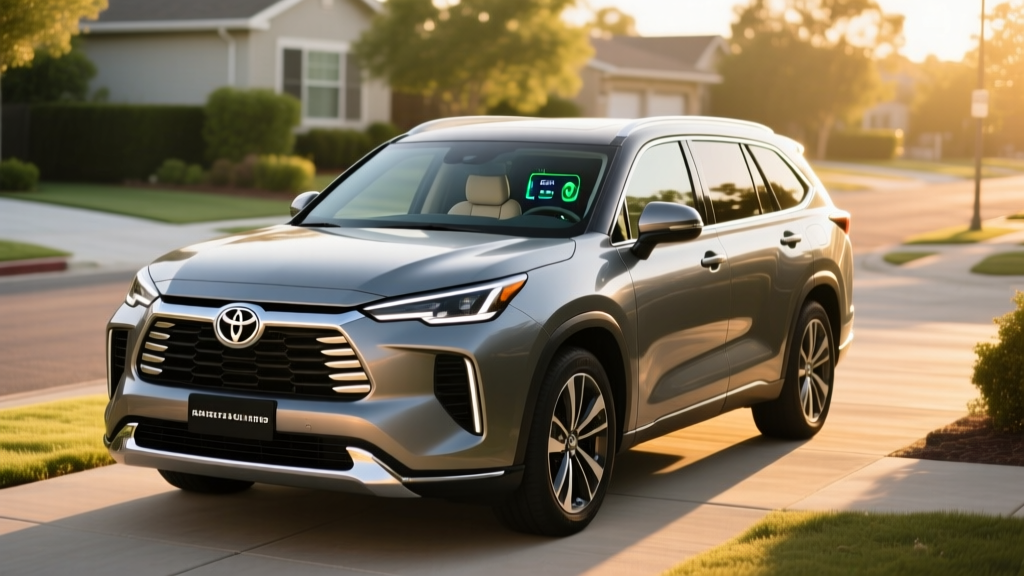
The 2026 Toyota Grand Highlander Hybrid Limited occupies a rare sweet spot in the three-row SUV market. It delivers 36 MPG combined EPA — a figure most compact sedans can't match — while seating up to seven adults and hauling over 97 cubic feet of cargo. For buyers who need three rows, can't charge at home, and want to avoid the $50,000+ price tag of electric rivals, this hybrid remains the default answer.
The Limited trim sits mid-range in the Hybrid lineup, adding SofTex-trimmed heated and ventilated front seats, a 12.3-inch infotainment touchscreen, and Toyota Safety Sense 3.0. Starting at roughly $50,955 MSRP (including destination), it undercuts comparable plug-in hybrid and electric three-row SUVs by $5,000–$15,000 while requiring zero lifestyle adjustment — no plug, no charging apps, no range planning.
HEV vs. PHEV: What the Grand Highlander Hybrid Actually Is
Conventional Hybrid (HEV): The Grand Highlander Hybrid is a self-charging hybrid. It uses a small battery (approximately 1.4 kWh usable) paired with electric motors and a 2.5-liter four-cylinder engine. You never plug it in. Regenerative braking and the engine itself keep the battery topped up. You simply fill it with gas and drive.
Plug-In Hybrid (PHEV): Toyota does not currently offer a Grand Highlander Plug-In Hybrid for the US market. The RAV4 Prime and Prius Prime are PHEVs with 42+ miles of electric-only range and larger batteries (18.1 kWh and 13.6 kWh, respectively) that require plugging in. If you want a three-row Toyota PHEV, the closest option is the Sienna — but it's a minivan, not an SUV.
Why it matters: Because this is a conventional HEV, there is no electric-only driving range to report, no kWh battery to charge, and no DC fast-charging capability. Every mile is a hybrid mile, blending engine and electric motor seamlessly.
Fuel Economy: EPA Ratings and Real-World MPG
| Driving Cycle | EPA Estimate | Real-World Expectation |
|---|---|---|
| City | 36 MPG | 37–40 MPG (hybrids excel in stop-and-go) |
| Highway | 35 MPG | 30–33 MPG (aerodynamic drag at 70+ mph) |
| Combined | 36 MPG | 33–37 MPG (mixed driving) |
Source: EPA Fuel Economy
Hybrids typically exceed their EPA city ratings in real-world urban driving because regenerative braking recaptures energy at every stoplight. Highway driving is where the Grand Highlander Hybrid's boxy SUV aerodynamics and 4,600-pound curb weight work against it. Expect 30–33 MPG at sustained 75 MPH on the interstate, particularly with roof cargo or a full passenger load. In winter, cold-start enrichment and cabin heating can drop combined figures to 30–32 MPG.
For context, the gas-only Grand Highlander Turbo (2.4L, 265 hp) earns 24 MPG combined. Over 15,000 miles per year at $3.50/gallon, the hybrid saves approximately $700–$900 annually in fuel costs.
Powertrain: 362 HP Without the Guilt
| Specification | Value |
|---|---|
| Engine | 2.5L inline-4 (Dynamic Force) |
| Hybrid System | Toyota Hybrid System (4th gen) — front and rear electric motors |
| Combined Net Horsepower | 245 hp (standard Hybrid) / 362 hp (Hybrid MAX AWD) |
| Drivetrain | AWD (electronic on-demand rear motor) |
| 0–60 MPH | ~7.8 sec (standard Hybrid) / ~6.3 sec (Hybrid MAX) |
| Towing Capacity | 3,500 lbs (standard) / 5,000 lbs (Hybrid MAX) |
| Fuel Tank | 17.1 gallons |
| Total Driving Range | ~615 miles (at combined EPA) |
The Limited trim is available in both the standard Hybrid powertrain (245 hp) and the Hybrid MAX (362 hp). The Hybrid MAX pairs a turbocharged 2.4-liter four-cylinder with a more powerful electric motor and a 6-speed automatic transmission (rather than the eCVT in the standard Hybrid). The trade-off: Hybrid MAX drops to 27 MPG combined but gains 5,000-pound towing and a notably more responsive driving feel. For most families prioritizing fuel savings, the standard Hybrid is the smarter pick.
2026 Grand Highlander Hybrid Limited Pricing and Tax Credit Status
| Trim / Configuration | MSRP (incl. destination) |
|---|---|
| Hybrid Limited AWD (standard 245 hp) | ~$50,955 |
| Hybrid MAX Limited AWD (362 hp) | ~$54,500 |
Federal Tax Credit (§30D): The Grand Highlander Hybrid does not qualify for the $7,500 federal EV tax credit. The IRS §30D credit applies only to battery electric vehicles (BEVs) and plug-in hybrids (PHEVs) with batteries of at least 7 kWh. Since the Grand Highlander Hybrid is a conventional HEV with a ~1.4 kWh battery and no plug-in capability, it falls outside the credit's scope entirely.
State incentives: A handful of states offer rebates or HOV-lane access for conventional hybrids, but these are uncommon and vary by jurisdiction. Check your state's energy office or DMV for current programs.
Total cost perspective: Even without a tax credit, the Grand Highlander Hybrid Limited's total cost of ownership is competitive. Over five years, its fuel savings versus the gas-only Turbo model and its strong Toyota resale value offset the higher MSRP versus a gas-only competitor like the Hyundai Palisade or Kia Telluride.
Battery Warranty, Reliability, and Replacement Costs
Hybrid Battery Warranty: Toyota covers the hybrid battery with a 10-year / 150,000-mile warranty (whichever comes first) across all 50 states. This has been Toyota's standard hybrid battery warranty since the 2020 model year.
Powertrain Warranty: 5 years / 60,000 miles.
Limited Vehicle Warranty: 3 years / 36,000 miles.
Toyota's hybrid system is one of the most proven electrified powertrains on the road. The Prius, Camry Hybrid, and Highlander Hybrid have accumulated billions of real-world miles since 1997. The hybrid battery in the Grand Highlander is a nickel-metal hydride (NiMH) pack — less energy-dense than lithium-ion but extremely durable and heat-tolerant. Based on historical Toyota hybrid data, most hybrid batteries last well beyond 150,000 miles with minimal degradation.
Replacement cost if out of warranty: A replacement hybrid battery pack for a Toyota three-row hybrid (based on Highlander Hybrid precedent) runs approximately $3,000–$5,000 installed at a dealership. Independent hybrid specialists often offer refurbished packs for $1,500–$2,500. Given the 10-year/150,000-mile warranty and the pack's track record, this is a low-probability expense for most original owners.
Reliability outlook: Toyota consistently ranks at or near the top of J.D. Power and Consumer Reports reliability surveys. The Grand Highlander was introduced for the 2024 model year, so long-term data specific to this nameplate is still building. However, its powertrain is shared with the Highlander Hybrid, which has years of proven service.
Who Should Buy the Grand Highlander Hybrid Limited — and Who Shouldn't
Pros
- 36 MPG combined in a 3-row, 7-seat SUV — class-leading efficiency
- No plug-in required; zero lifestyle change from a gas car
- 615+ mile total range eliminates fill-up frequency
- Toyota Safety Sense 3.0 standard (adaptive cruise, lane tracing, auto emergency braking)
- 10-year/150,000-mile hybrid battery warranty
- Strong resale value and proven hybrid reliability
Cons
- No federal tax credit eligibility
- Hybrid MAX fuel economy drops to 27 MPG combined
- No electric-only driving — every mile burns some gas
- Third row tight for adults on long trips
- Limited trim pricing pushes past $50,000
- Infotainment still trails rivals in responsiveness
Choose the Grand Highlander Hybrid Limited if: You need three rows, drive 12,000–20,000 miles per year, can't install a home charger, and want maximum fuel savings with zero charging hassle. It's ideal for families in apartments, condos, or areas with sparse public charging.
Choose a PHEV (like the Kia Sorento PHEV or Mazda CX-90 PHEV) if: You have home charging access, your daily commute is under 30 miles, and you want some electric-only driving for school runs and errands while keeping gas flexibility for road trips.
Choose a full EV (like the Kia EV9 or Tesla Model X) if: You have reliable home Level 2 charging, your road trips are under 250 miles between stops, and you want zero tailpipe emissions, lower per-mile energy costs, and eligibility for the $7,500 federal tax credit.
Frequently Asked Questions
How many MPG does the 2026 Grand Highlander Hybrid get?
The EPA rates it at 36 MPG city / 35 MPG highway / 36 MPG combined. Real-world city driving often yields 37–40 MPG thanks to regenerative braking, while sustained highway driving at 75 MPH typically returns 30–33 MPG.
Does the Grand Highlander Hybrid need to be plugged in?
No. It is a conventional hybrid (HEV), not a plug-in hybrid (PHEV). The battery charges itself through regenerative braking and the gasoline engine. You simply fill the 17.1-gallon tank with regular unleaded fuel.
How far can the Grand Highlander Hybrid go on a full tank?
At the EPA combined rating of 36 MPG with a 17.1-gallon tank, total range is approximately 615 miles. Real-world mixed driving typically yields 550–600 miles between fill-ups.
Does the 2026 Grand Highlander Hybrid qualify for any tax credit?
It does not qualify for the federal §30D clean vehicle credit ($7,500), which requires a plug-in vehicle with at least 7 kWh of battery capacity. Check your state energy office for any local hybrid incentives, though these are uncommon.
Is the Grand Highlander Hybrid reliable?
Toyota's hybrid powertrain has over 25 years of proven reliability across millions of vehicles. The hybrid battery is covered for 10 years / 150,000 miles. Based on Highlander Hybrid precedent, most owners will never need a hybrid battery replacement.
What does a hybrid battery replacement cost?
If needed out of warranty, a new Toyota hybrid battery pack costs approximately $3,000–$5,000 installed at a dealer. Refurbished packs from independent shops run $1,500–$2,500. This is a rare expense given the 150,000-mile warranty and Toyota's durability record.
How does the Grand Highlander Hybrid compare to a full EV three-row SUV?
Full EVs like the Kia EV9 (304-mile range, ~$54,900) offer lower per-mile energy costs and zero emissions but require home charging infrastructure and cost $5,000+ more upfront before tax credits. The Grand Highlander Hybrid wins for buyers without charging access or those who frequently tow or take long road trips through areas with sparse charging.