Quick Verdict: The GV80 Goes Plug-In
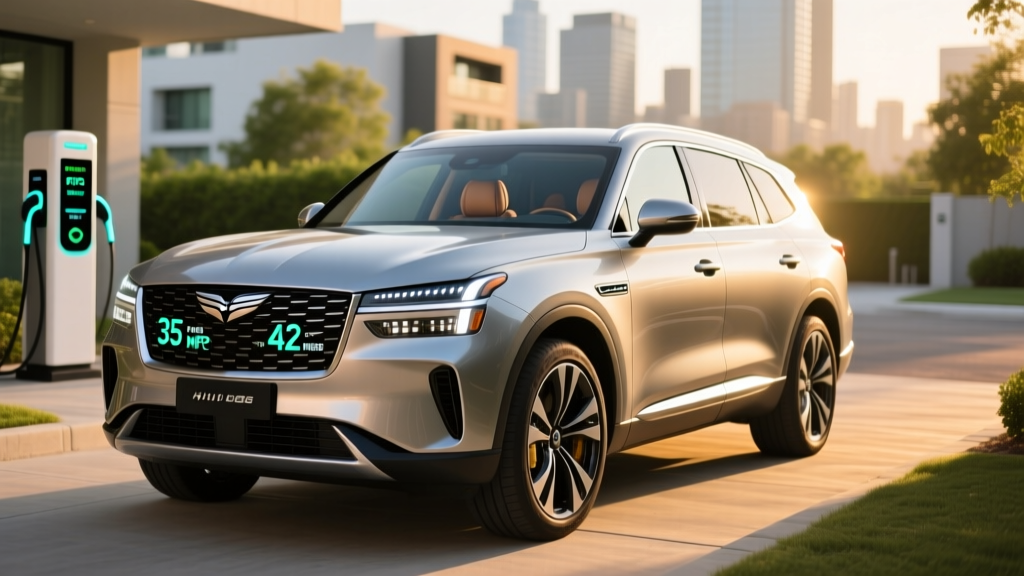
Genesis finally brings electrification to its flagship midsize SUV for the 2026 model year. The 2026 Genesis GV80 Hybrid arrives as a plug-in hybrid (PHEV) — not a conventional hybrid — pairing a turbocharged 2.5-liter inline-four with a rear-axle electric motor and an 18.7 kWh (gross) lithium-ion battery pack. The result is an EPA-estimated 32 miles of electric-only driving, 42 MPGe combined when the battery is charged, and 25 MPG combined once the battery depletes and the gas engine takes over. With a combined system output of 325 horsepower, it slots between the base 2.5T and the performance-oriented 3.5T V6 trims, offering luxury buyers a bridge between full electrification and gas-only convenience.
Starting at $68,350 (including destination), the GV80 PHEV commands a premium over the gas-only 2.5T but undercuts the V6 models while delivering notably better fuel economy for commuters who can charge at home. Below, we dissect every number that matters — from real-world MPG to battery warranty to federal tax credit eligibility — so you can decide whether this PHEV fits your garage.
HEV vs PHEV: What Genesis Is (and Isn't) Offering
Let's clear up a common source of confusion before diving into specs. A conventional hybrid (HEV) — like a Toyota RAV4 Hybrid — uses a small battery (typically 1–2 kWh) that recharges through regenerative braking and the engine. You never plug it in. A plug-in hybrid (PHEV) carries a substantially larger battery that you charge from a wall outlet or public charger, giving you a meaningful electric-only driving range before the gas engine kicks in.
| Attribute | Conventional Hybrid (HEV) | Plug-In Hybrid (PHEV) — GV80 |
|---|---|---|
| Battery size | 1–2 kWh | 18.7 kWh (gross) |
| Plug-in required? | No | Yes (for EV range) |
| Electric-only range | <1 mile at low speed | 32 miles (EPA est.) |
| Federal tax credit | Not eligible | Up to $5,500 (§30D, sourcing-dependent) |
| Home charging | Not applicable | Level 2, ~3 hours |
Genesis has confirmed that the 2026 GV80 is offered exclusively as a PHEV in the US market. There is no conventional HEV variant. If you see references to a "GV80 Hybrid," it refers to this plug-in model. The PHEV powertrain debuted in select Asian and European markets on the previous-generation GV80, but 2026 marks its first US availability on the redesigned second-generation platform.
Powertrain and Performance Specs
The GV80 PHEV pairs a 2.5-liter turbocharged inline-four (277 hp on its own) with a 100 kW (134 hp) electric motor integrated into the rear axle, creating an electronically controlled all-wheel-drive system. Combined system output is rated at 325 horsepower and 380 lb-ft of torque. An 8-speed automatic transmission handles the front-engine power, while the rear motor operates through a single-speed reduction gear.
| Specification | 2026 Genesis GV80 PHEV |
|---|---|
| Engine | 2.5L turbo I-4 + rear electric motor |
| Combined horsepower | 325 hp |
| Combined torque | 380 lb-ft |
| Transmission | 8-speed automatic (front) / single-speed (rear motor) |
| Drivetrain | AWD (e-AWD, no mechanical link to rear) |
| Battery (gross / usable) | 18.7 kWh / ~15.2 kWh usable |
| Battery chemistry | NMC (nickel manganese cobalt) |
| 0–60 mph (mfr. est.) | 6.4 seconds |
| Towing capacity | 5,000 lbs (braked) |
| Curb weight | ~5,080 lbs |
The electric motor's instant torque fills in the turbo lag inherent to the 2.5T engine, making the PHEV feel noticeably more responsive off the line than the gas-only equivalent. In EV mode, acceleration is adequate for city merging but not brisk — expect roughly 9.5 seconds to 60 mph on electric power alone.
Fuel Economy: EPA Numbers and Real-World MPG
The EPA rates the 2026 GV80 PHEV at 42 MPGe (miles per gallon equivalent) when operating on combined battery and gasoline energy, and 25 MPG combined once the battery is depleted and the vehicle runs as a conventional hybrid. Here is the full breakdown:
| Mode | City | Highway | Combined |
|---|---|---|---|
| Charge-depleting (EV + gas, MPGe) | 45 MPGe | 39 MPGe | 42 MPGe |
| Charge-sustaining (gas only, MPG) | 24 MPG | 27 MPG | 25 MPG |
Real-world MPG note: PHEVs reward consistent home charging. If you plug in nightly and your commute is under 30 miles, you may use almost no gasoline for weeks — effectively achieving 100+ MPGe over a month. Conversely, if you never charge, the GV80 PHEV operates as a heavy hybrid and will return closer to 22–23 MPG in mixed driving due to the extra weight of the battery pack. Cold weather (below 30°F) typically reduces electric-only range by 20–30%, bringing the 32-mile EPA figure down to roughly 22–25 miles in winter.
For comparison, the gas-only 2026 GV80 2.5T AWD achieves 21 city / 25 highway / 23 combined MPG per fueleconomy.gov. The PHEV's advantage is substantial — but only if you charge regularly.
Electric-Only Range, Charging, and Battery Details
The GV80 PHEV delivers an EPA-estimated 32 miles of electric-only range. That covers the average American one-way commute (roughly 16 miles each way per Census Bureau data) with margin to spare, meaning many owners can complete daily driving entirely on electricity.
Total combined range — battery plus the 21.1-gallon fuel tank — reaches approximately 460 miles, eliminating range anxiety on road trips where charging infrastructure may be sparse.
| Charging Level | Power | Time (0–100%) | Notes |
|---|---|---|---|
| Level 1 (120V household) | ~1.4 kW | ~12 hours | Overnight top-up only |
| Level 2 (240V, J1772) | 7.2 kW (onboard charger max) | ~2.8 hours | Recommended home method |
| DC fast charge | Not supported | N/A | No CCS or NACS DC inlet |
Like most PHEVs, the GV80 does not support DC fast charging. The 7.2 kW onboard AC charger is competitive for the segment — the BMW X5 xDrive50e charges at a similar rate, while the Toyota RAV4 Prime is limited to 6.6 kW. For home charging, a Level 2 wallbox (such as a ChargePoint Home Flex or Emporia Level 2) on a 40-amp circuit will fully replenish the battery in under three hours, easily covering a midday top-up if you work from home.
The 18.7 kWh (gross) NMC battery pack sits beneath the rear cargo floor, which reduces under-floor storage slightly compared to the gas GV80 but does not impact the main cargo volume. Genesis quotes approximately 15.2 kWh of usable capacity — the remaining ~3.5 kWh serves as a buffer to protect long-term battery health by preventing full 0% or 100% cell-level states.
Battery Warranty, Reliability, and Replacement Cost
Genesis Hybrid Battery Warranty: 10 years / 100,000 miles (whichever comes first), covering defects and capacity loss below 70% of original capacity. This is among the strongest hybrid battery warranties in the luxury segment, matching Hyundai's coverage (Genesis is Hyundai's luxury division). The powertrain warranty also runs 10 years / 100,000 miles.
PHEV battery degradation data is still maturing for this specific pack, but we can draw on Hyundai Motor Group's track record with the Tucson PHEV and Santa Fe PHEV, which share similar NMC cell suppliers (SK On). Fleet data from those models shows approximately 8–12% capacity loss over the first 5 years / 75,000 miles under normal use — well within the 70% warranty threshold.
Should the battery require out-of-warranty replacement, expect a cost in the $8,000–$12,000 range (parts and labor), based on current Hyundai Motor Group PHEV battery pricing. However, given the generous 10-year warranty and the protective buffer built into the pack management system, most original owners will never face this expense. The 12V auxiliary battery is a separate, conventional item and is not covered under the hybrid battery warranty.
Genesis as a brand rates above average in J.D. Power's Vehicle Dependability Study, and the PHEV powertrain adds an electric motor with fewer moving parts than a conventional drivetrain. The primary reliability watch-item is the 8-speed transmission's integration with the electric rear axle — a relatively new configuration for the group in the US market.
Pricing, Trims, and Federal Tax Credit Eligibility
The 2026 Genesis GV80 PHEV is offered in two trims:
| Trim | MSRP (incl. destination) | Key Features |
|---|---|---|
| PHEV Advanced | $68,350 | 20" wheels, leatherette, 12.3" cluster, navigation, Highway Driving Assist 2 |
| PHEV Prestige | $75,200 | Nappa leather, 22" wheels, head-up display, digital side mirrors, rear entertainment |
Regarding the federal EV tax credit under IRS §30D: the GV80 PHEV qualifies as a "new clean vehicle" because its battery exceeds the 7 kWh minimum. However, the actual credit amount depends on several factors that change periodically:
- MSRP cap: SUVs must be under $80,000 MSRP. Both GV80 PHEV trims qualify.
- Buyer income cap: Modified AGI must not exceed $150,000 (single), $225,000 (head of household), or $300,000 (joint filers).
- Battery sourcing: The credit is split into two halves — $3,750 for critical minerals sourcing and $3,750 for battery component manufacturing. The GV80's SK On battery currently meets the component requirement but faces restrictions on foreign entities of concern (FEOC) for critical minerals. As of early 2026, the estimated qualifying credit is $3,750 (component half only), though this may change as Genesis adjusts its supply chain.
- Point-of-sale transfer: Under current IRS rules, you can transfer the credit to the dealer at purchase, reducing your out-of-pocket cost immediately rather than waiting for tax filing.
Always verify current eligibility on the IRS clean vehicle credit page and consult a tax professional before relying on credit amounts for purchase decisions. State incentives vary: California's CVRP, Colorado's innovative motor vehicle credit, and several Northeast states offer additional rebates for PHEVs.
Who Should Choose the GV80 PHEV vs a Full EV or Gas SUV?
Pros
- 32 miles EV range covers most commutes gas-free
- 460-mile total range eliminates road-trip charging stops
- 10-year / 100k-mile battery warranty
- 325 hp with electric torque fill is satisfying
- Qualifies for partial federal tax credit ($3,750 est.)
- Luxury interior rivals BMW X5, Mercedes GLE
Cons
- No DC fast charging capability
- ~22–23 MPG if you never plug in (heavy as a hybrid)
- Higher starting price than gas 2.5T ($68,350 vs ~$58,000)
- Reduced under-floor cargo storage
- Full $7,500 credit unlikely due to FEOC sourcing rules
- Real-world winter EV range drops to ~22–25 miles
Choose the GV80 PHEV if: You have home or workplace Level 2 charging, your daily driving is under 35 miles, you want luxury SUV comfort without committing to a full EV, and you regularly take road trips where charging infrastructure is unreliable.
Choose a full EV (e.g., Genesis GV80 EV when it arrives, BMW iX, Rivian R1S) if: You drive more than 50 miles daily, you want zero tailpipe emissions, you have reliable home and public charging access, and you want lower per-mile energy costs and less maintenance.
Choose the gas GV80 2.5T if: You cannot charge at home or work, your annual mileage is low (under 8,000 miles), or the $10,000 price premium of the PHEV doesn't pencil out over your ownership horizon.
Frequently Asked Questions
How many MPG does the 2026 Genesis GV80 Hybrid get?
The GV80 PHEV achieves 42 MPGe combined when using both battery and gasoline energy. Once the battery is depleted, it returns 25 MPG combined (24 city / 27 highway) as a conventional hybrid. Real-world results vary significantly based on how often you charge — consistent plugging in can push your effective monthly economy well above 42 MPGe.
How far can the GV80 PHEV go on electric only?
The EPA rates it at 32 miles of electric-only range. In real-world conditions — particularly highway speeds above 65 mph or temperatures below freezing — expect 22 to 28 miles. Gentle city driving in mild weather can stretch it to 35 miles thanks to regenerative braking.
Does the 2026 GV80 Hybrid qualify for a tax credit?
Yes, it qualifies under IRS §30D as a new clean vehicle. However, due to battery critical-mineral sourcing restrictions (FEOC rules), the estimated qualifying credit for 2026 is $3,750, not the full $7,500. Always check irs.gov for the latest eligible vehicle list and consult a tax professional.
Is the GV80 PHEV reliable, and what does battery replacement cost?
Genesis covers the hybrid battery for 10 years / 100,000 miles, and Hyundai Motor Group's PHEV track record shows manageable degradation (8–12% over 5 years). Out-of-warranty battery replacement is estimated at $8,000–$12,000, though most owners will never need it within the warranty period.
Can the GV80 PHEV DC fast charge?
No. Like most plug-in hybrids, the GV80 PHEV supports only AC charging — up to 7.2 kW on Level 2 (240V), taking about 2.8 hours for a full charge. DC fast charging is not available because the relatively small battery doesn't justify the added cost and weight of a DC inlet and associated thermal management.
How does the GV80 PHEV compare to the BMW X5 xDrive50e?
The X5 xDrive50e offers roughly 38 miles of EV range and a larger battery (~25.7 kWh gross) but starts around $74,000. The GV80 PHEV is priced lower, offers a longer battery warranty (10 years vs. BMW's 8 years / 80,000 miles), and provides comparable luxury. The X5 edges ahead on EV range and slightly more powerful combined output (483 hp).