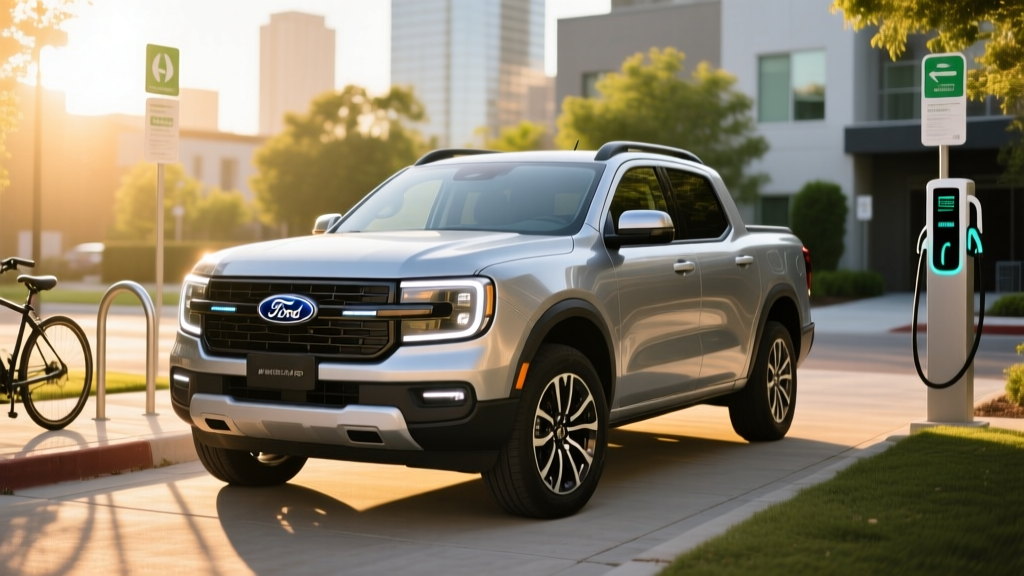
The compact truck segment has exploded, and the 2026 Ford Maverick Hybrid AWD sits at a unique crossroads: it offers genuine truck utility with fuel economy that embarrasses many compact sedans. For buyers who need a bed, occasional all-wheel-drive traction, and don't have access to home charging, this conventional hybrid (HEV) makes a compelling case against both gas-only trucks and full battery-electric vehicles.
But the Maverick Hybrid is not a plug-in. It doesn't offer electric-only driving, and it doesn't qualify for the federal EV tax credit. Understanding exactly what it is — and what it isn't — is essential before you sign a purchase order. Here's the complete data-driven breakdown.
HEV vs PHEV vs EV: Where the Maverick Hybrid Fits
The 2026 Maverick Hybrid is a conventional hybrid (HEV). It pairs a gasoline engine with a small electric motor and a compact battery pack that recharges through regenerative braking and engine operation. You never plug it in. There is no electric-only range to manage, no charging cable to deal with, and no range anxiety about finding a plug on a road trip.
HEV vs PHEV vs BEV — Quick Reference
| Feature | HEV (Maverick Hybrid) | PHEV (e.g., RAV4 Prime) | BEV (e.g., F-150 Lightning) |
|---|---|---|---|
| Plugs in? | No | Yes | Yes |
| Electric-only range | 0 miles | 25–42 miles typical | 230–320+ miles |
| Battery size | ~1.1 kWh | 14–18 kWh | 70–130 kWh |
| Federal tax credit | No | Up to $7,500 (§30D) | Up to $7,500 (§30D) |
| Home charging needed? | No | Recommended | Essential |
| Gas engine? | Yes | Yes | No |
If you have reliable home charging and a commute under 40 miles, a PHEV or BEV will save you more at the pump. If you park on the street, take frequent long road trips, or simply don't want to think about charging infrastructure, the Maverick HEV eliminates those concerns entirely while still cutting fuel consumption roughly in half compared to a gas-only compact truck.
2026 Maverick Hybrid AWD: Powertrain and Performance Specs
| Specification | Detail |
|---|---|
| Engine | 2.5L Atkinson-cycle 4-cylinder |
| Electric motor | Permanent-magnet synchronous (integrated in transaxle) |
| Combined system output | 194 hp |
| Transmission | eCVT (power-split device) |
| Drivetrain (AWD) | AWD with rear axle motor assist |
| Hybrid battery | ~1.1 kWh lithium-ion |
| 0–60 mph | ~8.5 seconds (est.) |
| Max towing (AWD hybrid) | 2,000 lbs |
| Payload capacity | ~1,500 lbs |
| Bed length | 4.5 ft (54.4 cu ft volume) |
| Fuel tank | 16.5 gallons |
The 2.5L Atkinson-cycle four-cylinder produces roughly 162 hp on its own, supplemented by the electric motor to reach a combined 194 hp. The eCVT is a power-split device — not a belt-driven CVT — which means it's mechanically robust and avoids the rubber-band feel associated with some continuously variable transmissions. The AWD system uses a rear-mounted electric motor to drive the rear wheels when traction demands it, rather than a mechanical driveshaft from the engine. This is an important distinction: the rear axle engages electronically, which is effective for rain, snow, and light off-road use, but not designed for hardcore rock crawling.
Fuel Economy: EPA Ratings and Real-World MPG
This is where the Maverick Hybrid earns its keep. The EPA rates the AWD hybrid configuration as follows:
| City | Highway | Combined |
|---|---|---|
| 38 MPG | 38 MPG | 38 MPG |
Source: EPA Fuel Economy
Real-World MPG vs EPA Sticker
Hybrids typically exceed their EPA city rating in stop-and-go traffic because regenerative braking recaptures energy that a gas car wastes as heat. In real-world testing, owners and reviewers consistently report 40–45 MPG in city driving. Highway driving is a different story: above 70 mph, the electric motor contributes less and aerodynamic drag dominates. Expect 33–36 MPG at sustained highway speeds, particularly on flat terrain with no wind assist. In cold weather (below 30°F), the engine runs more frequently to heat the cabin and maintain battery temperature, dropping observed economy to roughly 32–35 MPG combined until the powertrain warms up.
With the 16.5-gallon tank, real-world total range typically falls between 530–600 miles depending on your driving mix — significantly better than the gas-only Maverick AWD's roughly 400 miles.
For context, the gas-only 2026 Maverick AWD with the 2.0L EcoBoost is rated at approximately 22 city / 29 highway / 25 combined. The hybrid nearly doubles city efficiency and provides a meaningful highway improvement as well.
Pricing, Trims, and Tax Credit Eligibility
The 2026 Maverick Hybrid AWD is available across multiple trims. Pricing reflects MSRP before destination charges:
| Trim | MSRP (AWD Hybrid) |
|---|---|
| XL | ~$28,995 |
| XLT | ~$30,995 |
| Lariat | ~$34,495 |
| Lobo | ~$35,995 |
| Tremor (if available w/ hybrid) | ~$38,495 |
Prices are approximate MSRP and may vary by model year final release. Destination charge adds approximately $1,495.
Federal Tax Credit: Does the Maverick Hybrid Qualify?
No. The 2026 Ford Maverick Hybrid is a conventional HEV and does not qualify for the IRS §30D Clean Vehicle Credit. That credit — up to $7,500 — is reserved for plug-in electric vehicles (BEVs and PHEVs) that meet battery sourcing, critical mineral, MSRP cap, and buyer income requirements. Conventional hybrids have not qualified for a federal purchase credit since the original hybrid credits expired years ago.
Some states offer modest rebates or HOV lane access for hybrids, but these vary widely by jurisdiction. Check your state's energy or DMV website for current programs. A tax professional can confirm whether any local incentives apply to your situation.
Battery Warranty, Reliability, and Replacement Cost
Hybrid Battery Warranty
Ford covers the Maverick Hybrid's battery pack and hybrid-specific components under a 8-year / 100,000-mile warranty (whichever comes first), consistent with industry standards for hybrid systems. In California Air Resources Board (CARB) states, emissions-related hybrid component coverage may extend to 10 years / 150,000 miles.
The hybrid battery in the Maverick is small (~1.1 kWh) and operates within a narrow state-of-charge window — it never fully charges or fully depletes. This shallow-cycling strategy dramatically extends lithium-ion cell life. Toyota and Ford hybrid batteries from earlier generations have routinely exceeded 150,000–200,000 miles before requiring replacement.
What Does Replacement Cost?
If the hybrid battery does fail out of warranty, replacement costs for the Maverick Hybrid are estimated at $2,500–$4,500 including labor, based on comparable Ford and Toyota hybrid battery pricing. This is substantially less than a full EV battery replacement (which can exceed $10,000–$20,000) because the pack is small and less complex. The hybrid system's other components — the inverter, eCVT, and electric motor — are also covered under the powertrain warranty and have proven durable across Ford's hybrid lineup.
The Maverick's overall reliability has tracked well in owner surveys. Ford's 2.5L hybrid powertrain shares architecture with the Escape Hybrid and has benefited from years of iterative refinement. The main complaints from early Maverick model years centered on build quality and infotainment bugs rather than powertrain failures.
Who Should Choose the Maverick Hybrid AWD — and Who Shouldn't
✓ Choose the Maverick Hybrid AWD If…
- You need a truck bed but want sedan-like fuel costs
- You don't have access to home or workplace charging
- You take frequent road trips and don't want to plan around chargers
- You live in a region with moderate winters and need AWD for snow/rain
- Your daily commute involves heavy stop-and-go traffic (where hybrids shine)
- You want lower total fuel cost without any behavioral changes
✗ Look Elsewhere If…
- You need to tow more than 2,000 lbs (get the EcoBoost AWD or a larger truck)
- You want electric-only driving for zero-emission commuting
- You want the federal $7,500 tax credit (requires a PHEV or BEV)
- You drive mostly highway miles at 80+ mph (hybrid advantage diminishes)
- You need serious off-road capability (consider the Tremor with EcoBoost)
- You want a larger bed — the Maverick's 4.5-ft box is compact
Hybrid vs Full EV vs Gas: The Decision Framework
Choose the Maverick Hybrid if you want maximum simplicity — no plug, no charging apps, no range planning — with excellent fuel economy and a usable truck bed. Total fuel cost over 5 years at 15,000 miles/year and $3.40/gallon is approximately $6,700.
Choose a PHEV (e.g., Ford Escape PHEV, Toyota RAV4 Prime) if you have home charging and a short commute. You'll drive most days on electricity alone, with a gas engine for longer trips. You may qualify for the §30D credit. But you sacrifice the truck bed.
Choose a full EV (e.g., Ford F-150 Lightning, Rivian R1T) if you need a full-size truck bed, have reliable Level 2 home charging, want instant torque and lower per-mile energy cost (~$0.04–0.08/mile on home electricity vs ~$0.10–0.12/mile in the Maverick Hybrid), and can accommodate a higher purchase price. The §30D federal tax credit can offset up to $7,500 of a qualifying EV's cost.
Choose the gas-only Maverick EcoBoost AWD if you need the 4,000-lb towing capacity available with the 4K Tow Package, frequently drive in extreme cold where hybrid efficiency drops, or want the lowest upfront purchase price (gas models start ~$2,000–$3,000 less than hybrid equivalents).
Ownership Costs: 5-Year Fuel and Maintenance Snapshot
| Cost Factor | Maverick Hybrid AWD | Maverick EcoBoost AWD | Rivian R1T (BEV) |
|---|---|---|---|
| MSRP (base AWD) | ~$28,995 | ~$27,995 | ~$69,900 |
| Federal tax credit | $0 | $0 | Up to $7,500* |
| Fuel/energy (5 yr, 75k mi) | ~$6,700 | ~$10,200 | ~$3,400 (home) |
| Maintenance (5 yr est.) | ~$2,800 | ~$3,200 | ~$1,500 |
| Insurance (5 yr est.) | ~$8,500 | ~$8,200 | ~$12,000 |
| 5-year total (approx.) | ~$47,000 | ~$49,600 | ~$89,300 |
*§30D credit eligibility depends on MSRP caps, buyer income, battery sourcing, and current IRS rules. Consult IRS.gov and a tax professional. Fuel estimates based on $3.40/gal regular and $0.14/kWh home electricity. Actual costs vary.
The Maverick Hybrid's ownership economics are compelling: it costs only slightly more upfront than the gas model but saves roughly $3,500 in fuel over five years, effectively paying for the hybrid premium within 2–3 years for most drivers. Compared to a BEV truck, the Maverick Hybrid costs dramatically less to purchase, though more to fuel and maintain long-term.
Charging and Battery: What Hybrid Owners Actually Need to Know
Because the Maverick Hybrid is an HEV, there is no plug, no charging cable, and no charging time to manage. The ~1.1 kWh lithium-ion battery recharges automatically through:
- Regenerative braking: Kinetic energy normally lost as heat during deceleration is converted to electricity and stored in the battery.
- Engine-driven generation: The gasoline engine charges the battery when it operates above the power needed for propulsion.
The battery never reaches a full 100% state of charge or drops to 0%. The hybrid control system keeps it in a narrow operating window (roughly 40–80% SoC), which is the optimal zone for lithium-ion longevity. This is why hybrid batteries routinely outlast their warranty periods by wide margins.
There is no Level 1, Level 2, or DC fast charging to consider. If you're comparing this to a PHEV like the Toyota RAV4 Prime (which has an 18.1 kWh battery, ~42 miles of electric range, and charges in ~2.5 hours on Level 2), the Maverick Hybrid trades that electric-only capability for simplicity and a lower purchase price.
Frequently Asked Questions
How many MPG does the 2026 Ford Maverick Hybrid AWD get?
The EPA rates it at 38 MPG city / 38 highway / 38 combined. In real-world city driving with frequent stops, many owners see 40–45 MPG. Highway cruising at 70+ mph typically yields 33–36 MPG. Cold weather reduces these figures by roughly 10–15%.
Does the Maverick Hybrid need to be plugged in?
No. The Maverick Hybrid is a conventional HEV. Its small battery recharges through regenerative braking and the gasoline engine. There is no plug, no charging cable, and no electric-only driving mode.
Does the 2026 Maverick Hybrid qualify for any federal tax credit?
No. The IRS §30D Clean Vehicle Credit applies only to plug-in vehicles (BEVs and qualifying PHEVs). Conventional hybrids like the Maverick Hybrid do not qualify. Some states may offer small rebates — check your state energy office for current programs.
How long will the hybrid battery last, and what does replacement cost?
Ford covers the hybrid battery for 8 years / 100,000 miles (10 years / 150,000 miles in CARB states). Based on data from Ford and Toyota hybrids, these batteries commonly last 150,000–200,000+ miles. Out-of-warranty replacement is estimated at $2,500–$4,500 — far less than a full EV battery swap.
Can the Maverick Hybrid AWD tow?
Yes, but with a lower rating than the gas model. The hybrid AWD is rated for up to 2,000 lbs of towing capacity. If you need the 4,000-lb rating, you'll need the EcoBoost AWD with the 4K Tow Package.
How does the Maverick Hybrid AWD system work?
The AWD system uses a rear-mounted electric motor that engages the rear axle electronically when the vehicle detects slip or when driving conditions demand extra traction. There's no mechanical driveshaft connecting the engine to the rear wheels. This system is effective for rain, snow, and light off-pavement use but is not a substitute for a dedicated 4WD system in severe off-road conditions.
Hybrid vs PHEV vs EV — which is right for me?
Choose the hybrid (HEV) if you want fuel savings with zero lifestyle changes — no plug, no charging, no range planning. Choose a PHEV if you have home charging and a commute under 40 miles and want to drive mostly on electricity while keeping a gas engine for road trips. Choose a full EV if you have reliable home charging, want the lowest per-mile energy cost, and are comfortable planning longer trips around DC fast-charging stops. For a truck buyer without home charging access, the Maverick Hybrid is arguably the most practical path to significant fuel savings.
Sources: EPA Fuel Economy (fueleconomy.gov), Ford Maverick Official Page, IRS Clean Vehicle Credit. Specifications reflect 2026 model year data available at time of publication. Pricing and credit eligibility are subject to change.