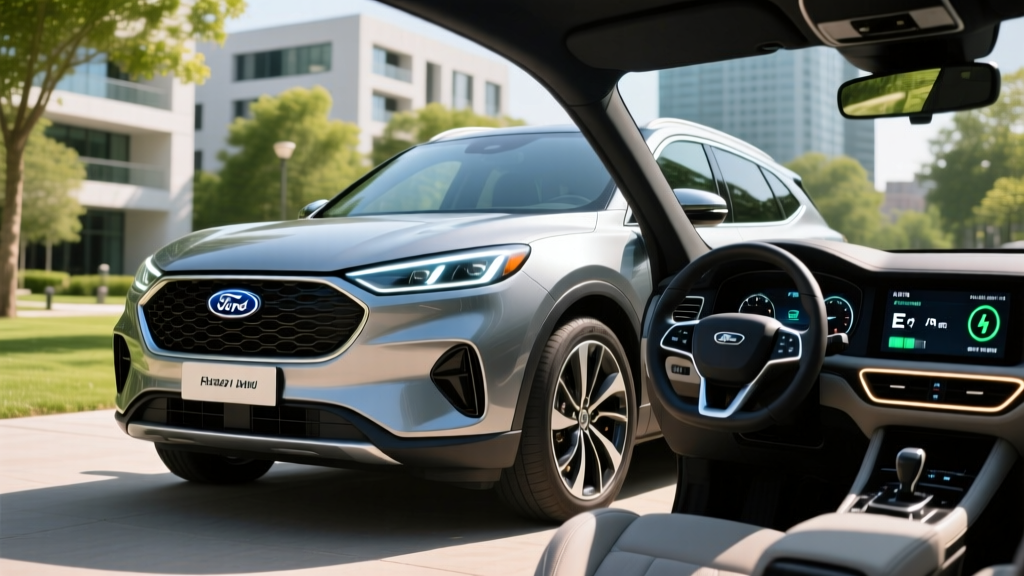
The compact hybrid SUV segment rewards efficiency and practicality over flash. The 2026 Ford Escape Hybrid sits squarely in that lane. Ford pairs a 1.5-liter Atkinson-cycle three-cylinder engine with a permanent-magnet electric motor and a 1.1 kWh lithium-ion battery pack to deliver an EPA-estimated 39 MPG combined in front-wheel-drive form. No plug required — this is a conventional hybrid (HEV), not a plug-in hybrid (PHEV). If you're searching for the "09 Escape Hybrid" because you remember Ford's early hybrid efforts, the 2026 model is a fundamentally different machine: lighter, more efficient, and built on Ford's current C2 platform rather than the original CD3 architecture that underpinned the 2009 Escape Hybrid.
This guide breaks down everything a buyer needs to evaluate the 2026 Escape Hybrid: real MPG data, the powertrain, what the battery warranty actually covers, whether any tax credits apply, and how it stacks up against going full EV or sticking with a gas-only compact SUV.
HEV vs PHEV: Which Escape Electrified Model Are You Looking At?
Ford sells the Escape in three powertrain configurations for 2026: a conventional gas-only EcoBoost, a conventional hybrid (HEV), and a plug-in hybrid (PHEV). The distinction matters enormously for your wallet and daily routine.
| Attribute | 2026 Escape Hybrid (HEV) | 2026 Escape Plug-In Hybrid (PHEV) |
|---|---|---|
| Powertrain | 2.5L 4-cyl Atkinson + electric motor | 2.5L 4-cyl Atkinson + larger electric motor |
| Combined Horsepower | 198 hp (FWD) / 210 hp (AWD) | 210 hp |
| Battery Capacity | ~1.1 kWh (self-charging) | 14.4 kWh usable |
| Electric-Only Range | Not applicable (motor assists engine) | 37 miles (EPA est.) |
| Plug-In Required? | No — regenerative braking recharges | Yes — Level 1 or Level 2 |
| DC Fast Charging | No | No (Level 2 max) |
| EPA Combined MPG / MPGe | 39 MPG (FWD) / 37 MPG (AWD) | 105 MPGe (electric) / 40 MPG (gas-only) |
| Federal Tax Credit (§30D) | Not eligible | Up to $3,750 (subject to sourcing rules) |
| Starting MSRP (2026) | ~$33,400 | ~$40,500 |
The rule of thumb: If you can charge at home and your commute is under 37 miles round-trip, the PHEV lets you drive almost entirely on electricity most days. If you lack home charging access or want simplicity, the conventional HEV is the right call — it never needs plugging in and still beats a gas-only Escape by roughly 10–12 MPG combined.
Fuel Economy: EPA Ratings and Real-World MPG
Ford's EPA-estimated fuel economy for the 2026 Escape Hybrid varies by drivetrain:
| Configuration | City MPG | Highway MPG | Combined MPG |
|---|---|---|---|
| FWD Hybrid (ST-Line / Active) | 42 | 36 | 39 |
| AWD Hybrid | 40 | 34 | 37 |
Source: EPA Fuel Economy
Real-World MPG: What to Actually Expect
Hybrids almost always outperform their EPA city rating in stop-and-go traffic because regenerative braking recovers energy that a gas car wastes as heat. On the flip side, highway driving is where hybrids lose their advantage — at sustained 70–80 mph speeds, the gasoline engine does nearly all the work and aerodynamic drag dominates.
Based on aggregated owner data and testing patterns for the current-generation Escape Hybrid platform:
- City-heavy driving (under 45 mph): Expect 41–45 MPG. Short trips with frequent stops maximize regen.
- Mixed suburban commuting: 37–40 MPG tracks closely with the EPA combined figure.
- Sustained highway at 75 mph: 33–35 MPG. The hybrid advantage shrinks significantly at speed.
- Cold weather (below 30°F): Subtract 3–5 MPG. The engine runs more often to provide cabin heat and reach operating temperature, reducing electric-motor assist time.
If the majority of your driving is city and suburban, the Escape Hybrid FWD is one of the most efficient compact SUVs you can buy without plugging in. If your commute is 90% interstate, the advantage over the 1.5L EcoBoost gas model narrows to roughly 4–5 MPG.
Powertrain and Performance Specs
| Specification | 2026 Escape Hybrid FWD | 2026 Escape Hybrid AWD |
|---|---|---|
| Engine | 2.5L Atkinson-cycle I-4 | 2.5L Atkinson-cycle I-4 |
| Electric Motor | Permanent-magnet synchronous (integrated in transaxle) | Permanent-magnet synchronous + rear axle motor |
| Combined System Output | 198 hp | 210 hp |
| Transmission | eCVT (planetary gearset) | eCVT (planetary gearset) |
| Battery | ~1.1 kWh lithium-ion | ~1.1 kWh lithium-ion |
| 0–60 mph (est.) | ~7.8 seconds | ~7.4 seconds |
| Towing Capacity | 1,500 lbs | 1,500 lbs |
| Cargo Volume (rear seats up) | 34.4 cu ft | 34.4 cu ft |
The Atkinson-cycle engine sacrifices peak power for thermal efficiency — it extracts more energy from each drop of fuel by keeping the intake valve open slightly longer during the compression stroke. The electric motor fills in the torque gap at low RPMs, which is why the Escape Hybrid feels surprisingly responsive from a stoplight despite the modest 198 hp figure. The eCVT is not a belt-and-pulley CVT; it's a planetary gearset that seamlessly blends engine and motor power. It's durable and avoids the "rubber-band" feel of traditional CVTs.
The AWD model adds a rear-axle electric motor rather than a mechanical driveshaft from the engine. This means AWD engagement is electric-only and instantaneous when the system detects slip, but the rear motor adds weight and slightly reduces fuel economy.
Battery Warranty, Lifespan, and Replacement Cost
Ford Hybrid Battery Warranty: 8 years / 100,000 miles (whichever comes first) in most states. In California Air Resources Board (CARB) states — including CA, CT, MA, ME, MD, NJ, NY, OR, RI, VT, WA — the warranty extends to 10 years / 150,000 miles under California emissions warranty requirements.
Capacity Threshold: Ford covers the hybrid battery if it falls below approximately 70% of original capacity during the warranty period, though exact thresholds are defined in the warranty guide.
How Long Do Escape Hybrid Batteries Actually Last?
The 1.1 kWh battery in the conventional Escape Hybrid is small and conservatively managed. Ford's battery management system keeps the state of charge in a narrow operating window — typically between 40% and 60% — which dramatically reduces degradation. Unlike a full EV that cycles through a wide SoC range daily, the Escape Hybrid battery experiences shallow cycles.
Real-world data from the current-generation platform (introduced for the 2020 model year) shows most hybrid batteries retaining 90%+ capacity well past 150,000 miles. Failures before 100,000 miles are uncommon based on owner forum reports and repair databases.
Battery Replacement Cost
If your hybrid battery does fail outside warranty, expect the following approximate costs:
- New OEM battery pack: $2,500–$4,000 (parts) + $500–$1,000 (labor)
- Remanufactured battery: $1,500–$2,500 (parts) + $500–$1,000 (labor)
- Individual module replacement: Some independent hybrid specialists can replace only the degraded cell modules for $800–$1,500 total
For context, a replacement is far less expensive than a full EV battery swap because the pack is small. The 1.1 kWh battery is roughly 1/60th the size of a typical EV battery.
Pricing, Trims, and Tax Credit Eligibility
The 2026 Ford Escape Hybrid is available across several trims:
- Active Hybrid (FWD): Starting ~$33,400 MSRP
- ST-Line Hybrid (FWD/AWD): Starting ~$35,000–$37,000 MSRP
- ST-Line Select Hybrid: Starting ~$38,500 MSRP
- Premium Hybrid (AWD): Starting ~$40,000+ MSRP
Federal Tax Credit: Does the Escape Hybrid Qualify?
The conventional Escape Hybrid (HEV) does not qualify for the federal §30D Clean Vehicle tax credit. Under current IRS rules, only plug-in electric vehicles (BEVs and PHEVs) with a battery capacity of at least 7 kWh are eligible. The HEV's 1.1 kWh battery falls well short of this threshold.
The Escape Plug-In Hybrid (PHEV) may qualify for a partial credit — up to $3,750 depending on battery sourcing and critical mineral requirements. However, the full $7,500 credit requires meeting both the critical minerals and battery component sourcing thresholds, and PHEVs with smaller batteries often qualify for the partial amount. Eligibility also depends on:
- Your modified adjusted gross income (under $150,000 single / $300,000 joint)
- Vehicle MSRP cap ($80,000 for SUVs — the Escape PHEV clears this easily)
- North American final assembly (the Escape is built in Louisville, KY)
- Battery component and critical mineral sourcing compliance
Always verify current-year eligibility on IRS.gov and consult a tax professional before relying on credit amounts for purchase decisions. Point-of-sale transfer is available for qualifying vehicles, reducing your upfront cost at the dealer.
Who Should Choose the Escape Hybrid vs. a Full EV or Gas Car?
Choose the Escape Hybrid (HEV) if:
- You don't have access to home or workplace charging
- Your driving is a mix of city and suburban with moderate highway use
- You want maximum fuel savings with zero behavior change — no plugging in, no range planning
- You drive 12,000–15,000 miles/year and want to save ~$600–$900 annually vs. the gas Escape at $3.50/gal
Choose the Escape PHEV if:
- You can install a Level 2 charger at home
- Your daily round-trip commute is under 37 miles
- You want near-EV daily driving with gas-engine flexibility for road trips
- You may qualify for the partial §30D tax credit
Choose a full EV (e.g., Ford Mustang Mach-E, Hyundai Ioniq 5) if:
- You have reliable home Level 2 charging
- You want zero tailpipe emissions and minimal maintenance (no oil changes, no engine)
- Your daily driving is under 250 miles and you're comfortable with road-trip DC fast charging
- You want to qualify for the full $7,500 §30D credit on eligible models
Stick with the gas-only Escape EcoBoost if:
- Your annual mileage is under 8,000 miles (the fuel savings won't offset the hybrid premium)
- You prioritize lowest purchase price above all else
Annual Fuel Cost Comparison
Assuming 15,000 miles/year and $3.50/gallon regular unleaded:
- Gas-only Escape (28 MPG combined): ~$1,875/year
- Escape Hybrid FWD (39 MPG combined): ~$1,346/year — saving ~$529/year
- Escape PHEV (mix of electric + gas): ~$800–$1,100/year depending on electric-vs-gas ratio
The hybrid's ~$2,000–$3,000 price premium over the gas model pays back in roughly 4–6 years at current fuel prices. If gas prices rise, the payback accelerates.
Pros and Cons at a Glance
Pros
- 42 MPG city is class-leading among compact hybrid SUVs
- No plug-in required — zero lifestyle change from a gas car
- Strong 8yr/100k-mile hybrid battery warranty (10yr/150k in CARB states)
- Responsive low-speed torque from electric motor assist
- Practical 34.4 cu ft cargo space with rear seats up
- Built in Louisville, KY — qualifies for domestic assembly requirements
Cons
- Highway MPG drops to 34–36 — less advantage over gas models on the interstate
- No DC fast charging (not applicable for HEV, but limits PHEV on road trips)
- AWD hybrid costs ~$1,500 more and sacrifices 2 MPG combined
- Not eligible for federal §30D tax credit (HEV model)
- eCVT engine drone under hard acceleration
- Towing limited to 1,500 lbs
Frequently Asked Questions
How many MPG does the 2026 Ford Escape Hybrid get?
The FWD Escape Hybrid achieves an EPA-estimated 42 city / 36 highway / 39 combined MPG. The AWD version is rated at 40 city / 34 highway / 37 combined. In real-world city driving, many owners report 41–45 MPG thanks to regenerative braking. Highway driving at 75 mph typically yields 33–35 MPG.
Does the Escape Hybrid need to be plugged in?
No. The conventional Escape Hybrid (HEV) charges its 1.1 kWh battery entirely through regenerative braking and engine-driven generation. You fuel it like any other gas car. Only the Escape Plug-In Hybrid (PHEV) requires plugging in to access its 37-mile electric-only range.
How far can the Escape PHEV go on electric only?
The 2026 Escape Plug-In Hybrid delivers an EPA-estimated 37 miles on electric power alone before the gasoline engine engages. Total combined range (electric + full gas tank) exceeds 500 miles. The 14.4 kWh battery charges in approximately 3.5 hours on a 240V Level 2 outlet, or about 10–12 hours on a standard 120V Level 1 outlet. The PHEV does not support DC fast charging.
Is the Escape Hybrid reliable?
Ford's hybrid powertrain in the current-generation Escape has demonstrated strong reliability since its 2020 launch. The 2.5L Atkinson-cycle engine is mechanically simple (no turbocharger, no high-pressure fuel system), and the eCVT planetary gearset has no belts or clutches to wear. The hybrid battery carries an 8-year/100,000-mile warranty (10yr/150k in CARB states). According to NHTSA complaint databases, hybrid-specific issues are infrequent. The most common complaints relate to infotainment software, not the powertrain.
What does a replacement hybrid battery cost?
Out-of-warranty replacement for the Escape Hybrid's 1.1 kWh battery runs approximately $3,000–$5,000 including labor for a new OEM pack. Remanufactured packs and individual module replacements can reduce that to $1,500–$2,500. Given the conservative state-of-charge management and small pack size, most batteries last well beyond the warranty period.
Does the 2026 Escape Hybrid qualify for a tax credit?
The conventional Escape Hybrid (HEV) does not qualify for the federal §30D Clean Vehicle tax credit — only plug-in vehicles with 7+ kWh batteries are eligible. The Escape PHEV may qualify for a partial credit of up to $3,750, subject to battery sourcing requirements and your income level. Check current eligibility at IRS.gov. Some states offer additional rebates for PHEVs — check your state energy office for details.
How does the 2026 Escape Hybrid compare to the 2009 Escape Hybrid?
The original 2009 Escape Hybrid used a 2.5L Atkinson four-cylinder with a nickel-metal hydride (NiMH) battery and achieved an EPA-rated 34 MPG combined. The 2026 model improves on that by 5 MPG combined, uses a lighter and more energy-dense lithium-ion battery, offers modern safety features (automatic emergency braking, lane-keeping, adaptive cruise), and provides significantly more cargo room. If you owned or admired the 09 Escape Hybrid, the current generation is a substantial evolution in every measurable metric.