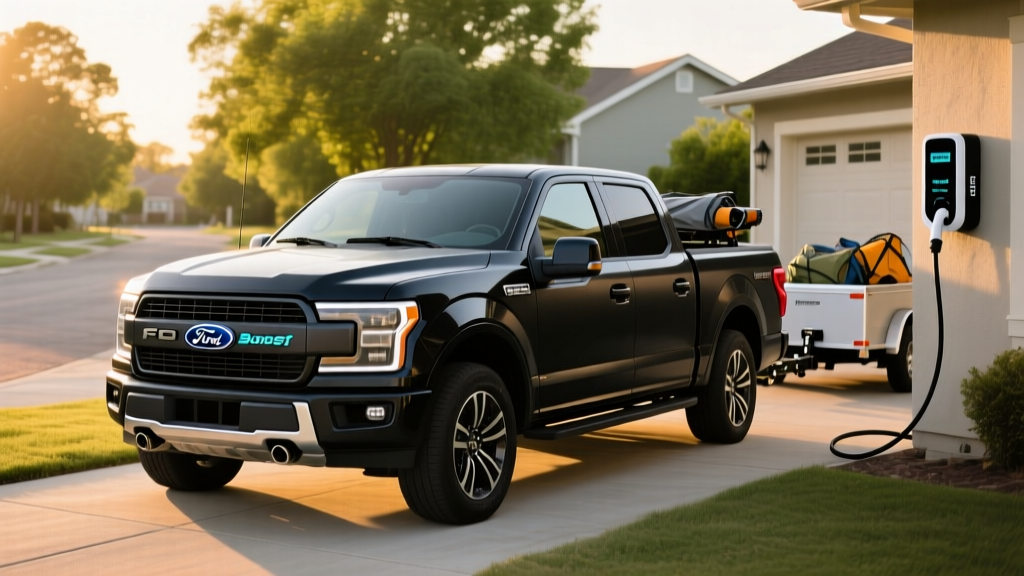
If you need a full-size pickup that can tow a trailer, haul a week's worth of lumber, and still return mid-20s fuel economy around town, Ford's PowerBoost hybrid V6 is one of the most practical powertrains on the market. The 2026 F-150 Hybrid carries forward the proven 3.5-liter twin-turbo V6 paired with an electric motor — no plug required, no range anxiety, and no compromise on capability.
Unlike a plug-in hybrid (PHEV) or a battery-electric truck, the F-150 PowerBoost is a conventional full hybrid (HEV). It charges its own small battery through regenerative braking and the engine, meaning you never need to plug it in. You just fill up with gas and drive. This guide breaks down the 2026 F-150 Hybrid's real-world MPG, powertrain specs, towing limits, pricing, and whether it makes more sense than a full EV or a gas-only truck for your situation.
HEV vs PHEV vs EV: Where the F-150 PowerBoost Fits
Before we get into the numbers, it's essential to understand what kind of hybrid the F-150 PowerBoost is — and what it isn't.
| Feature | F-150 PowerBoost (HEV) | Plug-In Hybrid (PHEV) | Battery Electric (BEV) |
|---|---|---|---|
| Needs to be plugged in? | No | Yes (for EV range) | Yes |
| Electric-only range | ~1-2 miles at low speed | 20-50 miles typical | 230-400+ miles |
| Fuel source | Gasoline + regen braking | Gasoline + grid electricity | Grid electricity only |
| Tailpipe emissions | Yes | Yes (when engine runs) | None |
| Home charging needed? | No | Recommended (Level 2) | Required (Level 2 ideal) |
| Federal §30D tax credit | No | Up to $7,500 (if eligible) | Up to $7,500 (if eligible) |
| Typical use case | Towing, fleet, no charger access | Short commutes + long road trips | Home charging access, daily driving |
The PowerBoost is a conventional hybrid. Its 1.5 kWh lithium-ion battery is tiny compared to a PHEV or EV — it exists to assist the gas engine during acceleration, capture energy during braking, and enable brief electric-only movement at very low speeds (think: creeping through a drive-through). You will never plug this truck in, and Ford doesn't expect you to.
2026 F-150 Hybrid Powertrain: Engine, Motor, and Horsepower
The PowerBoost powertrain pairs Ford's 3.5-liter EcoBoost twin-turbo V6 with a 35 kW (47 hp) electric motor integrated into the 10-speed automatic transmission. Here's what that produces:
| Specification | 2026 F-150 PowerBoost Hybrid |
|---|---|
| Engine | 3.5L twin-turbo V6 + 35 kW electric motor |
| Combined Horsepower | 430 hp |
| Combined Torque | 570 lb-ft |
| Transmission | 10-speed modular hybrid automatic |
| Drivetrain | RWD or 4WD |
| Hybrid Battery | 1.5 kWh lithium-ion (self-charging) |
| 0-60 mph | ~5.8 seconds (4WD) |
| Max Towing Capacity | Up to 7,000 lbs (properly equipped) |
| Max Payload | Up to 2,120 lbs |
The 430 hp and 570 lb-ft of torque put the PowerBoost ahead of Ford's 5.0L V8 in output, while delivering significantly better fuel economy. The electric motor fills in torque at low RPM before the turbos spool, which gives the truck a surprisingly responsive feel off the line — especially useful when merging onto highways with a load.
One of the PowerBoost's signature features is Pro Power Onboard, available in 2.0 kW and 7.2 kW configurations. The 7.2 kW version can power a job site's worth of tools, a camper's appliances, or serve as emergency home backup during an outage — all from the hybrid system's battery and engine. This is a genuine work-truck differentiator that neither the gas V8 nor competing electric trucks match as easily.
Fuel Economy: EPA MPG vs Real-World Results
Fuel economy is the primary reason buyers choose the PowerBoost over the 3.5L EcoBoost gas V6 or the 5.0L V8. Here's what the EPA rates it at, and what you can actually expect:
| Configuration | City MPG | Highway MPG | Combined MPG |
|---|---|---|---|
| F-150 PowerBoost 4x2 (EPA) | 25 | 26 | 25 |
| F-150 PowerBoost 4x4 (EPA) | 23 | 24 | 23 |
| F-150 PowerBoost 4x4 (real-world, mixed) | 21-24 MPG typical; 19-21 towing or heavy load | ||
Source: fueleconomy.gov
Real-world context: Conventional hybrids tend to exceed their EPA city estimates in stop-and-go traffic because regenerative braking recaptures more energy at low speeds. Many F-150 PowerBoost owners report 26-28 MPG in suburban and city driving without aggressive hypermiling. Highway driving is less impressive — at 75+ mph, aerodynamic drag dominates and the hybrid system provides minimal assistance. Expect highway MPG to land near or slightly below the EPA sticker.
Towing penalty: When towing a 5,000-7,000 lb trailer, fuel economy drops to approximately 12-15 MPG depending on terrain, wind, and speed. This is comparable to the gas-only 3.5L EcoBoost under similar loads. The hybrid advantage narrows significantly under heavy towing, but the PowerBoost still matches or slightly beats the V8.
Total Range: With the optional 30.6-gallon fuel tank and 23 MPG combined (4x4), the F-150 PowerBoost can travel approximately 700 miles between fill-ups. That's 100+ miles more range than the 5.0L V8 with the same tank, and roughly double the range of most electric pickups on a single charge.
Pricing, Trims, and Tax Credit Eligibility
The PowerBoost hybrid is available across multiple F-150 trims for 2026, though not on the base XL. Here's the pricing landscape:
| Trim (4x4, SuperCrew) | Starting MSRP (est.) | PowerBoost Availability |
|---|---|---|
| XLT | ~$58,000 | Optional (+$3,400 over 3.5L EcoBoost) |
| Lariat | ~$66,000 | Optional / Standard on select packages |
| King Ranch | ~$76,000 | Available |
| Platinum | ~$78,000 | Available |
Prices are estimated based on Ford's 2026 model-year announcements and may vary by dealer. Destination charges additional.
Does the F-150 Hybrid Qualify for a Federal Tax Credit?
No. The F-150 PowerBoost is a conventional hybrid (HEV), not a plug-in hybrid or battery-electric vehicle. It does not qualify for the IRS §30D Clean Vehicle Credit, which requires a minimum battery capacity of 7 kWh and plug-in charging capability. The PowerBoost's 1.5 kWh battery falls far short of this threshold.
For reference, the IRS §30D credit applies to new PHEVs and BEVs that meet battery sourcing, critical mineral, MSRP cap ($80,000 for trucks/vans/SUVs), and buyer income limits (AGI under $150,000 single / $300,000 joint). Full details are available at IRS.gov.
Some states offer their own incentives for conventional hybrids, but these are rare and typically modest. Check your state's energy office or DMV for current programs.
Battery Warranty, Reliability, and Replacement Cost
Hybrid battery longevity is the single most common concern among first-time hybrid buyers. Here's what Ford covers:
Ford Hybrid Battery Warranty: 8 years / 100,000 miles (whichever comes first). In California Air Resources Board (CARB) states — including CA, NY, MA, WA, and others — the warranty extends to 10 years / 150,000 miles for hybrid-specific components.
Powertrain Warranty: 5 years / 60,000 miles on the engine, transmission, and drivetrain.
The PowerBoost's 1.5 kWh battery is small and operates within a narrow state-of-charge window (Ford's software prevents deep discharge or full charge, which are the primary causes of lithium-ion degradation). This shallow-cycling strategy is the same approach Toyota has used for decades with its hybrid systems, and it's proven highly durable.
Replacement cost: If the hybrid battery does fail outside of warranty, Ford dealer replacement typically costs between $3,000 and $5,000 including labor. Third-party hybrid battery specialists may offer refurbished units for $1,500-$2,500. However, widespread failures of the PowerBoost battery have not been a significant pattern — the system has been in production since the 2021 model year with generally positive reliability feedback.
The 3.5L EcoBoost V6 itself is a well-established engine with years of production data. The addition of the electric motor and hybrid transmission has not introduced major new failure modes in fleet or consumer use. For the most current reliability data, check NHTSA.gov for any open recalls or technical service bulletins.
Who Should Choose the F-150 PowerBoost — And Who Shouldn't
The PowerBoost isn't the right choice for every truck buyer. Here's a practical decision framework:
Choose the F-150 PowerBoost Hybrid if:
- You drive a full-size truck daily and want to reduce fuel costs without changing your routine
- You don't have access to home or workplace charging (apartment, street parking, no garage)
- You tow regularly and need 600+ miles of range between fuel stops
- You want Pro Power Onboard for job-site or camping use
- You want more torque than the V8 with better fuel economy
Look at a full EV (F-150 Lightning, Silverado EV) if:
- You have reliable Level 2 home charging
- Your daily driving is under 250 miles and you rarely tow over 5,000 lbs
- You want the lowest per-mile fuel cost and zero tailpipe emissions
- You qualify for the §30D tax credit (up to $7,500)
Stick with the gas-only 3.5L EcoBoost or 5.0L V8 if:
- You need maximum towing (13,000-14,000 lbs with the 3.5L EcoBoost and Max Trailer Tow package)
- You want the lowest upfront purchase price
- You primarily drive highway miles where the hybrid advantage is minimal
A critical trade-off to understand: the PowerBoost's maximum towing capacity is 7,000 lbs — significantly less than the gas-only 3.5L EcoBoost, which can tow up to 14,000 lbs with the Max Trailer Tow package. If you regularly haul a large boat, horse trailer, or heavy equipment trailer, the hybrid is not the right configuration. But for a utility trailer, a small camper, or a pair of ATVs, 7,000 lbs is more than sufficient.
Pros
- 25 MPG combined (4x2) — best-in-class for a full-size truck
- 430 hp / 570 lb-ft — more torque than the 5.0L V8
- Pro Power Onboard up to 7.2 kW — job-site and emergency power
- ~700-mile total range with 30.6-gal tank
- No plug-in charging required — zero lifestyle change
- 8-year / 100,000-mile hybrid battery warranty
Cons
- Max towing limited to 7,000 lbs (gas EcoBoost tows 14,000)
- ~$3,400 premium over the 3.5L EcoBoost gas engine
- No federal tax credit eligibility
- Highway MPG advantage minimal at 75+ mph
- Not available on base XL trim
Frequently Asked Questions
How many MPG does the 2026 F-150 Hybrid get?
The EPA rates the 2026 F-150 PowerBoost 4x2 at 25 city / 26 highway / 25 combined MPG. The 4x4 version is rated at 23 city / 24 highway / 23 combined. In real-world suburban driving, many owners report 25-28 MPG. Highway-only driving at 75+ mph typically returns 21-23 MPG. Towing drops fuel economy to 12-15 MPG.
Does the F-150 Hybrid need to be plugged in?
No. The F-150 PowerBoost is a conventional full hybrid (HEV), not a plug-in hybrid. Its 1.5 kWh battery recharges through regenerative braking and the gas engine. You simply fill up at a gas station like any other truck.
How far can the F-150 Hybrid go on electric power alone?
The PowerBoost can move the truck under electric power alone for roughly 1-2 miles at very low speeds (under 25 mph). This is designed for parking-lot maneuvering and stop-and-go traffic creep, not for meaningful electric-only driving. If you want 20-40 miles of electric-only range, you need a plug-in hybrid — and Ford does not currently offer the F-150 as a PHEV in the US market.
Is the F-150 Hybrid reliable?
The PowerBoost system has been in production since 2021 with no widespread pattern of major failures. The 3.5L EcoBoost V6 is one of Ford's most produced engines, and the hybrid components (electric motor, battery) operate under conservative charge management that promotes longevity. Ford backs the hybrid battery with an 8-year / 100,000-mile warranty (10 years / 150,000 miles in CARB states).
What does it cost to replace the F-150 Hybrid battery?
Dealer replacement for the PowerBoost hybrid battery typically runs $3,000-$5,000 including labor. Independent hybrid specialists may offer refurbished units for $1,500-$2,500. However, given the shallow-cycling battery management and Ford's warranty coverage, out-of-pocket replacement within the first 150,000 miles is uncommon.
Does the 2026 F-150 Hybrid qualify for any tax credits?
No. The federal §30D Clean Vehicle Credit requires plug-in capability and a minimum 7 kWh battery. The PowerBoost's 1.5 kWh battery does not qualify. Some states may offer minor incentives for conventional hybrids, but these are uncommon. Check your state energy office for current programs.
How does the PowerBoost compare to the F-150 Lightning electric truck?
The Lightning offers 230-320 miles of EPA range, zero tailpipe emissions, ~$0.04-$0.06 per mile fuel cost (vs. ~$0.18 for the hybrid at $4/gal), and eligibility for the §30D tax credit. But the Lightning costs significantly more, requires home Level 2 charging, has less total range for long road trips, and its towing range drops sharply under heavy loads. The PowerBoost is the pragmatic choice for buyers who need maximum range, tow frequently, or lack charging access.