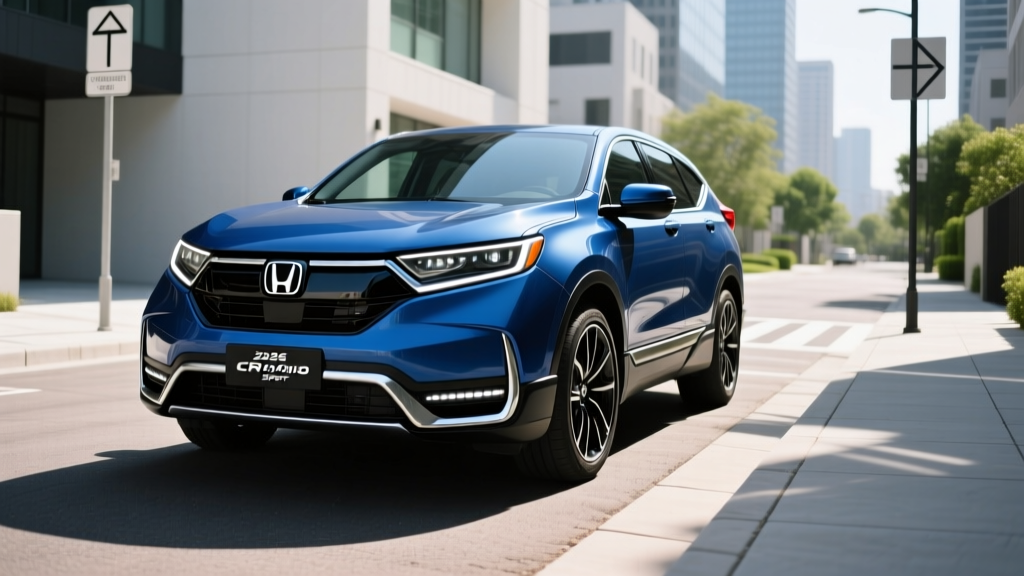
The 2026 Honda CR-V Hybrid Sport sits in a sweet spot that many compact SUV buyers are actively hunting for: genuine hybrid efficiency without the plug-in complexity or the price premium of a full electric vehicle. With the CR-V Hybrid lineup continuing to anchor Honda's electrified strategy, the Sport trim specifically targets buyers who want the sportier aesthetic, standard all-wheel drive, and fuel economy that makes a measurable dent in their annual fuel spend.
This guide breaks down exactly what the 2026 CR-V Hybrid Sport delivers in terms of EPA-rated MPG, powertrain engineering, real-world fuel economy, battery longevity, and whether any federal or state incentives apply. If you're cross-shopping against the Toyota RAV4 Hybrid, Hyundai Tucson Hybrid, or considering stepping up to a PHEV, the data below will help you decide.
HEV vs PHEV: Where the CR-V Hybrid Sport Fits
Before diving into specs, it's critical to understand what the 2026 CR-V Hybrid Sport is — and what it is not. This is a conventional hybrid electric vehicle (HEV), not a plug-in hybrid (PHEV). That distinction drives everything from how you fuel it to what incentives you can claim.
HEV vs PHEV — Key Differences
| Feature | HEV (CR-V Hybrid Sport) | PHEV (e.g., CR-V e:PHEV — not US-spec) |
|---|---|---|
| Plugs in to charge? | No — regenerative braking and engine charge the battery | Yes — Level 1/Level 2 charging |
| Electric-only range | ~1 mile at low speed | Typically 25–35 miles |
| Battery size | ~1.06 kWh (small buffer) | 17–18 kWh usable |
| Federal tax credit (§30D) | Not eligible | Up to $7,500 if criteria met |
| Fueling | Gas station only | Gas + electricity |
The CR-V Hybrid Sport captures energy that would otherwise be wasted during braking and deceleration, stores it in a compact lithium-ion battery, and uses that energy to assist the gasoline engine or propel the vehicle at very low speeds. You never plug it in. You simply drive it like any other gas car — it just uses substantially less fuel.
2026 CR-V Hybrid Sport Powertrain & Performance Specs
Honda's fourth-generation two-motor hybrid system powers the 2026 CR-V Hybrid Sport. This is a series-parallel architecture where the electric motors handle most low-speed driving, and the 2.0-liter Atkinson-cycle four-cylinder engine primarily acts as a generator — only directly driving the wheels at higher highway speeds through a lock-up clutch mechanism.
| Specification | Value |
|---|---|
| Engine | 2.0L DOHC Atkinson-cycle 4-cylinder |
| Combined system horsepower | 204 hp |
| Combined torque (lb-ft) | 247 lb-ft (electric motor peak) |
| Drivetrain | Standard AWD (real-time torque-vectoring rear axle) |
| Transmission | e-CVT (no traditional gears) |
| 0–60 mph (est.) | ~7.8 seconds |
| Towing capacity | 1,000 lbs |
| Hybrid battery chemistry | Lithium-ion |
| Base MSRP | ~$36,350 (incl. destination) |
The 247 lb-ft of torque from the electric motor is available from near-zero RPM, which gives the CR-V Hybrid Sport a punchy, responsive feel in city driving that belies its 204-hp combined output. This is one of the tangible benefits of hybrid architecture: the electric motor fills in the torque gap that a naturally aspirated four-cylinder engine would leave at low speeds.
EPA Fuel Economy: City, Highway, and Combined MPG
Fuel efficiency is the primary reason buyers choose the Hybrid Sport over the gas-only CR-V trims. Here's how the EPA rates it, per fueleconomy.gov:
| Cycle | EPA MPG |
|---|---|
| City | 40 MPG |
| Highway | 34 MPG |
| Combined | 37 MPG |
That 40 MPG city figure is the headline number, and it's where Honda's hybrid system truly excels. At low speeds, the electric motors do the heavy lifting while the engine runs only as needed to recharge the small battery buffer. In stop-and-go traffic, regenerative braking recovers energy that would otherwise be lost as heat in the brake pads.
Real-World MPG vs. EPA Estimates
Hybrids often exceed their EPA city ratings in real-world driving because the EPA city cycle includes moderate-speed segments that don't fully capture the efficiency advantage of electric-only operation in heavy congestion. Based on owner-reported data and independent testing patterns:
- City / suburban driving: Expect 38–43 MPG. Heavy stop-and-go traffic actually improves hybrid efficiency relative to gas cars.
- Highway (65–75 mph sustained): Expect 30–34 MPG. At highway speeds, the engine is doing most of the work and aerodynamic drag dominates. The hybrid advantage shrinks.
- Cold weather (below 30°F): Expect a 5–10% reduction, putting combined real-world around 33–35 MPG. The engine runs more frequently to provide cabin heat and maintain battery temperature.
- Mixed driving (annual average): Most owners report 35–39 MPG combined over thousands of miles, closely tracking the 37 MPG EPA combined figure.
Hybrid Battery Warranty, Lifespan & Replacement Cost
Battery longevity is consistently the top concern for hybrid buyers, and it deserves a direct, data-backed answer.
2026 CR-V Hybrid Battery Warranty
- Hybrid battery warranty: 8 years / 100,000 miles (10 years / 150,000 miles in CARB states including CA, NY, MA, WA, OR, and others)
- Capacity threshold: Honda warrants against failure and significant capacity loss that impairs hybrid system function
- Powertrain warranty: 5 years / 60,000 miles (covers engine, transmission, hybrid motor components)
How Long Do Honda Hybrid Batteries Actually Last?
Honda's hybrid battery packs are designed for the life of the vehicle. Real-world data from earlier-generation CR-V Hybrids and Accord Hybrids shows that the vast majority of lithium-ion hybrid battery packs last well beyond 150,000 miles without requiring replacement. The key reasons:
- Small depth of discharge: The ~1.06 kWh battery is never fully depleted or fully charged during normal operation. The system keeps the state of charge (SoC) in a narrow 40–80% window, which dramatically reduces cell stress.
- Active thermal management: Honda's hybrid system monitors battery temperature and adjusts charging/discharging rates to prevent overheating.
- Low cycle count: Unlike a full EV battery that cycles through large portions of its capacity daily, a hybrid battery experiences hundreds of micro-cycles rather than full charge-discharge events.
Battery Replacement Cost
If replacement is needed outside of warranty, a new OEM Honda CR-V hybrid battery pack typically costs between $2,000 and $4,000 installed at a dealership. Independent hybrid-specialty shops may offer refurbished packs for $1,500–$2,500. For context, this is a fraction of full EV battery replacement costs ($8,000–$20,000+), because the hybrid pack is physically much smaller.
Pricing, Trims & Tax Credit Eligibility
The 2026 CR-V Hybrid Sport is positioned as the entry point into the CR-V Hybrid lineup, with the Sport-L and Sport Touring trims stepping up in features and price.
| Trim | MSRP | Key Additions |
|---|---|---|
| Sport | ~$36,350 | AWD, 18" wheels, sport styling, 9" touchscreen |
| Sport-L | ~$39,350 | Leather seats, power liftgate, heated front seats |
| Sport Touring | ~$42,350 | Bose audio, wireless CarPlay/Android Auto, navigation, heated steering wheel |
Does the CR-V Hybrid Sport Qualify for a Federal Tax Credit?
No. The 2026 CR-V Hybrid Sport is a conventional hybrid (HEV), not a plug-in vehicle. The federal IRS §30D Clean Vehicle Credit applies only to plug-in electric vehicles (BEVs and PHEVs) that meet battery capacity, critical mineral sourcing, MSRP caps, and buyer income requirements. Conventional hybrids do not qualify for §30D.
However, consider these potential savings avenues:
- State-level hybrid incentives: Some states offer rebates or HOV lane access for hybrids — check your state's energy office or DMV for current programs.
- Insurance discounts: Several insurers offer hybrid/electrified vehicle discounts (typically 5–10%).
- Lower fuel and maintenance costs: Hybrid regenerative braking reduces brake pad wear, often extending pad life to 60,000–80,000+ miles.
CR-V Hybrid Sport vs. RAV4 Hybrid vs. Tucson Hybrid
The compact hybrid SUV segment is fiercely competitive. Here's how the CR-V Hybrid Sport stacks up against its two primary rivals on the metrics that matter most:
| Metric | Honda CR-V Hybrid Sport | Toyota RAV4 Hybrid XLE | Hyundai Tucson Hybrid SEL |
|---|---|---|---|
| Combined HP | 204 hp | 219 hp | 226 hp |
| EPA Combined MPG | 37 MPG | 39 MPG | 38 MPG |
| EPA City MPG | 40 MPG | 41 MPG | 38 MPG |
| Drivetrain | AWD standard | AWD standard | AWD standard |
| Cargo volume (behind 2nd row) | 36.3 cu ft | 37.6 cu ft | 38.7 cu ft |
| Base MSRP (AWD) | ~$36,350 | ~$34,500 | ~$34,250 |
| Hybrid battery warranty | 8 yr/100k mi | 10 yr/150k mi | 10 yr/100k mi |
The RAV4 Hybrid edges the CR-V on combined MPG and price, while the Tucson Hybrid offers the most power and cargo space. The CR-V Hybrid Sport's advantage lies in its driving refinement — Honda's e-CVT tuning delivers smoother, more linear acceleration with less of the engine "drone" that some drivers notice in Toyota's hybrid system under hard throttle. The interior materials and ride quality on the CR-V Sport also tend to rate higher in owner satisfaction surveys.
Who Should Choose the CR-V Hybrid Sport — and Who Shouldn't
Choose the CR-V Hybrid Sport if:
- You want 37+ MPG combined without changing your fueling habits (no plugging in)
- Your daily driving is mostly city/suburban where hybrid efficiency peaks
- You want AWD for snow/rain without a fuel-economy penalty
- You plan to own the vehicle 8+ years (well within battery warranty)
- You value driving refinement and interior quality over maximum cargo space
Consider alternatives if:
- You have home charging access and want 25+ miles of electric-only range (look at PHEVs like the RAV4 Prime or Tucson PHEV)
- You want full electric operation and zero gas use (consider a BEV like the Hyundai Ioniq 5 or Tesla Model Y)
- You need towing capacity above 1,000 lbs (the hybrid's 1,000-lb rating is limited)
- Budget is the top priority — the gas-only CR-V LX AWD starts ~$4,000 lower
- No charging access + want simplicity? → HEV (CR-V Hybrid Sport)
- Home charging + short commute + want gas backup? → PHEV (RAV4 Prime, Tucson PHEV)
- Home charging + want lowest running cost + no gas? → BEV (Model Y, Ioniq 5, EV6)
Frequently Asked Questions
How many MPG does the 2026 CR-V Hybrid Sport get?
The EPA rates it at 40 MPG city, 34 MPG highway, and 37 MPG combined with standard AWD. In real-world mixed driving, most owners report 35–39 MPG combined. City-heavy drivers may see 40+ MPG, while sustained highway driving at 75+ mph will drop efficiency to 30–33 MPG.
Does the CR-V Hybrid need to be plugged in?
No. The CR-V Hybrid Sport is a conventional hybrid (HEV). Its small lithium-ion battery is charged entirely by the gasoline engine and regenerative braking. You fuel it exclusively at gas stations — there is no plug, no charging cable, and no need for any electrical infrastructure.
Is the 2026 CR-V Hybrid Sport reliable?
Honda's hybrid powertrain has a strong reliability track record. The two-motor hybrid system has fewer moving parts than a conventional automatic transmission (no gear sets, torque converter, or clutch packs to wear). The hybrid battery carries an 8-year/100,000-mile warranty (10 years/150,000 miles in CARB states). Based on historical data from Honda's hybrid lineup, major powertrain issues are uncommon within the first 150,000+ miles.
What does a CR-V Hybrid battery replacement cost?
Outside of warranty, a new OEM hybrid battery pack typically costs $2,000–$4,000 installed. Refurbished packs from independent hybrid shops run $1,500–$2,500. However, most Honda hybrid batteries last the life of the vehicle (150,000+ miles) without needing replacement due to the system's conservative state-of-charge management.
Does the CR-V Hybrid Sport qualify for the $7,500 federal tax credit?
No. The IRS §30D Clean Vehicle Credit applies only to plug-in vehicles (BEVs and PHEVs) that meet battery capacity thresholds and other criteria. Conventional hybrids like the CR-V Hybrid Sport are not eligible for the federal credit. Check your state's energy office for any local hybrid incentives.
How does the CR-V Hybrid compare to a full EV for daily commuting?
A full EV (like the Tesla Model Y or Hyundai Ioniq 5) offers lower per-mile energy costs (typically $0.04–$0.06/mile vs. ~$0.09/mile for the CR-V Hybrid at $3.50/gallon) and zero tailpipe emissions. However, EVs require home or workplace charging access, cost more upfront, and involve longer refueling times on road trips. If you can charge at home and your commute is under 250 miles round-trip, a BEV will save more. If charging access is uncertain or you frequently take long road trips, the CR-V Hybrid Sport provides a strong efficiency gain with zero lifestyle changes.
What is the towing capacity of the 2026 CR-V Hybrid Sport?
The CR-V Hybrid Sport is rated to tow up to 1,000 lbs — sufficient for a small utility trailer or a couple of dirt bikes, but not enough for a boat or camper. If you need more towing capacity, the gas-only CR-V with the turbocharged 1.5L engine is rated for up to 1,500 lbs.
Sources: EPA fuel economy data via fueleconomy.gov; IRS §30D credit rules via irs.gov; Honda specification data via automobiles.honda.com. Pricing and specifications reflect 2026 model year information available at time of publication and are subject to change. Verify tax credit eligibility with a qualified tax professional.