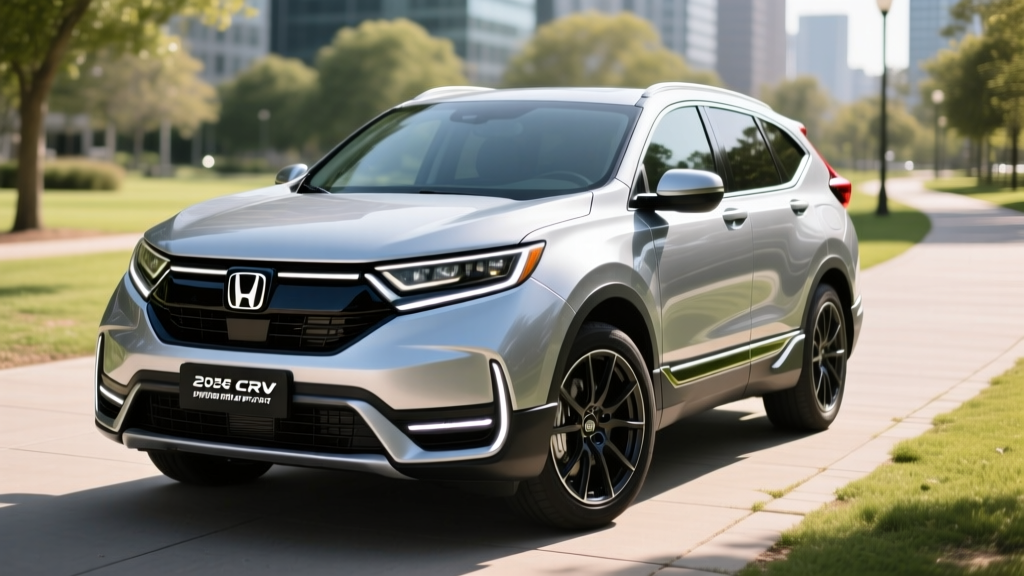
The 2026 Honda CR-V Hybrid Sport-L sits in the sweet spot of Honda's compact SUV lineup: it pairs a proven two-motor hybrid system with the Sport-L's upscale trim features, delivering strong fuel economy without the complexity (or price premium) of a plug-in hybrid. If you're cross-shopping this against a full EV or a conventional gas CR-V, this guide breaks down every number that matters — from EPA MPG to battery warranty — so you can decide with confidence.
Quick Verdict: Who the 2026 CR-V Hybrid Sport-L Is For
The 2026 CR-V Hybrid Sport-L is a conventional hybrid electric vehicle (HEV), not a plug-in hybrid (PHEV). That means it generates its own electricity through regenerative braking and its gasoline engine — you never plug it in. For buyers who want meaningful fuel savings without changing their fueling habits or installing home charging equipment, this is the right configuration.
Choose the CR-V Hybrid Sport-L if: You drive 12,000–15,000 miles per year in mixed city/highway conditions, lack reliable access to plug-in charging, and want a compact SUV that slashes fuel costs versus a gas-only model without the EV learning curve.
Look elsewhere if: You have home Level 2 charging and a short commute (a PHEV or full BEV may save more), or you need the CR-V's maximum towing capacity (the hybrid tows 1,000 lbs vs. 1,500 lbs for the gas turbo model).
Fuel Economy: EPA Numbers vs. Real-World MPG
The EPA rates the 2026 CR-V Hybrid Sport-L with front-wheel drive at 43 MPG city / 36 MPG highway / 40 MPG combined. The available all-wheel-drive (AWD) variant drops slightly to 40 MPG city / 34 MPG highway / 37 MPG combined, according to fueleconomy.gov.
| Drivetrain | City MPG | Highway MPG | Combined MPG |
|---|---|---|---|
| FWD | 43 | 36 | 40 |
| AWD | 40 | 34 | 37 |
Real-World MPG: What to Actually Expect
Honda's two-motor hybrid system excels in stop-and-go traffic, where the electric motors do most of the work at low speeds. In real-world city driving, owners frequently report matching or slightly exceeding the EPA city figure — 42–45 MPG is common on suburban errand runs with frequent stops.
Highway driving tells a different story. At sustained 70–80 mph speeds, the 2.0-liter Atkinson-cycle engine operates more directly, and real-world highway MPG typically lands between 32–35 MPG for the AWD model. Cold weather (below 35°F) can knock 3–5 MPG off combined figures due to increased engine runtime for cabin heat and reduced battery efficiency. On a 400-mile winter road trip at highway speeds, plan for roughly 33–35 MPG in the AWD Sport-L.
Powertrain Specs: Horsepower, Engine, and Motors
The 2026 CR-V Hybrid uses Honda's fourth-generation two-motor hybrid system. Here's the full breakdown:
| Engine | 2.0L DOHC Atkinson-cycle 4-cylinder |
| Engine Output | 145 hp @ 6,100 rpm / 134 lb-ft torque |
| Electric Motors | Two-motor system (drive + generator) |
| Drive Motor Output | 184 hp / 247 lb-ft torque |
| Combined System Output | 204 hp / 247 lb-ft torque |
| Transmission | Direct-drive (no conventional gearbox) |
| 0–60 mph (est.) | ~7.8 seconds |
| Towing Capacity | 1,000 lbs |
| Fuel Tank | 14.0 gallons |
| Total Range (est.) | ~518 miles (AWD combined) |
The two-motor system operates in three modes: EV Drive (battery-only at low speeds), Hybrid Drive (engine generates electricity for the drive motor), and Engine Drive (engine directly powers wheels at highway cruising speeds). The transitions are nearly imperceptible — a hallmark of Honda's hybrid tuning.
HEV vs. PHEV vs. Full EV: Which Powertrain Fits You?
A common question from CR-V shoppers: should you go hybrid, plug-in hybrid, or full electric? Honda currently offers the CR-V as a conventional hybrid (HEV) in the US market. The CR-V does not have a PHEV variant sold in the United States, though a PHEV version is available in other markets. Here's how the three powertrain types compare:
| Factor | HEV (CR-V Hybrid) | PHEV (e.g., Toyota RAV4 Prime) | BEV (e.g., Tesla Model Y) |
|---|---|---|---|
| Plug-in Required? | No | Yes (optional — runs on gas if not plugged in) | Yes (mandatory) |
| Electric-Only Range | ~1 mile at low speed | 25–42 miles typical | 250–330 miles typical |
| Home Charging Needed? | No | Recommended (120V or 240V) | Yes (240V Level 2 strongly recommended) |
| Combined Efficiency | 37–40 MPG | 38–40 MPG + 94+ MPGe on electric | 100–130 MPGe |
| Federal Tax Credit (§30D) | Not eligible | Up to $7,500 (if eligible) | Up to $7,500 (if eligible) |
| Maintenance | Standard (oil, filters) | Standard + battery system | Minimal (no oil, fewer fluids) |
The bottom line: The CR-V Hybrid Sport-L (HEV) is ideal if you want fuel savings with zero behavioral change. If you have home charging and a commute under 30 miles, a PHEV like the RAV4 Prime can cover most daily driving on electricity alone. A full BEV makes the most financial sense if you drive high annual miles, have reliable charging access, and want to minimize operating costs long-term.
Pricing, Trim Features, and Tax Credit Eligibility
The 2026 Honda CR-V Hybrid Sport-L carries an MSRP of approximately $38,350 (including destination charge) for the FWD model, with AWD adding roughly $1,500. The Sport-L trim sits above the Sport and below the Sport Touring, adding features like:
- Leather-trimmed seats and leather-wrapped steering wheel
- Wireless Apple CarPlay and Android Auto on a 9-inch touchscreen
- Wireless phone charger
- Power-adjustable front seats with heated front seats
- Power tailgate with hands-free access
- Honda Sensing suite (adaptive cruise, lane-keeping, collision mitigation)
Does the 2026 CR-V Hybrid Qualify for a Federal Tax Credit?
No. The federal §30D Clean Vehicle Credit applies only to plug-in electric vehicles (PHEVs and BEVs) with a minimum battery capacity of 7 kWh. Because the CR-V Hybrid is a conventional HEV with a small self-charging battery (approximately 1.1 kWh), it does not qualify for the federal EV tax credit. This is confirmed by the IRS guidelines on qualifying clean vehicles.
Some states may offer small incentives for hybrid purchases — check your state energy office or department of environmental quality for current programs. However, these are typically modest ($250–$500) compared to the §30D credit.
Battery Warranty, Reliability, and Replacement Costs
Hybrid battery longevity is the top concern for first-time hybrid buyers. Here's what Honda covers:
Honda Hybrid Battery Warranty: 8 years / 100,000 miles (10 years / 150,000 miles in CARB states including California, New York, Massachusetts, and others that follow California emissions standards). The warranty covers battery capacity below a defined threshold and defects.
Hybrid System Warranty: 8 years / 100,000 miles on hybrid-specific components including the electric motors, power control unit, and associated wiring.
How Long Do Honda Hybrid Batteries Actually Last?
Honda's lithium-ion hybrid battery packs are designed to last the life of the vehicle under normal use. Real-world data from Honda's hybrid lineup (Insight, Accord Hybrid, CR-V Hybrid) shows most original batteries lasting 150,000–200,000+ miles before needing replacement. The battery in an HEV is small (~1.1 kWh) and operates within a narrow state-of-charge window (roughly 40–60%), which dramatically reduces degradation compared to a full EV battery that cycles through a wider range.
Hybrid Battery Replacement Cost
If replacement is needed outside warranty, a Honda CR-V Hybrid battery pack costs approximately $2,000–$3,500 for the part, with labor adding $500–$800, for a total of roughly $2,500–$4,300. Third-party refurbished batteries are emerging at lower price points. Given that the battery is small and stress levels are low, unplanned replacement is uncommon within the first 15 years of ownership.
Overall Reliability
Honda's hybrid powertrain has an excellent reliability track record. The 2.0L Atkinson-cycle engine is understressed, the two-motor system has no traditional transmission to fail, and regenerative braking reduces wear on the friction brake pads (many hybrid owners report original brake pads lasting 80,000+ miles). The NHTSA vehicle page and IIHS ratings should be checked for the latest crash-test results as they become available for the 2026 model year.
5-Year Ownership Cost vs. Gas-Only CR-V
Does the hybrid premium pay for itself? Let's compare the 2026 CR-V Hybrid Sport-L (AWD, $39,850 MSRP) against the comparably equipped gas-only CR-V EX-L AWD (~$38,350 MSRP) over five years and 75,000 miles:
| Cost Factor | CR-V Hybrid Sport-L AWD | CR-V EX-L AWD (Gas) |
|---|---|---|
| Purchase Price (MSRP) | $39,850 | $38,350 |
| Fuel Cost (@ $3.40/gal, 75k mi) | $6,892 (37 MPG combined) | $8,947 (28 MPG combined) |
| Fuel Savings | Hybrid saves ~$2,055 over 5 years | |
| Maintenance (est.) | ~$2,800 | ~$3,200 |
| Insurance (est. avg.) | ~$7,500 | ~$7,200 |
| Estimated 5-Year Total | ~$57,042 | ~$57,697 |
The hybrid's fuel and maintenance savings roughly offset its higher purchase price within five years. Beyond year five, the hybrid pulls ahead — and you've been driving a more responsive, quieter SUV the entire time. The electric motor's 247 lb-ft of torque delivers strong off-the-line acceleration that the gas turbo model can't match at low speeds.
Pros and Cons
Pros
- 40 MPG combined (FWD) — class-leading for a non-plug-in compact SUV
- 204 hp combined with instant electric torque for confident merging
- No plug-in charging required — zero lifestyle change from a gas car
- Sport-L trim adds leather, wireless charging, and power tailgate at a reasonable price
- Honda Sensing ADAS suite is standard — no expensive package upgrades needed
- Excellent hybrid battery reliability with 8-year/100,000-mile warranty
- Regenerative braking extends friction brake life significantly
Cons
- No federal tax credit — HEVs don't qualify for §30D
- 1,000-lb towing capacity (vs. 1,500 lbs for the gas model)
- Highway MPG drops to 32–35 in real-world driving at 75+ mph
- No electric-only commuting capability (unlike a PHEV)
- Cargo space slightly reduced vs. gas model due to hybrid battery placement (~36.3 cu ft vs. ~39.3 cu ft behind rear seats)
- AWD model's combined 37 MPG is 3 MPG less than the FWD variant
Frequently Asked Questions
How many MPG does the 2026 CR-V Hybrid Sport-L get?
The EPA rates the FWD model at 43 city / 36 highway / 40 combined MPG. The AWD model is rated at 40 city / 34 highway / 37 combined MPG. Real-world city driving often matches or slightly exceeds the EPA figure, while sustained highway driving at 70+ mph typically yields 32–35 MPG in the AWD model.
Does the 2026 CR-V Hybrid need to be plugged in?
No. The CR-V Hybrid is a conventional hybrid (HEV). It charges its small battery through regenerative braking and the gasoline engine. You fuel it like any other gas car — there is no plug, no charging cable, and no electric-only range to manage.
How far can the CR-V Hybrid drive on electric power alone?
Less than one mile at very low speeds (under 25 mph). The hybrid system uses electric-only mode for initial acceleration from stops and low-speed maneuvering, but the gasoline engine engages quickly. If electric-only commuting is a priority, you need a PHEV or full BEV, not a conventional hybrid.
Is the CR-V Hybrid reliable? What does a battery replacement cost?
Honda's hybrid system has an excellent reliability record. The hybrid battery is warranted for 8 years/100,000 miles (10 years/150,000 miles in CARB states). Most Honda hybrid batteries last 150,000–200,000+ miles. If replacement is needed out of warranty, expect $2,500–$4,300 total (parts + labor).
Does the 2026 CR-V Hybrid qualify for any federal tax credit?
No. The federal §30D Clean Vehicle Credit requires a plug-in vehicle with at least 7 kWh of battery capacity. The CR-V Hybrid is a conventional HEV with approximately 1.1 kWh, so it does not qualify. Check with your state for any local hybrid incentives, though these are typically small.
How does the CR-V Hybrid compare to the Toyota RAV4 Hybrid?
The 2026 RAV4 Hybrid (AWD, 219 hp combined) is rated at 41 city / 38 highway / 40 combined MPG — slightly better highway efficiency than the CR-V Hybrid AWD. The RAV4 also offers a PHEV variant (RAV4 Prime, 42 miles electric-only range) that the CR-V lacks in the US. However, the CR-V Hybrid Sport-L offers a more premium interior at its trim level and Honda's strong safety-tech inclusion as standard. Both are top-tier choices; your preference may come down to styling, interior feel, and dealer experience.
What's the difference between the CR-V Hybrid Sport and Sport-L?
The Sport-L adds leather-trimmed seats, a leather-wrapped steering wheel, wireless phone charging, and a power tailgate over the base Sport trim. The hybrid powertrain, horsepower, and fuel economy are identical between the two. The Sport-L typically adds $1,500–$2,000 to the Sport's MSRP and is the better value for buyers who want leather without stepping up to the fully loaded Sport Touring.