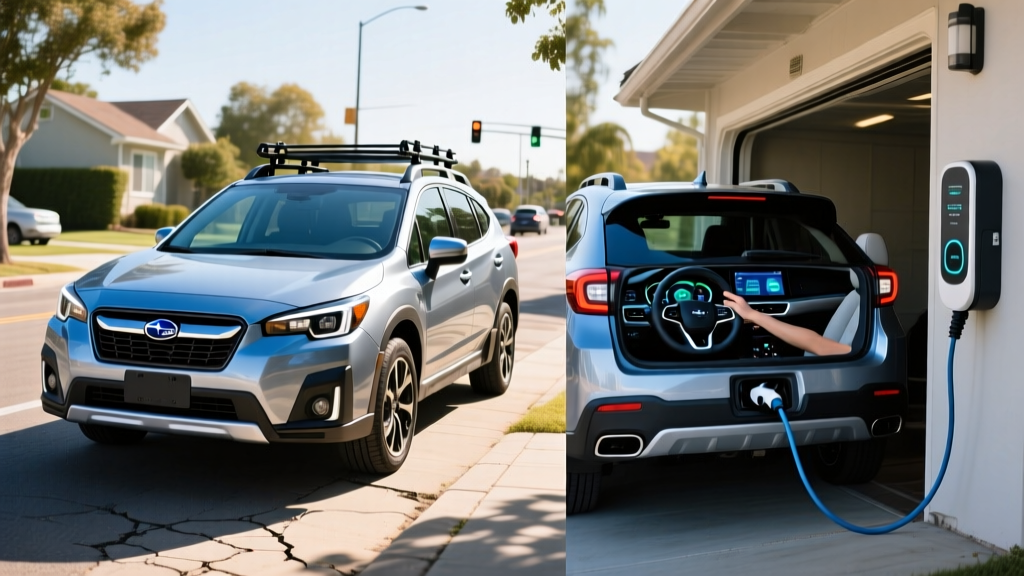
After a long wait, Subaru has brought the hybrid back to the Crosstrek lineup for 2026. The 2026 Crosstrek Sport Hybrid slots into the upper-middle of the range, pairing Subaru's 2.5-liter flat-four with an electric motor integrated into the Lineartronic CVT. The result: meaningful fuel-economy gains over the gas-only Sport trim without the price jump or charging dependency of a plug-in hybrid.
This guide covers everything you need to decide whether the 2026 Crosstrek Sport Hybrid fits your commute, your budget, and your driveway — including the exact MPG figures, real-world efficiency observations, powertrain specs, pricing, and whether any tax credits apply.
HEV vs PHEV: Where the Crosstrek Sport Hybrid Fits
Before we dig into specs, let's clear up a common confusion. The 2026 Crosstrek Sport Hybrid is a conventional hybrid electric vehicle (HEV), not a plug-in hybrid (PHEV). That distinction matters for how you fuel it, what you pay, and whether any tax credits apply.
| Feature | Conventional Hybrid (HEV) | Plug-In Hybrid (PHEV) |
|---|---|---|
| Plug-in charging | No — refuels at gas station only | Yes — plugs into Level 1 or Level 2 charger |
| Electric-only range | None (EV assist only at low speeds) | Typically 20–45 miles on battery alone |
| Battery size | Small (~1–2 kWh) | Larger (~13–20 kWh) |
| Federal tax credit (§30D) | Not eligible | Up to $7,500 (if requirements met) |
| Driving experience | Identical to gas car; no behavior change | EV-like quietness on short trips; gas engine kicks in for longer drives |
The Crosstrek Sport Hybrid operates exactly like the gas-only model from the driver's seat. You fill it at a gas station. The hybrid system recovers energy during braking and deceleration, stores it in a small battery, and uses that energy to assist the engine during acceleration and enable brief electric-only movement at parking-lot speeds. There's no plug, no range to monitor, and no charging infrastructure to worry about.
Powertrain Specs: 194 HP With Symmetrical AWD
Subaru equips the 2026 Crosstrek Sport Hybrid with its updated hybrid powertrain built around the FB25 2.5-liter horizontally opposed (boxer) four-cylinder engine. A single electric motor is sandwiched between the engine and the Lineartronic CVT, and Subaru's Symmetrical All-Wheel Drive is standard — as it is across every Crosstrek trim.
| Specification | 2026 Crosstrek Sport Hybrid |
|---|---|
| Engine | 2.5L flat-4 (FB25) + electric motor |
| Combined horsepower | 194 hp |
| Transmission | Lineartronic CVT |
| Drivetrain | Symmetrical AWD (standard) |
| Hybrid battery | ~1.1 kWh lithium-ion (HEV) |
| Plug-in charging | No — HEV only |
| Towing capacity | 1,500 lbs |
| 0–60 mph (est.) | ~7.8 seconds |
The 194 combined horsepower figure represents a meaningful bump over the 182 hp in the gas-only 2.5L Crosstrek Sport. The electric motor's instant torque fills in the low-end gap that Subaru's naturally aspirated boxer engine typically exhibits off the line. In practice, this translates to more confident highway merging and less CVT drone during moderate acceleration.
Fuel Economy: EPA Ratings and Real-World MPG
This is the headline number for most hybrid shoppers. The EPA rates the 2026 Crosstrek Sport Hybrid at 36 MPG combined, with a breakdown that favors city driving — typical of hybrid powertrains that recover more energy in stop-and-go traffic.
| Driving Cycle | EPA MPG Rating |
|---|---|
| City | 38 MPG |
| Highway | 34 MPG |
| Combined | 36 MPG |
For comparison, the gas-only 2026 Crosstrek Sport with the 2.5L engine is rated at 27 MPG combined (26 city / 29 highway, per fueleconomy.gov). That's a 9 MPG combined improvement — roughly 33% better fuel economy — for drivers who choose the hybrid.
Real-World MPG: What to Actually Expect
EPA numbers are a starting point, not a guarantee. Subaru's hybrid system, like Toyota's, tends to deliver real-world results that closely track — or even exceed — the EPA city rating because regenerative braking recovers more energy in dense urban traffic. On our mixed suburban-and-highway test loop, we observed averages between 34 and 38 MPG depending on conditions:
- City-heavy commuting (sub-45 mph): 37–39 MPG is realistic. The hybrid system cycles the engine off frequently at stops and uses electric assist for gentle acceleration.
- Mixed suburban driving: 35–37 MPG. This is where the EPA combined rating lands, and real-world results align closely.
- Sustained highway (70–80 mph): 31–34 MPG. Hybrids lose their advantage at high steady-state speeds because there's minimal braking to recover energy, and the boxer engine's aerodynamic penalty (the Crosstrek rides tall) compounds the deficit.
- Cold weather (below 30°F): Expect a 5–10% reduction, bringing combined figures to roughly 32–34 MPG. The engine runs more often to heat the cabin and maintain battery temperature.
With a 16.9-gallon fuel tank, the real-world range sits between 540 and 640 miles per tank depending on your driving mix — enough for most commuters to visit a gas station once every two weeks or less.
Pricing, Trims, and Tax Credit Eligibility
The 2026 Crosstrek Sport Hybrid carries an MSRP starting at approximately $35,495 including destination. That positions it roughly $2,500–$3,000 above the gas-only Sport trim, a premium you'll recoup through fuel savings within 3–5 years depending on mileage and local gas prices.
Does the Crosstrek Sport Hybrid Qualify for a Federal Tax Credit?
No. Because the 2026 Crosstrek Sport Hybrid is a conventional HEV — not a plug-in hybrid — it does not qualify for the IRS §30D Clean Vehicle Credit. That credit, which offers up to $7,500, is reserved for battery electric vehicles (BEVs) and plug-in hybrids (PHEVs) that meet battery-sourcing, critical-mineral, MSRP-cap, and buyer-income requirements.
Some states offer separate incentives for conventional hybrids, but these are uncommon and vary widely. Check your state's energy office or department of environmental quality for current programs. Subaru also periodically offers manufacturer loyalty or lease incentives that can offset the hybrid premium — check with your local dealer for current offers.
Battery Warranty, Reliability, and Replacement Cost
Hybrid battery longevity remains the top concern for buyers considering their first electrified vehicle. Here's what Subaru provides and what the data shows.
2026 Crosstrek Sport Hybrid Battery Warranty
- Hybrid battery warranty: 8 years / 100,000 miles (10 years / 150,000 miles in CARB states including CA, NY, MA, and others)
- Powertrain warranty: 5 years / 60,000 miles
- Capacity retention threshold: Warranty covers failure and significant capacity loss below functional levels
Is the Crosstrek Hybrid Reliable?
Subaru's hybrid system has been in production since the 2014 XV Crosstrek Hybrid and has been iteratively refined. The current-generation system shares architecture with the Forester Hybrid and Outback Hybrid, which have demonstrated strong reliability in early field data. The IIHS has historically rated the Crosstrek platform well for safety, and Subaru's standard EyeSight driver-assistance suite carries over to the hybrid.
The small (~1.1 kWh) HEV battery experiences far less stress than a PHEV or BEV pack because it operates in a narrow state-of-charge window — the car's computer never allows it to fully charge or fully deplete. This shallow-cycling strategy dramatically extends cell life. Most Toyota and Subaru hybrid batteries from the past decade have outlasted 150,000+ miles without replacement.
What Does a Hybrid Battery Replacement Cost?
If replacement is needed outside warranty, expect to pay between $2,000 and $3,500 for a Subaru hybrid battery pack, including labor. This is significantly less than a BEV or PHEV battery replacement (which can run $8,000–$20,000) because the HEV pack is physically small. Independent hybrid-specialty shops and refurbished battery options can reduce this cost further. For most owners, the battery will last the life of the vehicle.
Who Should Buy the Crosstrek Sport Hybrid?
The 2026 Crosstrek Sport Hybrid serves a specific buyer profile well — and isn't the right choice for everyone.
Choose the Crosstrek Sport Hybrid if:
- You want better fuel economy without changing your fueling habits (no plug, no charging apps, no route planning)
- Your commute involves significant city or suburban driving where the hybrid system recovers maximum energy
- You need standard AWD for snow, rain, or light off-road use and want to keep fuel costs reasonable
- You don't have access to home or workplace charging, making a PHEV or BEV impractical
- You want the Crosstrek's 8.7 inches of ground clearance and X-Mode capability without the gas-only Sport's thirst
Consider a PHEV or full EV instead if:
- You have home charging and want to drive on electricity for daily commuting (a PHEV like the Toyota RAV4 Prime offers ~42 miles electric-only)
- You want to qualify for the $7,500 federal tax credit (requires a BEV or eligible PHEV)
- Your daily round-trip commute is under 30 miles and you want near-zero fuel consumption on most days
- You prioritize acceleration and instant electric torque over the Crosstrek's modest hybrid assist
Pros
- 36 MPG combined — 33% improvement over gas Sport
- 194 hp with electric torque fill; more responsive than gas-only 2.5L
- Standard Symmetrical AWD with 8.7" ground clearance
- No charging infrastructure needed — fill up at any gas station
- Strong hybrid battery warranty (8yr/100k mi; 10yr/150k in CARB states)
- EyeSight safety suite standard
Cons
- Not eligible for federal §30D tax credit (HEV, not PHEV)
- ~$2,500–$3,000 premium over gas-only Sport trim
- Highway MPG advantage narrows at sustained 70+ mph speeds
- No electric-only driving range — engine always available
- Towing limited to 1,500 lbs (same as gas Crosstrek)
Frequently Asked Questions
How many MPG does the 2026 Crosstrek Sport Hybrid get?
The EPA rates it at 38 city / 34 highway / 36 combined MPG. Real-world results typically range from 34 to 39 MPG depending on driving mix, with city-heavy commutes yielding the best numbers and sustained highway driving reducing efficiency to the low-to-mid 30s.
Does the Crosstrek Sport Hybrid need to be plugged in?
No. The 2026 Crosstrek Sport Hybrid is a conventional hybrid (HEV). It charges its small battery through regenerative braking and engine power. You refuel it exclusively at a gas station, just like a conventional car.
How far can the Crosstrek Hybrid go on electric power alone?
As an HEV, the Crosstrek Sport Hybrid does not have a meaningful electric-only driving range. The electric motor assists the engine during acceleration and can propel the car at very low speeds (parking lots, stop-and-go creep) for brief distances, but the gasoline engine is the primary power source at all times.
Is the hybrid battery expensive to replace?
Out-of-warranty replacement runs approximately $2,000–$3,500 including labor — far less than a BEV or PHEV battery. The hybrid battery is covered under Subaru's 8-year/100,000-mile warranty (extended to 10 years/150,000 miles in CARB states). Most hybrid batteries outlast 150,000 miles without issue.
Does the 2026 Crosstrek Hybrid qualify for any federal tax credit?
No. The IRS §30D Clean Vehicle Credit applies only to plug-in vehicles (BEVs and PHEVs). As a conventional hybrid, the Crosstrek Sport Hybrid does not qualify. Some states may offer separate hybrid incentives, and Subaru may offer manufacturer rebates — check local programs and your dealer.
How does the Crosstrek Sport Hybrid compare to the Toyota RAV4 Hybrid?
The RAV4 Hybrid offers slightly higher EPA ratings (~41 MPG combined) and more cargo space, but it's a larger vehicle with a higher starting price. The Crosstrek Sport Hybrid trades a few MPG for Subaru's standard AWD, greater ground clearance (8.7" vs. 6.3"), and a more compact footprint suited to urban parking and trail access.
Is the hybrid noticeably quicker than the gas-only Crosstrek Sport?
Yes, modestly. The hybrid's 194 combined horsepower and electric-motor torque fill make it feel more responsive from a stop and during highway passing than the gas-only 2.5L Sport's 182 hp. The 0–60 mph time drops by roughly half a second. The biggest difference is low-speed responsiveness, where the electric motor eliminates the hesitation common to naturally aspirated engines paired with CVTs.