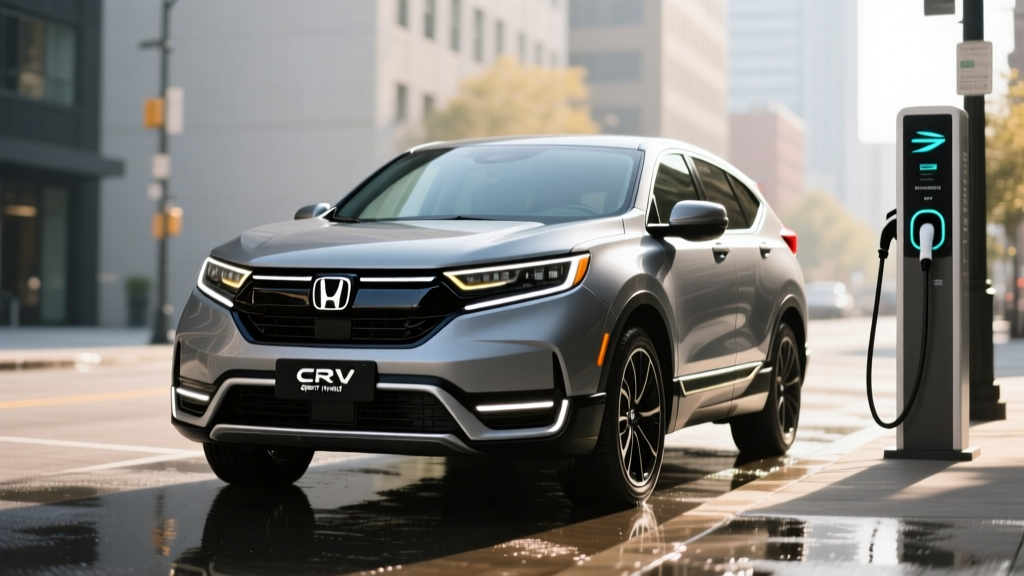
The Honda CR-V has been one of America's best-selling compact SUVs for over two decades, and its hybrid variant continues to be the volume leader in the lineup. The 2026 CR-V Sport Hybrid carries forward Honda's two-motor hybrid system with modest refinements, aiming squarely at buyers who want electric-motor efficiency without plugging in. This review breaks down the exact EPA fuel economy figures, real-world expectations, powertrain specs, pricing, and the ownership considerations that matter most to hybrid shoppers.
2026 CR-V Sport Hybrid: Key Specifications
| Specification | Value |
|---|---|
| Powertrain | 2.0L Atkinson-cycle 4-cyl + two-motor hybrid system |
| Combined Horsepower | 204 hp |
| Combined Torque | 247 lb-ft (electric motor peak) |
| Transmission | Direct-drive (e-CVT equivalent) |
| Drivetrain | FWD standard / AWD available (Sport Touring Hybrid) |
| EPA MPG (FWD) | 43 city / 36 highway / 40 combined |
| EPA MPG (AWD) | 40 city / 34 highway / 37 combined |
| Fuel Tank | 14.0 gallons |
| Estimated Total Range (FWD) | ~560 miles |
| 0–60 mph | ~7.8 seconds (est.) |
| Cargo Volume (behind rear seats) | 36.3 cu ft |
| Cargo Volume (rear seats folded) | 76.5 cu ft |
| Towing Capacity | 1,000 lbs |
| Hybrid Battery Warranty | 8 years / 100,000 miles |
| Base MSRP (Sport Hybrid FWD) | ~$35,350 |
EPA MPG vs. Real-World Fuel Economy
The EPA rates the 2026 CR-V Sport Hybrid at 43 city / 36 highway / 40 combined MPG in front-wheel-drive form. The AWD Sport Touring Hybrid drops slightly to 40/34/37. These numbers are competitive within the compact hybrid SUV segment, trailing the Toyota RAV4 Hybrid's 41 combined but outpacing it in city driving.
EPA Fuel Economy Breakdown
| Trim / Drivetrain | City | Highway | Combined | Est. Total Range |
|---|---|---|---|---|
| Sport Hybrid FWD | 43 MPG | 36 MPG | 40 MPG | ~560 mi |
| Sport Touring Hybrid AWD | 40 MPG | 34 MPG | 37 MPG | ~518 mi |
Real-world expectations: Honda's two-motor hybrid system excels in stop-and-go city driving, where the electric motor handles most low-speed propulsion and the gas engine acts primarily as a generator. In mixed suburban commuting, owners typically report 38–42 MPG, closely matching the EPA combined figure. Highway-only driving at 75+ mph tends to yield 33–35 MPG in FWD trims — the Atkinson-cycle 2.0L engine is less efficient under sustained high-speed load than in city conditions. In cold weather (below 35°F), expect a 5–8% reduction in fuel economy as the engine runs more frequently for cabin heat and battery conditioning.
Unlike plug-in hybrids or full EVs, the CR-V Sport Hybrid never needs to be plugged in. The 1.06 kWh lithium-ion hybrid battery recharges entirely through regenerative braking and engine-driven generation. You simply fill the 14.0-gallon tank with regular 87-octane gasoline and drive.
Hybrid (HEV) vs. Plug-In Hybrid (PHEV) vs. Full EV
A common source of confusion is the difference between conventional hybrids like the CR-V Sport Hybrid and plug-in alternatives. Here's how they compare in practical terms:
| Factor | Conventional Hybrid (HEV) | Plug-In Hybrid (PHEV) | Battery Electric (BEV) |
|---|---|---|---|
| Plugging in required? | No | Optional (but recommended) | Yes |
| Electric-only range | ~1 mile (low speed only) | 20–45 miles typical | 200–400+ miles |
| Battery size | ~1 kWh | 12–22 kWh | 60–100+ kWh |
| Fuel/energy cost per mile | ~$0.10–0.12 | ~$0.04 (electric) / ~$0.11 (gas) | ~$0.03–0.05 |
| Federal tax credit | Not eligible | Up to $7,500 (if qualified) | Up to $7,500 (if qualified) |
| Best for | No home charging access | Short commutes + road trips | Home charging + daily driving |
The 2026 CR-V is offered only as a conventional hybrid — Honda does not currently sell a CR-V plug-in hybrid in the United States. If you need electric-only commuting capability in a Honda, you would need to look at a different model or consider a competitor like the Toyota RAV4 Prime PHEV (42 miles electric-only) or the Hyundai Tucson PHEV (33 miles electric-only).
Who should choose the CR-V Sport Hybrid? Buyers who want significantly better fuel economy than a gas-only compact SUV (the gas CR-V rates at 29 combined MPG) but don't have access to home or workplace charging. If you can install a Level 2 charger at home and your daily commute is under 30 miles, a PHEV or full EV will deliver lower per-mile operating costs. If you take frequent road trips into areas with sparse charging infrastructure, the CR-V Hybrid's 560-mile total range and gas-station convenience are genuine advantages.
Powertrain and Driving Dynamics
Honda's fourth-generation two-motor hybrid system pairs a 2.0-liter Atkinson-cycle four-cylinder engine with two electric motors. The combined system output is 204 horsepower and 247 lb-ft of torque, with the electric motor providing its peak torque from 0 RPM — giving the CR-V Hybrid a responsive, punchy feel off the line that the gas-only model (190 hp) can't match.
The system operates in three modes:
- EV Drive: Battery powers the electric motor for low-speed cruising and light acceleration (limited range, typically under 1 mile)
- Hybrid Drive: Engine generates electricity that feeds the drive motor; battery supplements during hard acceleration
- Engine Drive: At highway cruising speeds, a lock-up clutch directly connects the engine to the front wheels for maximum efficiency
The transition between modes is nearly seamless — most drivers won't notice when the engine engages or disengages. Acceleration to 60 mph takes approximately 7.8 seconds, which is adequate for merging and passing but not sporty by any stretch. The "Sport" in the trim name refers to styling (blacked-out grille, 19-inch wheels, sport seats) rather than performance tuning.
AWD is available on the Sport Touring Hybrid trim, using a rear-mounted electric motor that provides up to 50% rear torque distribution when needed. This system is lighter and more responsive than a mechanical AWD system, and it doesn't significantly impact fuel economy.
Pricing, Trims, and Tax Credit Eligibility
The 2026 CR-V Hybrid is offered across multiple trims, with the Sport Hybrid sitting as the entry point to the hybrid lineup:
| Trim | Drivetrain | MSRP (est.) |
|---|---|---|
| Sport Hybrid | FWD | $35,350 |
| Sport Hybrid | AWD | $36,850 |
| Sport-L Hybrid | FWD / AWD | $37,850 / $39,350 |
| Sport Touring Hybrid | AWD (std) | $42,350 |
Federal Tax Credit: Not Eligible
The 2026 CR-V Sport Hybrid is a conventional hybrid (HEV), not a plug-in vehicle. Under IRS §30D rules, only plug-in electric vehicles (PHEVs and BEVs) with a battery capacity of at least 7 kWh qualify for the federal clean vehicle credit. The CR-V Hybrid's 1.06 kWh battery does not meet this threshold. No federal tax credit is available for this vehicle.
Some states and utilities offer rebates for conventional hybrids, but these vary by jurisdiction and are typically modest ($250–$500). Check your state's energy office or utility provider for current programs.
At roughly $35,350 to start, the CR-V Sport Hybrid carries approximately a $4,000 premium over the gas-only CR-V EX. Based on the fuel economy gap (40 vs. 29 combined MPG) and a national average gas price of ~$3.30/gallon, a driver covering 15,000 miles annually would save approximately $550–$650 per year in fuel costs. That premium pays for itself in roughly 6–7 years before factoring in the hybrid's potentially higher resale value.
Battery Warranty, Reliability, and Replacement Cost
Hybrid battery longevity is consistently the top concern among first-time hybrid buyers, and it's an area where Honda's track record is strong.
Hybrid Battery Warranty Coverage
- Duration: 8 years / 100,000 miles (whichever comes first)
- Extended in CARB states: 10 years / 150,000 miles in states that follow California emissions standards
- Coverage threshold: Battery capacity loss below approximately 60–70% of original capacity, or complete failure
- Additional powertrain warranty: 5 years / 60,000 miles on engine, transmission, and hybrid system components
Honda's hybrid system has proven durable in real-world use. The 1.06 kWh battery is small and operates within a narrow state-of-charge window (roughly 40–80%), which minimizes degradation stress. Unlike full EVs that cycle through deep charge/discharge ranges, the CR-V Hybrid's battery management system is conservative by design. Third-generation CR-V Hybrids (2020–2022 models) have shown minimal capacity loss even at high mileage, and there are no widespread reports of premature battery failures.
Replacement cost if out of warranty: A new hybrid battery pack for the CR-V runs approximately $2,000–$3,500 including labor at a Honda dealership. Independent hybrid specialists may offer refurbished packs for $1,200–$2,000. Given the conservative battery management and small pack size, most CR-V Hybrids will never need a battery replacement during typical ownership (8–12 years / 150,000–200,000 miles).
The broader powertrain — the 2.0L Atkinson-cycle engine, electric motors, and power control unit — is mechanically simpler than a conventional automatic transmission. There is no multi-speed gearbox, no torque converter, and no traditional starter motor to fail. Honda's hybrid components have been in production across multiple models (Accord Hybrid, Civic Hybrid) with strong reliability data.
Interior, Technology, and Practicality
The Sport Hybrid shares its interior with the rest of the CR-V lineup: a 7-inch touchscreen (9-inch on Sport Touring), wireless Apple CarPlay and Android Auto (on higher trims), a 10.2-inch digital instrument cluster, and Honda Sensing (adaptive cruise control, lane-keeping assist, automatic emergency braking, and road departure mitigation).
The hybrid battery pack is mounted under the cargo floor, which preserves the full 36.3 cu ft of rear cargo volume — identical to the gas CR-V. There is no cargo compromise for choosing the hybrid, and no frunk (the engine bay houses the 2.0L engine and power electronics).
One practical note: the CR-V Hybrid's 1,000-pound towing capacity is lower than some competitors (the RAV4 Hybrid tows up to 1,750 lbs). If you need to tow a small trailer or bike rack, verify your requirements before purchasing. For most buyers hauling cargo inside the vehicle rather than behind it, this is a non-issue.
Pros and Cons
Pros
- Strong city MPG (43) with responsive electric-motor torque
- No plugging in required — ideal for apartment/condo dwellers
- 560+ mile total range eliminates refueling stops on road trips
- Full cargo volume preserved (no battery intrusion)
- Proven hybrid system with 8-year/100,000-mile battery warranty
- Honda Sensing ADAS suite standard on all trims
Cons
- No federal tax credit (conventional hybrid)
- AWD adds ~$1,500 and reduces MPG to 37 combined
- Highway MPG (34–36) less impressive than city figures
- 1,000-lb towing capacity trails some competitors
- Sport trim is cosmetic only — no performance upgrade over other hybrid trims
- No plug-in hybrid option available in the CR-V lineup
Who Should Buy the 2026 CR-V Sport Hybrid?
Choose the CR-V Sport Hybrid if:
- You commute in stop-and-go city/suburban traffic and want maximum MPG without plugging in
- You live in an apartment or lack access to home/workplace charging
- You take frequent long road trips and don't want to plan around charging stations
- You want a mainstream compact SUV with strong resale value and dealer support
- Your daily driving is under 60 miles and you value simplicity over electric-only operation
Consider a PHEV or full EV instead if:
- You can install a Level 2 home charger and want to eliminate most gasoline use
- Your daily commute is under 35 miles round-trip (a PHEV covers this electric-only)
- You want access to the $7,500 federal tax credit (requires a qualified PHEV or BEV)
- You want the lowest possible per-mile operating cost (~$0.03–0.05/mi for EV vs. ~$0.11/mi for hybrid)
Frequently Asked Questions
How many MPG does the 2026 CR-V Sport Hybrid get?
The EPA rates the FWD Sport Hybrid at 43 city / 36 highway / 40 combined MPG. The AWD version drops to 40/34/37. In real-world mixed driving, expect 38–42 MPG. Highway-only driving at 75+ mph typically yields 33–35 MPG, and cold weather can reduce economy by 5–8%.
Does the CR-V Sport Hybrid need to be plugged in?
No. The CR-V Sport Hybrid is a conventional hybrid (HEV), not a plug-in. Its 1.06 kWh battery charges entirely through regenerative braking and the gasoline engine. You only ever need to fill the gas tank.
Is there a plug-in hybrid CR-V available?
Honda does not currently sell a CR-V plug-in hybrid (PHEV) in the United States. If you want a compact SUV PHEV with electric-only range, competitors include the Toyota RAV4 Prime (42 mi electric, 94 MPGe), Hyundai Tucson PHEV (33 mi electric), and Mitsubishi Outlander PHEV (38 mi electric).
Does the 2026 CR-V Hybrid qualify for a federal tax credit?
No. Under IRS §30D, only vehicles with a battery capacity of at least 7 kWh that can be plugged in qualify for the federal clean vehicle credit. The CR-V Hybrid's 1.06 kWh battery and lack of a plug make it ineligible. Only PHEVs and full BEVs qualify.
How long will the CR-V Hybrid battery last?
Honda covers the hybrid battery for 8 years / 100,000 miles (10 years / 150,000 miles in CARB states). In practice, Honda's conservative battery management — keeping the small pack within a narrow 40–80% state-of-charge window — means most batteries last well beyond the warranty period. Replacement cost, if needed out of warranty, is approximately $2,000–$3,500.
Is the CR-V Hybrid faster than the gas CR-V?
Slightly. The hybrid produces 204 hp combined (vs. 190 hp for the turbo gas model) and 247 lb-ft of electric motor torque available from 0 RPM, giving it a more responsive feel in city driving. The 0–60 mph time of ~7.8 seconds is marginally quicker than the gas model. However, the hybrid's advantage is responsiveness, not outright speed.
What is the difference between the Sport Hybrid and Sport Touring Hybrid?
The Sport Hybrid is the base hybrid trim with FWD standard, 19-inch wheels, and a 7-inch touchscreen. The Sport Touring Hybrid adds standard AWD, a 9-inch touchscreen with wireless CarPlay/Android Auto, heated rear seats, a Bose premium audio system, wireless phone charging, and a hands-free power tailgate. The Sport Touring is approximately $7,000 more than the Sport Hybrid FWD.
How does the CR-V Hybrid compare to the RAV4 Hybrid?
The Toyota RAV4 Hybrid rates at 41 combined MPG (all trims AWD) vs. the CR-V Hybrid's 40 combined (FWD) or 37 (AWD). The RAV4 Hybrid offers more towing capacity (1,750 lbs vs. 1,000 lbs) and standard AWD, but the CR-V Hybrid delivers more cargo space (36.3 vs. 37.5 cu ft — comparable) and a more refined interior. Both are strong choices; the decision often comes down to brand preference and dealer experience.