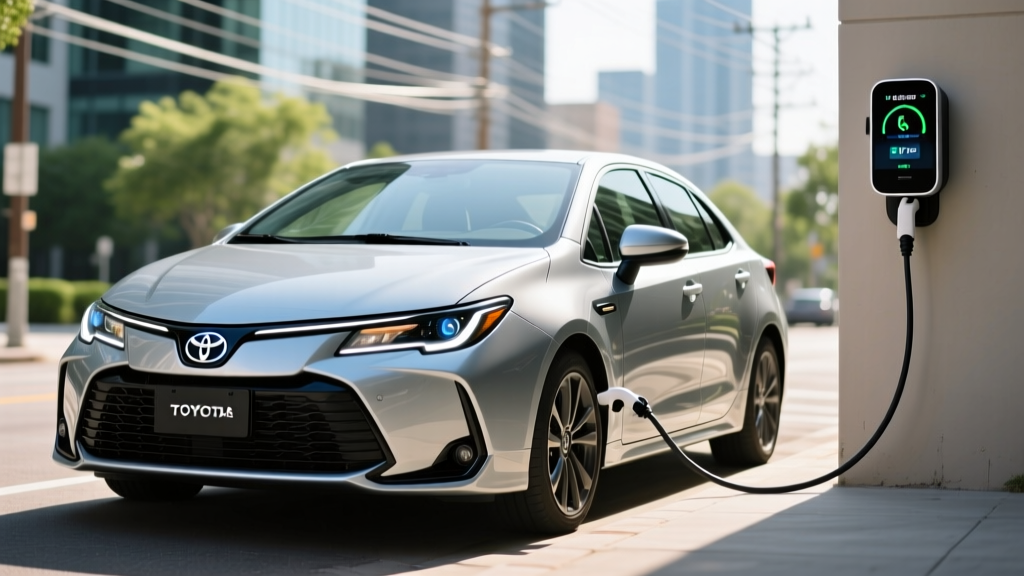
The 2026 Toyota Corolla Hybrid XLE sits at a crossroads many buyers face: you want to cut fuel costs dramatically, but you're not ready to plug in. As the top-trim conventional hybrid in Toyota's best-selling compact lineup, the XLE adds premium touches—SofTex seating, a 12.3-inch infotainment display, wireless phone charging, and Toyota Safety Sense 3.0—on top of a powertrain that sips fuel at a rate most plug-in vehicles can only dream of matching on a per-mile basis.
This guide breaks down the exact specs, real-world MPG behavior, battery longevity data, and ownership math for the 2026 Corolla Hybrid XLE so you can decide whether this HEV, a plug-in hybrid, or a full battery-electric vehicle fits your life.
2026 Corolla Hybrid XLE: Core Specifications at a Glance
| Attribute | 2026 Corolla Hybrid XLE |
|---|---|
| Powertrain Type | Conventional Hybrid (HEV) — no plug required |
| Engine | 1.8L 4-cylinder Atkinson-cycle + 2 electric motor-generators |
| Combined System Horsepower | 138 hp |
| Drivetrain | FWD standard (AWD-e available on LE; XLE is FWD) |
| EPA MPG (City / Highway / Combined) | 53 / 46 / 50 |
| Fuel Tank Capacity | 11.4 gallons |
| Total Driving Range | ~570 miles |
| 0–60 mph (est.) | ~9.2 seconds |
| Hybrid Battery | ~0.9 kWh lithium-ion (sealed, self-charging) |
| Starting MSRP (XLE trim) | ~$28,400 (before destination) |
| Federal Tax Credit | Not eligible (§30D requires plug-in capability) |
| Hybrid Battery Warranty | 10 years / 150,000 miles |
Fuel Economy: EPA Ratings vs. Real-World MPG
The EPA rates the 2026 Corolla Hybrid XLE at 53 mpg city, 46 mpg highway, and 50 mpg combined, according to fueleconomy.gov. These figures apply to the FWD XLE with its 16-inch alloy wheels; stepping to larger wheels on sportier trims drops ratings by 1–2 mpg.
| Driving Scenario | EPA Rating | Real-World Expectation |
|---|---|---|
| City / Stop-and-Go | 53 mpg | 50–58 mpg (regenerative braking excels here) |
| Highway (70 mph cruise) | 46 mpg | 42–47 mpg (aerodynamic drag, less regen benefit) |
| Combined (mixed driving) | 50 mpg | 46–54 mpg depending on route composition |
| Cold Weather (below 30°F) | — | 38–44 mpg (engine runs more for cabin heat) |
Toyota's hybrid synergy drive system recovers kinetic energy during deceleration and uses the electric motor for low-speed propulsion, which is why the Corolla Hybrid actually exceeds its EPA city rating in heavy traffic. On suburban commutes with frequent stops, owners consistently report 55+ mpg. Highway-only road trips are where the system loses its advantage—the gasoline engine shoulders nearly the entire load at sustained speed, and the Atkinson-cycle 1.8L prioritizes efficiency over power.
In cold weather, expect a 10–15% fuel-economy hit. The engine must run more frequently to heat the cabin and bring the catalytic converter up to operating temperature. A block heater or garage parking mitigates some of this loss.
HEV vs. PHEV vs. BEV: Which Electrified Powertrain Fits You?
The Corolla Hybrid is a conventional hybrid electric vehicle (HEV). It has a small battery that charges exclusively through regenerative braking and the gasoline engine. There is no plug, no electric-only driving range to speak of (the motor assists at low speeds for brief moments), and no dependency on charging infrastructure.
| Factor | HEV (Corolla Hybrid) | PHEV (e.g., Prius Prime) | BEV (e.g., Tesla Model 3) |
|---|---|---|---|
| Plug Required? | No | Yes (optional but recommended) | Yes (mandatory) |
| Electric-Only Range | ~0 miles (motor assist only) | 35–44 miles typical | 250–350+ miles |
| Total Range | ~570 miles | ~400–440 miles combined | 250–350+ miles |
| Fuel Cost Per Mile | ~$0.07 (at $3.50/gal) | ~$0.04 electric / $0.07 gas | ~$0.03–0.05 (home charging) |
| Home Charging Needed? | No | Recommended for EV range | Essential |
| Federal Tax Credit (§30D) | Not eligible | Up to $7,500 (if eligible) | Up to $7,500 (if eligible) |
| Best For | Apartment dwellers, high-mileage commuters, no charger access | Home chargers with short commutes + road trip flexibility | Home charging access, daily commutes under 300 mi |
Choose the Corolla Hybrid (HEV) if: You lack reliable access to a Level 2 home charger, you drive 40+ miles daily in mixed or city conditions, you want the lowest possible fuel bill without altering your refueling habits, or you live in an apartment or street-parking situation where plugging in is impractical.
Consider a PHEV instead if: You can install a home charger, your daily commute is under 40 miles (covering it entirely on electricity), and you still want gas-engine flexibility for longer road trips.
Consider a BEV if: You have dependable home or workplace charging, your daily driving stays within the vehicle's range, and you want to eliminate gasoline entirely while capturing the full $7,500 federal tax credit (subject to eligibility).
Powertrain Deep Dive: 138 HP and the 5th-Gen Hybrid System
The 2026 Corolla Hybrid uses Toyota's fifth-generation hybrid synergy drive. A 1.8-liter Atkinson-cycle four-cylinder engine produces roughly 96 hp on its own, supplemented by two motor-generators (MG1 and MG2) routed through a planetary gearset that functions as an electronically controlled continuously variable transmission (eCVT). Combined system output is 138 horsepower.
The lithium-ion hybrid battery pack holds approximately 0.9 kWh of usable energy. This is not a traction battery designed for electric-only propulsion—it's a buffer that captures regenerative braking energy and provides torque-fill during acceleration. The electric motor can move the car at very low speeds (parking lots, creeping traffic) for short distances, but the gasoline engine engages within seconds under any meaningful throttle input.
Acceleration to 60 mph takes approximately 9.2 seconds. That's adequate for merging and passing but won't feel quick. The eCVT eliminates shift shock and keeps the engine in its most efficient RPM range, though it produces the characteristic "motorboat" drone under hard acceleration that Toyota has worked to dampen with sound insulation in the XLE trim.
Hybrid Battery Longevity: Warranty, Degradation, and Replacement Cost
Toyota Hybrid Battery Warranty: 10 years or 150,000 miles (whichever comes first), covering defects and capacity loss below a defined threshold. This applies to all 50 states. California and states adopting CARB standards may see extended emissions-related coverage.
Toyota's hybrid battery track record is among the best in the industry. Data from fleet operators and long-term owners shows that Toyota hybrid batteries routinely last 150,000–200,000+ miles before meaningful degradation. The Prius, which shares similar hybrid architecture, has demonstrated less than 10% capacity loss over 150,000 miles in multiple independent studies.
The Corolla Hybrid's smaller lithium-ion pack undergoes shallower charge-discharge cycles than a PHEV or BEV battery because the system never fully depletes or fully charges it—the onboard computer maintains a state-of-charge window between roughly 40% and 80% to maximize cycle life. This buffer management strategy is why Toyota hybrid batteries outlast their warranty periods with regularity.
Replacement cost if out of warranty: A new OEM hybrid battery pack for the Corolla Hybrid runs approximately $2,000–$3,500 installed at a dealership. Independent hybrid specialists often offer refurbished packs for $1,000–$2,000. Given the battery's demonstrated longevity, most original owners will never face this expense—and if you buy a used Corolla Hybrid, the 10-year/150,000-mile warranty provides substantial remaining coverage on vehicles under those thresholds.
Pricing, Trims, and Tax Credit Reality
The 2026 Toyota Corolla Hybrid XLE starts at approximately $28,400 (before the $1,095 destination charge). Key XLE-standard features include:
- 12.3-inch Toyota Audio Multimedia touchscreen with wireless Apple CarPlay and Android Auto
- SofTex synthetic leather seating surfaces
- Heated front seats
- Wireless Qi phone charging pad
- Smart Key with push-button start
- Toyota Safety Sense 3.0 (pre-collision, lane departure, adaptive cruise, road sign assist)
- 16-inch alloy wheels
- Automatic climate control
Adding options like a premium JBL audio system, head-up display, or advanced parking assist can push the as-tested price to $31,000–$33,000.
Federal Tax Credit Status: The Corolla Hybrid does not qualify for the IRS §30D Clean Vehicle Credit. That credit applies exclusively to plug-in electric vehicles (BEVs and PHEVs) with a minimum battery capacity of 7 kWh. Because the Corolla Hybrid's battery is under 1 kWh and the vehicle cannot be plugged in, it is ineligible regardless of buyer income or MSRP. Some states and municipalities offer their own hybrid incentives—check your local energy provider or state environmental agency for current programs. See IRS §30D guidelines for plug-in vehicle credit rules.
5-Year Ownership Cost Snapshot
| Cost Factor | Corolla Hybrid XLE (5 yr / 75,000 mi) | Gas-Only Compact (5 yr / 75,000 mi) |
|---|---|---|
| Purchase Price (MSRP) | $28,400 | $25,000 |
| Fuel Cost (at $3.50/gal, 50 vs 30 mpg) | $5,250 | $8,750 |
| Maintenance (oil, filters, brakes) | $2,200 (less brake wear from regen) | $3,200 |
| Insurance (est. average) | $6,500 | $6,200 |
| Estimated Depreciation | $11,000 | $12,500 |
| Total 5-Year Cost | ~$53,350 | ~$55,650 |
The Corolla Hybrid's $3,400 fuel savings over five years largely offsets its higher purchase price versus a gas-only compact. Regenerative braking also reduces brake pad wear—many Toyota hybrid owners report original brake pads lasting 80,000+ miles. Toyota's hybrid components carry strong resale value, with IIHS safety ratings and long-term reliability data supporting lower depreciation.
Pros and Cons: The Honest Assessment
Pros
- 50+ mpg combined in real-world mixed driving; often exceeds EPA in city traffic
- No charging infrastructure required—refuel at any gas station in 3 minutes
- 570-mile total range eliminates range anxiety entirely
- 10-year/150,000-mile hybrid battery warranty with proven longevity
- XLE trim delivers premium features at a mainstream price point
- Toyota Safety Sense 3.0 standard across all trims
- Low maintenance costs (regenerative braking saves pads; no turbo complexity)
Cons
- No federal tax credit eligibility (unlike PHEVs and BEVs)
- 138 hp feels modest during highway passing maneuvers
- eCVT drone under hard acceleration remains noticeable
- XLE limited to FWD (AWD-e only available on lower LE trim)
- Trunk space slightly reduced vs. gas Corolla (~13.1 cu ft due to battery placement)
- Higher base price than gas-only Corolla LE (~$4,000 premium)
Frequently Asked Questions
How many MPG does the 2026 Corolla Hybrid XLE get?
The EPA rates it at 53 mpg city, 46 mpg highway, and 50 mpg combined. In real-world city and suburban driving with frequent stops, owners regularly see 52–58 mpg. Highway-only trips at 70+ mph typically yield 42–47 mpg. Cold weather can reduce combined economy to the high 30s or low 40s.
Does the Corolla Hybrid need to be plugged in?
No. The Corolla Hybrid is a conventional HEV. Its small lithium-ion battery charges entirely through regenerative braking and the gasoline engine. You never plug it in—just fill up at a gas station as you would with any conventional car.
Is the Corolla Hybrid reliable, and what does battery replacement cost?
Toyota's hybrid system has over 25 years of proven reliability since the original Prius in 1997. The hybrid battery is warranted for 10 years/150,000 miles, and real-world data shows most Toyota hybrid batteries last well beyond that. If replacement is needed out of warranty, expect $2,000–$3,500 for a new OEM pack, or $1,000–$2,000 for a refurbished unit from an independent specialist.
Does the 2026 Corolla Hybrid qualify for any tax credit?
It does not qualify for the federal §30D Clean Vehicle Credit, which requires plug-in capability and a minimum 7 kWh battery. Some states, utilities, or local governments offer separate hybrid incentives or rebates—check your state's energy office or the DOE's Alternative Fuels Data Center for current programs in your area.
Hybrid vs. PHEV vs. EV: which should I choose?
If you cannot charge at home (apartment living, street parking, no garage outlet), the Corolla Hybrid (HEV) is your best electrified option—you get 50 mpg with zero lifestyle changes. If you can charge at home and commute under 40 miles, a PHEV like the Prius Prime lets you drive on electricity daily while keeping gas for road trips. If you have reliable home charging and want maximum fuel savings plus the $7,500 tax credit, a BEV makes sense—provided its range covers your needs.
Is the XLE trim worth it over the Corolla Hybrid LE?
The XLE adds approximately $3,500 over the LE and includes SofTex seats, heated front seats, a larger 12.3-inch screen, wireless charging, and Smart Key. If you value comfort features and plan to keep the car 5+ years, the XLE's amenities justify the premium. If your priority is pure fuel-economy value, the LE delivers identical MPG at a lower price.