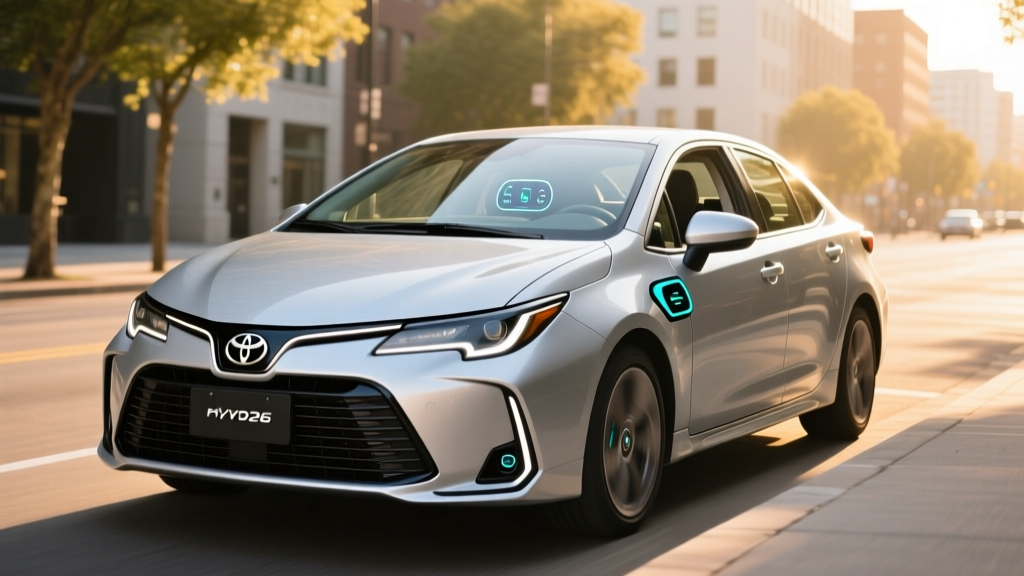
The Toyota Corolla Hybrid has quietly become one of the most compelling arguments for electrification without the plug. For 2026, Toyota continues the formula that has made this sedan a staple among efficiency-minded buyers: a proven fifth-generation hybrid powertrain, available electronic all-wheel drive, and a starting price that undercuts most rivals. If you are researching the 2026 Corolla Hybrid, this guide covers every number that matters — from EPA MPG to battery warranty — so you can decide whether this HEV belongs in your driveway.
2026 Corolla Hybrid: Quick Verdict
The 2026 Corolla Hybrid is a conventional hybrid electric vehicle (HEV), not a plug-in. It charges its own small battery through regenerative braking and the gasoline engine. You never plug it in. The payoff is exceptional fuel economy — up to 53 MPG combined on the LE trim — without any change to your daily routine. For buyers who lack home charging access or simply want maximum efficiency with zero lifestyle adjustment, this is the sweet spot.
Fuel Economy: EPA Ratings vs Real-World MPG
Fuel economy is the headline act here, and the numbers do not disappoint. The 2026 Corolla Hybrid is rated by the EPA at up to 53 MPG city, 46 MPG highway, and 50 MPG combined on the LE FWD trim. The AWD-equipped trims see a modest penalty due to the rear electric motor drawing additional energy.
| Trim | City MPG | Highway MPG | Combined MPG | Drivetrain |
|---|---|---|---|---|
| LE | 53 | 46 | 50 | FWD |
| LE AWD | 47 | 41 | 44 | AWD |
| SE | 47 | 41 | 44 | FWD |
| SE AWD | 44 | 38 | 41 | AWD |
Source: fueleconomy.gov
Real-World MPG: What to Actually Expect
Toyota's hybrid system excels in stop-and-go driving, where the electric motor handles low-speed propulsion and regenerative braking recovers energy. In real-world city driving, many owners report exceeding the EPA city estimate — 54-56 MPG is common in moderate climates with light traffic. This is the opposite of gas-only cars, which typically fall below their EPA city rating.
Highway driving tells a different story. At sustained 70-80 MPH speeds, the gasoline engine does most of the work, and real-world highway fuel economy tends to land 2-4 MPG below the EPA sticker. On a 300-mile highway trip at 75 MPH, expect roughly 42-44 MPG from the LE FWD — still excellent, but noticeably less than the city figure.
Cold-weather impact: Hybrid fuel economy drops 10-15% in freezing temperatures. The engine runs more frequently to provide cabin heat and maintain battery temperature. In winter conditions, a 50 MPG combined rating may dip to 43-45 MPG. This is normal for all hybrids and still far better than a comparable gas-only vehicle in the same conditions.
Powertrain and Performance Specs
The 2026 Corolla Hybrid uses Toyota's fifth-generation hybrid system, pairing a 1.8-liter four-cylinder Atkinson-cycle engine with one or two electric motor-generators and a lithium-ion hybrid battery pack.
| Specification | Value |
|---|---|
| Engine | 1.8L 4-cylinder Atkinson-cycle |
| Gas Engine Power | 95 hp @ 5,200 rpm |
| Front Electric Motor | 70 kW (94 hp) |
| Net Combined System Power | 138 hp |
| Rear Motor (AWD only) | 30 kW (41 hp) |
| Transmission | eCVT (planetary gearset) |
| Hybrid Battery | ~0.9 kWh lithium-ion |
| 0-60 MPH (est.) | ~9.0 seconds (FWD) |
| Fuel Tank | 11.4 gallons |
| Total Range (est.) | ~570 miles (LE FWD) |
The 138 net combined horsepower figure is modest — this is not a performance car. The eCVT provides smooth, seamless acceleration without the rubber-band feel of older CVTs, but passing maneuvers at highway speed require planning. The electric motor's instant torque gives the Corolla Hybrid a surprisingly responsive feel from a stoplight, even if the 0-60 time won't impress at a drag strip.
How Does the Corolla Hybrid Compare: HEV vs PHEV vs EV?
Choosing between a conventional hybrid, a plug-in hybrid, and a full battery electric vehicle depends on your daily routine, charging access, and budget. Here is how the 2026 Corolla Hybrid stacks up against the alternatives.
| Factor | Corolla Hybrid (HEV) | Prius Prime (PHEV) | Tesla Model 3 (BEV) |
|---|---|---|---|
| Plug-in Required? | No | Yes (for EV range) | Yes |
| Electric-Only Range | None | ~44 mi | ~340 mi |
| Fuel Economy / Efficiency | 50 MPG comb. | 52 MPG + 127 MPGe | 132 MPGe |
| Starting MSRP (2026) | ~$24,000 | ~$33,000 | ~$39,000 |
| Federal Tax Credit (§30D) | Not eligible | Up to $3,750* | Up to $7,500* |
| Home Charging Needed? | No | Recommended | Essential |
* Tax credit eligibility depends on MSRP caps, buyer income limits, and battery component/critical mineral sourcing requirements under IRS §30D. Verify current eligibility at irs.gov.
Pricing and Trim Breakdown
The 2026 Corolla Hybrid is available in three trims, with AWD available on LE and SE. Pricing remains competitive, positioning this sedan well below most hybrid rivals.
| Trim | MSRP | Key Features |
|---|---|---|
| LE FWD | ~$24,025 | Toyota Safety Sense 3.0, 8" touchscreen, wireless CarPlay/Android Auto, LED headlights |
| LE AWD | ~$25,425 | All LE features + electronic AWD with rear motor |
| SE FWD | ~$27,025 | Sport-tuned suspension, 16" alloy wheels, Smart Key, paddle shifters |
| SE AWD | ~$28,425 | All SE features + electronic AWD |
Destination charge (~$1,095) not included. Verify final pricing with Toyota's official site.
Hybrid Battery Warranty and Reliability
Hybrid battery longevity remains one of the top concerns for buyers considering their first hybrid. Toyota addresses this with one of the strongest hybrid battery warranties in the industry.
- Hybrid Battery Coverage: 10 years / 150,000 miles (whichever comes first)
- Hybrid System Components: 8 years / 100,000 miles
- Limited Powertrain Warranty: 5 years / 60,000 miles
- Basic Warranty: 3 years / 36,000 miles
In California-emission states (CARB states), hybrid battery coverage may extend further. Check your state's specific warranty terms.
How Long Will the Hybrid Battery Actually Last?
Toyota's hybrid battery packs have an exceptional track record. The Corolla Hybrid uses a relatively small lithium-ion pack (~0.9 kWh) that operates in a narrow state-of-charge window — typically between 40% and 80%. This shallow cycling dramatically reduces degradation compared to a full EV battery that regularly cycles from 10% to 90%.
Based on data from Toyota's Prius fleet (which shares similar hybrid architecture), hybrid batteries routinely last 150,000 to 200,000+ miles before any significant capacity loss. Many first-generation Prius vehicles are still running on their original batteries at 250,000 miles. The Corolla Hybrid's fifth-generation system benefits from improved thermal management and cell chemistry.
What Does Hybrid Battery Replacement Cost?
If your hybrid battery does fail outside of warranty, replacement costs for a Toyota hybrid battery pack typically range from $2,000 to $4,000 including labor, depending on the source (new OEM vs refurbished). Independent hybrid specialists often offer refurbished packs at the lower end of that range. Given the 10-year/150,000-mile warranty and the proven longevity of Toyota's hybrid systems, most owners will never face this expense.
Who Should Buy the 2026 Corolla Hybrid?
✓ Choose the Corolla Hybrid If:
- You want maximum MPG without plugging in
- You live in an apartment or lack home charging access
- Your commute involves heavy stop-and-go traffic
- You want a low purchase price with proven reliability
- You drive 15,000+ miles per year and want to minimize fuel costs
- You want available AWD for snow-belt winters
✗ Look Elsewhere If:
- You want electric-only commuting (consider Prius Prime)
- You need strong acceleration (0-60 is ~9 seconds)
- You want the lowest possible operating cost (a BEV with home solar wins)
- You want a federal tax credit (only BEVs/PHEVs qualify)
- You need a hatchback or SUV body style (look at Corolla Cross Hybrid)
The Financial Case: Corolla Hybrid vs Gas-Only Corolla
At current fuel prices (~$3.25/gallon national average), the Corolla Hybrid's 50 MPG combined versus the gas-only Corolla LE's ~35 MPG combined saves approximately $520 per year for a driver covering 15,000 miles annually. Over a typical 7-year ownership period, that translates to roughly $3,640 in fuel savings — more than offsetting the hybrid's modest price premium over the gas model. In states with higher fuel costs (California, New York, Hawaii), the savings are substantially larger.
Frequently Asked Questions
How many MPG does the 2026 Corolla Hybrid get?
The most efficient trim (LE FWD) is EPA-rated at 53 city / 46 highway / 50 combined MPG. Real-world city driving often exceeds the EPA estimate, while highway driving at 75+ MPH typically yields 2-4 MPG less than the sticker. AWD trims see a 5-6 MPG combined reduction.
Does the Corolla Hybrid need to be plugged in?
No. The Corolla Hybrid is a conventional hybrid (HEV). Its small battery recharges through regenerative braking and the gasoline engine. You fuel it exactly like a regular car — just with fewer trips to the gas station.
Is the 2026 Corolla Hybrid reliable?
Toyota's hybrid system is among the most proven in the automotive industry, with over 25 years of continuous refinement since the original Prius. The hybrid battery is covered for 10 years/150,000 miles. Toyota consistently ranks at or near the top of J.D. Power and Consumer Reports reliability surveys, and the Corolla line has historically been one of the brand's most dependable models.
How much does a Corolla Hybrid battery replacement cost?
Outside of warranty, a replacement hybrid battery pack typically costs $2,000-$4,000 including labor. However, Toyota's hybrid batteries routinely last 150,000-200,000+ miles, and the 10-year/150,000-mile warranty covers the vast majority of ownership periods. Most owners will never need a replacement.
Does the Corolla Hybrid qualify for a tax credit?
No. The federal §30D Clean Vehicle Credit applies only to plug-in electric vehicles (BEVs and PHEVs). The Corolla Hybrid is a conventional hybrid and does not qualify for this federal credit. Some states or utilities may offer small incentives for hybrid purchases — check your local programs.
Is the Corolla Hybrid AWD system good in snow?
The electronic AWD system uses a separate rear-mounted electric motor that engages automatically when the front wheels lose traction. It is not a heavy-duty AWD system like you would find in a Subaru, but it provides meaningful traction improvement over FWD in light snow, wet roads, and icy starts. For moderate winter conditions, it is highly effective. For severe snow-belt driving, a dedicated AWD SUV with higher ground clearance remains the better choice.
Corolla Hybrid vs Prius: which is better?
The Prius offers slightly more power (194 hp vs 138 hp), a hatchback body style, and marginally better fuel economy (up to 57 MPG combined). It also starts roughly $4,000 higher. The Corolla Hybrid wins on price and traditional sedan styling. If you need cargo versatility and don't mind the premium, the Prius is the stronger car. If budget is the priority, the Corolla Hybrid delivers nearly identical efficiency at a lower cost.