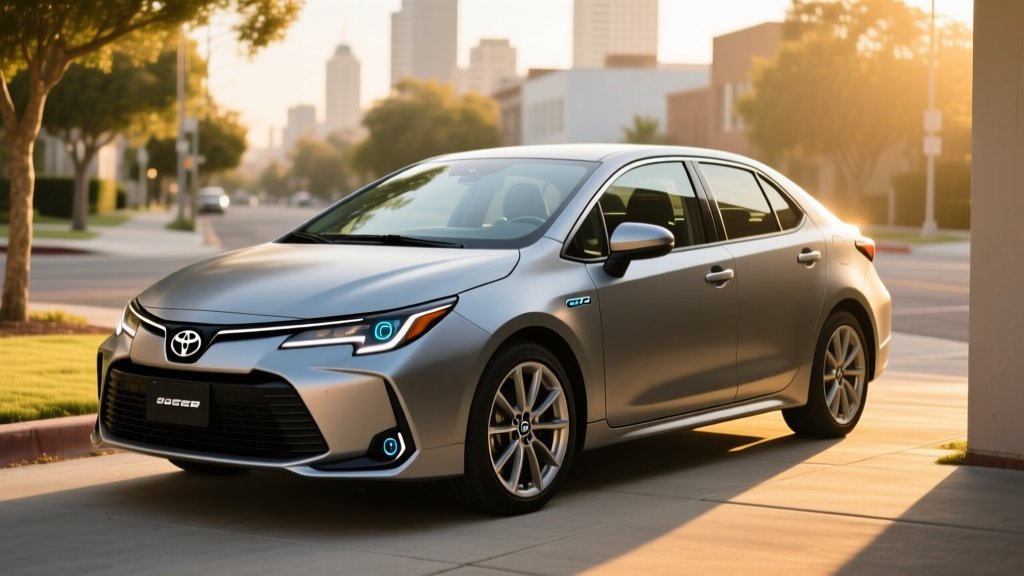
The 2026 Toyota Corolla Hybrid All-Wheel Drive occupies a narrow but compelling lane: it delivers genuine all-weather traction and 50 MPG combined without requiring a plug, a charger, or any change to your driving habits. For buyers who want electrified efficiency but lack home charging access or face brutal winters, Toyota's fifth-generation hybrid system paired with electronic AWD remains one of the most practical powertrains on the market.
This guide covers every number that matters — EPA fuel economy, real-world MPG, powertrain output, battery warranty, pricing, and how the Corolla Hybrid AWD stacks up against plug-in hybrids and full battery-electric vehicles.
EPA Fuel Economy and Real-World MPG
The 2026 Corolla Hybrid AWD carries an EPA rating of 51 MPG city / 49 MPG highway / 50 MPG combined, according to fueleconomy.gov. That combined figure places it among the most efficient all-wheel-drive vehicles sold in the United States, regardless of powertrain type.
| Driving Cycle | EPA MPG | Real-World Expectation |
|---|---|---|
| City | 51 MPG | 52–56 MPG (regenerative braking favors stop-and-go) |
| Highway | 49 MPG | 44–48 MPG (aero drag, sustained speed above 70 mph) |
| Combined | 50 MPG | 47–52 MPG depending on climate and terrain |
| Cold weather (below 32°F) | — | 42–46 MPG (engine runs more for cabin heat) |
The real-world story with Toyota's hybrid system is that city driving consistently exceeds the EPA sticker. Regenerative braking recaptures energy at every stop, and the 1.8-liter Atkinson-cycle engine shuts off entirely at low speeds. Highway driving tells the opposite story: above 70 mph, the Corolla's aerodynamic profile and the hybrid system's reduced regenerative benefit push consumption higher. In sustained cold weather, expect a 10–15% fuel-economy penalty as the gasoline engine runs more frequently to provide cabin heat and maintain battery temperature.
HEV vs. PHEV: Where the Corolla Hybrid Fits
The 2026 Corolla Hybrid is a conventional hybrid electric vehicle (HEV), not a plug-in hybrid. This distinction matters for ownership logistics, cost, and daily routine.
| Attribute | HEV (Corolla Hybrid) | PHEV (e.g., Prius Prime) | BEV (e.g., Tesla Model 3) |
|---|---|---|---|
| Plug-in charging needed? | No | Yes (for EV range) | Yes (always) |
| Electric-only range | 0 miles (motor assists engine) | 35–44 miles typical | 250–360 miles typical |
| Home charger required? | No | Recommended (Level 2) | Essential (Level 2) |
| Federal tax credit (§30D) | Not eligible | Up to $7,500* | Up to $7,500* |
| Gasoline engine | Yes (primary power) | Yes (backup + highway) | No |
| Battery size | ~1.0 kWh (small buffer) | ~13.6 kWh usable | 50–82 kWh |
| Upfront cost premium | Low (~$1,500 over gas) | Moderate ($4,000–$7,000) | High ($8,000–$15,000) |
* §30D credit subject to MSRP caps, buyer income limits, and battery-sourcing requirements. See IRS.gov for current eligibility rules.
The Corolla Hybrid's small ~1.0 kWh nickel-metal-hydride battery pack charges entirely through regenerative braking and the gasoline engine. You never plug it in. This makes it ideal for apartment dwellers, street parkers, and anyone without access to a dedicated charging circuit — the single largest barrier to PHEV and BEV adoption.
Powertrain and AWD System Breakdown
The 2026 Corolla Hybrid AWD uses Toyota's fifth-generation hybrid synergy drive, pairing a 1.8-liter four-cylinder Atkinson-cycle engine with a front-mounted motor-generator and a separate rear-axle electric motor for all-wheel drive.
| Specification | Value |
|---|---|
| Combined system horsepower | 138 hp |
| Gasoline engine | 1.8L 4-cyl Atkinson cycle, 98 hp / 105 lb-ft |
| Front electric motor | Integrated motor-generator (MG2) |
| Rear electric motor (AWD) | 41 hp / 62 lb-ft (rear axle, engagement up to ~43 mph and on slip) |
| Transmission | Electronically controlled CVT (eCVT) |
| Battery type | Nickel-metal hydride (NiMH), ~1.0 kWh |
| Drivetrain | Electronic on-demand AWD (rear motor) |
| 0–60 mph | ~9.1 seconds |
| EPA combined MPG | 50 MPG |
| Fuel tank capacity | 11.4 gallons |
| Estimated total range | ~570 miles per tank |
| Curb weight | ~3,085 lbs |
The electronic AWD system is not a traditional mechanical setup with a driveshaft. Instead, the rear-axle motor engages automatically during acceleration from a stop, on low-traction surfaces, and when the front wheels slip. It operates primarily below 43 mph, which covers most situations where AWD matters — snow-covered intersections, wet on-ramps, and gravel driveways. At highway speeds, the Corolla Hybrid AWD operates as a front-wheel-drive vehicle to preserve fuel economy.
The 138 combined horsepower figure is adequate for commuting and merging but not spirited. The 0–60 mph time of approximately 9.1 seconds places the Corolla Hybrid AWD in the middle of the compact-hybrid segment. If acceleration priority is high, the front-wheel-drive Corolla Hybrid (which is slightly lighter) shaves roughly 0.5 seconds off that figure.
Pricing, Trims, and Tax Credit Eligibility
The 2026 Corolla Hybrid AWD is available in LE and SE trims. Pricing starts at approximately $24,050 MSRP for the LE AWD (including destination charge), with the SE AWD starting around $26,550.
| Trim | MSRP (incl. destination) | AWD Standard? | Key Additions |
|---|---|---|---|
| LE AWD | $24,050 | Yes | 8" touchscreen, wireless CarPlay/Android Auto, TSS 3.0 |
| SE AWD | $26,550 | Yes | Sport-tuned suspension, 16" alloy wheels, paddle shifters, Smart Key |
Does the 2026 Corolla Hybrid qualify for a federal tax credit?
No. The Corolla Hybrid is a conventional HEV, which does not qualify for the IRS §30D Clean Vehicle Credit. That credit applies only to plug-in electric vehicles (PHEVs and BEVs) with battery capacities of at least 7 kWh, subject to MSRP caps ($55,000 for sedans), buyer income limits ($150,000 single / $300,000 joint), and battery critical-mineral and component sourcing requirements.
Some states offer rebates or reduced registration fees for hybrids, but these vary widely. Check your state's energy office or the Alternative Fuels Data Center for local incentives.
Battery Warranty, Lifespan, and Replacement Cost
Hybrid battery longevity is the most common concern among first-time hybrid buyers. Toyota addresses this with substantial warranty coverage.
Toyota Hybrid Battery Warranty (2026 Models)
- Coverage: 10 years / 150,000 miles (whichever comes first)
- Applies to: Hybrid battery pack and all hybrid-system components (inverter, motor-generators, eCVT)
- Capacity threshold: Warranty covers defects and premature degradation; Toyota does not publish a specific state-of-health percentage trigger (unlike some BEV warranties at 70% SoH)
- Transferable: Yes, to subsequent owners — supports resale value
Toyota's NiMH hybrid batteries have a long track record of durability. Data from fleet operators and long-term owners shows that Prius and Corolla Hybrid packs routinely exceed 150,000 miles with minimal capacity loss. NiMH chemistry is less energy-dense than the lithium-ion packs in BEVs but is inherently stable, tolerant of temperature extremes, and resistant to the calendar degradation that affects larger lithium-ion batteries.
If replacement is eventually needed outside warranty, a refurbished Corolla Hybrid battery pack typically costs $2,000–$3,500 installed at an independent hybrid specialist, or $3,500–$5,000 for a new OEM pack at a Toyota dealer. This is far less than the $10,000–$20,000+ BEV battery replacement costs that dominate headlines, largely because the Corolla Hybrid's pack is roughly 1.0 kWh versus 60–80 kWh in a full electric vehicle.
Reliability and Safety Record
Toyota's hybrid powertrain is among the most proven in the automotive industry, with over 25 million hybrid vehicles sold globally since 1997. The Corolla Hybrid benefits from shared architecture with the Prius, which consistently earns top reliability ratings from Consumer Reports and J.D. Power.
The eCVT transmission is a planetary gearset with no belts, clutches, or traditional shifting mechanisms — there are fewer wear components than in a conventional automatic. Brake pad life is extended significantly by regenerative braking; many hybrid owners report 60,000–80,000 miles on original factory pads.
For safety, the 2026 Corolla Hybrid comes standard with Toyota Safety Sense 3.0, which includes:
- Pre-Collision System with Pedestrian Detection
- Lane Departure Alert with Steering Assist
- Full-Speed Range Dynamic Radar Cruise Control
- Lane Tracing Assist
- Automatic High Beams
- Road Sign Assist
This is an SAE Level 2 driver-assistance system — the driver must remain fully engaged, with hands on the wheel and eyes on the road at all times. It is not autonomous driving.
Who Should Choose the Corolla Hybrid AWD — and Who Shouldn't
Reasons to Buy
- 50 MPG combined with no plug-in requirement or charging infrastructure needed
- On-demand AWD for snow, rain, and gravel — without the fuel-economy penalty of mechanical AWD
- Low starting price ($24,050) — thousands less than comparable PHEVs or BEVs
- 10-year/150,000-mile hybrid battery warranty with proven long-term durability
- ~570-mile total range per tank eliminates range anxiety entirely
- Standard Toyota Safety Sense 3.0 with comprehensive ADAS features
- Strong resale value supported by Toyota's hybrid reputation
Reasons to Look Elsewhere
- 138 hp and ~9.1-second 0–60 — adequate but not quick; highway merging requires planning
- No federal tax credit — PHEVs and BEVs can net up to $7,500 back
- AWD system disengages above ~43 mph — not a performance AWD system
- Rear seat and cargo space are tighter than compact SUV hybrids (RAV4 Hybrid, CR-V Hybrid)
- No EV-only driving mode; gasoline engine always available and frequently active
- SE trim still lacks premium features like heated seats or premium audio standard
Choose the Corolla Hybrid AWD if:
You commute in a region with real winters, lack access to home or workplace charging, want minimal ownership complexity, and prioritize low fuel cost over acceleration or electric-only driving. It's the right call for apartment dwellers in Minneapolis, street parkers in Boston, and anyone who wants electrified efficiency without lifestyle changes.
Choose a PHEV (like the Prius Prime) if:
You have access to a Level 2 charger at home or work, your daily commute is under 40 miles round-trip, and you want to drive primarily on electricity while retaining a gas engine for road trips. The §30D credit can offset the higher purchase price significantly.
Choose a BEV (like the Tesla Model 3 or Hyundai Ioniq 6) if:
You have reliable home charging, want zero tailpipe emissions, value instant torque and quiet operation, and are ready to plan around DC fast charging on road trips. Total cost of ownership can be lowest here if electricity rates are favorable and you qualify for the full tax credit.
Frequently Asked Questions
How many MPG does the 2026 Corolla Hybrid AWD get?
The EPA rates it at 51 city / 49 highway / 50 combined. In real-world city driving, many owners see 52–56 MPG thanks to regenerative braking. Highway driving above 70 mph typically yields 44–48 MPG, and cold weather can drop combined figures to 42–46 MPG.
Does the Corolla Hybrid AWD need to be plugged in?
No. The Corolla Hybrid is a conventional HEV. Its small battery charges through regenerative braking and the gasoline engine. There is no plug, no charging port, and no electric-only driving range.
How far can the Corolla Hybrid AWD go on a tank of gas?
With an 11.4-gallon fuel tank and 50 MPG combined, you can expect approximately 570 miles between fill-ups in mixed driving. Real-world range varies from about 510 miles (highway-heavy, cold weather) to over 600 miles (city-heavy, mild weather).
Is the Corolla Hybrid AWD reliable, and what does battery replacement cost?
Toyota's hybrid system has a 25+ year track record with millions of vehicles in service. The hybrid battery is covered for 10 years / 150,000 miles. Out-of-warranty replacement runs $2,000–$3,500 for a refurbished pack or $3,500–$5,000 for a new OEM unit — far less than BEV battery replacement.
Does the 2026 Corolla Hybrid qualify for any tax credit?
It does not qualify for the federal §30D Clean Vehicle Credit, which is reserved for plug-in vehicles (PHEVs and BEVs). Some states offer separate hybrid incentives — check the Alternative Fuels Data Center or your state energy office for local programs.
How does the AWD system work?
The Corolla Hybrid AWD uses a separate 41-hp electric motor on the rear axle. It engages automatically from a stop, during acceleration, and when front-wheel slip is detected — primarily below 43 mph. There is no mechanical driveshaft connecting the front and rear axles.
Corolla Hybrid AWD vs. RAV4 Hybrid AWD — which is better?
The RAV4 Hybrid AWD offers more cargo space (37.6 cu ft vs. 13.1 cu ft in the Corolla sedan), higher ground clearance, and 219 combined hp, but gets 39–41 MPG combined and starts around $33,000. If you need utility and can accept lower MPG, the RAV4 is the stronger choice. If efficiency and a lower price matter most, the Corolla Hybrid AWD wins.