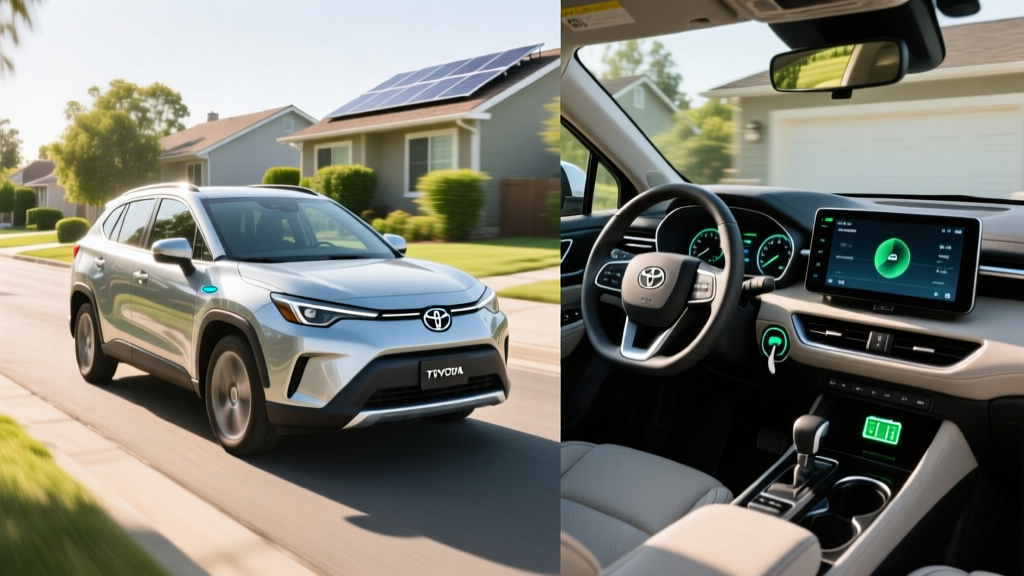
Quick Verdict: The 2026 Corolla Cross Hybrid SE at a Glance
The 2026 Corolla Cross Hybrid SE occupies a narrow but appealing lane: a compact crossover with standard all-wheel drive, a combined 42 MPG EPA rating, and a sub-$32,000 starting price. It is a conventional hybrid (HEV), not a plug-in — meaning no charging cord, no electric-only range, and no federal tax credit under IRS §30D. What it does offer is a proven fifth-generation Toyota Hybrid System, 196 combined horsepower, and the kind of real-world city fuel economy that often beats its EPA sticker. For buyers who want crossover utility and hybrid efficiency without the complexity, cost, or charging dependency of a PHEV or full EV, the SE trim hits a practical sweet spot.
| Spec | Value |
|---|---|
| Powertrain | 2.0L 4-cyl + 2 electric motors (AWD) |
| Combined Horsepower | 196 hp |
| EPA MPG (City / Hwy / Combined) | 46 / 38 / 42 |
| Fuel Tank Capacity | 10.6 gallons |
| Total Driving Range | ~445 miles |
| 0–60 mph | ~7.5 seconds (est.) |
| Drivetrain | Electronic AWD (rear motor) |
| Cargo Volume (rear seats up / down) | 25.5 / 61.8 cu ft |
| Base MSRP (SE AWD) | $31,395 (incl. destination) |
| Hybrid Battery Warranty | 10 years / 150,000 miles |
| Federal Tax Credit (§30D) | Not eligible (HEV, not PHEV/BEV) |
HEV vs. PHEV: Where the Corolla Cross Hybrid Fits
Before digging into the numbers, it is essential to understand what the Corolla Cross Hybrid is — and what it is not. Toyota offers this model exclusively as a conventional hybrid (HEV). There is no plug-in hybrid (PHEV) variant of the Corolla Cross in the U.S. market for 2026.
| Feature | HEV (Corolla Cross Hybrid) | PHEV (e.g., RAV4 Prime) | BEV (e.g., bZ4X) |
|---|---|---|---|
| Plug-in Charging | No — self-charging via engine & regen | Yes — Level 1/2 AC | Yes — Level 1/2/DC |
| Electric-Only Range | None (EV assist only at low speed) | ~35–42 mi typical | 220–300+ mi typical |
| Gas Engine | Yes — primary power + charges battery | Yes — kicks in after battery depletes | No |
| Fuel / Energy | Gasoline only | Gasoline + electricity | Electricity only |
| Federal Tax Credit (§30D) | Not eligible | Eligible (if requirements met) | Eligible (if requirements met) |
| Typical Starting Price | ~$31,000 | ~$44,000+ | ~$38,000+ |
The HEV architecture means the Corolla Cross Hybrid charges its own small battery pack (approximately 1.0 kWh usable, lithium-ion) through regenerative braking and the gasoline engine. You never plug it in. The electric motors assist during acceleration, enable brief low-speed EV-mode coasting, and allow the engine to shut off at stops — all of which reduce fuel consumption without any change to your refueling habits.
Fuel Economy: EPA Ratings and Real-World MPG
| Driving Cycle | EPA Rating |
|---|---|
| City | 46 MPG |
| Highway | 38 MPG |
| Combined | 42 MPG |
The city-highway split is the signature advantage of Toyota's hybrid system. In stop-and-go driving, the electric motors do heavy lifting while the engine runs at its most efficient RPM or shuts off entirely. The 46 MPG city figure is not just a lab result — it is the scenario where this powertrain genuinely shines.
Real-world expectations: In mixed suburban and city driving, owners and testers routinely report 43–47 MPG, sometimes exceeding the EPA combined estimate. On sustained highway trips at 70–75 mph, expect the number to settle around 36–39 MPG — closer to the EPA highway rating, since the engine is doing more continuous work. In cold weather (below freezing), short-trip city MPG may dip to 38–41 MPG until the engine and catalytic converter reach operating temperature. These are modest penalties compared to a BEV's cold-weather range loss, and they affect fuel cost, not usability.
With a 10.6-gallon tank and 42 MPG combined, total range lands around 445 miles. That is competitive with or better than most gas-only compact crossovers and eliminates any range-anxiety conversation entirely — you refuel at any gas station in three minutes.
Powertrain and Performance
The 2026 Corolla Cross Hybrid uses Toyota's fifth-generation hybrid system built around a 2.0-liter Dynamic Force four-cylinder engine. The engine itself produces 150 horsepower and 138 lb-ft of torque. A front-mounted electric motor adds additional torque for launch assist, while a dedicated rear-axle electric motor provides electronic all-wheel drive — no mechanical driveshaft connects the front and rear axles.
Combined system output is rated at 196 horsepower. That is a meaningful jump over the gas-only Corolla Cross (169 hp) and gives the Hybrid SE confident highway merging and passing ability. The 0–60 mph time is estimated at approximately 7.5 seconds, which is brisk for this segment and noticeably quicker than the non-hybrid model's ~9-second run.
The electronic AWD system engages the rear motor automatically when slip is detected or during hard acceleration. It is not a trail-rated off-road system, but it provides genuine all-weather traction for snow, rain, and gravel — a key reason buyers choose the Hybrid over the FWD-only gas base model. The hybrid battery pack is mounted under the rear seats, preserving cargo space and keeping the center of gravity low.
Pricing, Trims, and Tax Credit Eligibility
The 2026 Corolla Cross Hybrid is offered in three trims, all with standard AWD:
- S: ~$29,845 MSRP (incl. destination)
- SE: ~$31,395 MSRP (incl. destination) — adds sport-tuned suspension, 18-inch alloy wheels, SofTex seats, dual-zone climate
- XSE: ~$33,245 MSRP (incl. destination) — adds premium audio, wireless charging, heated front seats
Federal tax credit: The Corolla Cross Hybrid does not qualify for the IRS §30D Clean Vehicle Credit. That credit applies only to battery electric vehicles (BEVs) and plug-in hybrids (PHEVs) that meet battery-component and critical-mineral sourcing requirements, MSRP caps ($80,000 for SUVs), and buyer income limits. Conventional hybrids like this one have never been eligible. There is no federal purchase incentive for HEVs in 2026.
Some states and utilities offer rebates or reduced registration fees for hybrids. These vary widely by jurisdiction — check your state energy office or local utility for current programs. Toyota's own financial services page occasionally lists manufacturer loyalty or lease incentives that may apply.
Reliability and Hybrid Battery Warranty
Hybrid Battery Warranty: Toyota covers the Corolla Cross Hybrid's battery pack for 10 years or 150,000 miles (whichever comes first) under its Hybrid Battery Warranty. The broader powertrain warranty covers 5 years / 60,000 miles, and the basic new-vehicle warranty is 3 years / 36,000 miles.
Toyota's hybrid systems have an exceptionally long track record. The Prius has been in production since 1997 in Japan (2000 in the U.S.), and the hybrid architecture in the Corolla Cross is a direct descendant of that lineage. The hybrid battery pack is a lithium-ion unit designed for shallow cycling — it never fully charges or fully depletes, which dramatically extends cell life. Data from fleet and long-term ownership reports shows Toyota hybrid batteries routinely lasting 150,000–200,000+ miles before significant capacity loss.
Replacement cost: If the hybrid battery does need replacement outside warranty, a new OEM pack for the Corolla Cross Hybrid currently costs approximately $2,500–$3,500 installed at a Toyota dealer. Third-party refurbished packs are available for roughly $1,500–$2,200 installed. This is a fraction of a BEV traction battery replacement and is comparable to a major repair on any gas vehicle (transmission rebuild, for example).
The hybrid system has fewer wear items than a conventional gas powertrain: no starter motor, no alternator, no traditional automatic transmission (the e-CVT has no belts or friction clutches), and regenerative braking significantly extends brake pad life. According to Consumer Reports, Toyota consistently ranks among the top brands for predicted reliability, and its hybrid models often outperform their gas counterparts in long-term dependability scores.
Who Should Choose the Corolla Cross Hybrid SE?
Choose the 2026 Corolla Cross Hybrid SE if:
- You want 40+ MPG without plugging in or changing your driving habits
- You need AWD for snow/rain but don't want a large SUV's fuel bill
- Your budget is $30,000–$35,000 and you want low total cost of ownership
- You lack access to home or workplace EV charging
- You drive 12,000–15,000 miles per year and want to minimize fuel spending
Consider a PHEV (like the RAV4 Prime) or BEV instead if:
- You have home Level 2 charging and a short commute you could run on electricity
- You want to qualify for the federal §30D tax credit (up to $7,500)
- You want electric-only driving for daily errands with zero tailpipe emissions
- You drive fewer than 10,000 miles per year and can charge overnight — a BEV may cost less per mile
The Corolla Cross Hybrid SE makes the most financial sense for drivers who log moderate-to-high annual mileage, primarily in city and suburban conditions where the hybrid system's efficiency advantage is largest. At 15,000 miles per year and $3.30 per gallon, the 42 MPG combined rating translates to roughly $1,179 in annual fuel cost — compared to approximately $1,775 for a gas-only compact crossover rated at 28 MPG combined. That is a savings of about $596 per year, or roughly $2,980 over five years, before factoring in the hybrid's modest price premium over the gas model.
Pros and Cons
Pros
- 42 MPG combined EPA; real-world city often exceeds 44 MPG
- 196 hp with standard AWD — quick and capable in bad weather
- No plug-in charging required; refuel at any gas station
- Sub-$32,000 starting price for the SE trim
- 10-year / 150,000-mile hybrid battery warranty
- Low running costs: extended brake pad life, no alternator/starter
Cons
- No electric-only driving range — always uses some gasoline
- Not eligible for federal §30D tax credit
- Highway MPG (38) trails city MPG (46) — highway-heavy commuters see less benefit
- Cargo volume (25.5 cu ft) is modest for the segment
- Infotainment and interior materials are functional but not premium
Frequently Asked Questions
How many MPG does the 2026 Corolla Cross Hybrid SE get?
The EPA rates it at 46 MPG city, 38 MPG highway, and 42 MPG combined. In real-world city and suburban driving, many owners report 43–47 MPG. Highway-only trips at 70+ mph typically yield 36–39 MPG.
Can the Corolla Cross Hybrid drive on electric power only?
Only at very low speeds (under ~25 mph) for brief distances, such as coasting through a parking lot. It has no meaningful electric-only range like a PHEV. The battery is approximately 1.0 kWh — far too small for sustained electric driving. Its purpose is to assist the gas engine, not replace it.
Does the 2026 Corolla Cross Hybrid qualify for a tax credit?
No. The IRS §30D Clean Vehicle Credit applies only to plug-in electric vehicles (BEVs and PHEVs). Conventional hybrids like the Corolla Cross Hybrid are not eligible. Some state or utility programs may offer smaller incentives — check your local programs. See the IRS Clean Vehicle Credit page for current eligibility rules.
Is the hybrid battery reliable and what does replacement cost?
Toyota's hybrid batteries have a strong longevity record, often lasting 150,000–200,000+ miles. The battery is covered by a 10-year / 150,000-mile warranty. Out-of-warranty replacement costs approximately $2,500–$3,500 for a new OEM pack or $1,500–$2,200 for a refurbished unit.
How does the Corolla Cross Hybrid compare to a full EV like the Toyota bZ4X?
The bZ4X offers 222–252 miles of EPA range and qualifies for potential tax credits, but starts around $38,000+, requires access to charging infrastructure, and loses range in cold weather. The Corolla Cross Hybrid costs less upfront, needs no charging, has unlimited range via gas stations, and is simpler for apartment dwellers or those without a garage. If you can charge at home and have a short commute, a BEV may save more on fuel. If you need flexibility, the hybrid is the lower-risk choice.
Is the Corolla Cross Hybrid SE worth the upgrade over the S trim?
The SE adds sport-tuned suspension, 18-inch wheels, SofTex-trimmed seats, dual-zone automatic climate control, and a leather-wrapped steering wheel for roughly $1,550 more. If you value ride comfort and interior feel, the SE is the best value in the lineup. The XSE adds premium features but pushes the price above $33,000, where you start approaching RAV4 Hybrid territory.