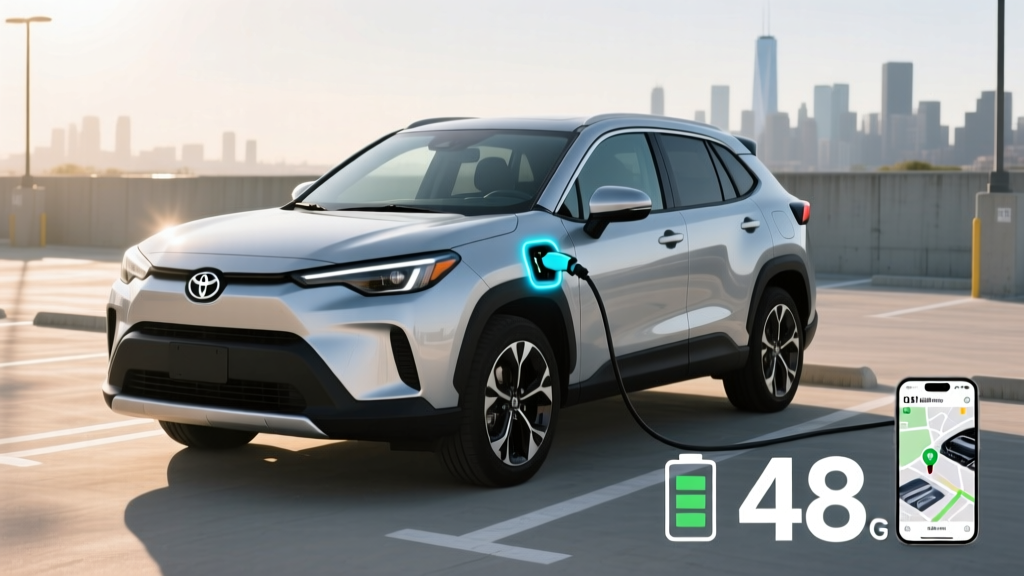
The compact crossover segment is crowded, but the 2026 Corolla Cross Hybrid occupies a specific niche: it's the entry point for buyers who want electrified efficiency without plugging in, changing habits, or stretching their budget. Toyota's fifth-generation hybrid system pairs a 2.0-liter four-cylinder with two motor-generators and an electronic all-wheel-drive system to produce 196 combined horsepower and an EPA-estimated 42 MPG combined. That's the headline. But the real question for shoppers cross-referencing the RAV4 Hybrid, Honda CR-V Hybrid, and fully electric alternatives is whether those numbers hold up in daily driving — and what ownership actually costs over five years.
We've compiled the official specs, real-world fuel economy data, and ownership economics to help you decide if the 2026 Corolla Cross Hybrid is the right electrified vehicle for your driveway.
2026 Corolla Cross Hybrid: Core Specifications at a Glance
| Specification | 2026 Corolla Cross Hybrid |
|---|---|
| Powertrain | 2.0L 4-cyl + 2 motor-generators (eAWD) |
| Combined Horsepower | 196 hp |
| EPA MPG (City / Highway / Combined) | 45 / 38 / 42 |
| Fuel Tank Capacity | 10.6 gallons |
| Total Driving Range | ~445 miles |
| 0–60 mph (est.) | ~7.5 seconds |
| Drivetrain | Electronic AWD (eAWD) standard |
| Hybrid Battery Type | Lithium-ion (sealed NiMH on prior gens; Li-ion current) |
| Cargo Volume (behind rear seats) | 25.5 cu ft |
| Starting MSRP (S trim) | ~$30,450 (incl. destination) |
| Federal Tax Credit (§30D) | Not eligible (HEV, not PHEV/BEV) |
| Hybrid Battery Warranty | 10 years / 150,000 miles |
Fuel Economy: EPA Numbers vs. Real-World MPG
The EPA rates the 2026 Corolla Cross Hybrid at 45 MPG city, 38 MPG highway, and 42 MPG combined. For context, the gas-only Corolla Cross AWD is rated at 29 MPG combined — a 45% efficiency improvement from the hybrid system. According to fueleconomy.gov, the Corolla Cross Hybrid's combined rating places it at the top of the compact AWD crossover segment, edging out the Honda CR-V Hybrid (40 combined) and the Hyundai Tucson Hybrid (38 combined).
Why Hybrids Often Beat Their EPA City Number
Here's what spec sheets don't tell you: Toyota's hybrid system recovers braking energy and uses the electric motor heavily at low speeds, which means stop-and-go urban driving is where this powertrain shines brightest. In real-world city commuting with frequent stops, many owners report 46–48 MPG on the dash display. Highway driving tells a different story. At sustained 75+ mph speeds, the gasoline engine carries most of the load, and the aerodynamic profile of a crossover works against efficiency. Expect 35–37 MPG on long highway trips.
City commuting (stop-and-go): 44–48 MPG
Mixed suburban driving: 40–43 MPG
Sustained highway (70–80 mph): 35–37 MPG
Cold weather (below 32°F): 36–39 MPG combined (engine runs more for cabin heat)
The Corolla Cross Hybrid doesn't need to be plugged in — ever. The system charges its small hybrid battery through regenerative braking and the gasoline engine. If you're comparing this to a plug-in hybrid, the distinction matters (more on that below).
HEV vs. PHEV vs. EV: Which Powertrain Fits Your Life?
The 2026 Corolla Cross is available only as a conventional hybrid (HEV). There is no plug-in hybrid (PHEV) variant and no fully electric (BEV) Corolla Cross in Toyota's 2026 lineup. Here's how these three powertrain types compare for a buyer considering this vehicle:
| Factor | HEV (Corolla Cross Hybrid) | PHEV (e.g., RAV4 Prime) | BEV (e.g., Tesla Model Y) |
|---|---|---|---|
| Plug in to charge? | No | Yes (optional) | Yes (required) |
| Electric-only range | None (motor assists at low speed) | ~42 miles | 260–330 miles |
| Home charging needed? | No | Recommended (Level 2) | Yes (Level 2 strongly recommended) |
| Federal tax credit | None | Up to $7,500 (§30D, if eligible) | Up to $7,500 (§30D, if eligible) |
| Maintenance complexity | Low (no plug, small battery) | Moderate (two systems) | Low (fewer moving parts) |
| Best for | No home charging; long trips; budget buyers | Home chargers with short commutes | Home chargers; daily driving under 250 mi |
Choose the Corolla Cross Hybrid (HEV) if you don't have access to home or workplace charging, regularly take road trips beyond 300 miles, or want the lowest purchase price and simplest ownership experience. Consider a PHEV like the RAV4 Prime if you can install a Level 2 charger and your daily commute is under 40 miles — you'd drive mostly on electricity with a gas backup. Look at a BEV if you have reliable home charging, want to eliminate gas entirely, and your typical drives stay within 250 miles.
Powertrain and Driving Impressions
Toyota's fifth-generation hybrid powertrain in the Corolla Cross pairs a 2.0-liter Dynamic Force four-cylinder engine (150 hp on its own) with a front-mounted motor-generator and a rear-mounted motor-generator that provides electronic all-wheel drive. Combined system output is 196 horsepower. The rear motor activates automatically when the system detects slip or under hard acceleration — there's no mechanical driveshaft connecting the front and rear axles.
The result is a 0–60 mph time in the mid-7-second range, which is genuinely quick for a fuel-sipping compact crossover. The gas-only Corolla Cross AWD takes roughly 9 seconds to 60. The electric motor's instant torque fills in the low-end response that small-displacement engines typically lack, making the hybrid feel more responsive around town than its horsepower figure alone suggests.
One trade-off: the continuously variable transmission (eCVT) creates a droning engine note under hard acceleration, typical of Toyota hybrids. It's unobtrusive during normal driving but noticeable when merging onto a freeway at full throttle.
Pricing, Trims, and Tax Credit Eligibility
The 2026 Corolla Cross Hybrid starts at approximately $30,450 for the S trim (including destination), with the SE and XSE trims climbing to roughly $33,000–$35,500 fully optioned. That positions it roughly $2,000–$3,000 above the gas-only Corolla Cross and $3,000–$5,000 below the RAV4 Hybrid.
Federal Tax Credit: What You Need to Know
The Corolla Cross Hybrid does not qualify for the federal §30D clean vehicle tax credit. Under current IRS rules, the §30D credit (up to $7,500) is available only for battery electric vehicles (BEVs) and plug-in hybrid electric vehicles (PHEVs) that meet battery component and critical mineral sourcing requirements. Conventional hybrids like the Corolla Cross Hybrid are excluded by statute.
Some states and local utilities offer their own incentives for hybrid vehicles, though these are increasingly rare as incentive programs shift toward plug-in vehicles. Check your state energy office or utility provider for any current rebates. The fuel savings alone — roughly $600–$800 per year versus the gas-only model at 15,000 miles annually — provide a payback on the hybrid premium in approximately 3–4 years at current fuel prices.
Battery Longevity, Warranty, and Replacement Cost
How Long Do Toyota Hybrid Batteries Actually Last?
Toyota's hybrid battery track record is among the best in the industry. The Corolla Cross Hybrid uses a relatively small lithium-ion battery pack (roughly 1.0–1.5 kWh of usable capacity — far smaller than a BEV's 60–100 kWh pack) that operates within a conservative state-of-charge window. The system never fully charges or fully depletes the battery, which dramatically extends cycle life.
Based on long-term data from the Prius, RAV4 Hybrid, and Camry Hybrid platforms, Toyota hybrid batteries routinely last 150,000–200,000+ miles before significant degradation. Failures within the warranty period are uncommon. When replacement is eventually needed out of warranty, a new OEM hybrid battery for the Corolla Cross Hybrid is estimated at $2,500–$4,000 installed, with refurbished units available for $1,500–$2,500. For context, most owners will sell or trade the vehicle before this expense arises.
The broader hybrid system — including the motor-generators, power control unit, and eCVT — is covered under Toyota's 5-year/60,000-mile powertrain warranty, with hybrid-specific components covered for 8 years/100,000 miles.
Ownership Costs: 5-Year Comparison
| Cost Factor (5 years / 75,000 mi) | Corolla Cross Hybrid | Corolla Cross Gas AWD | RAV4 Hybrid |
|---|---|---|---|
| Purchase Price (base MSRP) | ~$30,450 | ~$27,950 | ~$34,500 |
| Fuel Cost (est. $3.40/gal avg) | ~$6,070 | ~$8,790 | ~$6,500 |
| Maintenance (est.) | ~$2,800 | ~$3,200 | ~$2,900 |
| Insurance (est. avg) | ~$7,500 | ~$7,200 | ~$7,800 |
| Federal Tax Credit | $0 | $0 | $0 |
| Est. 5-Year Total | ~$46,820 | ~$47,140 | ~$51,700 |
The hybrid's fuel savings effectively erase its price premium over the gas model within five years, and you're driving a more responsive, all-wheel-drive-equipped vehicle from day one. The RAV4 Hybrid offers more interior space but costs roughly $5,000 more over the same period.
Pros and Cons
- 42 MPG combined (45 city) — class-leading for AWD crossovers
- 196 hp with responsive low-end electric torque
- Standard eAWD at a sub-$31K starting price
- No plug-in required — zero lifestyle change from a gas car
- 10-year/150,000-mile hybrid battery warranty
- Toyota Safety Sense 3.0 standard (adaptive cruise, lane-keeping, auto emergency braking)
- No federal tax credit eligibility (HEV exclusion)
- Cargo space (25.5 cu ft) trails RAV4 Hybrid (37.5 cu ft)
- eCVT drone under hard acceleration
- Highway MPG drops to mid-30s at 75+ mph
- Rear seat is snug for taller passengers
- No PHEV or EV variant available in the Corolla Cross lineup
Frequently Asked Questions
How many MPG does the 2026 Corolla Cross Hybrid get?
The EPA rates it at 45 MPG city, 38 MPG highway, and 42 MPG combined. In real-world city driving, expect 44–48 MPG thanks to heavy regenerative braking. Highway cruising at 75+ mph yields 35–37 MPG. Cold weather reduces combined economy to roughly 36–39 MPG due to increased engine operation for cabin heating.
Does the Corolla Cross Hybrid need to be plugged in?
No. The Corolla Cross Hybrid is a conventional hybrid (HEV), not a plug-in hybrid (PHEV). The battery charges through regenerative braking and the gasoline engine. You fuel it like any other car — there is no charging port.
Is the Corolla Cross Hybrid reliable, and what does a battery replacement cost?
Toyota's hybrid systems have two decades of proven reliability across millions of vehicles. The hybrid battery is warrantied for 10 years/150,000 miles and typically lasts 150,000–200,000+ miles. Out-of-warranty replacement runs $2,500–$4,000 for a new OEM battery or $1,500–$2,500 for a refurbished unit. Toyota's warranty documentation details full coverage terms.
Does the 2026 Corolla Cross Hybrid qualify for any tax credit?
It does not qualify for the federal §30D clean vehicle credit, which is limited to BEVs and PHEVs meeting battery sourcing requirements. Some state or utility programs may offer small hybrid rebates, but these vary by jurisdiction and are increasingly uncommon. Check your state energy office for current programs.
Should I get the Corolla Cross Hybrid or a full EV?
If you have reliable home Level 2 charging, a daily commute under 250 miles, and want to eliminate gas costs entirely, a BEV like the Hyundai Ioniq 5 or Tesla Model Y offers lower operating costs and stronger incentives. If you lack home charging, take frequent long road trips, or want the lowest upfront price with no charging logistics, the Corolla Cross Hybrid is the more practical choice. It delivers roughly 45% better fuel economy than the gas Corolla Cross with zero behavioral change required.
How does the Corolla Cross Hybrid compare to the RAV4 Hybrid?
The RAV4 Hybrid offers more power (219 hp), significantly more cargo space (37.5 cu ft), and a slightly larger cabin — but costs roughly $4,000 more and returns 39 MPG combined versus the Corolla Cross Hybrid's 42. If you need the space and tow capacity (1,750 lbs for the RAV4 vs. 1,500 lbs for the Corolla Cross), the RAV4 is worth the premium. If you're a solo driver or couple prioritizing efficiency and value, the Corolla Cross Hybrid is the smarter buy.