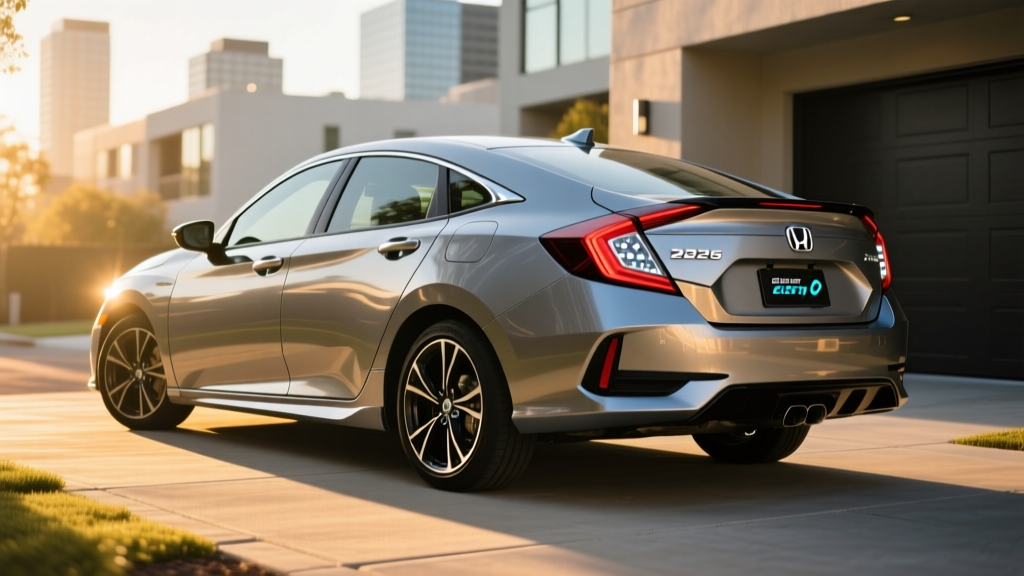
2026 Honda Civic Sport Hybrid Sedan: Quick Verdict
The 2026 Honda Civic Sport Hybrid Sedan occupies a pragmatic middle ground: it delivers electric-like torque and city efficiency without ever requiring a plug. For buyers who want to cut fuel consumption dramatically but lack reliable home charging access, this conventional hybrid (HEV) remains one of the most rational vehicles on the market. The Sport Hybrid trim pairs Honda's two-motor hybrid system with a 2.0-liter Atkinson-cycle engine, producing a combined 200 horsepower and an EPA-rated 50 MPG combined — numbers that make it one of the most efficient non-plug-in compact sedans available.
This is not a plug-in hybrid (PHEV) and not a battery electric vehicle (BEV). It has no electric-only range, no charge port, and no eligibility for the federal §30D clean vehicle credit. What it does offer is proven hybrid reliability, low running costs, and a starting MSRP that undercuts most competitors in the electrified compact segment.
| Specification | 2026 Civic Sport Hybrid Sedan |
|---|---|
| Powertrain Type | Conventional Hybrid (HEV) |
| Engine | 2.0L 4-cyl Atkinson-cycle |
| Combined System Horsepower | 200 hp |
| Combined System Torque | 232 lb-ft (electric motor) |
| Transmission | e-CVT (direct drive) |
| EPA MPG (City / Hwy / Combined) | 51 / 44 / 50 |
| Fuel Tank Capacity | 10.6 gallons |
| Total Driving Range | ~530 miles |
| 0–60 mph | ~7.5 seconds (est.) |
| Drivetrain | Front-wheel drive |
| Starting MSRP | $30,650 (incl. destination) |
| Federal Tax Credit | Not eligible (HEV) |
| Hybrid Battery Warranty | 8 years / 100,000 miles |
HEV vs PHEV vs BEV: Where the Civic Sport Hybrid Fits
Before evaluating the Civic Sport Hybrid, it's worth clarifying the three electrified powertrain types, because confusion here leads to mismatched expectations at the dealership.
| Attribute | HEV (e.g., Civic Hybrid) | PHEV (e.g., Toyota Prius Prime) | BEV (e.g., Tesla Model 3) |
|---|---|---|---|
| Plugs in? | No — regenerative braking charges battery | Yes — Level 1 or Level 2 | Yes — Level 1, 2, or DC fast |
| Electric-Only Range | None (motor assists engine) | 25–45 miles typical | 250–360+ miles |
| Fuel Needed? | Yes — gasoline always | Yes — after electric range depletes | No — electric only |
| Federal Tax Credit (§30D) | Not eligible | Up to $7,500 if eligible | Up to $7,500 if eligible |
| Best For | No home charging, want simplicity | Short commutes + occasional road trips | Home charging available, mostly electric driving |
The Civic Sport Hybrid is an HEV. Its small lithium-ion traction battery (approximately 1.1 kWh usable capacity) is charged exclusively by the gasoline engine and regenerative braking. You will never plug it in. The electric motor provides low-speed torque and assists during acceleration, but the vehicle cannot travel any meaningful distance on electricity alone. This is fundamentally different from a PHEV like the Toyota Prius Prime, which offers ~40 miles of electric-only driving before the gas engine engages.
Choose the Civic Sport Hybrid if: You don't have access to home or workplace charging, you want lower fuel costs without behavioral changes, and you prefer the lowest upfront price among electrified options.
Consider a PHEV or BEV instead if: You have a garage or driveway where you can install a Level 2 charger, your daily commute is under 40 miles (PHEV sweet spot), or you want to eliminate gasoline use entirely and qualify for federal tax incentives.
Fuel Economy: EPA Ratings and Real-World MPG
The EPA rates the 2026 Civic Sport Hybrid Sedan at 51 MPG city, 44 MPG highway, and 50 MPG combined, according to data published on fueleconomy.gov. These figures place it among the most efficient non-plug-in vehicles in its class.
| Driving Condition | EPA Rating | Real-World Expectation |
|---|---|---|
| City | 51 MPG | 50–55 MPG (hybrids excel in stop-and-go) |
| Highway | 44 MPG | 40–46 MPG (depends on speed, terrain) |
| Combined | 50 MPG | 46–52 MPG |
| Cold Weather (below 30°F) | Not rated separately | 42–47 MPG (engine runs more for heat) |
Why real-world city MPG often exceeds the EPA sticker: Conventional hybrids recapture energy during braking and low-speed driving through regenerative braking. In dense urban traffic with frequent stops, the electric motor does more of the work, and the engine shuts off at idle. Many Civic Hybrid owners report 52–55 MPG in warm-weather city driving.
Where MPG drops: Sustained highway driving above 70 mph reduces the hybrid system's advantage because the electric motor contributes less at cruising speed, and aerodynamic drag increases. In winter, the gasoline engine runs more frequently to provide cabin heat and maintain battery temperature, typically reducing combined fuel economy by 5–10%. On a 600-mile winter road trip at 75 mph with temperatures in the 20s, expect closer to 40–42 MPG.
With the 10.6-gallon fuel tank, real-world total range typically falls between 450 and 550 miles depending on driving conditions — competitive with some long-range BEVs but with the advantage of a 3-minute refueling stop at any gas station.
Powertrain and Driving Dynamics
Honda's two-motor hybrid system in the 2026 Civic Sport Hybrid pairs a 2.0-liter Atkinson-cycle four-cylinder engine with two electric motors. The system produces a combined 200 horsepower, with the drive motor delivering 232 lb-ft of torque from a standstill. This torque characteristic gives the Civic Hybrid a responsive, electric-like feel off the line that belies its economy-car credentials.
The e-CVT (electronically controlled continuously variable transmission) is not a belt-and-pulley CVT in the traditional sense. Honda's system uses a direct-drive arrangement where the engine and motor can independently or jointly drive the front wheels. At low speeds, the vehicle operates primarily in EV drive mode (motor only, engine off or acting as a generator). At highway cruising, the engine can mechanically connect to the wheels for efficiency. During hard acceleration, both the engine and motor combine output.
The 0–60 mph time is estimated at approximately 7.5 seconds — adequate for highway merging and passing, though not sporty in the performance sense. The "Sport" in the trim name refers to exterior styling, wheel design, and paddle shifters that adjust regenerative braking intensity rather than any meaningful performance upgrade over the standard Hybrid.
Regenerative braking is adjustable via steering-wheel-mounted paddles, offering four levels of deceleration. The strongest setting provides noticeable one-pedal-like slowing in city traffic, though it does not bring the car to a complete hold as some full EVs do. This is a useful feature for drivers transitioning from a BEV who want to retain some regenerative braking feel.
Pricing, Trims, and Tax Credit Eligibility
The 2026 Honda Civic Sport Hybrid Sedan carries a starting MSRP of approximately $30,650, including destination charges. This positions it roughly $1,200–$1,500 above the equivalent gasoline-only Civic Sport trim, a premium that typical drivers will recoup within 18–24 months through fuel savings, depending on annual mileage and local gas prices.
Federal tax credit: The Civic Sport Hybrid does not qualify for the IRS §30D Clean Vehicle Credit. That credit applies only to plug-in electric vehicles (BEVs and PHEVs) meeting specific battery sourcing, MSRP caps, and buyer income requirements, as outlined on irs.gov. Conventional hybrids (HEVs) have not been eligible for the federal purchase credit since the original Hybrid Tax Credit expired for most manufacturers in the late 2000s.
State incentives: A small number of states offer rebates or reduced registration fees for hybrids, but these are uncommon and vary by jurisdiction. Check your state's energy or environmental agency website for current programs. Do not count on state incentives when budgeting for this vehicle.
Total cost comparison at 15,000 miles/year:
| Annual Cost Factor | Civic Sport Hybrid (50 MPG) | Civic Sport Gas (33 MPG combined) |
|---|---|---|
| Fuel Cost ($3.50/gal) | $1,050 | $1,591 |
| Annual Fuel Savings | ~$541/year with the hybrid | |
| 5-Year Fuel Savings | ~$2,705 | |
At current fuel prices, the hybrid premium is recovered in roughly 2–3 years. Over a 10-year ownership period, total fuel savings typically reach $5,000–$6,000, making the hybrid the more economical choice for most buyers who plan to keep the vehicle long-term.
Battery Longevity, Warranty, and Replacement Costs
Hybrid Battery Warranty: Honda covers the Civic Hybrid's lithium-ion traction battery for 8 years or 100,000 miles (whichever comes first) under the federal emissions-related warranty. In states that follow California Air Resources Board (CARB) standards — including CA, NY, MA, WA, OR, and others — the warranty extends to 10 years or 150,000 miles.
This is a critical point for hybrid buyers: the traction battery in a conventional hybrid like the Civic Sport Hybrid is far smaller and less stressed than a BEV battery pack. At roughly 1.1 kWh of usable capacity, the battery undergoes shallow charge-discharge cycles (typically operating between 40% and 80% state of charge) managed by the vehicle's battery management system. This shallow cycling dramatically reduces degradation compared to the deep cycles a BEV battery experiences.
Real-world longevity data: Honda's hybrid systems have demonstrated strong durability in the field. The predecessor Insight and earlier Civic Hybrid models using nickel-metal hydride (NiMH) batteries commonly exceeded 150,000 miles without battery replacement. The current lithium-ion system is expected to match or exceed this track record. Industry data from fleet operators and long-term owners suggests that modern HEV batteries typically last 150,000–200,000+ miles before capacity loss becomes noticeable enough to affect fuel economy.
Battery replacement cost: If the hybrid battery does fail outside of warranty, a replacement from Honda typically costs between $2,000 and $4,000 including parts and labor. Third-party refurbished battery options are available for approximately $1,200–$2,000. This is a fraction of BEV battery replacement costs ($8,000–$20,000+), reflecting the much smaller battery size.
Signs of hybrid battery degradation: Reduced fuel economy (typically a 5–15% drop), more frequent engine engagement at low speeds, and dashboard warning lights. These symptoms usually appear gradually over many years rather than as sudden failure.
Reliability, Safety, and Ownership Practicalities
Honda's hybrid powertrain has earned a reputation for reliability across multiple model lines. The two-motor system has fewer moving parts than a conventional automatic transmission — there is no torque converter, no multi-speed gearset, and no traditional belt-driven accessories. The e-CVT direct-drive arrangement eliminates many failure points associated with conventional transmissions.
The 2026 Civic carries strong safety credentials. The Civic line has historically earned top ratings from both the NHTSA and the IIHS. Standard Honda Sensing suite includes adaptive cruise control, lane-keeping assist, forward collision warning with automatic emergency braking, and traffic sign recognition. Note that these are SAE Level 1–2 driver-assistance features — they do not constitute self-driving capability, and the driver must remain fully engaged at all times.
Insurance costs: Hybrid vehicles typically carry insurance premiums comparable to their gasoline counterparts, unlike BEVs which often see 10–20% higher premiums due to higher repair costs. Expect annual insurance costs in line with a gasoline Civic Sport, varying by your driving record, location, and coverage level.
Maintenance: The Civic Hybrid requires the same routine maintenance as the gasoline model — oil changes, tire rotations, brake fluid, cabin air filter. One advantage: regenerative braking significantly reduces wear on the friction brakes, often extending brake pad life to 80,000–100,000+ miles. There is no additional hybrid-specific maintenance required under normal ownership.
Who Should Buy the 2026 Civic Sport Hybrid?
Pros
- 50 MPG combined — among the most efficient non-plug-in vehicles available
- No charging infrastructure required — works with existing gas station network
- Low upfront cost vs PHEVs and BEVs; no tax credit dependency
- Proven hybrid reliability with 8-year/100k-mile battery warranty
- Responsive electric torque in city driving
- 530+ mile total range; 3-minute refueling
Cons
- No electric-only driving — always burns gasoline
- Not eligible for federal or most state EV incentives
- Highway MPG (44) trails city MPG (51) noticeably
- "Sport" trim is cosmetic, not a performance upgrade
- FWD only — no AWD option for snow-belt buyers
- Higher upfront cost vs gasoline-only Civic (~$1,200–$1,500 premium)
Choose the 2026 Civic Sport Hybrid if:
- You live in an apartment or lack access to home/workplace charging
- Your commute involves significant city or stop-and-go driving
- You want to reduce fuel costs without changing your refueling habits
- You plan to own the vehicle 5+ years (to capture full fuel savings)
- You want the lowest total cost of ownership among electrified compacts
Look at a PHEV or BEV instead if:
- You can install a Level 2 home charger and want to drive on electricity daily
- Your commute is under 40 miles round-trip (PHEV covers this on electric alone)
- You want to qualify for the federal §30D tax credit (up to $7,500 for eligible BEVs/PHEVs)
- You want zero tailpipe emissions for daily driving
Frequently Asked Questions
How many MPG does the 2026 Civic Sport Hybrid get?
The EPA rates it at 51 MPG city, 44 MPG highway, and 50 MPG combined. Real-world city driving often yields 50–55 MPG, while sustained highway driving at 70+ mph typically returns 40–46 MPG. Cold weather reduces combined economy to approximately 42–47 MPG.
Does the Civic Sport Hybrid need to be plugged in?
No. This is a conventional hybrid (HEV), not a plug-in hybrid (PHEV). The battery charges through regenerative braking and the gasoline engine. There is no charge port on the vehicle.
How far can the Civic Hybrid go on electric only?
The Civic Sport Hybrid cannot drive on electric power alone for any meaningful distance. The electric motor assists the gasoline engine during acceleration and low-speed driving, but the engine is always the primary power source. If you want electric-only driving, you need a PHEV or BEV.
Is the hybrid battery reliable, and what does replacement cost?
Honda's hybrid batteries have demonstrated strong longevity, commonly exceeding 150,000 miles without failure. The battery is warrantied for 8 years/100,000 miles (10 years/150,000 miles in CARB states). Out-of-warranty replacement costs $2,000–$4,000 from Honda, or $1,200–$2,000 for a refurbished unit.
Does the 2026 Civic Hybrid qualify for any tax credit?
No. The federal §30D Clean Vehicle Credit applies only to plug-in vehicles (BEVs and PHEVs). Conventional hybrids are not eligible. A small number of states may offer hybrid-specific incentives, but these are uncommon — check your state's energy agency for details.
How does the Civic Hybrid compare to the Toyota Corolla Hybrid?
Both vehicles target the same buyer, but the Civic Hybrid offers more horsepower (200 hp vs. ~138 hp for the Corolla Hybrid), a more refined interior, and slightly higher EPA combined MPG (50 vs. ~50–52 depending on Corolla trim). The Corolla Hybrid offers available AWD, which the Civic does not. Pricing is comparable, with both starting in the $25,000–$31,000 range depending on trim.
What is the total driving range?
With the 10.6-gallon fuel tank and 50 MPG combined rating, the Civic Sport Hybrid delivers approximately 530 miles of total range under EPA conditions. Real-world range typically falls between 450 and 550 miles depending on driving conditions, speed, and temperature.