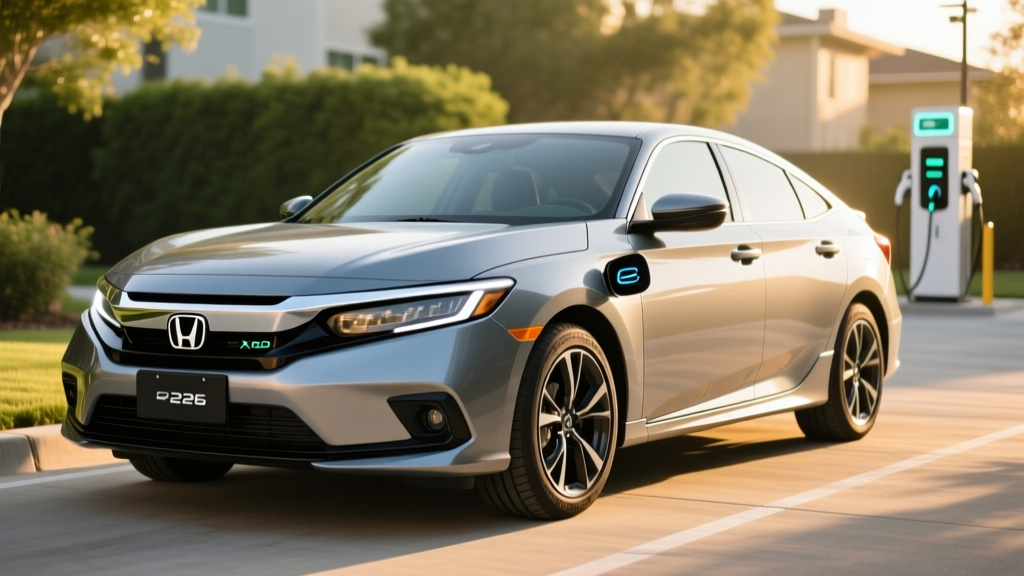
The Honda Civic Hybrid has quietly become one of the most efficient non-plug-in vehicles on the road, and the 2026 model year continues that trajectory with meaningful powertrain refinements. If you've been searching for 2026 Civic Hybrid MPG data to figure out whether this compact sedan deserves a spot on your shortlist, you're in the right place. Below we cover EPA ratings, real-world fuel economy, the two-motor hybrid system, pricing, and how the Civic Hybrid stacks up against plug-in hybrids and full EVs.
2026 Honda Civic Hybrid MPG: EPA Ratings and Real-World Numbers
Honda's two-motor hybrid system in the 2026 Civic pairs a 2.0-liter Atkinson-cycle four-cylinder engine with two electric motors, delivering a combined system output of 200 horsepower and 232 lb-ft of torque. That's the same proven architecture introduced for the 2025 model year, now carried forward with minor software calibration updates for 2026.
| Trim | City MPG | Highway MPG | Combined MPG | Est. Total Range |
|---|---|---|---|---|
| Sport Hybrid | 50 | 47 | 49 | ~540 mi |
| Sport Touring Hybrid | 50 | 45 | 48 | ~528 mi |
Source: EPA / fueleconomy.gov
Honda's two-motor system operates primarily as a series hybrid at low and moderate speeds — the engine acts as a generator while the electric motor drives the wheels. This means city driving often exceeds the EPA city rating, with owners routinely reporting 52–55 MPG in stop-and-go traffic. Highway fuel economy at sustained 75–80 mph tends to drop to 42–45 MPG, as the engine engages a direct-drive clutch and aerodynamic drag increases. In mixed real-world driving, expect 46–50 MPG combined, which closely tracks the EPA estimate. Cold weather (below 30°F) can reduce efficiency by 5–10% due to increased engine warm-up cycles and cabin heating demand.
HEV vs. PHEV vs. EV: Which Powertrain Fits You?
The 2026 Civic Hybrid is a conventional hybrid (HEV) — not a plug-in hybrid (PHEV). This distinction matters, because it fundamentally changes how you interact with the car every day.
| Factor | HEV (Civic Hybrid) | PHEV (e.g., Toyota Prius Prime) | BEV (e.g., Tesla Model 3) |
|---|---|---|---|
| Plug-in Required? | No — regenerative braking recharges battery | Yes — plug in for electric-only range | Yes — must plug in to drive |
| Electric-Only Range | ~1 mi at low speed | 25–45 mi typical | 250–360 mi typical |
| Home Charging Needed? | No | Recommended (Level 1 or 2) | Required (Level 2 ideal) |
| Fuel Cost (per mile) | ~$0.09 at 49 MPG, $3.50/gal | ~$0.04 electric / ~$0.09 gas | ~$0.04–$0.06 (home charging) |
| Federal Tax Credit (§30D) | Not eligible | Up to $7,500 (if requirements met) | Up to $7,500 (if requirements met) |
| Best For | No home charger access, simplicity | Short commutes + long road trips | Home charging access, max savings |
The Civic Hybrid's biggest advantage is zero lifestyle change required. You never plug in, never think about charging infrastructure, and never worry about range. The trade-off is that your per-mile fuel cost stays higher than a PHEV running on electricity or a full EV — but you eliminate the upfront price premium and charging logistics those vehicles demand.
Powertrain Deep Dive: How the Two-Motor System Works
Honda's hybrid system is fundamentally different from Toyota's planetary-gear eCVT approach. Here's how it operates across driving scenarios:
- EV Drive (low speed, light load): Battery powers the propulsion motor; engine is off. Limited to roughly one mile at very low speeds.
- Hybrid Drive (most city/suburban driving): Engine spins the generator motor, which feeds electricity to the propulsion motor. The engine never directly drives the wheels — it's a series-hybrid configuration, which is why city MPG is so strong.
- Engine Drive (highway cruising): A lock-up clutch connects the engine directly to the wheels at steady highway speeds, where internal combustion is more efficient than the electric conversion path.
- Regenerative Braking: Both deceleration and braking recover kinetic energy back into the ~1.06 kWh lithium-ion battery pack.
| Specification | Value |
|---|---|
| Engine | 2.0L Atkinson-cycle 4-cylinder |
| Engine Power | 143 hp @ 6,000 rpm |
| Propulsion Motor | 184 hp / 232 lb-ft torque |
| Combined System Output | 200 hp / 232 lb-ft |
| Battery Capacity | ~1.06 kWh (lithium-ion) |
| Transmission | Single-speed direct drive (e-CVT) |
| Drivetrain | Front-wheel drive |
| 0–60 mph | ~7.2 seconds (est.) |
The 200-hp combined output makes the Civic Hybrid genuinely quick for a 49-MPG car. It pulls away from stoplights with electric-motor immediacy and merges onto highways without hesitation. This isn't the efficiency-at-all-costs compromise older hybrids demanded.
Pricing, Trims, and Tax Credit Eligibility
The 2026 Civic Hybrid is offered in two trims. Here's where pricing stands:
| Trim | MSRP (incl. destination) | Key Features |
|---|---|---|
| Sport Hybrid | ~$30,450 | 18" wheels, 7" touchscreen, wireless CarPlay/Android Auto, Honda Sensing suite |
| Sport Touring Hybrid | ~$33,450 | 9" touchscreen, Bose 12-speaker audio, wireless charging, leather-trimmed seats, navigation |
The 2026 Civic Hybrid is a conventional HEV and does not qualify for the federal §30D Clean Vehicle Credit. That credit (up to $7,500) applies only to plug-in vehicles — BEVs and PHEVs — that meet battery sourcing, critical mineral, MSRP cap, and buyer income requirements per IRS guidelines. However, the Civic Hybrid's ~$30,000 starting price undercuts most PHEVs and EVs by $5,000–$15,000, which often offsets the missing credit over a typical ownership period.
Battery Warranty, Lifespan, and Replacement Cost
Hybrid battery longevity is the single most common concern among first-time hybrid buyers. Honda addresses this with robust warranty coverage:
- Hybrid battery: 8 years / 100,000 miles (10 years / 150,000 miles in CARB states including CA, NY, MA, and others)
- Hybrid system components: 8 years / 100,000 miles
- Capacity retention threshold: Honda replaces the battery if it falls below functional specifications (no published % threshold like EVs)
In practice, Honda's lithium-ion hybrid batteries have proven durable. The small ~1.06 kWh pack undergoes shallow charge-discharge cycles (typically operating between 20% and 80% state of charge), which minimizes degradation. Real-world data from earlier-generation Honda hybrids suggests these packs routinely last 150,000–200,000+ miles before any capacity concern arises.
If replacement is needed out of warranty, expect a cost of $2,000–$3,500 for a new OEM hybrid battery pack, plus roughly $300–$500 in labor. Third-party refurbishment options can reduce that to $1,200–$2,000. Compare this to EV traction battery replacements, which typically run $8,000–$20,000+.
Who Should Buy the 2026 Civic Hybrid (and Who Shouldn't)
✓ Choose the Civic Hybrid If:
- You lack access to home or workplace charging
- You want maximum MPG with zero behavior change
- Your budget is $30,000–$35,000 and you want a well-equipped compact sedan
- You take regular road trips and don't want to plan around charging stops
- You want proven Honda reliability with strong resale value
✗ Look Elsewhere If:
- You have a short commute and home charging — a PHEV like the Prius Prime (44 mi electric) may save more
- You want to eliminate gas entirely — consider a BEV like the Chevrolet Equinox EV or Tesla Model 3
- You need AWD — the Civic Hybrid is FWD only (consider the Toyota Prius AWD or Subaru Crosstrek Hybrid)
- You want the federal tax credit to lower your effective purchase price
2026 Civic Hybrid vs. Key Competitors
| Vehicle | Combined MPG | HP | Starting MSRP | Tax Credit |
|---|---|---|---|---|
| Honda Civic Hybrid | 49 | 200 | ~$30,450 | None |
| Toyota Prius (HEV) | 57 | 196 | ~$29,450 | None |
| Toyota Prius Prime (PHEV) | 52 (gas) / 127 MPGe | 220 | ~$34,000 | Up to $7,500* |
| Hyundai Elantra Hybrid | 54 | 139 | ~$27,500 | None |
*PHEV tax credit eligibility depends on battery sourcing, MSRP caps, and buyer income. Verify at IRS.gov.
The Civic Hybrid trades a few MPG to the Prius and Elantra Hybrid but delivers substantially more horsepower (200 vs. 139 for the Elantra) and a more engaging driving experience. The Prius Prime makes sense if you can charge at home and want electric-only commuting, but its higher MSRP only pencils out if you qualify for the full federal credit.
Frequently Asked Questions
How many MPG does the 2026 Civic Hybrid actually get?
The EPA rates the Sport Hybrid trim at 50 city / 47 highway / 49 combined MPG, and the Sport Touring at 50/45/48. In real-world mixed driving, owners typically see 46–50 MPG combined. City driving often exceeds the EPA rating (52–55 MPG is common), while sustained highway driving at 75+ mph drops to roughly 42–45 MPG.
Does the Civic Hybrid need to be plugged in?
No. The 2026 Civic Hybrid is a conventional hybrid (HEV), not a plug-in. The small battery recharges through regenerative braking and the gasoline engine. You fuel it like any other car — just with far fewer stops at the pump.
Is the 2026 Civic Hybrid eligible for any tax credit?
No. The federal §30D Clean Vehicle Credit applies only to plug-in electric vehicles (BEVs and PHEVs). Conventional hybrids like the Civic Hybrid do not qualify. Some states offer their own incentives for hybrids, but these vary by jurisdiction — check your state's energy or DMV website for current programs.
How long will the Civic Hybrid battery last, and what does replacement cost?
Honda covers the hybrid battery for 8 years / 100,000 miles (10 years / 150,000 miles in CARB states). Real-world data from Honda's hybrid lineup suggests the lithium-ion pack typically lasts 150,000–200,000+ miles. Out-of-warranty replacement runs approximately $2,000–$3,500 for a new OEM battery.
How does the Civic Hybrid compare to a full EV for daily commuting?
If you have reliable home Level 2 charging and a commute under 40 miles round-trip, a full EV like the Tesla Model 3 or Chevrolet Equinox EV will cost roughly $0.04–$0.06 per mile to fuel versus ~$0.07–$0.09 for the Civic Hybrid. However, the EV requires a $500–$2,000 home charger installation, a higher purchase price, and charging-stop planning on road trips. The Civic Hybrid eliminates all of those requirements while still delivering excellent efficiency.
Is the 2026 Civic Hybrid available with all-wheel drive?
No. The Civic Hybrid is front-wheel drive only across both trims. If AWD is a priority in a hybrid, consider the Toyota Prius AWD (54 combined MPG) or the Subaru Crosstrek Hybrid (PHEV).