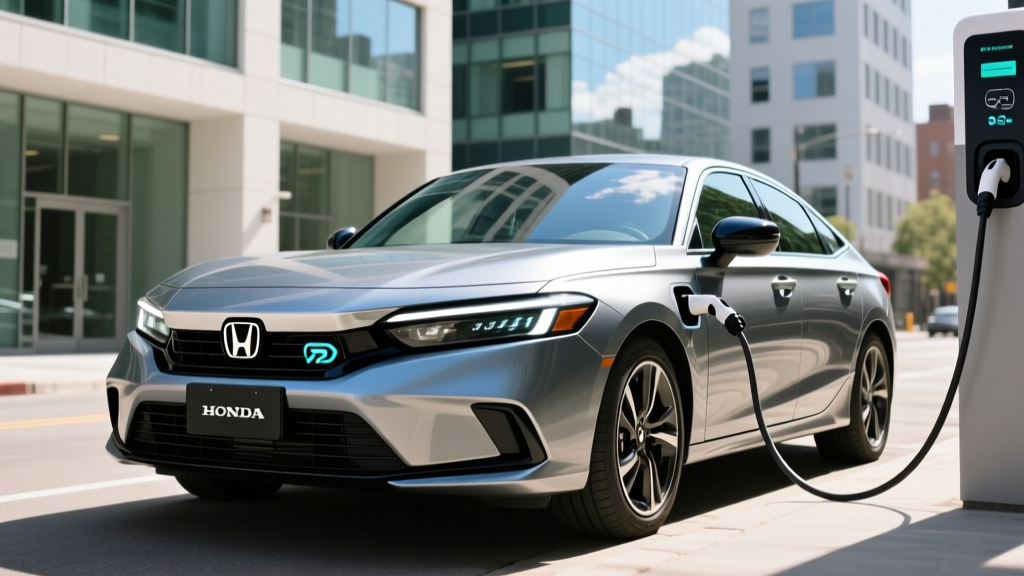
The Honda Civic has been a compact-car staple for decades, but the 2026 Civic Hybrid is the version most buyers should actually consider. With an EPA-estimated 49 MPG combined, a 200-horsepower dual-motor powertrain, and a starting price under $30,000, it occupies a compelling middle ground between conventional gas compacts and full battery-electric vehicles. This guide covers every number you need — from real-world fuel economy to battery warranty — so you can decide if the 2026 Civic Hybrid fits your daily driving and budget.
HEV vs PHEV: What the 2026 Civic Hybrid Actually Is
Before diving into specs, it is essential to clarify what Honda is selling here. The 2026 Civic Hybrid is a conventional hybrid electric vehicle (HEV), not a plug-in hybrid (PHEV). That distinction matters enormously for ownership expectations.
HEV vs PHEV — Key Differences
| Feature | HEV (2026 Civic Hybrid) | PHEV (e.g., Toyota Prius Prime) |
|---|---|---|
| Plugs in to charge? | No — self-charging via engine & regen | Yes — Level 1/Level 2 |
| Electric-only range | ~1 mile at low speed | 25–45 miles typical |
| Battery size | ~1.1 kWh (small buffer) | 13–18 kWh usable |
| Federal tax credit (§30D) | Not eligible | Up to $7,500 if requirements met |
| Home charging needed? | No — gas up and go | Recommended for EV-mode benefit |
The Civic Hybrid recovers energy through regenerative braking and the gasoline engine. You never plug it in — you simply refuel at any gas station.
If you are looking for electric-only commuting capability, Honda does not currently offer a Civic PHEV in the US market. Buyers wanting plug-in capability should cross-shop the Toyota Prius Prime, Hyundai Tucson PHEV, or a used Chevrolet Volt. But if your goal is maximum MPG with zero lifestyle change — no charging cables, no range planning, no home electrical upgrades — the Civic HEV is precisely engineered for that role.
Fuel Economy: EPA Ratings and Real-World MPG
The headline number for the 2026 Civic Hybrid is an EPA-estimated 49 MPG combined for the Sport Hybrid and Sport Touring Hybrid trims. Here is the full breakdown by driving cycle:
| Driving Cycle | EPA Estimate | Real-World Expectation |
|---|---|---|
| City | 50 MPG | 50–55 MPG (hybrids excel here) |
| Highway | 47 MPG | 42–46 MPG (sustained 70+ mph) |
| Combined | 49 MPG | 45–52 MPG (varies by driving mix) |
Why real-world city MPG can exceed the EPA sticker: Hybrids recapture kinetic energy every time you slow down. Stop-and-go traffic, which punishes conventional gas cars, actually benefits the Civic Hybrid because the electric motors handle low-speed propulsion while the engine shuts off at stops. Owners who drive predominantly in urban environments frequently report 52–55 MPG on the onboard trip computer.
Where you will see lower numbers: Sustained highway driving above 70 MPH, cold-weather operation (engine runs more to generate cabin heat), and aggressive acceleration all pull the figure toward the low-to-mid 40s. On a 300-mile winter road trip at 75 MPH with the heater running, expect closer to 42–44 MPG — still outstanding, but below the combined sticker.
For reference, the non-hybrid 2026 Civic with the 2.0L engine rates at 35 MPG combined per fueleconomy.gov. The hybrid powertrain delivers roughly a 40% improvement in fuel economy for a modest price premium.
Powertrain Specs: 200 HP From Two Motors and a 2.0L Atkinson Engine
Honda's fourth-generation two-motor hybrid system is the heart of the Civic Hybrid. Here is what is under the hood:
| Specification | Detail |
|---|---|
| Engine | 2.0L 4-cylinder Atkinson-cycle direct-injection |
| Electric Motors | Two-motor system (propulsion + generator) |
| Combined System Output | 200 HP / 232 lb-ft torque |
| Transmission | e-CVT (no traditional gears) |
| 0–60 MPH | ~7.1 seconds |
| Drivetrain | Front-wheel drive |
| Hybrid Battery | ~1.1 kWh lithium-ion (under rear seats) |
| Fuel Tank | 10.6 gallons |
| Total Driving Range | ~519 miles (EPA est.) |
The two-motor architecture means the Civic Hybrid drives primarily on electric power at low and moderate speeds. The gasoline engine acts mainly as a generator, producing electricity for the propulsion motor. At highway cruising speeds, a lock-up clutch connects the engine directly to the wheels for efficiency. This is why the car feels responsive and torque-rich around town — the electric motor delivers its 232 lb-ft instantly from a stop, unlike a turbocharged gas engine that needs to build boost.
Compared to the base 2.0L gas Civic (150 HP), the hybrid is significantly quicker and more refined. It also edges out the now-discontinued 1.5T turbo Civic (180 HP) in low-end responsiveness while delivering far better fuel economy.
Pricing, Trims, and Tax Credit Eligibility
The 2026 Civic Hybrid is available in two trims, both well-equipped:
| Trim | MSRP (incl. destination) | Key Features |
|---|---|---|
| Sport Hybrid | $29,845 | 7" touchscreen, wireless Apple CarPlay/Android Auto, Honda Sensing suite, 18" alloy wheels |
| Sport Touring Hybrid | $32,845 | 9" touchscreen, Bose 12-speaker audio, wireless charging, leather-trimmed seats, Honda Sensing with low-speed follow |
Federal Tax Credit: Not Eligible
The 2026 Civic Hybrid does not qualify for the IRS §30D New Clean Vehicle Credit. Under current IRS rules, the §30D credit (up to $7,500) is reserved for battery electric vehicles (BEVs) and plug-in hybrids (PHEVs) that meet battery capacity, critical-mineral sourcing, and MSRP/income requirements. Conventional hybrids like the Civic HEV are excluded from this credit.
Some states offer separate incentives for hybrids, though these are increasingly rare. Check your state energy office or AFDC incentive database for local programs.
Even without a federal credit, the Civic Hybrid's price premium over a comparable gas Civic is modest — roughly $1,500–$2,000 depending on trim. At current fuel prices (~$3.40/gallon national average), the hybrid's fuel savings pay back that premium in approximately 2.5 to 3 years for a driver covering 12,000 miles annually. After that, every fill-up is pure savings.
Battery Warranty, Reliability, and Replacement Cost
Hybrid battery longevity is consistently the top concern among first-time hybrid buyers. Here is what Honda provides and what real-world data shows:
2026 Civic Hybrid Battery & Powertrain Warranty
- Hybrid battery (high-voltage): 8 years / 100,000 miles (10 years / 150,000 miles in CARB states including CA, NY, MA, and others)
- Hybrid system components: 8 years / 100,000 miles
- Powertrain warranty: 5 years / 60,000 miles
- Bumper-to-bumper: 3 years / 36,000 miles
The hybrid battery warranty covers capacity loss below a defined threshold (typically 60–70% of original capacity) and manufacturing defects. In CARB-adopting states, the extended 10-year/150,000-mile coverage provides additional peace of mind.
Real-world reliability data: Honda's hybrid systems have proven durable. The previous-generation Civic Hybrid and the closely related Accord Hybrid powertrain have demonstrated battery lifespans well beyond 150,000 miles in normal use. Unlike early hybrid systems from the 2000s, modern lithium-ion hybrid batteries use sophisticated thermal management and shallow charge/discharge cycles (the car never uses the full battery capacity) to minimize degradation.
Out-of-warranty replacement cost: If the hybrid battery does eventually need replacement after the warranty period, expect to pay between $2,000 and $3,500 for a new OEM battery pack plus labor at a Honda dealer. Independent hybrid specialists and refurbished battery options can reduce this to $1,200–$2,000. Given the small ~1.1 kWh pack size, costs are far lower than a full EV battery replacement.
For reliability ratings, the 2026 Civic benefits from Honda's strong track record. The IIHS typically awards the Civic Top Safety Pick status, and Honda Sensing (standard on all trims) includes automatic emergency braking, lane-keeping assist, adaptive cruise control, and road departure mitigation.
Real-World Ownership: What Daily Driving Actually Feels Like
Numbers on a page matter, but the Civic Hybrid's appeal becomes clear in daily use. Here is what to expect:
City commuting: This is where the hybrid system shines. The electric motor handles launches from stoplights, and the engine remains off during low-speed creeping. Cabin noise is minimal because the engine is often not running. Expect to visit the gas station once every 10–12 days on a typical 30-mile daily commute.
Highway road trips: At 70–80 MPH, the engine engages directly via the lock-up clutch. The transition is seamless — most drivers will not notice it. With a 10.6-gallon tank and mid-40s highway MPG, the Civic Hybrid can cover 450+ miles between fill-ups. That is competitive with many diesel vehicles and far better than any non-hybrid compact.
Cold weather impact: In sub-freezing temperatures, expect a 5–10% fuel economy reduction (roughly 2–4 MPG). The engine must run more frequently to provide cabin heat and warm the hybrid system. This is normal for all hybrids and far less severe than the 20–40% range loss a full EV experiences in winter.
Maintenance costs: The Civic Hybrid requires the same basic maintenance as a gas Civic — oil changes, tire rotations, cabin air filter, brake fluid. In fact, brake pad wear is typically lower on the hybrid because regenerative braking handles most deceleration. There is no additional hybrid-specific maintenance required. Honda recommends standard 7,500-mile service intervals.
Pros
- 49 MPG combined — best in the compact sedan class
- 200 HP makes it quicker than most gas Civic trims
- No plug-in charging required — zero lifestyle change
- Over 500 miles of total range per tank
- Strong Honda Sensing safety suite standard
- Modest price premium over gas models
Cons
- No electric-only driving capability
- Not eligible for the $7,500 federal EV tax credit
- FWD only — no AWD option (unlike Toyota Prius)
- e-CVT drone under hard acceleration
- Only available in Sport and Sport Touring trims
- Cargo space slightly reduced vs. gas Civic
2026 Civic Hybrid vs. the Competition
The Civic Hybrid does not exist in a vacuum. Here is how it stacks up against the key alternatives in the compact hybrid sedan segment:
| Model | EPA Combined MPG | Horsepower | Starting MSRP | AWD Available? |
|---|---|---|---|---|
| 2026 Honda Civic Hybrid | 49 MPG | 200 HP | $29,845 | No |
| 2026 Toyota Prius (LE) | 57 MPG | 194 HP | $29,445 | Yes |
| 2026 Hyundai Elantra Hybrid | 54 MPG | 139 HP | $27,595 | No |
| 2026 Toyota Corolla Hybrid | 50 MPG | 138 HP | $24,745 | Yes |
The Toyota Prius leads on pure efficiency and offers available AWD, but the Civic Hybrid counters with significantly more power (200 HP vs. 194 for the Prius, and far more than the Elantra or Corolla hybrids). If driving engagement matters to you, the Civic's chassis tuning and torque-rich electric motor give it a clear dynamic edge. If maximum MPG and lowest price are your priorities, the Corolla Hybrid and Prius are strong alternatives.
Who Should Choose the 2026 Civic Hybrid — And Who Should Look Elsewhere
The Decision Framework
Choose the 2026 Civic Hybrid if:
- You want 45+ MPG without changing your fueling routine
- You do not have access to home or workplace EV charging
- You want a compact sedan with more power than typical hybrids
- You plan to keep the car 5+ years and want proven Honda reliability
- Your daily commute is 20–60 miles of mixed city/highway driving
Consider a full EV (BEV) instead if:
- You can install a Level 2 home charger
- You want zero tailpipe emissions and minimal maintenance
- You qualify for the $7,500 federal tax credit (which can make an EV cheaper than a hybrid)
- Your daily driving is under 40 miles round-trip
Consider a PHEV instead if:
- You want electric-only commuting (25–45 miles) but gas flexibility for road trips
- You can charge at home but take frequent long trips
- You want to reduce (not just minimize) gasoline use
Stick with a gas car if: your annual mileage is under 6,000 miles, where the fuel savings will not offset the hybrid premium within a reasonable timeframe.
Frequently Asked Questions
How many MPG does the 2026 Civic Hybrid get?
The EPA rates the 2026 Civic Hybrid at 50 MPG city, 47 MPG highway, and 49 MPG combined. In real-world city driving, many owners report 50–55 MPG thanks to regenerative braking. Highway driving at sustained speeds above 70 MPH typically yields 42–46 MPG.
Does the 2026 Civic Hybrid need to be plugged in?
No. The Civic Hybrid is a conventional HEV that charges its small battery pack through regenerative braking and the gasoline engine. You never plug it in — you simply refuel at a gas station as you would with any conventional car.
How far can the 2026 Civic Hybrid go on a full tank?
With a 10.6-gallon fuel tank and 49 MPG combined, the Civic Hybrid delivers approximately 519 miles of total range per the EPA estimate. In conservative real-world driving, expect 450–500 miles between fill-ups.
Is the Civic Hybrid battery reliable and what does replacement cost?
Honda covers the hybrid battery for 8 years/100,000 miles (10 years/150,000 miles in CARB states). Real-world data from Honda's hybrid lineup shows batteries routinely lasting 150,000+ miles. Out-of-warranty replacement costs $2,000–$3,500 at a dealer, or $1,200–$2,000 through independent hybrid shops.
Does the 2026 Civic Hybrid qualify for a federal tax credit?
No. The IRS §30D New Clean Vehicle Credit applies only to plug-in vehicles (BEVs and PHEVs) that meet battery sourcing and MSRP requirements. The Civic Hybrid, as a conventional HEV, does not qualify. Some states may offer small hybrid incentives — check the AFDC database for your state.
Is the Civic Hybrid slower than the gas Civic?
No — it is noticeably quicker. The hybrid system produces 200 HP and 232 lb-ft of torque, compared to 150 HP for the base 2.0L gas Civic. The 0–60 MPH time drops from roughly 8.5 seconds (gas) to approximately 7.1 seconds (hybrid). The electric motor's instant torque makes the hybrid feel particularly responsive in city driving.
Hybrid vs PHEV vs EV — which is right for me?
A conventional hybrid (HEV) like the Civic Hybrid is best if you want maximum MPG with no charging infrastructure and no behavioral changes. A plug-in hybrid (PHEV) suits drivers who can charge at home and want 25–45 miles of electric-only commuting but need gas flexibility for longer trips. A full EV (BEV) is ideal if you have reliable home charging, want zero tailpipe emissions, and your daily driving falls within the vehicle's range (typically 250–350+ miles for modern EVs).