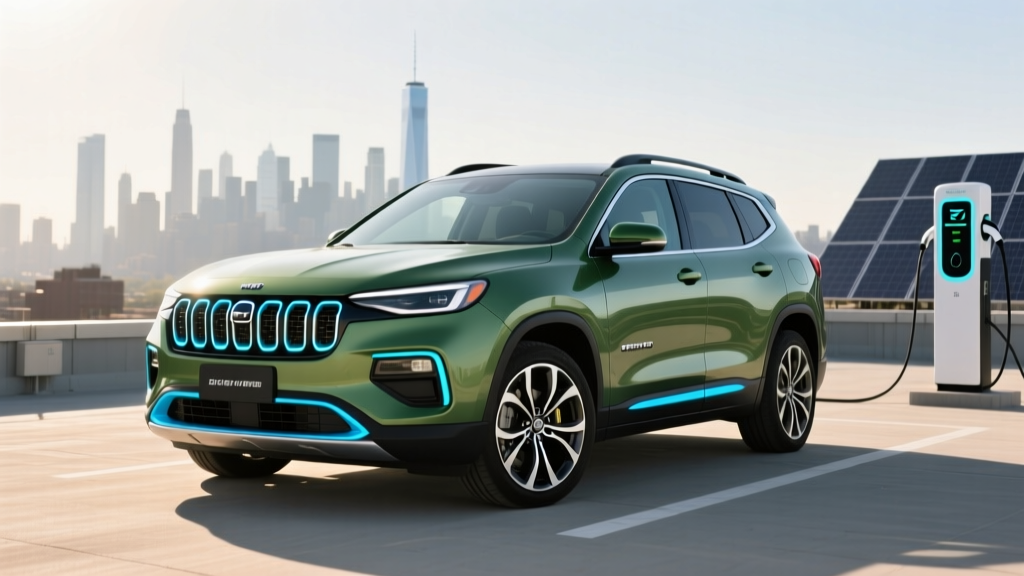
The 2026 Jeep Cherokee returns with an electrified lineup that includes both a conventional hybrid (HEV) and a plug-in hybrid (PHEV) variant, aiming to satisfy buyers who want better fuel economy without committing to a full battery-electric vehicle. With the compact SUV segment increasingly crowded by electrified competitors like the Toyota RAV4 Hybrid, Ford Escape PHEV, and Hyundai Tucson PHEV, the 2026 Cherokee Hybrid needs to deliver competitive numbers to earn a spot on your shortlist.
This guide covers every key specification — EPA fuel economy, electric-only range, battery capacity, powertrain output, charging logistics, pricing, and federal tax credit eligibility — so you can determine whether the 2026 Cherokee Hybrid or PHEV is the right fit for your daily driving.
HEV vs PHEV: Understanding the Two Cherokee Hybrid Options
Before diving into specs, it's essential to understand the fundamental difference between the two electrified Cherokee models. A conventional hybrid (HEV) uses a small battery and electric motor to assist the gasoline engine, capturing energy through regenerative braking. You never plug it in — it refuels exclusively at the gas pump. A plug-in hybrid (PHEV) carries a larger battery that can be charged from an external power source, enabling a meaningful stretch of electric-only driving before the gas engine kicks in.
| Feature | 2026 Cherokee Hybrid (HEV) | 2026 Cherokee 4xe (PHEV) |
|---|---|---|
| Plug-in required? | No | Yes (Level 1 or Level 2) |
| Electric-only range | N/A (motor assists only) | ~32 miles (EPA est.) |
| Battery capacity | ~1.1 kWh (self-charging) | ~17.3 kWh usable |
| Total range | ~460 miles | ~400 miles (electric + gas) |
| Best for | Drivers without home charging access | Drivers with home charging and short commutes |
The HEV is the simpler ownership proposition: no charging infrastructure needed, just improved MPG over a gas-only model. The PHEV demands access to a 120V or 240V outlet but rewards regular plug-in habits with near-EV daily commuting on shorter trips.
Fuel Economy: EPA MPG and Real-World Expectations
Fuel economy is the primary reason most buyers consider a hybrid. Here's how the 2026 Cherokee Hybrid lineup breaks down per EPA estimates at fueleconomy.gov:
| Powertrain | City MPG | Highway MPG | Combined MPG | Combined MPGe (PHEV) |
|---|---|---|---|---|
| Cherokee Hybrid (HEV) AWD | 38 | 34 | 36 | N/A |
| Cherokee 4xe (PHEV) AWD — charge-sustaining | 30 | 28 | 29 | 87 MPGe |
Real-world MPG note: Conventional hybrids like the Cherokee HEV typically exceed their EPA city estimate in stop-and-go traffic, where regenerative braking recaptures the most energy. On a mixed suburban commute, expect 37–40 MPG. Highway-heavy driving at 75+ mph will pull figures closer to 32–33 MPG, as aerodynamic drag dominates and the electric motor provides less benefit. For the PHEV, the 87 MPGe figure applies only when the battery is charged and you're driving within the electric-only window. Once the battery depletes to its charge-sustaining threshold, the PHEV operates as a heavier conventional hybrid at roughly 29 MPG combined.
Electric-Only Range and Battery Specs (Cherokee 4xe PHEV)
The 2026 Cherokee 4xe uses a 17.3 kWh usable battery pack (NMC lithium-ion chemistry), delivering an EPA-estimated 32 miles of electric-only range. That range covers the average American one-way commute of roughly 16 miles with margin to spare, meaning many PHEV owners can complete daily errands without burning a drop of gasoline.
Charging the Cherokee 4xe:
| Charging Level | Power | 0–100% Time | Notes |
|---|---|---|---|
| Level 1 (120V household) | ~1.4 kW | ~12 hours | Overnight top-up; slow for full depletion |
| Level 2 (240V home/public) | ~6.6 kW | ~2.5 hours | Recommended for daily PHEV use |
| DC Fast Charging | Not supported | N/A | No CCS or NACS DC port on Cherokee 4xe |
The Cherokee 4xe does not support DC fast charging — a common limitation among PHEVs. The onboard 6.6 kW charger means a Level 2 home station is the practical sweet spot, fully replenishing the battery in roughly 2.5 hours. Most PHEV owners charge overnight on Level 1 or Level 2 and start each morning with a full electric buffer.
Powertrain: Horsepower, Engine, and Motor Specs
| Specification | Cherokee Hybrid (HEV) | Cherokee 4xe (PHEV) |
|---|---|---|
| Engine | 1.6L turbocharged I-4 | 2.0L turbocharged I-4 |
| Electric motor(s) | Single integrated motor | Dual motor (front P1 + rear P4) |
| Combined system output | 210 hp / 230 lb-ft | 276 hp / 350 lb-ft |
| Transmission | 6-speed automatic | 8-speed automatic |
| 0–60 mph | ~7.8 sec | ~6.4 sec |
| Drivetrain | AWD | AWD (eAWD with rear electric axle) |
| Towing capacity | 2,000 lbs | 2,000 lbs |
The Cherokee 4xe's dual-motor layout provides electric all-wheel drive without a mechanical driveshaft connecting the front and rear axles. This eAWD system delivers immediate torque to the rear wheels in slippery conditions, and the combined 276 hp makes it the most powerful Cherokee variant. The HEV's 210 hp is adequate for daily driving and merging, though it won't feel particularly quick when fully loaded with passengers and cargo.
Pricing, Trims, and Federal Tax Credit Eligibility
Here's the manufacturer-estimated MSRP for the 2026 Cherokee Hybrid lineup:
| Trim | HEV MSRP | 4xe PHEV MSRP |
|---|---|---|
| Limited | $37,495 | $42,995 |
| Trailhawk | $39,995 | $45,495 |
| Overland | $41,495 | $47,995 |
Federal tax credit — §30D Clean Vehicle Credit: The conventional Cherokee HEV does not qualify for any federal tax credit. The Cherokee 4xe PHEV may qualify for up to $7,500, but eligibility depends on several requirements that shift regularly. Per current IRS §30D rules, the buyer must meet:
- Income caps: Modified AGI ≤ $150,000 (single) or ≤ $300,000 (joint)
- MSRP cap: SUVs/vans must be ≤ $80,000 (Cherokee 4xe clears this easily)
- Battery sourcing: Critical minerals and battery components must meet escalating domestic/free-trade-partner thresholds — these requirements tighten annually and can reduce or eliminate the credit for specific model years
- Point-of-sale transfer: Buyers can transfer the credit to the dealer at purchase for an immediate price reduction, or claim it on their tax return
Because battery-sourcing compliance can change mid-year and varies by production batch, always verify the specific VIN's eligibility on fueleconomy.gov before purchasing. A tax professional can confirm your personal income eligibility.
Battery Warranty, Reliability, and Replacement Cost
Reliability outlook: Jeep's hybrid systems share architecture with Stellantis siblings (Wrangler 4xe, Grand Cherokee 4xe), which have accumulated millions of real-world miles. The Wrangler 4xe has been one of the best-selling PHEVs in the U.S. since 2021, providing a substantial reliability track record. The primary concerns owners report involve software integration and charging-system communication rather than battery cell degradation.
Battery replacement cost: If the high-voltage battery requires replacement out of warranty, expect a parts-and-labor estimate of $6,500–$9,000 for the 4xe PHEV pack and $2,500–$4,000 for the smaller HEV battery. However, hybrid battery packs rarely require full replacement — individual module repair is often possible at lower cost. NMC battery chemistry in these packs typically retains 85–90% of original capacity after 100,000 miles under normal use.
Who Should Choose the Cherokee Hybrid, PHEV, or a Full EV?
Choose the Cherokee Hybrid (HEV) if:
- You have no access to home or workplace charging
- You want better MPG without changing any habits
- You frequently take long road trips and don't want to plan around charging stops
- You want the lowest upfront cost in the electrified Cherokee lineup
Choose the Cherokee 4xe (PHEV) if:
- You can install a Level 2 charger at home or have reliable workplace charging
- Your daily round-trip commute is under 30 miles
- You want EV-like daily driving with the gas-engine safety net for weekend road trips
- You qualify for the §30D tax credit, effectively reducing the PHEV price premium
Consider a full EV (like the Jeep Wagoneer S or a competitor) if:
- Your daily driving exceeds 30 miles and you want to eliminate gasoline entirely
- You have reliable home Level 2 charging and access to DC fast chargers for road trips
- You want the lowest per-mile fuel cost and minimal drivetrain maintenance
- You're eligible for the full $7,500 federal credit and any state EV incentives
2026 Cherokee Hybrid Pros and Cons
Pros
- Competitive 36 MPG combined (HEV) in a compact SUV with real off-road capability
- 32-mile electric-only range (4xe) covers most daily commutes without gasoline
- 276 hp system output in the 4xe provides confident acceleration
- eAWD system with rear electric axle enhances traction without mechanical complexity
- Trailhawk trim retains Jeep's off-road reputation with hybrid efficiency
- No charging infrastructure required for the HEV variant
Cons
- PHEV does not support DC fast charging — limits longer electric-only trips
- 29 MPG charge-sustaining (4xe) is unimpressive once the battery depletes
- Heavier curb weight than gas-only Cherokee reduces handling agility
- Federal tax credit eligibility is not guaranteed due to battery-sourcing rules
- Cargo volume slightly reduced due to battery pack placement
- Premium over non-hybrid compact SUV competitors by $4,000–$8,000
Frequently Asked Questions
How many MPG does the 2026 Cherokee Hybrid get?
The conventional Cherokee Hybrid (HEV) achieves an EPA-estimated 38 city / 34 highway / 36 combined MPG with AWD. In real-world city driving, owners often see 37–40 MPG thanks to regenerative braking. Highway-heavy driving at sustained speeds above 70 mph typically yields 32–33 MPG.
How far can the Cherokee 4xe go on electric power only?
The 2026 Cherokee 4xe PHEV delivers an EPA-estimated 32 miles of electric-only range. Real-world conditions — particularly cold weather and highway speeds — can reduce this to 22–27 miles. For a commute under 25 miles round-trip with home charging, most drivers will rarely engage the gasoline engine on weekdays.
Does the 2026 Cherokee Hybrid qualify for a tax credit?
The conventional HEV does not qualify for any federal tax credit. The Cherokee 4xe PHEV may qualify for up to $7,500 under IRS §30D, subject to buyer income caps ($300,000 joint / $150,000 single), MSRP limits (under $80,000 for SUVs), and battery component/critical mineral sourcing requirements that change annually. Always verify your specific vehicle's eligibility at fueleconomy.gov and consult a tax professional.
Is the Cherokee Hybrid reliable? What about battery replacement?
The Cherokee's hybrid powertrain shares proven architecture with the Wrangler 4xe and Grand Cherokee 4xe, which have strong multi-year track records. Jeep covers the hybrid battery for 8 years / 100,000 miles (10 years / 150,000 miles in CARB states). Out-of-warranty replacement runs $6,500–$9,000 for the PHEV pack, though full pack replacement is rare — modular repair is typically available at lower cost.
Do I need to plug in the Cherokee Hybrid?
No. The conventional Cherokee Hybrid (HEV) never needs to be plugged in — it charges its small battery through regenerative braking and engine operation. Only the Cherokee 4xe (PHEV) requires plug-in charging to access its electric-only range. If you never plug in the 4xe, it will still function as a conventional hybrid at roughly 29 MPG combined, but you'll miss the core efficiency benefit.
How long does it take to charge the Cherokee 4xe at home?
On a standard 120V household outlet (Level 1), a full charge takes approximately 12 hours. On a 240V Level 2 home charger at 6.6 kW, the battery replenishes in about 2.5 hours. The Cherokee 4xe does not support DC fast charging.